
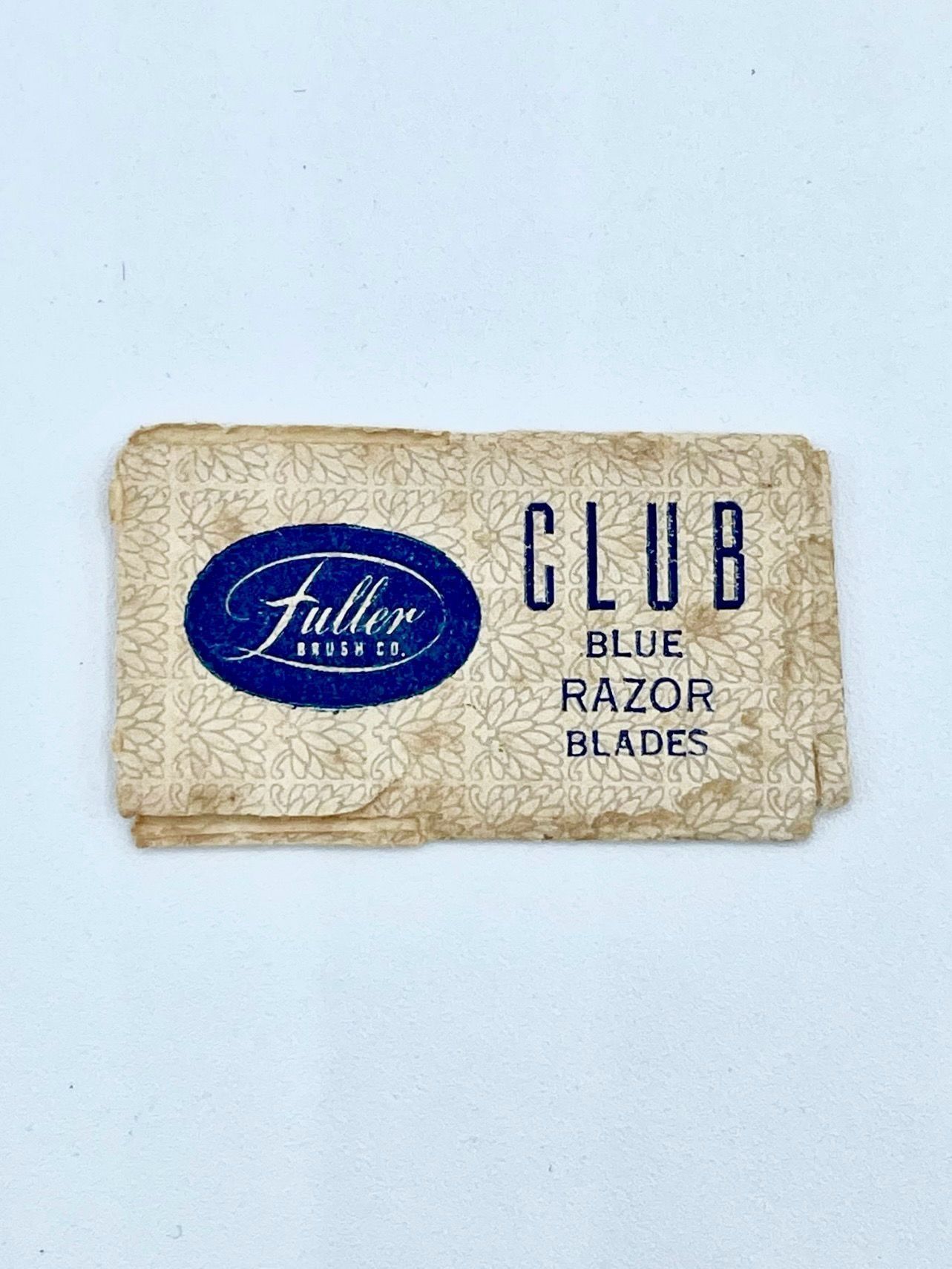
"Club Blue" double-edge razor blade with wrapper (Fuller Brush Company )
Object/Artifact
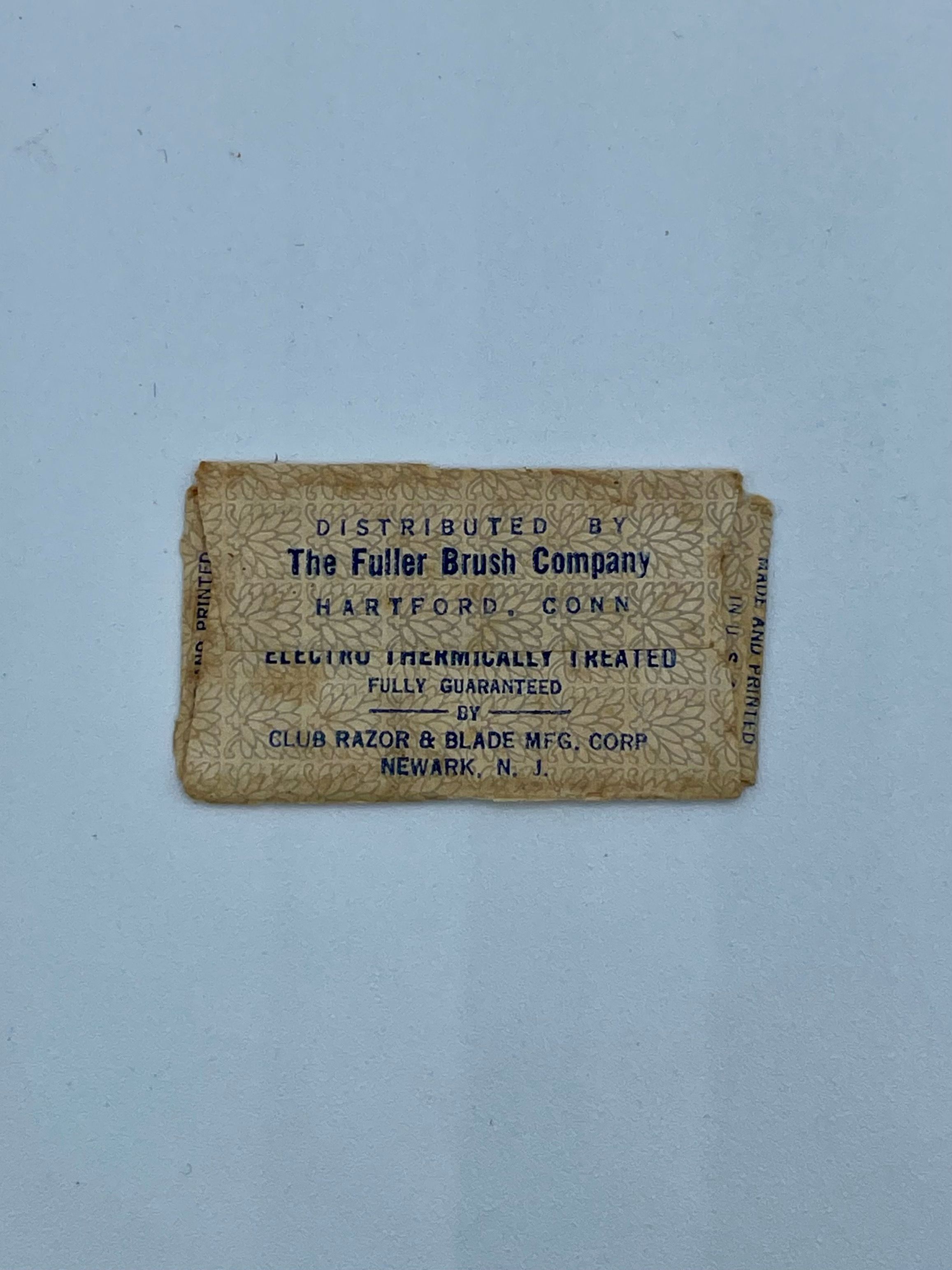
A "Club Blue" double-edge safety razor blade in its printed paper wrapper, a private-label product sold under the Fuller Brush Company name. The wrapper is a small rectangular sleeve printed on a cream ground patterned with a fine leaf/damask motif. The front carries the blue oval Fuller Brush Co. logo (the script "Fuller" over "BRUSH CO.") beside the product name set in dark blue block capitals: "CLUB / BLUE / RAZOR / BLADES." The reverse gives the distributor and manufacturer credits and the country of production. The visible element across both images is the folded wrapper; a blade is enclosed but is not separately pictured.
2025.1.41
The Cabrera Arús family collection
2025.1
Club Razor & Blade Mfg. Corp.
Fuller Brush Company
Newark
U.S.A.
North America
MAKER: A private-label arrangement between two American firms. Distributed under the Fuller Brush Company name (the door-to-door household-goods company), and manufactured by Club Razor & Blade Mfg. Corp. of Newark, New Jersey. The wrapper specifically credits Fuller as distributor and Club as the maker/guarantor, so the blade is a contract-manufactured Club product carrying Fuller's "Club Blue" branding rather than a Fuller-made item. DATE / PERIOD: Not dated on the object; most probably c. 1940s–1950s, possibly up to about 1960. The manufacturer, Club Razor & Blade of New Jersey, was active from roughly 1933 through at least 1961, which sets the outer bounds. The Fuller Brush Company was founded in Hartford in 1906 and remained in the Hartford area through the 1960s, moving its operations and headquarters to a new East Hartford campus in 1960; the wrapper's "HARTFORD, CONN" address (rather than East Hartford) is consistent with a date before that 1960 move. A mid-century date is the best fit. ORIGIN: United States. Place of manufacture: Newark, New Jersey (the manufacturer, Club Razor & Blade Mfg. Corp.). The distributor, the Fuller Brush Company, was at Hartford, Connecticut. Continent: North America. The wrapper side text reads "MADE AND PRINTED IN U.S.A."
Front: blue oval logo, script "Fuller" over "BRUSH CO."; "CLUB BLUE RAZOR BLADES"; leaf/damask patterned ground. Reverse: "DISTRIBUTED BY / The Fuller Brush Company / HARTFORD, CONN / ELECTRO THERMICALLY TREATED / FULLY GUARANTEED / BY / CLUB RAZOR & BLADE MFG. CORP / NEWARK, N.J."; vertical side text including "MADE AND PRINTED IN U.S.A." Languages: English only.
Fair
Leopoldo Arús Gálvez
owner
Club Razor & Blade Mfg. Corp.
Fuller Brush Company
Havana
Cuba
Caribbean
Central America
use
The object is a mid-century American private-label razor blade. The Fuller Brush Company, best known for door-to-door brushes and the "Fuller Brush Man," expanded its range of personal-care and household goods over the mid-twentieth century, and "Club Blue" blades fit that pattern of branded goods carried by its sales force; the blades themselves were made under contract by a specialist. That specialist, Club Razor & Blade Mfg. Corp. of Newark, was a documented New Jersey blade maker that also produced blades under the Marlin name and, in the late 1950s, patented a blade holder using paper strips between the blades. The "ELECTRO THERMICALLY TREATED" and "FULLY GUARANTEED" lines are typical period marketing for heat-treated carbon or stainless blades.
Provenance is recorded as probable: The "Admiral" record notes that the blade was likely sent to Cuba inside a postcard. The probable sender is the same relative — a relative who was married to an Englishman and eventually resettled in the United States, in New Jersey and later Florida. That single trajectory accounts for both postal channels without conflict: the British-made blades fit the period of residence in or occasional travel to the U.K., while this U.S.-manufactured "Club Blue" blade fits the New Jersey period, and the manufacturer's own location in Newark, New Jersey is geographically consistent with that resettlement. The two phases are one person's movement rather than two separate senders, so the country of manufacture should still be read off each object individually (here, the United States) while the acquisition channel is treated as continuous.