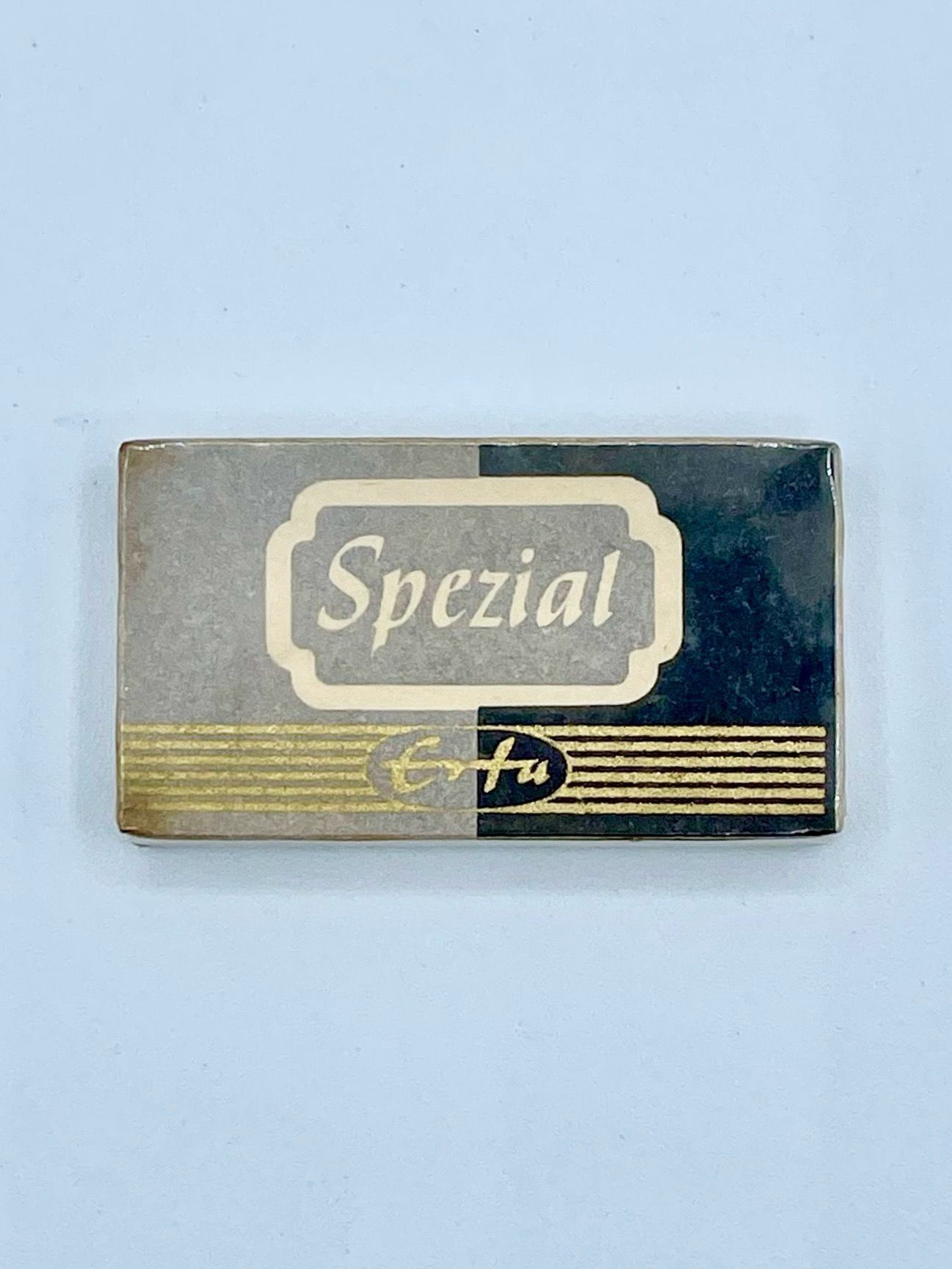
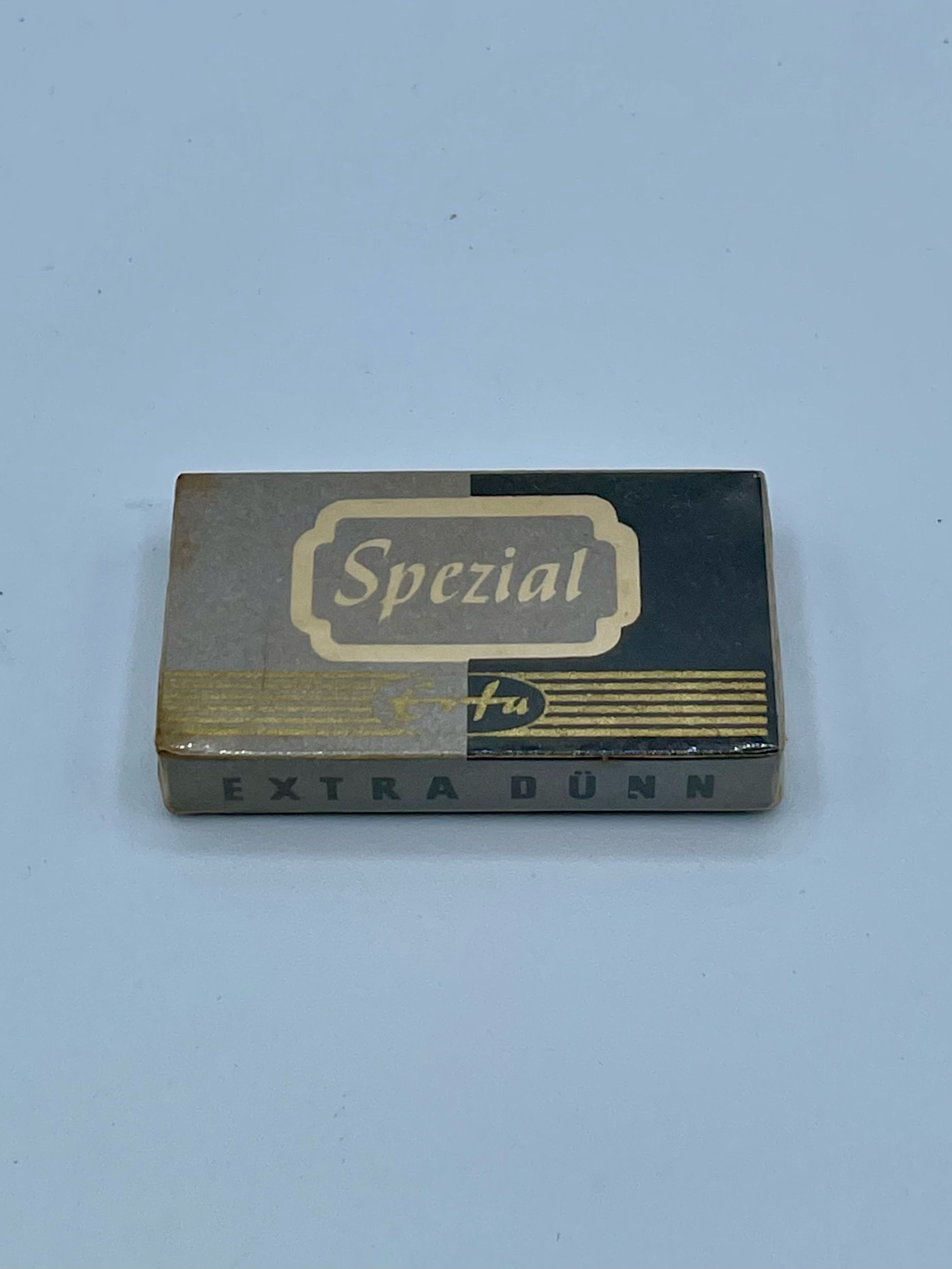
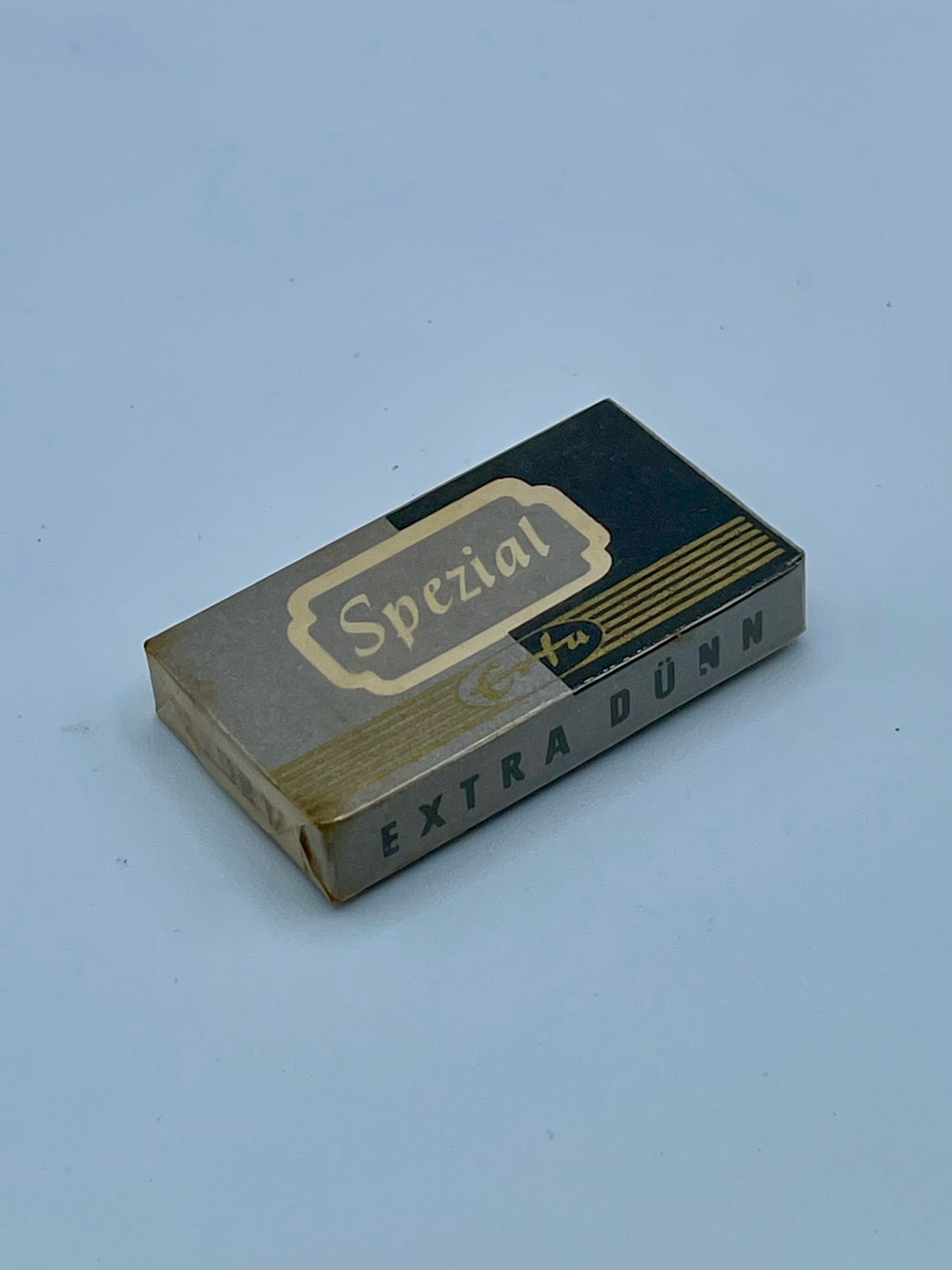
"Spezial" double-edge razor blades, Erfa (packet)
Object/Artifact
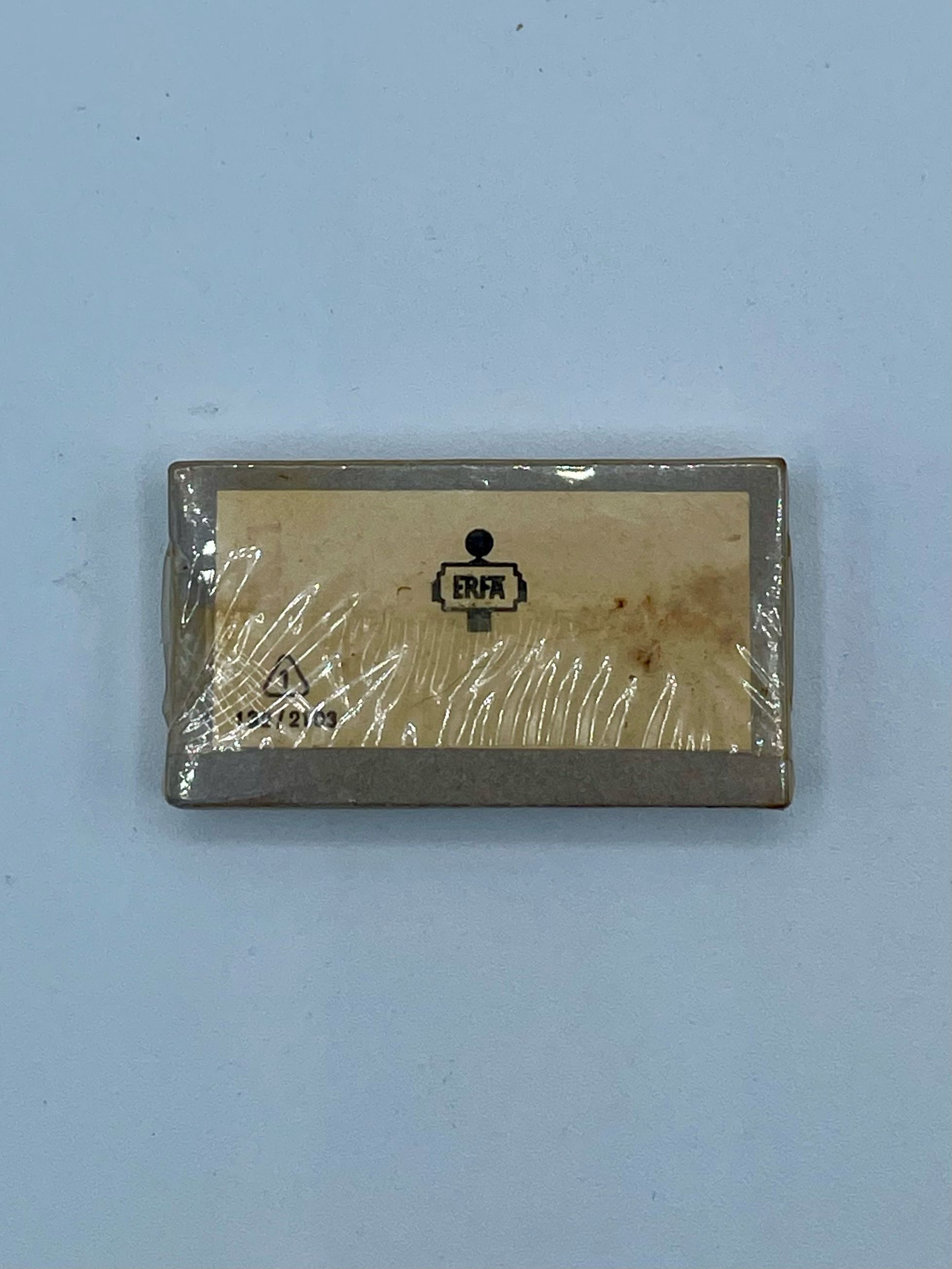
A small cardboard packet of "Spezial" double-edge safety razor blades made under the Erfa label, an East German brand. The box is printed in a two-tone scheme — a gray/silver left half and a black right half — with a white-edged cartouche across the top containing "Spezial" in a cursive script. A band of fine gold pinstripes runs along the lower front, interrupted by an oval bearing the cursive "Erfa" maker's logo straddling the two color fields. One long side is lettered "EXTRA DÜNN" (German for "extra thin," describing the blade gauge). The underside is a gold foil seal carrying the Erfa trademark — a small stylized figure or bust above a plaque reading "ERFA" — together with a triangular stamp enclosing the numeral "1" and a numeric code. The foil seal is intact, so the packet is still full.
2025.1.42
The Cabrera Arús family collection
2025.1
Erfa
1960s
G.D.R.
Central Europe
Europe
DATE / PERIOD: Not dated on the packet; GDR period, so necessarily within 1949–1990. The design idiom (the script cartouche, two-tone field, and gold pinstriping) reads as 1950s–1960s, and Erfa's association with early adjustable razors points to the earlier GDR decades, but a precise date cannot be fixed from the object. Best recorded as "GDR, c. 1950s–1960s (estimated)."
Top/front: "Spezial" (script, in cartouche); cursive "Erfa" logo in an oval; gold pinstripe band. Side: "EXTRA DÜNN". Underside (foil seal): Erfa figure-and-plaque trademark reading "ERFA"; a triangle enclosing "1"; an adjacent numeric code ("132 / 31.03").
Good
Leopoldo Arús Gálvez
owner
Erfa
producer
Havana
Cuba
Caribbean
Central America
use
The Erfa mark identifies this as an East German product. Reference and collector sources document Erfa as a GDR razor-blade label under which a number of blade varieties were manufactured in the German Democratic Republic, and as a GDR firm that made some of the early adjustable safety razors and competed with the Merkur company; surviving Erfa razors are explicitly described as made in the GDR. "Spezial" is the line name and "Extra Dünn" ("extra thin") the blade-type descriptor, consistent with the GDR practice of naming blade grades (other documented Erfa lines include Auslese and Rekord, with some marketed as ice-hardened). The figure-and-plaque device on the foil underside is the Erfa house trademark; the triangle-enclosed "1" and the numeric string alongside it are most likely a quality or lot/printing code, but their exact meaning is not determined here and should not be over-read.
The dominant — and by some accounts the only — razor-blade manufacturer in East Germany was VEB Feintechnik in Eisfeld, in southern Thuringia. It grew out of the Ritzma Werke founded by Albin Ritzmann in Eisfeld in 1920, a firm making razor blades and razors; after the war Ritzmann was expropriated and died in 1947 in Soviet Special Camp No. 2 (Buchenwald), and blade production was taken over by the VEB "Feintechnik Eisfeld," which established the Croma brand. One company history states plainly that the Ritzma Werke were converted after WWII into VEB Feintechnik and were at the time the only razor-blade manufacturer in the GDR, later sold after reunification and ultimately acquired in 2014 by the U.S. startup Harry's, with brands like "FTE Start" and "Croma" having been export successes to Africa and Asia. The complication: if Eisfeld really was the sole GDR blade maker, then Erfa-branded blades may have been produced there under the Erfa label rather than at a separate Erfa blade factory. But Erfa is independently documented as a maker of razors (the adjustable "Rasant" hardware, sometimes compared to Merkur's Progress), so the razor side and the blade side may not sit at the same plant. The safest position for now is: Erfa = a GDR brand, location undetermined, possibly tied to the Eisfeld blade operation. The name superficially suggests Erfurt, but that is a guess from the syllable alone. One useful dating anchor turned up along the way: an Erfa blade pack is documented as a 1969 stainless, ice-hardened ("eisgehärtet") issue, and an Erfa Rasant razor is noted as costing about 6 Ostmark around 1960 — both consistent with the c. 1950s–1960s estimate already on the Spezial packet.