
Fringed scarf, deep-red chain/link print
Clothing/Dress/Costume
A long rectangular lightweight silky scarf in deep red, printed with a large white interlocking-chain/link (or interlocking-ring) motif running along its length. The short ends have a knotted heading and a deep fringe of self-colored threads; the fringe is wavy and tangled with loose threads. This is the odd one out of the three, with a chain/link design rather than a plaid.
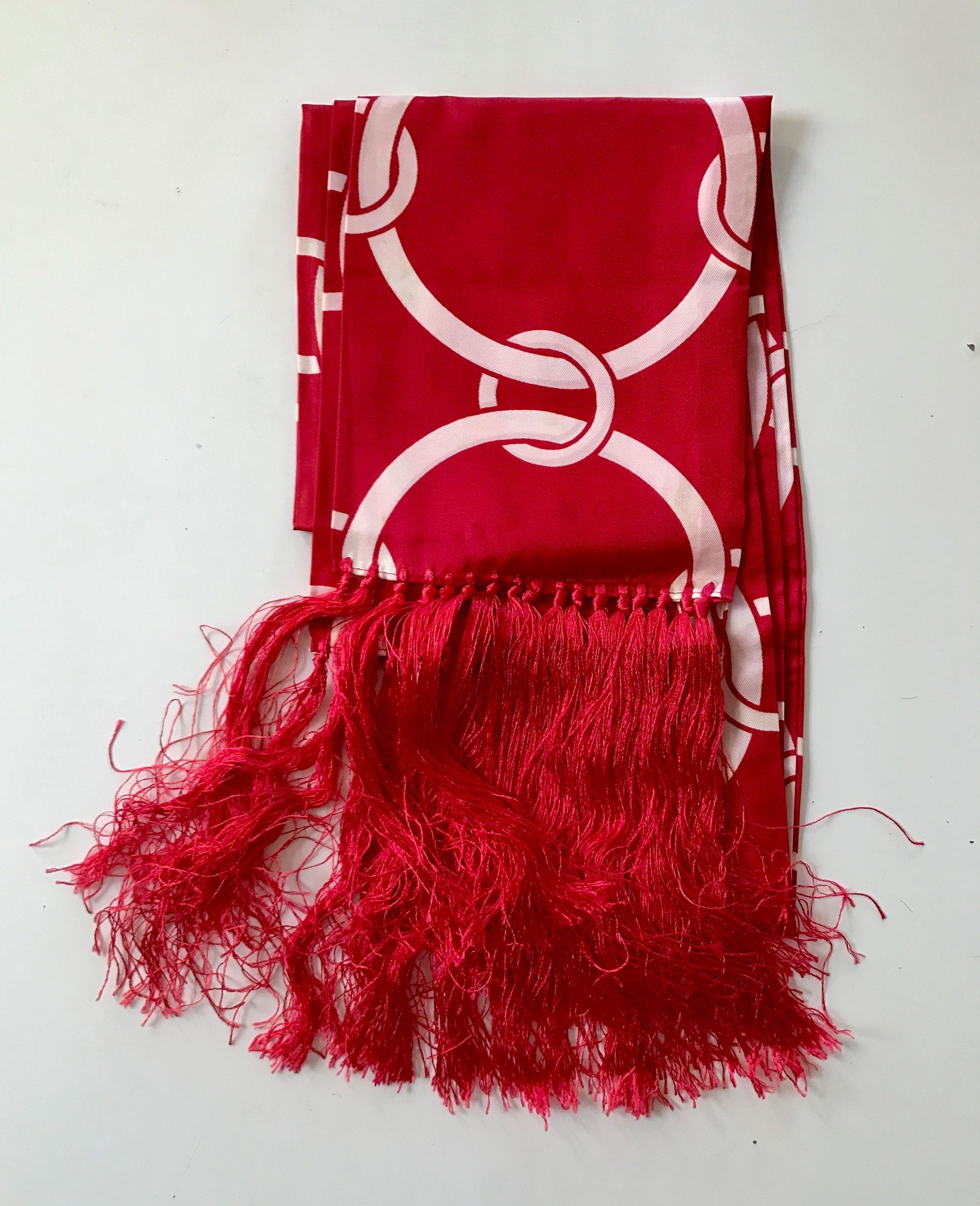
2025.1.243
Purchased by María A Arús Caraballo and her mother, Gertrudis Caraballo Gálvez, after a neighbor's purchase.
The Cabrera Arús family collection
Gertrudis Caraballo Gálvez collecition
2025.1
Scarf
Female
MATERIALS: Lightweight printed dress fabric of silky hand — silk or synthetic (the label's "no crinkle" suggests a synthetic such as polyester); fiber to be confirmed. Self-thread fringe. Sewn label. TECHNIQUES: Screen ("hand") printing on woven fabric; knotted heading and fringe at the ends.
1970s
Japan
Asia
MAKER: Per the label seen on the matching plaid scarf, a Japanese maker ("100% HAND PRINT / NO CRINKLE / MADE IN JAPAN"). No label is visible on this scarf; maker attributed by close match to its labelled sibling. DATE / PERIOD: Not dated; mid-to-late 20th century (estimated) for a Japanese hand-printed fashion scarf of this type. Undetermined more precisely. ORIGIN: Japan (manufacture), attributed via the matching labelled scarf ("Made in Japan"). Acquisition: 1970s Cuba per María A. Arús Caraballo.
177.9 cm
1
Good
María A. Arús Caraballo
owner
Gertrudis Caraballo Gálvez
owner
Havana
Cuba
Caribbean
Central America
purchase
Japan
Asia
production
This design is a bold white interlocking-chain/link motif on deep red, not the plaid shared by the orange and red/maroon scarves. It is therefore catalogued as a related but separate scarf, not part of the plaid set. No label is visible, so its maker and origin are not established; it may share the plaid pair's Japanese origin, but that should be confirmed rather than assumed.