
Beaded Afro-Cuban figure, Santería (Regla de Ocha)
Object/Artifact
A small freestanding figure, roughly 3 cm tall, built from beads worked into a three-dimensional form over a thread core. The palette is the most distinctive feature: the head and upper body are black, with yellow hands, foot, and face; the neck and arms are green; and the splayed skirt is predominantly white with red bead accents. A white-and-red round-brimmed hat sits at the back, practically destroyed. A length of brown plant-fiber twine (jute or similar) emerges at the top, frayed. The beadwork is dense and deliberate.
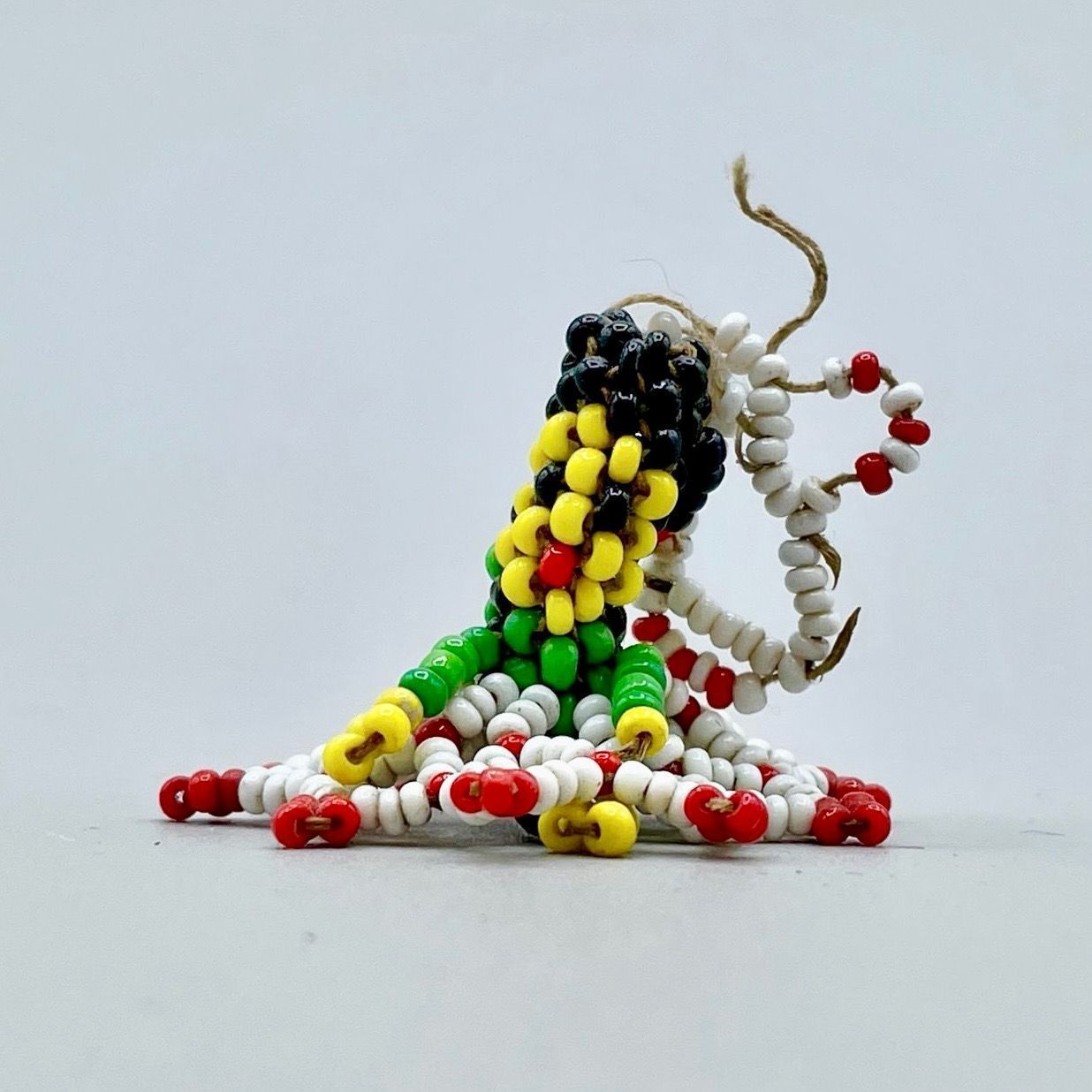
2025.1.54
The figure was found by María A. Cabrera Arús, as a child of about six or seven, in the backyard of her maternal grandparents' house in Cuba, around 1980. She kept it for herself.
The Cabrera Arús family collection
2025.1
Item was found by María A Cabrera Arús outside of her grandparents' house circa 1980.
1980s
MAKER: Unknown; handmade. The piece is a hand-worked beaded devotional/folk object with no maker's mark, almost certainly made by hand within an Afro-Cuban religious context. DATE / PERIOD: Made by or before circa 1980 (the date it was found); no closer date can be fixed from the object. The bead colors and materials are not time-specific. ORIGIN: Cuba. No specific region or workshop can be identified.
1
MATERIALS: Beads in black, yellow, green, white, and red, strung and woven on thread; brown plant-fiber twine (jute or cotton cord) forming the core/suspension. Bead and thread identification is by eye and not confirmed. TECHNIQUES: Three-dimensional bead weaving/netting — seed beads strung and interlinked into a shaped figure worked over a thread core, with a flared beaded skirt giving the figure stability.
Poor
María A. Cabrera Arús
owner
Havana
Cuba
Caribbean
Central America
acquisition
This seems a Santería object, and the figural form — a personage with a face, hands, a foot, a skirt, and a wide pamela hat, rendered in color-coded beadwork — is consistent with the material culture of Afro-Cuban Orisha religion (Regla de Ocha-Ifá, also called Santería or Lucumí), carried to Cuba by enslaved Yoruba people and expressed through beadwork in which specific colors and patterns stand for particular Orishas. The figure is a muñeco (a small constructed personage) rather than a strung necklace, so the colors should be read as evidence toward an identification rather than as a definitive one. Within the documented color associations, red and black are singled out as the colors of Elegua (Eshu), guardian of crossroads, doorways, and open doors; the same sources assign white to Obatalá, blue and white to Yemayá, red and white to Shangó, yellow and amber to Oshún, and green and black to Ogún. This figure combines black, green, white, red, and yellow. That breadth suggests a few possibilities: a composite figure referencing several powers; a representation of a particular road (camino) of an Orisha, since individual roads can carry expanded color sets — sources describe certain Eleguá roads strung with black and green, with red also used (one Eleguá road is described as black and green beadwork with red also used in the work); or a folk devotional figure not tied to a single canonical scheme. The strong yellow of the face, hands, and foot is notable: yellow is the color most associated with Oshún, the Orisha of rivers, love, beauty, and abundance, so the figure may combine attributes rather than encode one deity. Because this is a sacred object within a living tradition, the most reliable refinement will come not from further web research but from consultation with a knowledgeable practitioner (an olorisha, santero/santera, or babalawo) or a specialist in Afro-Cuban religious material culture, who could read the bead counts, sequences, and construction — and the meaning of the figure being dressed with a pamela hat and skirt.