
Bead-and-link necklace, dark blue cube beads with clear faceted glass
Jewelry
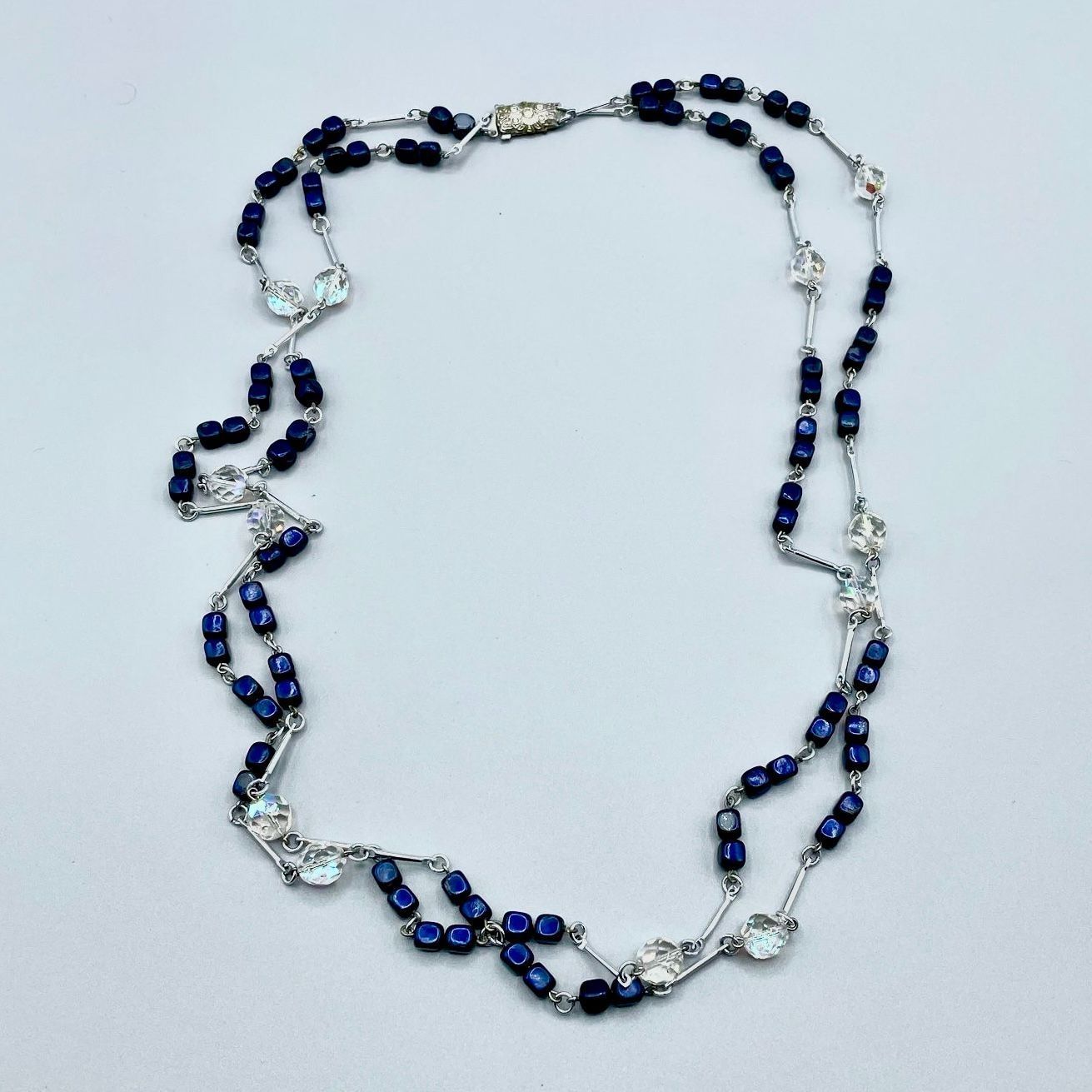
A long single-strand necklace built as a continuous chain of beads and metal links. Short groups of small dark-blue (cobalt/navy) cube or rounded-square beads alternate with single metal wire bar-links and, at intervals, larger clear colorless faceted round glass beads, so the strand reads as repeating segments: several blue cube beads, a wire link, a clear faceted bead, and so on around the full length. The fittings are silver-tone (wire links with looped ends joining the bead units). The closure is a rectangular decorative box clasp (push-in tongue type) with an ornamented silver-tone face. The necklace is long (opera-length).
2025.1.83
Necklace
Used by María A. Arús Caraballo, purchased at Le Trianon, in Havana.
The Cabrera Arús family collection
María A. Arús Caraballo collection
2025.1
MAKER: Unknown; unmarked in this view. No maker's mark visible on the clasp. Costume jewelry; manufacturer not identified. DATE / PERIOD: Not marked; mid-20th century (estimated). The hand-linked bead-and-bar construction and the decorative box clasp are consistent with mid-century costume jewelry, but nothing fixes a date; undetermined more precisely. ORIGIN: Possibly Czechoslovak — Jablonec nad Nisou / Železný Brod region — on the basis of construction. The bead-and-metal-link assembly (pressed glass beads joined by metal links and findings) matches the documented Jablonec-region method seen in the Museum of Glass and Jewellery reference volume, where period necklaces combine pressed glass beads with "pressed galvanized tombak" links and clasps. Attribution by construction and type, not confirmed by a one-to-one match.
MATERIALS: Glass beads — dark blue (cobalt) pressed-glass cube/square beads and clear colorless faceted round glass beads; silver-tone base-metal wire links and box clasp. Stringing is by wire links (eye-pin/bar-link assembly) rather than thread. TECHNIQUES: Bead-and-link construction — beads threaded on wire eye-pins and bar-links, the looped ends joined into a continuous chain, finished with a commercial box clasp. This linked method (as opposed to a single strung thread) is more robust and is the defining structural feature here.
Good
María A. Arús Caraballo
owner
Havana
Cuba
Caribbean
Central America
use, purchase
This is a long bead-and-link necklace alternating cobalt-blue pressed-glass cube beads with clear faceted glass beads on silver-tone wire links — mid-century costume jewelry, but structurally different from the strung triple-strand necklaces recorded earlier: here the beads are individually wire-linked into a chain rather than threaded on a continuous strand, which is a more durable construction and worth noting as a point of contrast in the group.
Comparison with the Jablonec reference volume (Dreaming of the Future: Design of Czechoslovak Glass and Jewellery 1948–1989, Museum of Glass and Jewellery in Jablonec nad Nisou) strengthens a Czechoslovak attribution for this necklace. The volume documents Jablonec-region jewelry (including pieces from Železný Brod and makers such as Preciosa and Jablonex) built from pressed glass beads linked with metal — "pressed galvanized tombak" (a brass alloy) links, findings, and box clasps — which is precisely the bead-and-wire-link construction of this necklace, as opposed to the strung-thread method of the multi-strand necklaces recorded earlier. This makes a Jablonec-region origin probable. It is not yet confirmed: none of the catalogue examples seen is a one-to-one match to this blue-cube-and-clear-faceted necklace, and the tombak-link-with-pressed-glass formula was widely produced and imitated. Verification would require matching the specific design (or its clasp) to a documented model, and a "tombak" (brass) versus other metal determination would itself support the attribution.