
Lapel Pin, "2da Conferencia Sindical Nacional de Mujeres Trabajadoras" (Second National Trade-Union Conference of Working Women)
Object/Artifact
Enameled metal commemorative lapel pin issued for the Second National Trade-Union Conference of Working Women (2da Conferencia Sindical Nacional de Mujeres Trabajadoras), organized by Cuba's CTC-R labor confederation in 1964. A circular enameled metal pin/badge. Around the upper edge, in raised letters, runs the legend "2da CONF. SIND. NAC. DE MUJERES" (continuing to "TRABAJADORAS" along the lower edge). The center shows two women's heads in left profile, rendered in white/cream with dark hair, set against a green half-field; the year "1964" is stacked vertically in the green field to the left of the face. The lower half of the pin is red, carrying the stylized monogram "CTC R" above the word "TRABAJADORAS." The pin shows considerable age: corrosion spots, enamel loss, oxidation, and surface wear throughout, though all text and the central image remain legible.
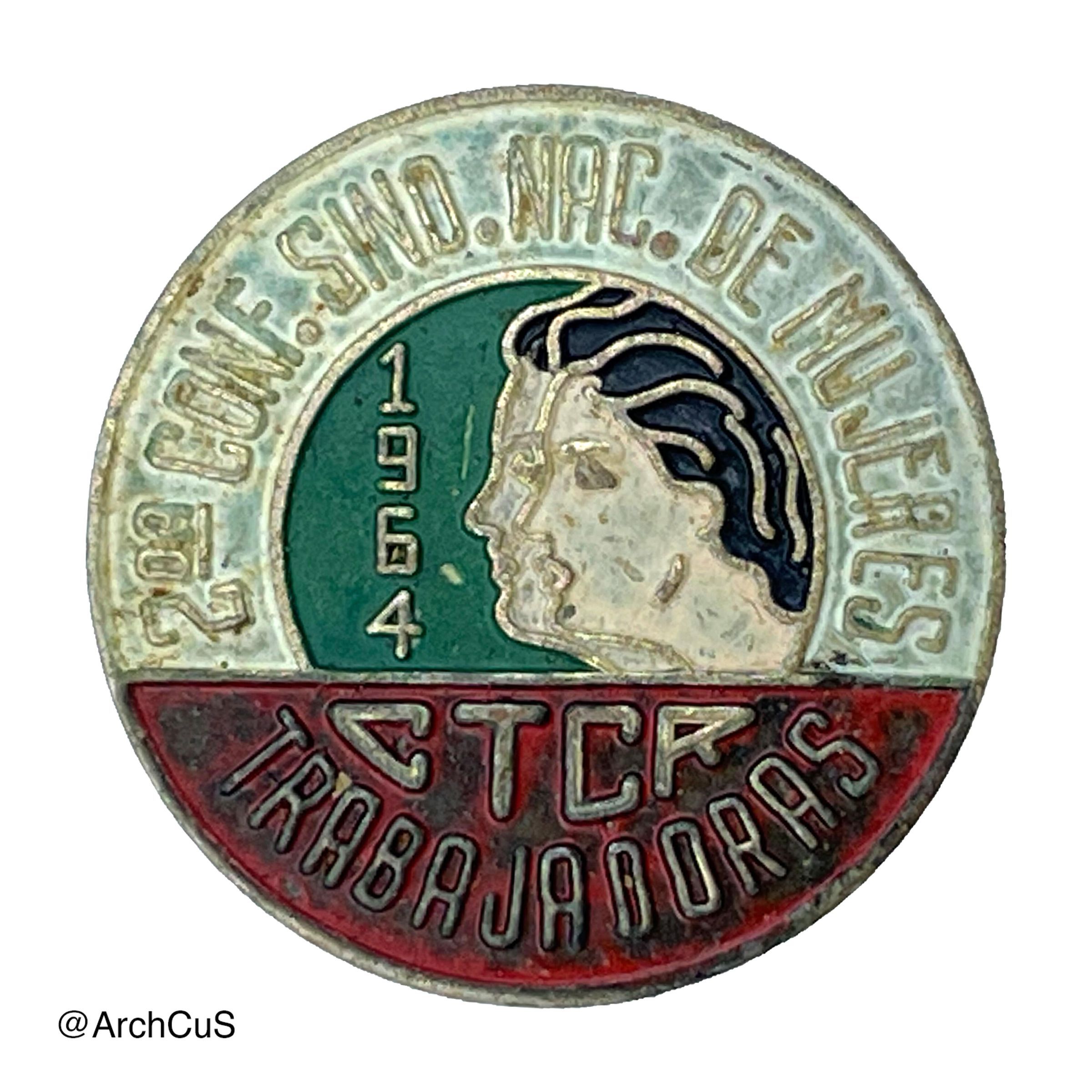
2025.1.14
This conference was organized by the CTC R (Central de Trabajadores de Cuba – Revolucionaria), the prorevolutionary national labor union.
The Cabrera Arús family collection
2025.1
1964
1960s
Engraving
2da Conf. Sind. Nac. de MUJERES TRABAJADORAS CTCR
Spanish
2nd National Union Conference of Working Women CTCR
Expansion: "2da Conferencia Sindical Nacional de Mujeres Trabajadoras" = "Second National Trade-Union Conference of Working Women." "CTC R" = Central de Trabajadores de Cuba – Revolucionaria.
2.1 cm
Metal
Metal (base metal, possibly brass or alloy) with applied/fired enamel or painted color fields; pin-back fastener on reverse (not visible in this image)
Fair
CTC-R
issuer
Leopoldo Arús Gálvez
owner
Havana
Cuba
Caribbean
Central America
2nd National Union Conference of Working Women
The pin marks the Second National Trade-Union Conference of Working Women (2da Conferencia Sindical Nacional de Mujeres Trabajadoras), held in 1964 under the auspices of the CTC-R. The 1964 conference sits within a dense institutional context. The Federación de Mujeres Cubanas (FMC), founded in 1960 under Vilma Espín, was the mass organization tasked with mobilizing women; the CTC handled their incorporation into organized labor. Women's labor-force participation was politically central: it was framed both as women's liberation and as an economic necessity for the revolution's development goals. Conferences like this one publicized targets for female employment, addressed workplace issues (childcare, maternity, training), and built the organizational scaffolding that later produced landmark legislation such as the 1974 Maternity Law and the 1975 Family Code.