
EP record "El Sucu-Sucu de Isla de Pinos" (Areíto/EGREM 7″ 45 rpm EP, EPA-6263)
Audio Recording
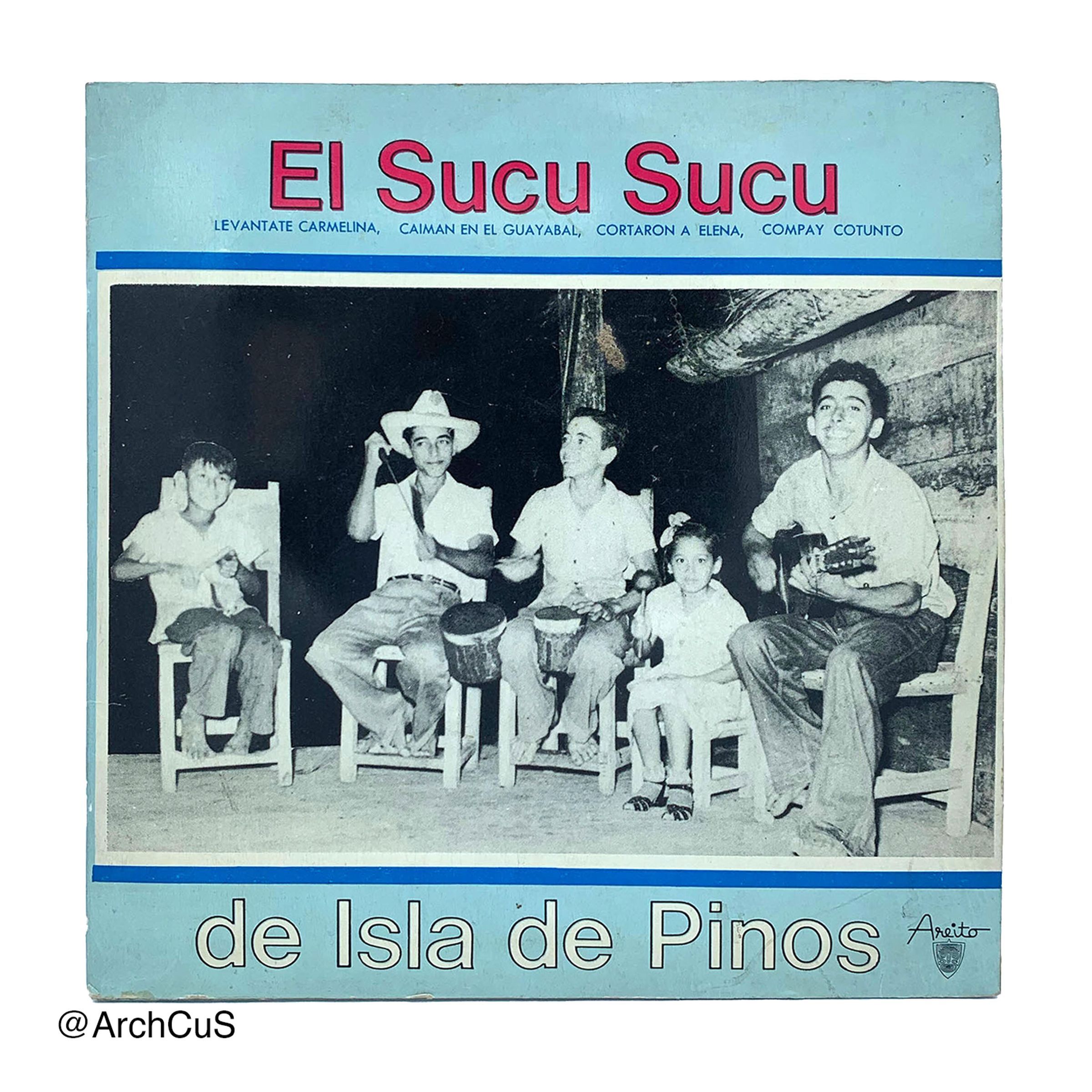
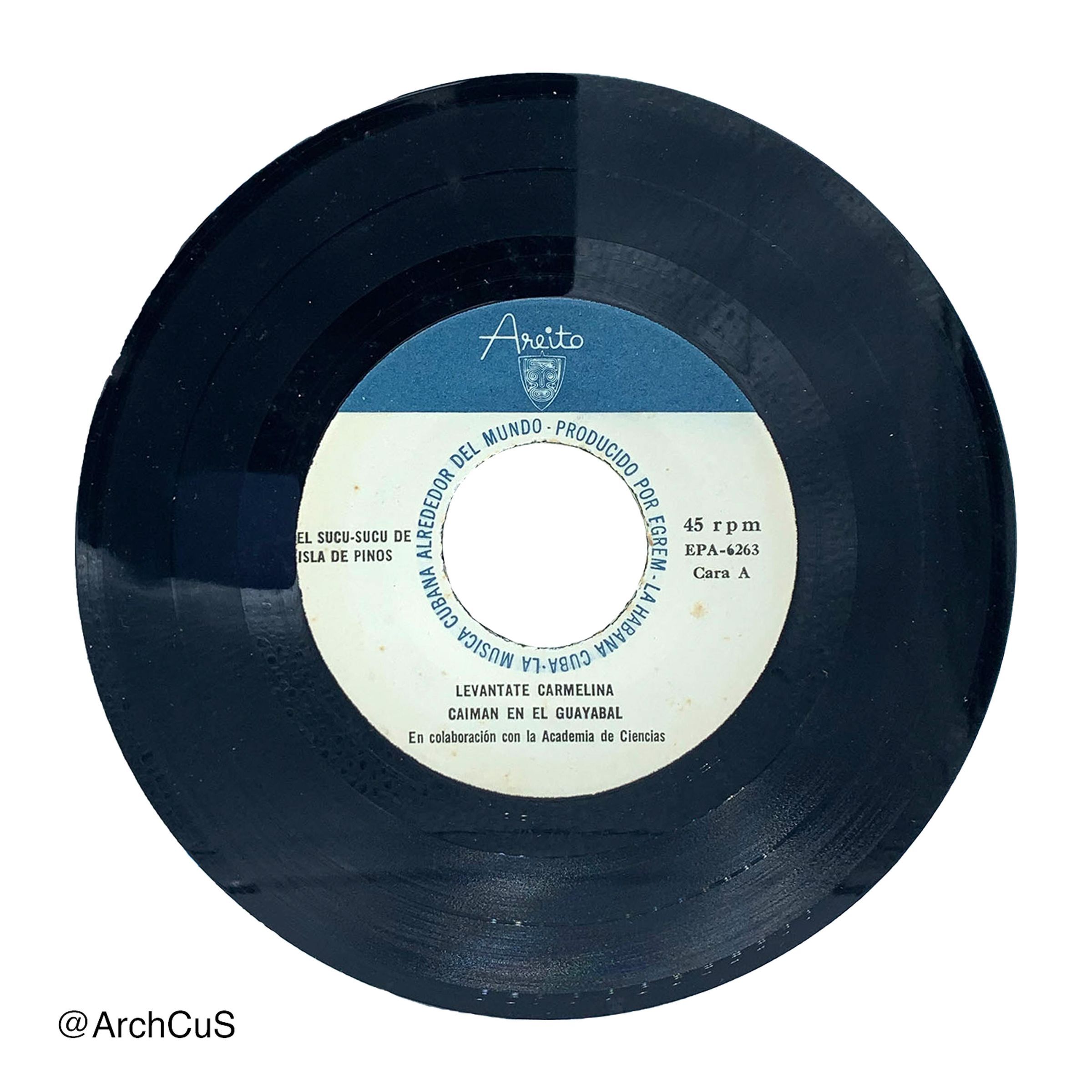
A 7-inch, 45 rpm extended-play vinyl record in an illustrated paper sleeve, produced by EGREM on its Areíto label in collaboration with the Academia de Ciencias de Cuba. It is an ethnomusicological release — four in-situ field recordings documenting the sucu-sucu, a son-family genre and dance native to Isla de Pinos, with comparative Caribbean examples. Side A: "Levántate Carmelina" (sucu-sucu) and "Caimán en el Guayabal" (son); Side B: "Cortaron a Elena" (a Puerto Rican plena) and "Compay Cotunto" (sucu-sucu). The blue Areíto disc label carries the Taíno cemí device, the EGREM slogan, "45 rpm," "EPA-6263."
2025.1.287
EGREM pressed it in collaboration with the Instituto de Etnología of the Academia de Ciencias de Cuba, as the recorded companion to a scholarly monograph; María Teresa Linares's study El Sucu-Sucu de la Isla de Pinos dates to 1967, the same year as the principal fieldwork. The genre itself is a Cuban "proto-son": musicologists place the sucu-sucu of Isla de la Juventud within the son complex alongside the changüí of Guantánamo, and it is closely tied to insular-Caribbean culture — to the country/round dances brought by Cayman and Jamaican migrants who settled on the island in the first half of the 20th century — using the son-sextet format of tres, guitar, marímbula, bongó, maracas, and claves. The record's framing is overtly ideological: the liner notes read the cover photograph as documentation of peasant life "before the triumph of the Revolution" — inadequate housing, poor clothing, the taburete stool as the typical guajiro seat — while celebrating the folk form itself.
45 RPM Record
The Cabrera Arús family collection
Leopoldo Arús Gálvez collection
2025.1
Noelvis Diaz
Designer
Dennys Moreno
Designer
Areíto
Spanish
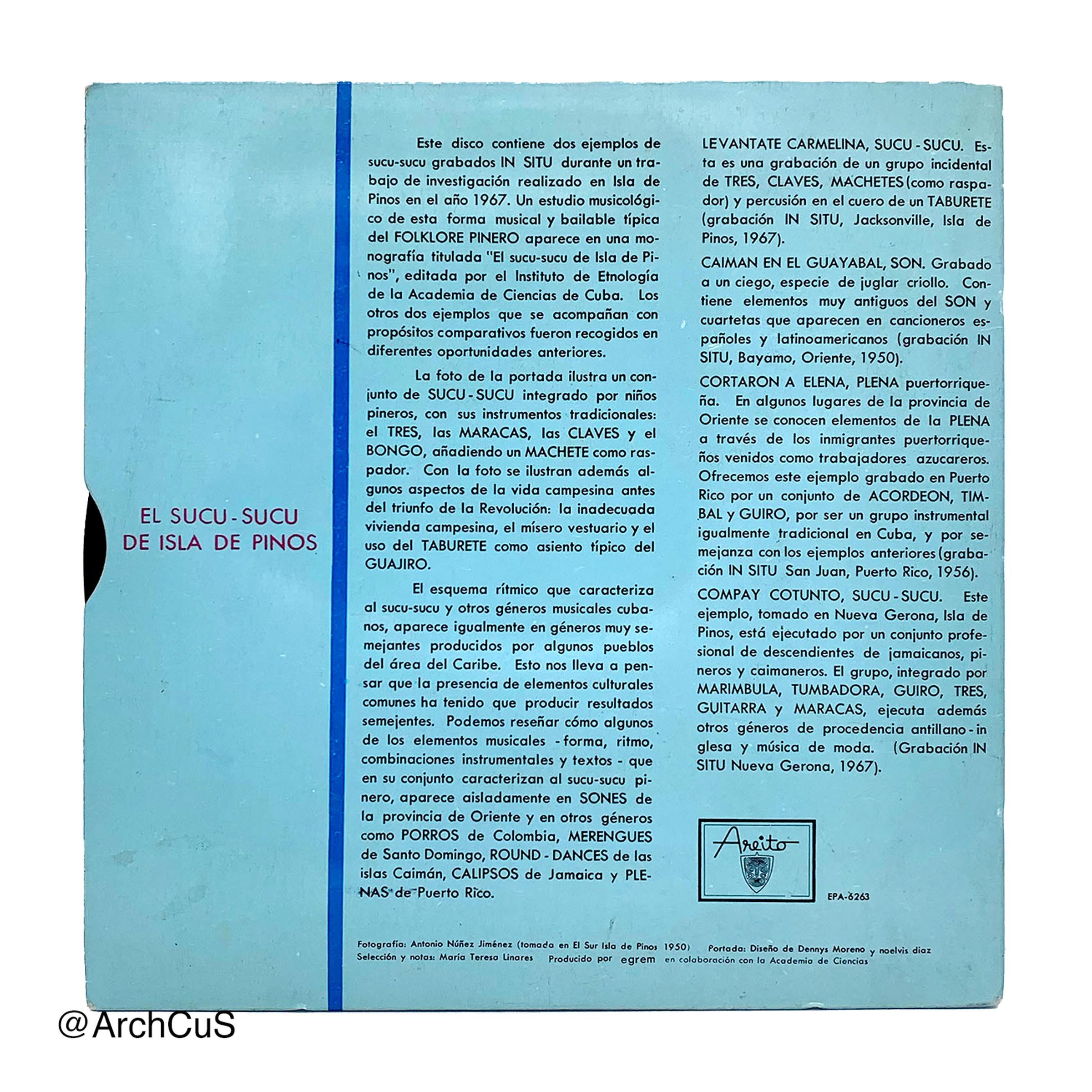
The front cover reproduces a black-and-white photograph of a sucu-sucu ensemble of pinero children with tres, maracas, claves, bongó, and a machete used as a scraper; the extensive back-cover liner notes (in Spanish) describe the genre, the instruments, and each recording, and place the sucu-sucu within a pan-Caribbean comparative frame (porros of Colombia, merengues of Santo Domingo, round-dances of the Cayman Islands, calypsos of Jamaica, plenas of Puerto Rico).
Credits: photograph by Antonio Núñez Jiménez (El Sur, Isla de Pinos, 1950); selection and notes by María Teresa Linares; cover design by Dennys Moreno and Noelvis Díaz. A multi-site field-recording compilation. By track (per the liner notes): "Levántate Carmelina" — Jacksonville, Isla de Pinos, 1967; "Caimán en el Guayabal" — Bayamo, Oriente, 1950; "Cortaron a Elena" — San Juan, Puerto Rico, 1956; "Compay Cotunto" — Nueva Gerona, Isla de Pinos, 1967. Produced, mastered, and pressed by EGREM in Havana (La Habana), Cuba. Cover photograph taken at El Sur, Isla de Pinos, 1950. Dating: the fieldwork and monograph are 1967; the catalog number EPA-6263 falls between the Los Van Van EP (EPA-6169, 1969) and the Bonne EP (EPA-6301, c. 1970–71), and the pre-1978 "Isla de Pinos" name is consistent — so the EP is best dated c. 1969–1970.
Levantate carmelina
Tres cubano
Caiman en el guayabal
Cortaron a elena
Acordeon
Compay cotunto
Maribula
Tumbadora
Guiro
Maracas
Label
Back of album sleeve
Este disco contiene dos ejemplos de sucu-sucu grabados IN SITU durante un trabajo de investigación realizado en Isla de Pinos en el año 1967. Un estudio musicológico de esta forma musical y bailable típica del FOLKLORE PINERO aparece en una monografía titulada "El sucu-sucu de Isla de Pinos", editada por el Instituto de Etnología de la Academia de Ciencias de Cuba. Los otros dos ejemplos que se acompañan con propósitos comparativos fueron recogidos en diferentes oportunidades anteriores. La foto de la portada ilustra un conjunto de SUCU-SUCU integrado por niños pineros, con sus instrumentos tradicionales: el TRES, las MARACAS, las CLAVES y el BONGO, añadiendo un MACHETE como raspador. Con la foto se ilustran además algunos aspectos de la vida campesina antes del triunfo de la Revolución: la inadecuada vivienda campesina, el mísero vestuario y el uso del TABURETE como asiento típico del GUAJIRO. El esquema rítmico que caracteriza al sucu-sucu y otros géneros muy semejantes producidos por algunos pueblos del área del Caribe. Esto nos lleva a pensar que la presencia de elementos culturales comunes ha tenido que producir resultados semejantes. Podemos reseñar cómo algunos de los elementos musicales - forma, ritmo, combinaciones instrumentales y textos - que en su conjunto caracterizan al sucu-sucu pinero, aparece aisladamente en SONES de la provincia de Oriente y en otros géneros como PORROS de Colombia, MERENGUES de Santo Domingo, ROUND-DANCES de las islas Caimán, CALIPSOS de Jamaica y PLENAS de Puerto Rico. LEVANTATE CARMELINA, SUCU-SUCU. Esta es una grabación de un grupo incidental de TRES, CLAVES, MACHETES (como raspador) y percusión en el cuero de un TABURETE (grabación IN SITU, Jacksonville, Isla de Pinos, 1967). CAIMAN EN EL GUAYABAL, SON. Grabado a un ciego, especie de juglar criollo. Contiene elementos muy antiguos del SON y cuartetas que aparecen en cancioneros españoles y latinoamericanos (grabación IN SITU, Bayamo, Oriente, 1950). CORTARON A ELENA, PLENA puertorriqueña. En algunos lugares de la provincia de Oriente se conocen elementos de la PLENA a través de los inmigrantes puertorriqueños venidos como trabajadores azucareros. Ofrecemos este ejemplo grabado en Puerto Rico por un conjunto de ACORDEON, TIMBAL y GUIRO, por ser un grupo instrumental igualmente tradicional en Cuba, y por semejanza con los ejemplos anteriores (grabación IN SITU San Juan, Puerto Rico, 1956). COMPAY COTUNTO, SUCU-SUCU. Este ejemplo, tomado en Nueva Gerona, Isla de Pinos, está ejecutado por un conjunto profesional de descendientes de jamaicanos, pineros y caimaneros. El grupo, integrado por MARIMBULA, TUMBADORA, GUIRO, TRES, GUITARRA y MARACAS, ejecuta además otros géneros de procedencia antillano - in glesa y música de moda. (Grabación IN SITU Nueva Gerona, 1967).
Spanish
This disc contains two examples of sucu-sucu recorded IN SITU during a research work carried out on the Isle of Pines in 1967. A musicological study of this musical and dance form typical of PINERO FOLKLORE appears in a monograph entitled "El sucu-sucu de Isla de Pinos", edited by the Institute of Ethnology of the Academy of Sciences of Cuba. The other two examples that are attached for comparative purposes were collected on different previous occasions. The cover photo illustrates a group of SUCU-SUCU made up of pineros children, with their traditional instruments: the TRES, the MARACAS, the CLAVES and the BONGO, adding a MACHETE as a scraper. The photo also illustrates some aspects of peasant life before the triumph of the Revolution: the inadequate peasant housing, the miserable clothing and the use of the STOOL as a typical seat of the GUAJIRO. The rhythmic scheme that characterizes the sucu-sucu and other very similar genres produced by some peoples of the Caribbean area. This leads us to think that the presence of common cultural elements must have produced similar results. We can review how some of the musical elements - form, rhythm, instrumental combinations and texts - that as a whole characterize the sucu-sucu from Pinero, appear in isolation in SONES from the province of Oriente and in other genres such as PORROS from Colombia, MERENGUES from Santo Sunday, ROUND-DANCES from the Cayman Islands, CALYPSOS from Jamaica and PLENAS from Puerto Rico. GET UP CARMELINE, SUCU-SUCU. This is a recording of an incidental group of TRES, CLAVES, MACHETES (as a scraper) and percussion on the leather of a STOOL (IN SITU recording, Jacksonville, Isle of Pines, 1967). CAIMAN IN GUAYABAL, THEY ARE. Engraving of a blind man, a kind of Creole minstrel. It contains very old elements of the SON and quatrains that appear in Spanish and Latin American songbooks (IN SITU recording, Bayamo, Oriente, 1950). THEY CUT ELENA, FULL Puerto Rican. In some places in the province of Oriente, elements of PLENA are known through Puerto Rican immigrants who came as sugar workers. We offer this example recorded in Puerto Rico by a group of ACORDEON, TIMBAL and GUIRO, for being an equally traditional instrumental group in Cuba, and for similarity with the previous examples (recording IN SITU San Juan, Puerto Rico, 1956). COMPAY COTUNTO, SUCU-SUCU. This example, taken in Nueva Gerona, Isla de Pinos, is executed by a professional group of descendants of Jamaicans, pineros and alligators. The group, made up of MARIMBULA, TUMBADORA, GUIRO, TRES, GUITARRA and MARACAS, also performs other genres of Antillean-English origin and fashionable music. (Recording IN SITU Nueva Gerona, 1967).
18.5 cm
18.5 cm
vinyl, record case
Case
Good
Leopoldo Arús Gálvez
owner
María Teresa Linares
Havana
Cuba
Caribbean
Central America
acquisition
Isla de Pinos
Cuba
Caribbean
Central America
music
María Teresa Linares (1920–2021) was a Cuban musicologist and ethnographer who wrote some ten books and produced more than a hundred records on Cuban and Caribbean music and ethnology; the cover photographer, Antonio Núñez Jiménez, was the geographer and revolutionary often called "the fourth discoverer of Cuba." The disc thus sits at the intersection of revolutionary science, folklore preservation, and pan-Caribbean comparative ethnomusicology — and it captures a genre (and an island name) on the cusp of change: Isla de Pinos was renamed Isla de la Juventud in 1978.
"Jacksonville" is a settlement on Isla de Pinos associated with the Cayman/Jamaican-descended community; worth a one-line confirmation. The performers of "Compay Cotunto" are described as a professional group of Jamaican-, pinero-, and Caymanian-descended musicians — a notable detail on the island's Anglo-Caribbean heritage.