
LP record "Orquesta Cubana de Música Moderna" (Areíto/EGREM 12″ 33⅓ rpm LP, LD-3273)
Audio Recording
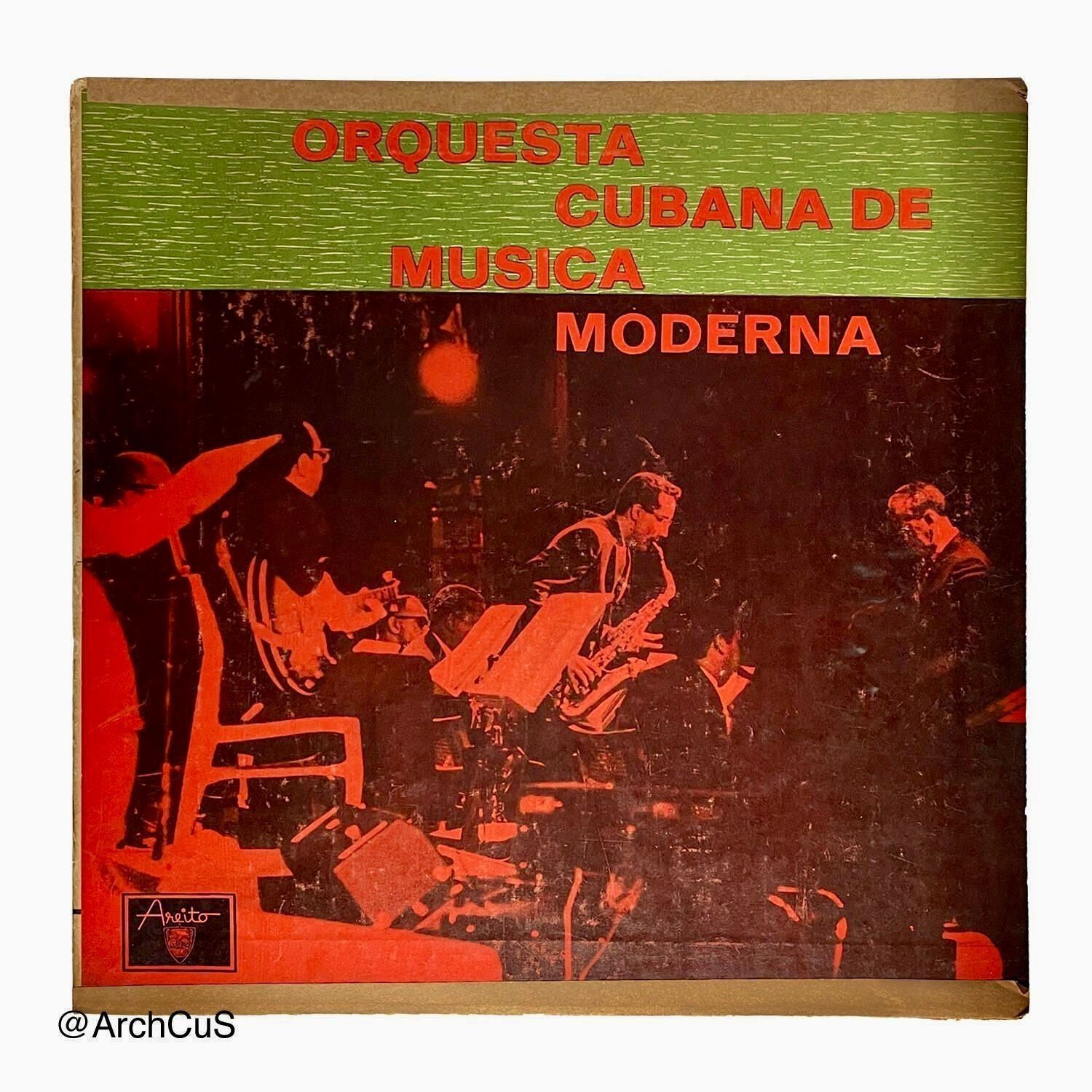
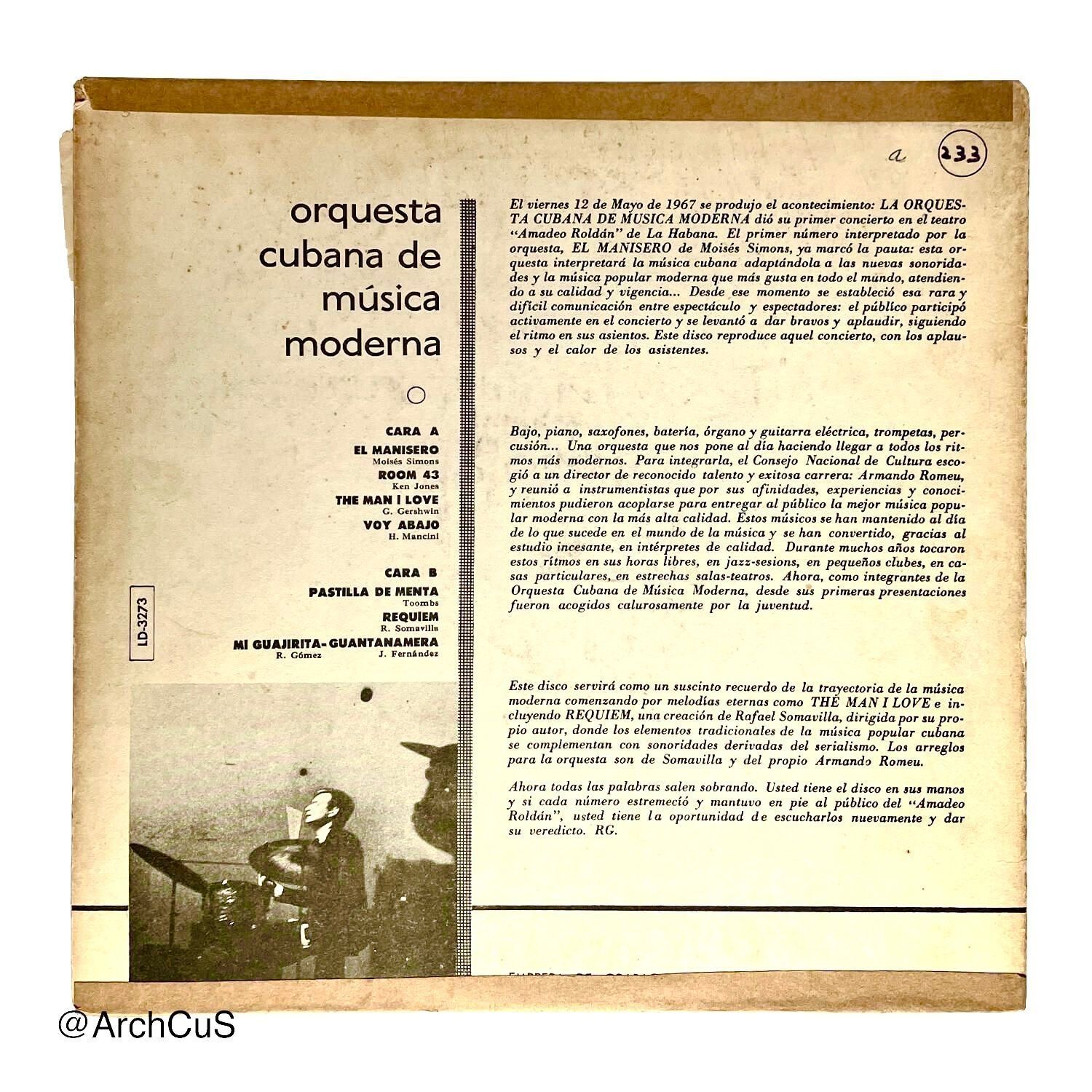
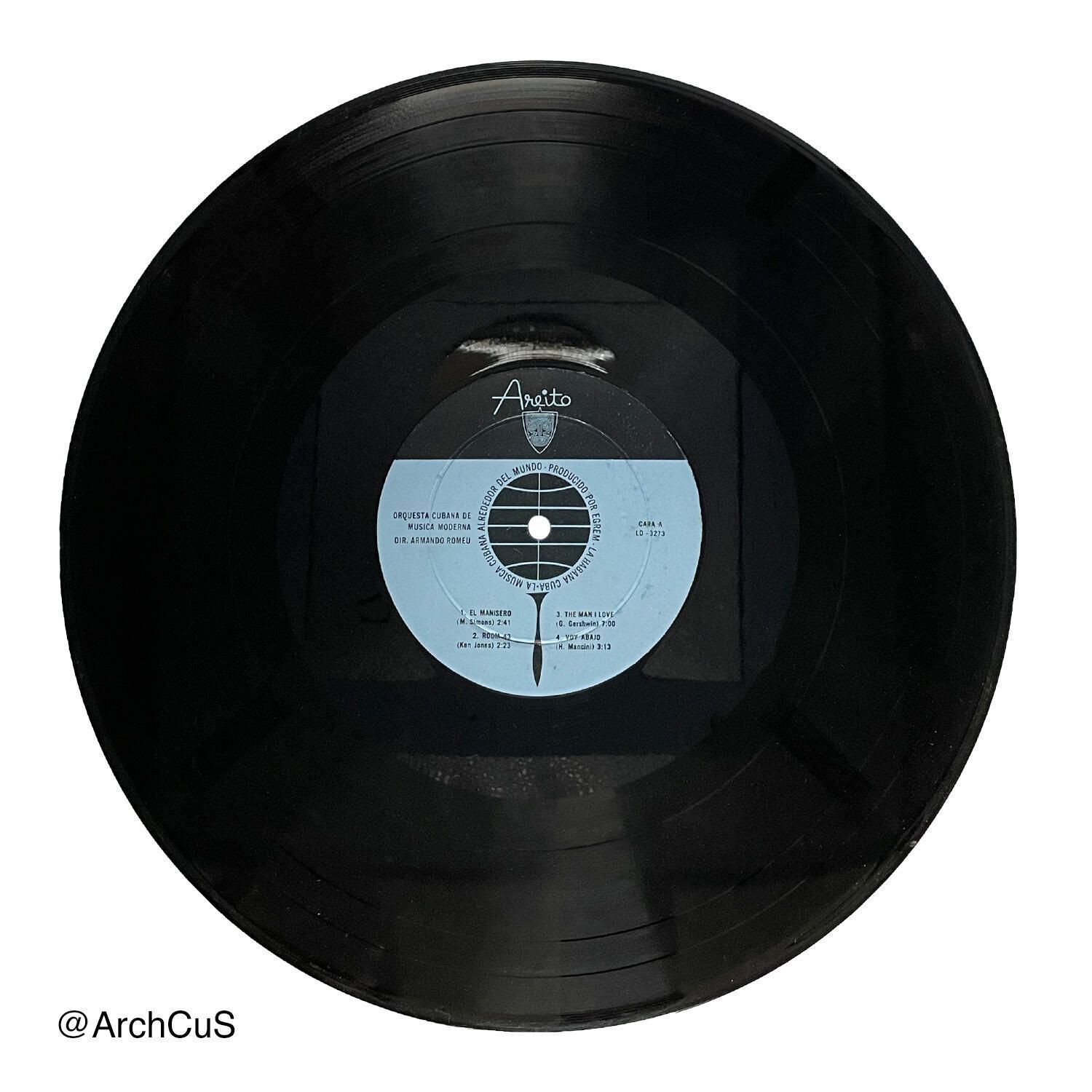
A 12-inch, 33⅓ rpm long-play vinyl record in a printed paper sleeve, produced and distributed by EGREM on its Areíto label. It is the debut album of the Orquesta Cubana de Música Moderna (OCMM), a big band/jazz orchestra directed by Armando Romeu, recorded live at the group's first concert. Side A: "El Manisero" (Moisés Simons), "Room 43" (Ken Jones), "The Man I Love" (Gershwin), "Voy Abajo" (Henry Mancini). Side B: "Pastilla de Menta" (Toombs), "Requiem" (Rafael Somavilla), "Mi Guajirita / Guantanamera" (R. Gómez / J. Fernández). The blue Areíto disc label, with its globe motif, reads "Orquesta Cubana de Música Moderna — Dir. Armando Romeu," the EGREM slogan, and "LD-3273."
2025.1.307
The founding document of the orchestra that institutionalized modern jazz and "música moderna" within post-1959 Cuba and became the seedbed of Cuban jazz. The OCMM was founded in Havana in 1967, organized by trumpeter Luis Escalante and the composer-arranger-saxophonist Armando Romeu, who was its director (later succeeded by Rafael Somavilla, then Paquito D'Rivera, Tony Taño, and Germán Piferrer). Its creation was a deliberate cultural-policy act: it was established by the then Consejo Nacional de Cultura and had a political character, intended to counteract the influence of foreign music (the Beatles, Nat King Cole, etc.) in the young Cuban revolution — an orchestra authorized to play jazz and Cuban music. Rather than simply banning Western pop and jazz, in other words, the state built its own state-sanctioned modern orchestra to channel that energy — and this very LP shows the result, mixing American Songbook standards (Gershwin's "The Man I Love," a Mancini number, Ken Jones's "Room 43") with Cuban classics ("El Manisero," "Guantanamera") and an original serialist "Requiem" by Somavilla. The personnel became a who's-who of Cuban music — over its life the band included Chucho Valdés, Paquito D'Rivera, Arturo Sandoval, Carlos Emilio Morales, Guillermo Barreto, Cachaíto López, and Enrique Plá — and it was from within the OCMM that Irakere emerged in 1973. The album captures the literal first night, applause and all.
33 RPM Record
The Cabrera Arús family collection
Leopoldo Arús Gálvez collection
2025.1
Orquesta Cubana de Música Moderna
Band
Armando Romeu
Director
R. Somavilla
Director
Areíto
EGREM
Big Band
Jazz
1967
Cuba
Caribbean
Central America
Spanish
English
The front cover is a red-toned concert photograph of the orchestra (saxophonist and drummer foreground) under the title in red on a green band; the back carries detailed liner notes (signed "RG") describing the first concert, the orchestra's instrumentation and personnel philosophy, and the serialist elements of Somavilla's "Requiem," plus a second concert photograph.
LD-3273
El Manisero
Moisés Simons
Composer
Room 43
Ken Jones
Composer
The man I love
George Gershwin
Composer
Voy abajo
H. Mancini
Composer
Pastilla de menta
Toombs
Composer
Requiem
R. Somavilla
Composer
Mi guajirita-guantanamera
R. Gómez
Composer
J. Fernández
Composer
Inscription
Back cover
El viernes 12 de Mayo de 1967 se produjo el acontecimiento: LA ORQUESTA CUBANA DE MUSICA MODERNA dió su primer concierto en el teatro "Amadeo Roldán" de La Habana. El primer número interpretado por la orquesta, EL MANISERO de Moisés Simons, ya marcó la pauta: esta orquesta interpretará la música cubana adaptándola a las nuevas sonoridades y la música popular moderna que más gusta en todo el mundo, atendiendo a su calidad y vigencia… Desde ese momento se estableció esa rara y dificil comunicación entre espectáculo y espectadores: el públíco participó activamente en el concierto y se levantó a dar bravos y aplaudir, siguiendo el ritmo en sus asientos. Este disco reproduce aquel concierto, con los aplausos y el calor de los asistentes. Bajo, piano, saxofones, batería, órgano y guitarra eléctrica, trompetas, percusión… Una orquesta que nos pone al día haciendo llegar a todos los ritmos más modernos. Para integrarla, el Consejo Nacional de Cultura escogió a un director de reconocido talento y exitosa carrera: Armando Romeu, y reunió a instrumentistas que por sus afinidades, experiencias y conocimientos pudieron acoplarse para entregar al público la mejor música popular moderna con la más alta calidad. Estos músicos se han mantenido al día de lo que sucede en el mundo de la música y se han convertido, gracias al estudio incesante, en intérpretes de calidad. Durante muchos años tocaron estos rítmos en sus horas libres, en jazz-sesions, en pequeños clubes, en casas particulares, en estrechas salas-teatros. Ahora, como integrantes de la Orquesta Cubana de Música Moderna, desde sus primeras presentaciones fueron acogidos calurosamente por la juventud. Este disco servirá como un suscinto recuerdo de la trayectoria de la música moderna comenzando por melodías eternas como THE MAN I LOVE e incluyendo REQUIEM, una creación de Rafael Somavilla, dirigida por su propio autor, donde los elementos tradicionales de la música popular cubana se complementan con sonoridades derivadas del serialismo. Los arreglos para la orquesta son de Somavilla y del propio Armando Romeu. Ahora todas las palabras salen sobrando. Usted tiene el disco en sus manos y si cada número estremecíó y mantuvo en pie al público del "Amadeo Roldán", usted tiene la oportunidad de escucharlos nuevamente y dar su veredicto. RG.
Spanish
On Friday, May 12, 1967, the event took place: THE CUBAN ORCHESTRA OF MODERN MUSIC gave its first concert at the "Amadeo Roldán" theater in Havana. The first number performed by the orchestra, EL MANISERO by Moisés Simons, already set the tone: this orchestra will perform Cuban music adapting it to the new sounds and the modern popular music that is most liked around the world, considering its quality and popularity… From that moment, a rare and difficult communication between show and public was established: the public actively participated in the concert and rose to cheer and applaud, marking the rhythm in their seats. This album reproduces that concert, with the applause and warmth of the attendees. Bass, piano, saxophones, drums, organ and electric guitar, trumpets, percussion... An orchestra that brings us up to date by playing the most modern rhythms. To integrate it, the National Council of Culture chose a director of recognized talent and successful career: Armando Romeu, and brought together instrumentalists who, due to their affinities, experiences and knowledge, were able to join together to deliver the best modern popular music with the highest quality to the public. These musicians have kept up to date with what happens in the world of music and, thanks to their incessant study, have become quality performers. For many years they played these rhythms in their spare time, in jazz-sessions, in small clubs, in private homes, in small theater-rooms. Now, as members of the Cuban Orchestra of Modern Music, from their first performances they were warmly welcomed by the youth. This album will serve as a succinct reminder of the trajectory of modern music beginning with eternal melodies such as THE MAN I LOVE and including REQUIEM, a creation by Rafael Somavilla, directed by its own author, where the traditional elements of Cuban popular music are complemented with sonorities derived from serialism. The arrangements for the orchestra are by Somavilla and by Armando Romeu himself. Now, words are superfluous. You have the album in your hands and, as each number touched and kept the audience of "Amadeo Roldán" on their feet, you have the opportunity to listen to them again and give your verdict. RG.
31.5 cm
31.5 cm
case, record
Fair
Leopoldo Arús Gálvez
owner
Orquesta Cubana de Música Moderna
artist
Havana
Cuba
Caribbean
Central America
recording, acquisition, use
According to Paquito D'Rivera, asked why the musicians are not credited in the album, "Fue una malísima práctica de la EGREM de no dar crédito a la gente que grababa, pero confesado medio serio medio en broma por Medardo Montero, el difunto director de la empresa, prevenían el dar crédito a “desertores” en potencia. O sea, que de esta manera no tenían que borrar los nombres de la gente que se iba quedando fuera del país y o presentaban pa’ largarse". (It was a very bad practice of EGREM not to give credit to the people playing, but as Medardo Montero, the late director of the company, confessed half seriously and half jokingly, it was a way to prevent giving credit to potential "deserters". In other words, in this way they did not have to erase the names of the people who left the country and/or filed to leave the country.)