
Hand-Sewn Plaid Scarf with Fringe
Clothing/Dress/Costume
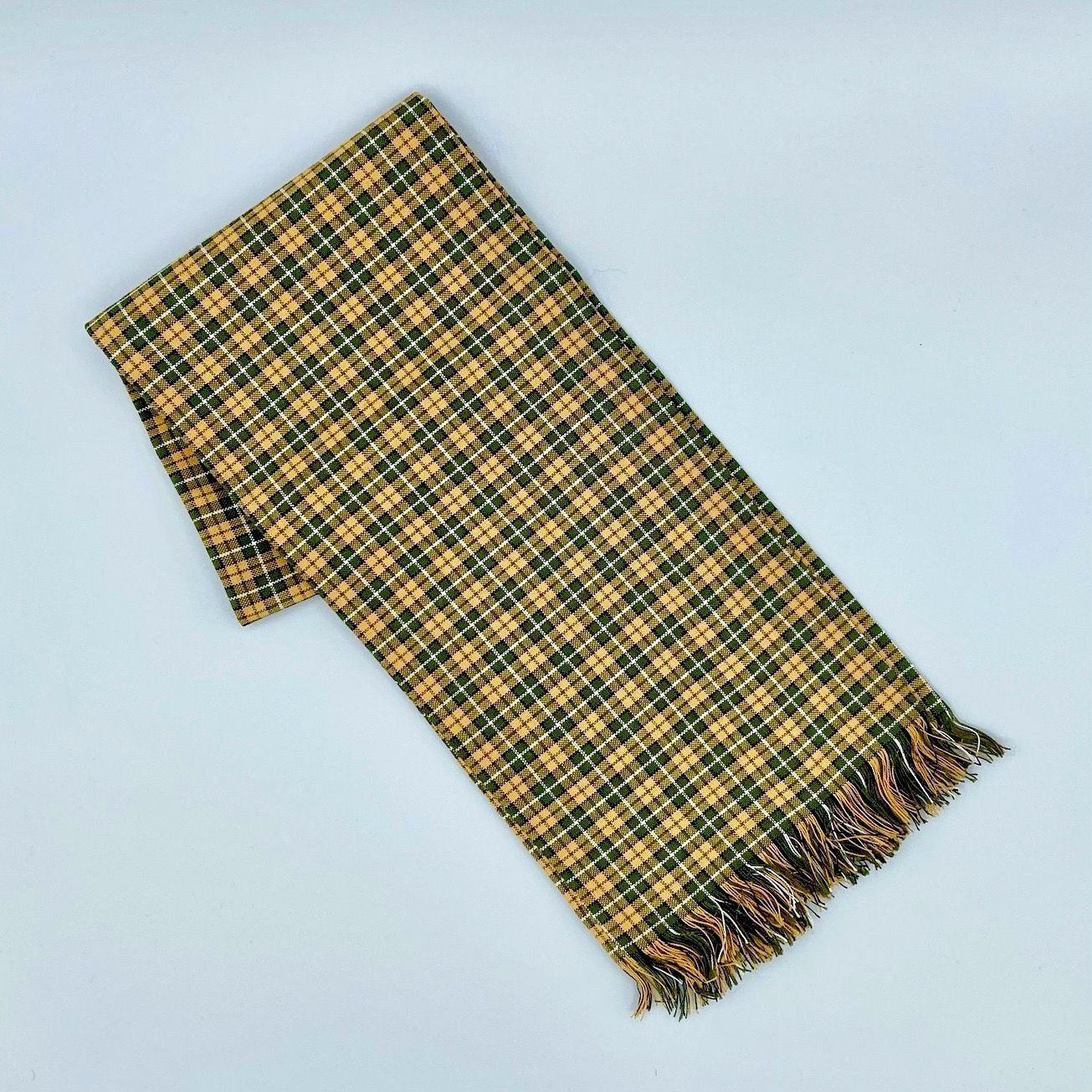
A rectangular plaid scarf in a small-scale yellow/mustard, green, and white check pattern, with hand-finished knotted fringe at the end(s). Hand-sewn by María A. Arús Caraballo during the 1970s. DESCRIPTION: A rectangular textile scarf. The fabric is a fine-scale yellow/mustard and green plaid (tartan-style) with thin white grid lines forming the lattice between blocks of color. The plaid is woven (not printed) — visible from the way the pattern reads consistently from front to back, with the characteristic over-and-under interlacement of dyed warp and weft threads typical of traditional plaid weaving. The dominant color is a warm mustard yellow, crossed by darker (green) horizontal and vertical bands at regular intervals, with finer white lines making the smallest grid divisions. The overall pattern reads as a "house check" or small-scale tartan. The scarf has a substantial fringed end: a row of dense fringe extending several centimeters from the cut edge of the fabric, formed by deliberately unraveling the weft threads to leave the warp threads hanging free, on both sides.
2025.1.32
Made and owned by María A. Arús Caraballo
The Cabrera Arús family collection
María A. Arús Caraballo collection
2025.1
María A. Arús Caraballo
1970s
Havana
Cuba
Caribbean
Central America
Hand-made Machine-loomed plaid fabric (the textile itself is industrial production — most likely state-distributed textile yardage); hand-finished hems on long edges; deliberately-unraveled fringe at the cut ends; possibly knotted/twisted fringe-end bundles
Good
María A. Arús Caraballo
maker, user
Havana
Cuba
Caribbean
Central America
manufacture, use
Cuban Finotype and Its Materiality
Cuban Revolutionary Fashion: With objects from the Cuba Material collection
Fashioning Cuban Socialism
Throughout the 1960s–1990s, Cuban households obtained the majority of their clothing not from state retail stores or imports but from home sewing — making garments at home from yardage acquired through the libreta de productos industriales (industrial products ration card) or through informal channels. Each Cuban household was allocated a small annual quota of textile yardage ("tela"), typically polyester, distributed through state outlets. Cuban women — overwhelmingly mothers, grandmothers, and aunts — converted this allocation into family clothing through home sewing, often using a Soviet "Чайка" (Chaika) sewing machine or a surviving pre-revolutionary Singer. Patterns came from Cuban magazines (Mujeres, Muchacha, Romances), from passed-around homemade pattern paper, and from observed details on other garments. Home sewing was so universal that the act of having a "tía costurera" or "abuela costurera" (sewing aunt or grandmother) was a near-universal Cuban family memory of the period. Yet because home-sewn garments were rarely preserved (they were worn out, outgrown, or eventually given away), the material evidence of this enormous practice is now scarce. A preserved hand-made 1970s scarf is therefore unusually valuable as documentary evidence. The yellow/mustard and green plaid pattern is highly characteristic of 1970s international fashion. Plaid (or "tela escocesa" / Scottish cloth in Cuban Spanish) was massively fashionable globally in the 1970s, appearing in everything from menswear (suits, ties, scarves) to women's clothing (skirts, dresses, scarves) to children's clothing (school uniforms, accessories). The specific yellow-mustard + green combination is part of the "earth tones" palette that defined late-1960s through 1970s design — alongside the avocado greens, burnt oranges, and chocolate browns that characterized the era. Whether this fabric came to Cuba through COMECON imports (possibly East German or Czechoslovak textile production), through state-textile-combinado domestic manufacture (Cuban factories produced plaid fabrics during this period), or through some other channel is not determinable from the object itself — but the plaid aesthetic was internationally circulated and Cuba was certainly within its visual reach.