
Handmade leather sleeve for a spoon (prisoner's improvised utensil holder)
Object/Artifact
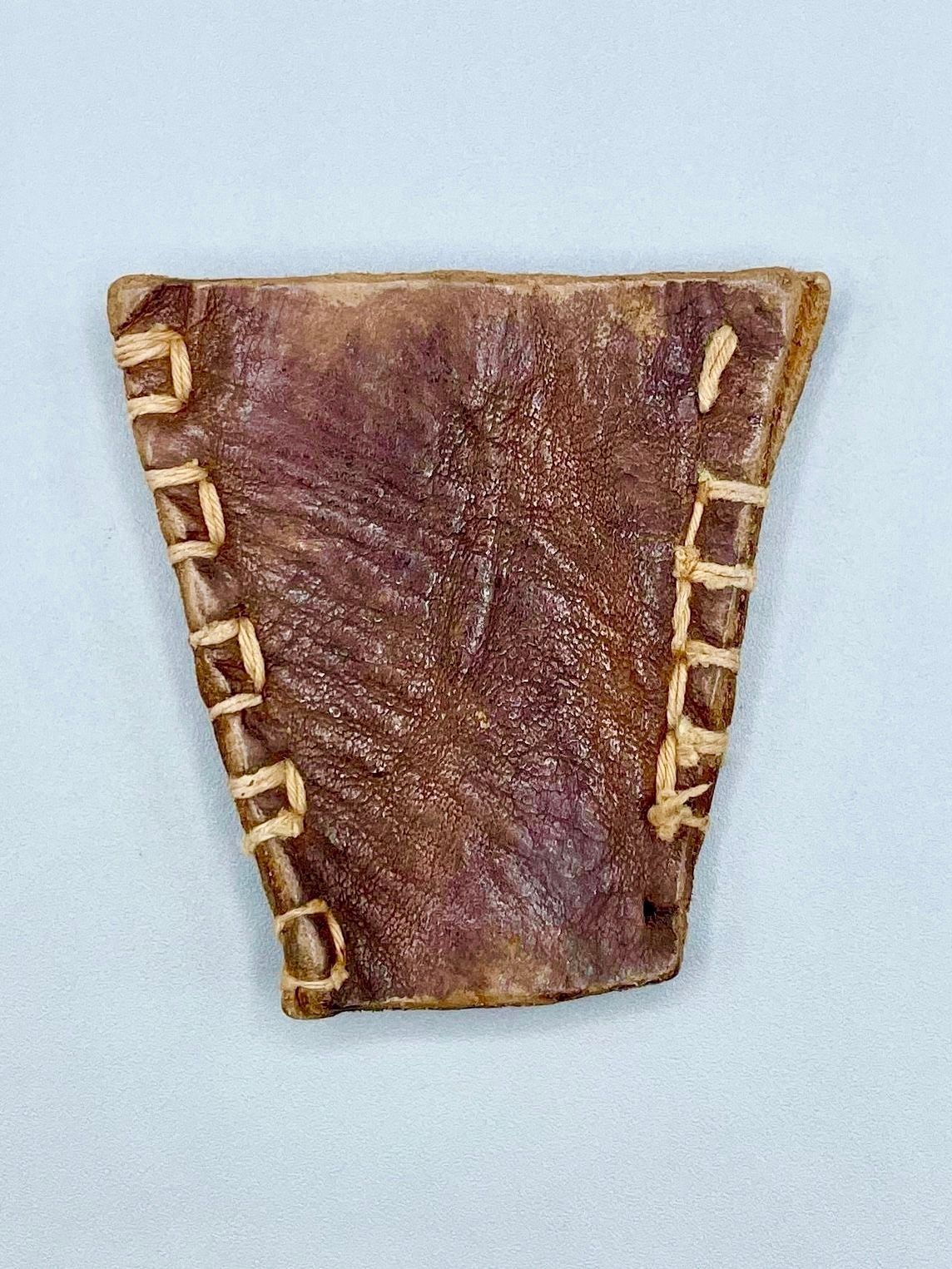
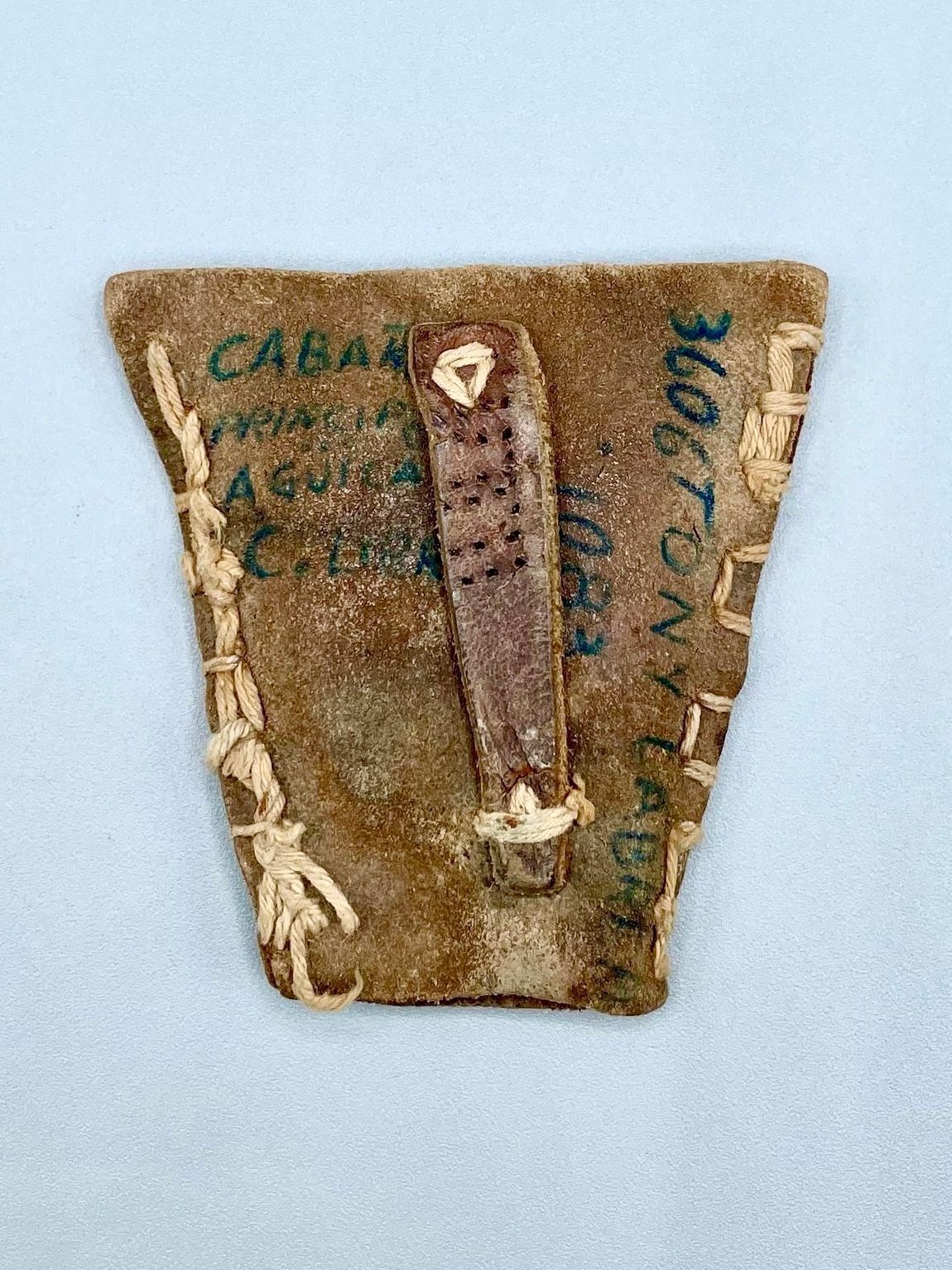
A small handmade case or sleeve of leather, roughly trapezoidal, wider at the top and tapering toward the base, made to hold a spoon. It is constructed from leather pieces laced together along both side edges with pale cord/string passed through punched holes in a whip-stitch or overcast manner. The front (first image) shows the grained, mottled outer surface. The reverse (second image) carries a narrow vertical leather loop or strap, stitched down at top and bottom, that holds the spoon's handle against the body of the sleeve; the surrounding surface is inscribed in ink (now faded blue-green and brown) with several lines of handwritten text, including place names and a personal name and number. The object is worn, soiled, stiffened, and stained throughout, consistent with hard daily use and long age.
2025.1.114
Made by the owner (José A. Cabrera Pérez) by hand, in prison — an improvised personal possession rather than a manufactured or commissioned object.
Per donor testimony, the owner was sentenced to three years' imprisonment for attempting to leave the country and for abandoning his military post while serving in the draft; the reverse of the sleeve is inscribed with the names of the prisons where he was held during that period, effectively recording his carceral itinerary on the object itself.
The Cabrera Arús family collection
José A. Cabrera Pérez collection
2025.1
1960s
Cuba
Caribbean
Central America
Date: Late 1960s (per donor testimony).
Handwritten ink inscriptions on the reverse: "CABAÑA", "PRINCIPE", "AGÜIRA", "C. LIBRE", a string of letters/numerals reading approximately "3606 TONY CABRERA" (the owner's name and an identifying number), and "1083"(?) among the lines.
Leather
Technique Hand-cut leather laced along the edges with cord through punched holes (whip/overcast stitching); applied stitched spoon-retaining loop on the reverse; hand-inked inscriptions. Improvised hand manufacture.
Fair
José A. Cabrera Pérez
owner, maker
The prison names inscribed in the reverse traces José A. Cabrera Pérez's carceral itinerary. All four named sites are documented Cuban penal institutions: La Cabaña — the Fortaleza de San Carlos de la Cabaña, the 18th-century fortress at the entrance to Havana harbor, used as a prison after 1959 and notorious in the early revolutionary period for holding political prisoners and for executions carried out in its moats. Príncipe — the Castillo del Príncipe, the 18th-century hilltop fortress in Havana that served as the city's principal prison from 1926 until it was decommissioned in 1974, holding both common and political prisoners. Agüica — a prison in Matanzas province, one of the penal facilities established under the revolutionary government; it remains in use today and is frequently cited in reporting on the Cuban prison system. Cuba Libre ("C. Libre" in the inscription) — a prison labor camp. Cuban penal labor camps (campamentos/granjas) of this kind formed part of the corrective-labor system to which prisoners were assigned for agricultural and construction work. The inscriptions trace a movement through two major Havana fortress-prisons (La Cabaña, Príncipe), a Matanzas provincial prison (Agüica), and a prison labor camp (Cuba Libre) — consistent with the period's practice of transferring prisoners between institutions and work camps. As a hand-made utensil holder carrying its owner's own record of where he was held, the piece is simultaneously an artifact of everyday prison survival and a personal document of political and military-justice confinement in late-1960s Cuba.