
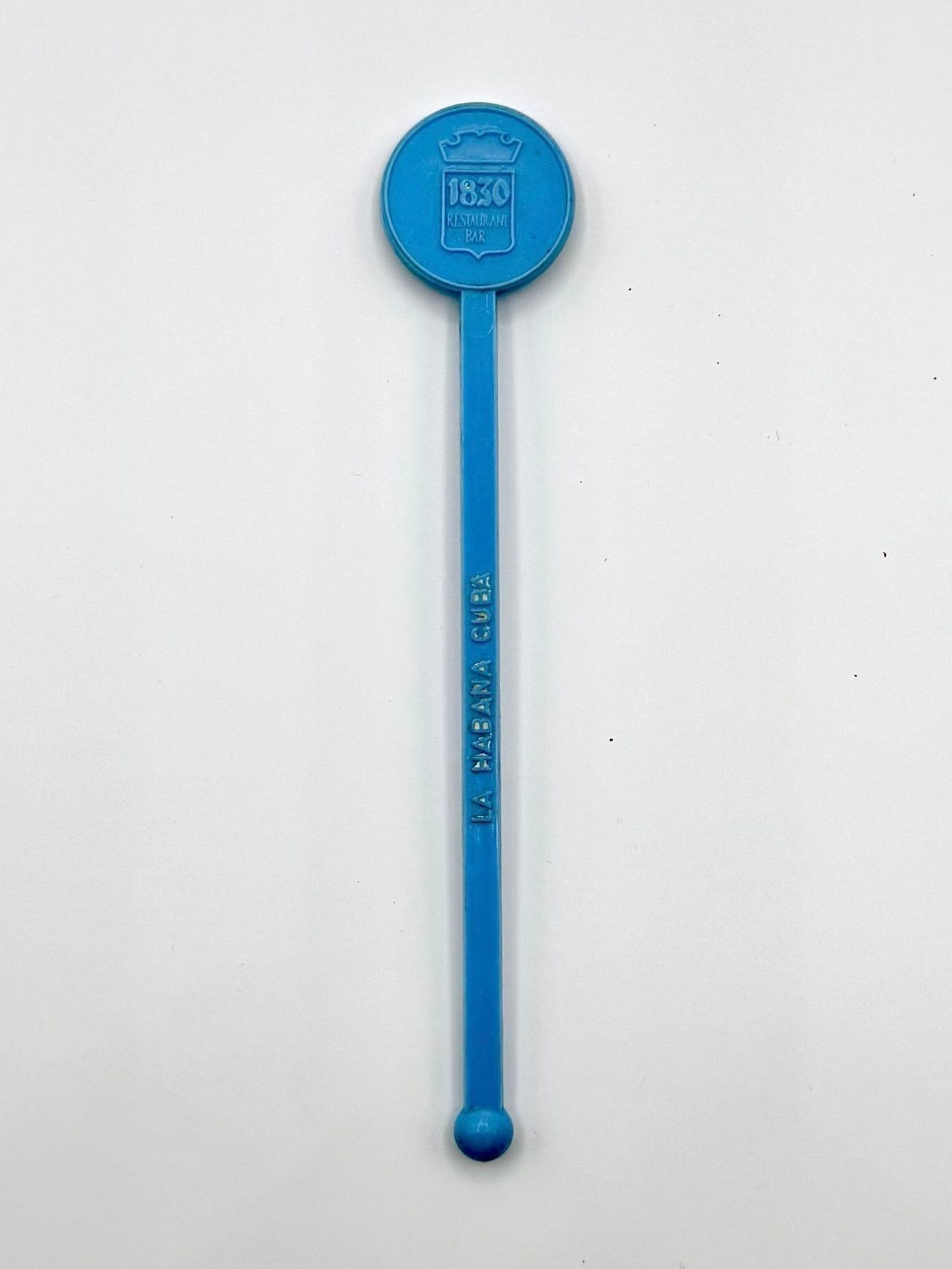
Restaurante 1830 (Havana) advertising drink stirrer / swizzle stick
Object/Artifact
Single opaque blue plastic drink stirrer. The round paddle is embossed with the restaurant's emblem — a heraldic crown above a shield bearing 1830 / RESTAURANT / BAR — within a ring border. The shaft is embossed lengthwise LA HABANA CUBA and ends in a small ball foot. Logo and lettering are integrally molded (embossed), not printed.
2025.25.9
María Teresa Cornide Hernández collection
2025.25
Havana
Cuba
Caribbean
Central America
Maker: Restaurante 1830, Havana (advertising barware); stirrer manufacturer not marked. Date: No earlier than the establishment of the Restaurante 1830 in the 1950s. Most plausibly state-era (1959–1980s, within range), given the restaurant's brief pre-revolution window versus its long post-nationalization operation; a 1950s pre-revolution origin cannot be excluded, which would fall just before the range. Exact date unconfirmed. (Tentative; boundary/transitional.)
Paddle (embossed): crowned shield with 1830 / RESTAURANT / BAR. Shaft (embossed): LA HABANA CUBA.
Plastic
Materials: Molded plastic (polystyrene), opaque blue. Technique: Injection-molded stirrer with integrally embossed logo and lettering; ball-foot terminal.
Good
Havana
Cuba
Caribbean
Central America
use, imagery
Restaurante 1830 occupies a 19th-century mansion at Malecón y 22 (Calzada esq. 20), Vedado, at the mouth of the Almendares beside the Torreón de la Chorrera. The site passed through earlier identities — Restaurante Arana (19th c.), Hotel La Mar, then Villa Miramar (1920s, leased by Carlos Miguel de Céspedes) — before being taken over in the 1950s by the proprietors of the Zaragozana restaurant, who established the "1830." It has run since as one of Havana's best-known restaurants, today a state enterprise (Complejo 1830 – Mesón de la Chorrera), noted for its gardens, "isla japonesa," and Moorish glorieta. Because the "1830" was established only in the 1950s and operated far longer under the state, this stirrer most likely dates to the post-1959 state era (in range), though a 1950s pre-revolution origin is possible. The Spanish "LA HABANA CUBA" branding fits either.