
Czech White Glass-Bead Multi-Strand Bib Necklace
Jewelry
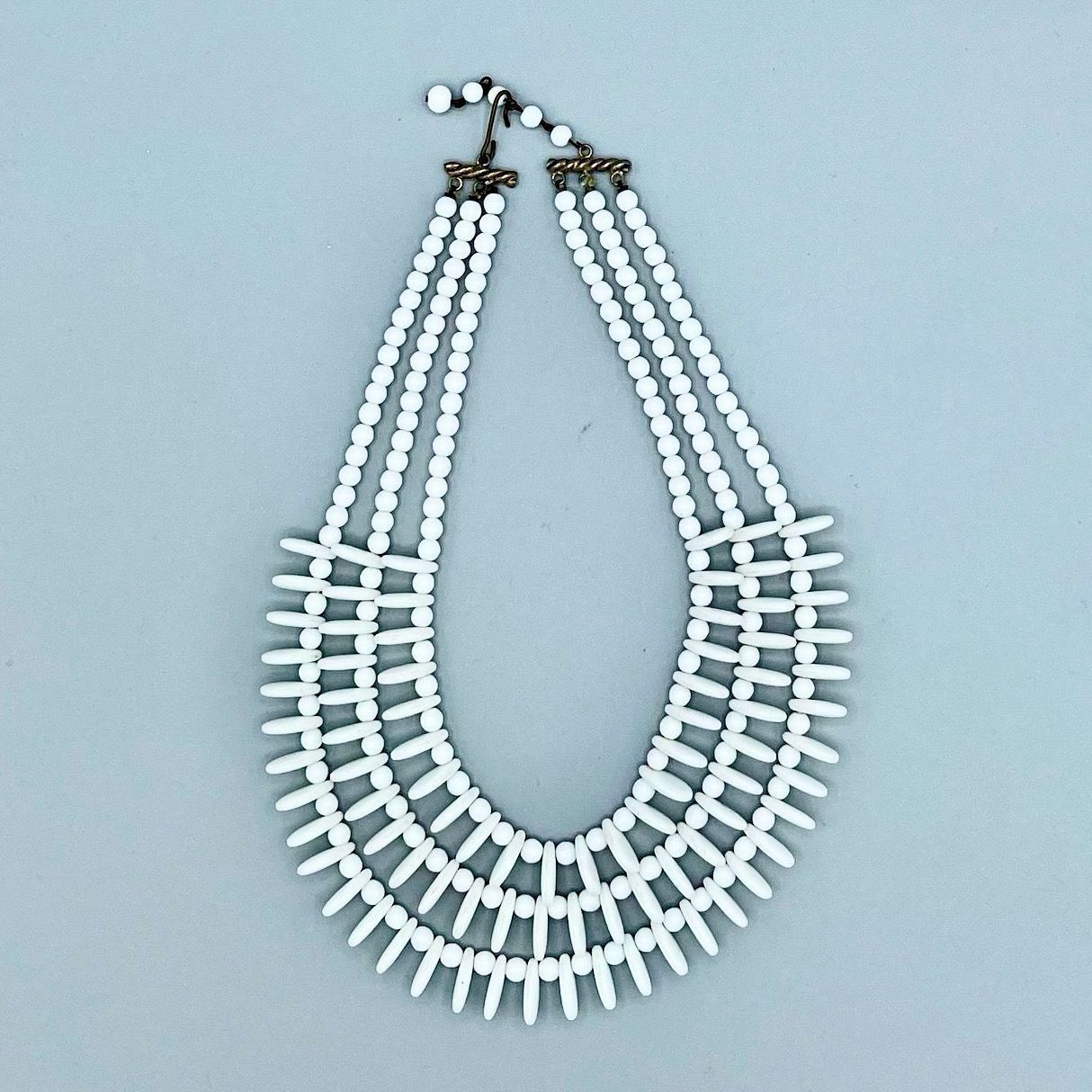
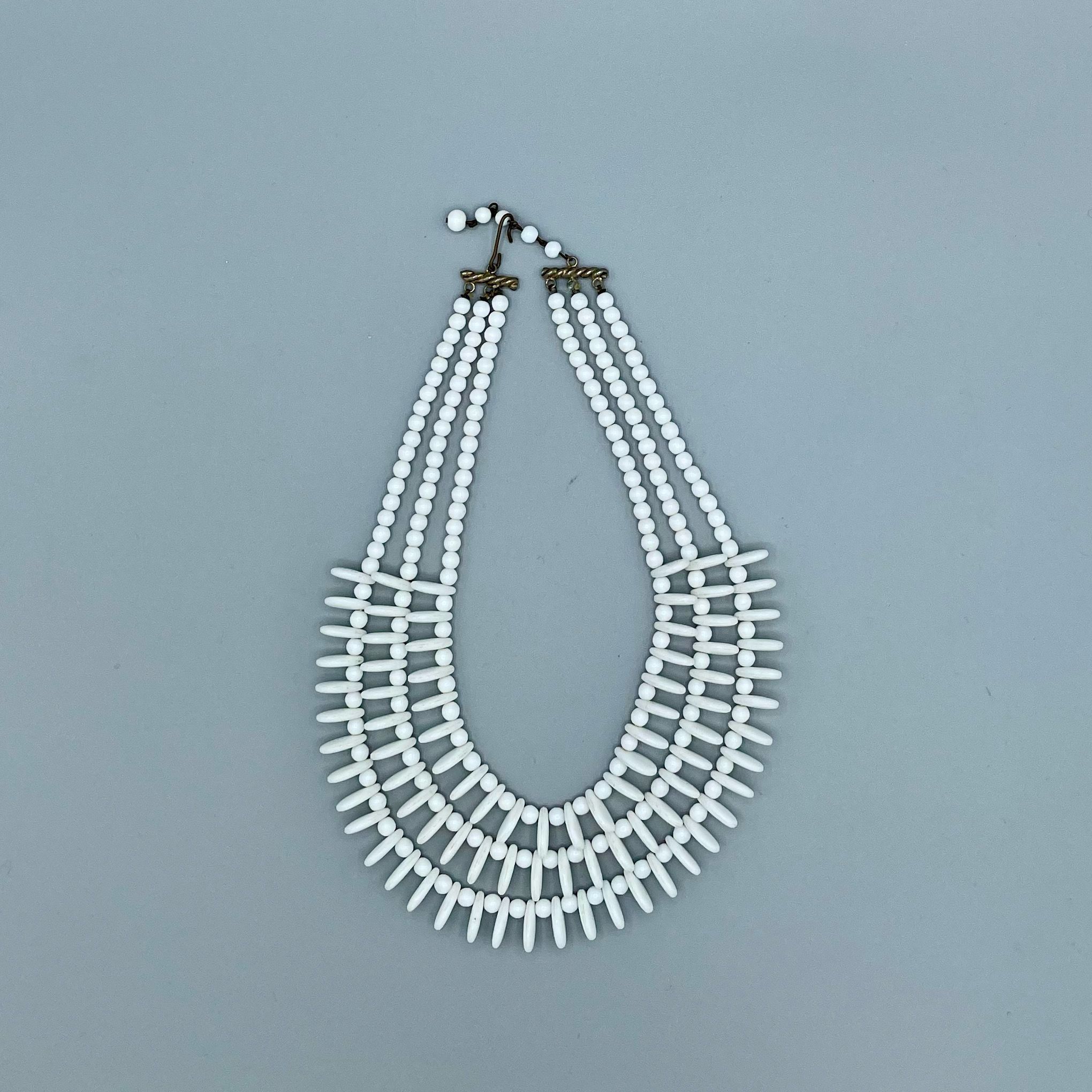
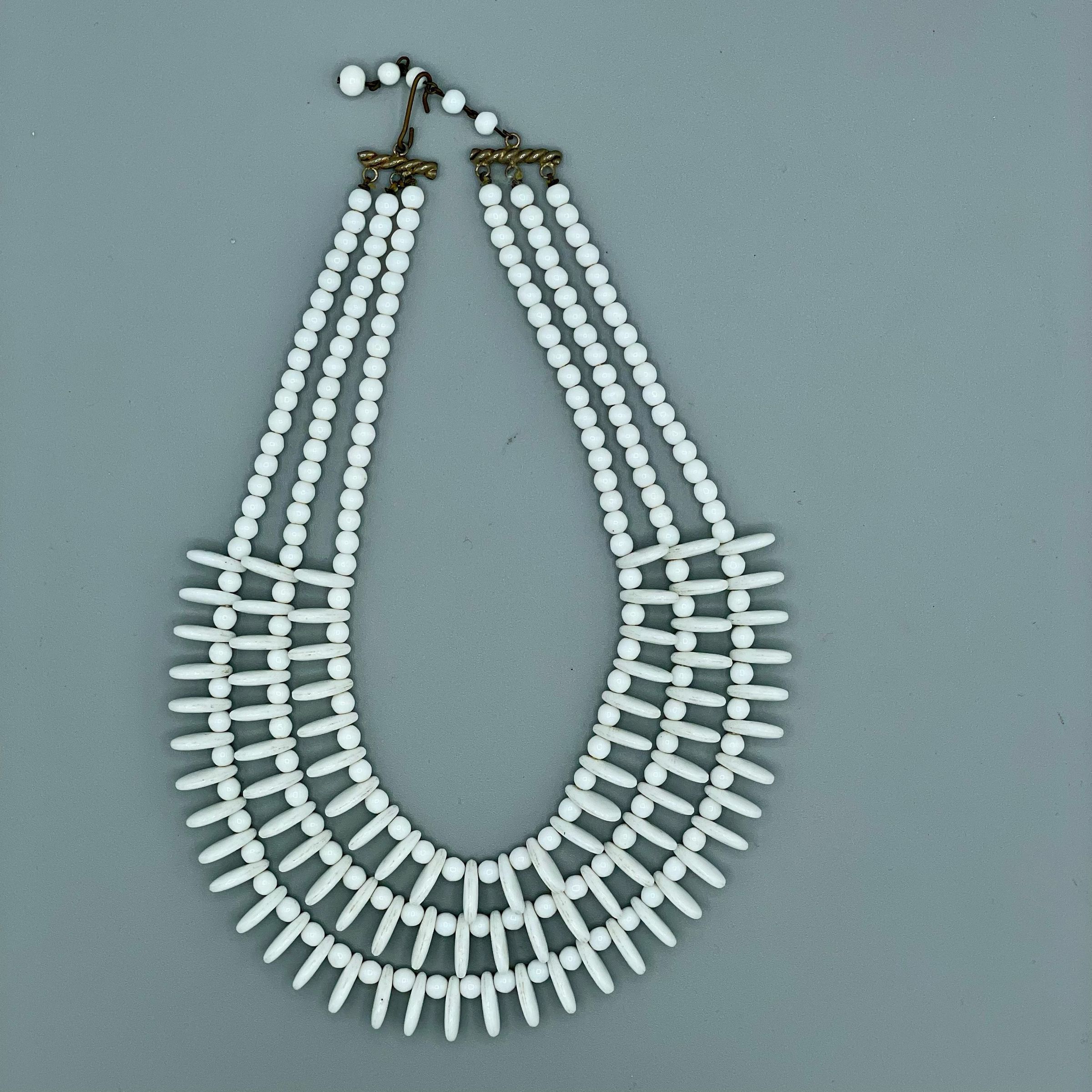
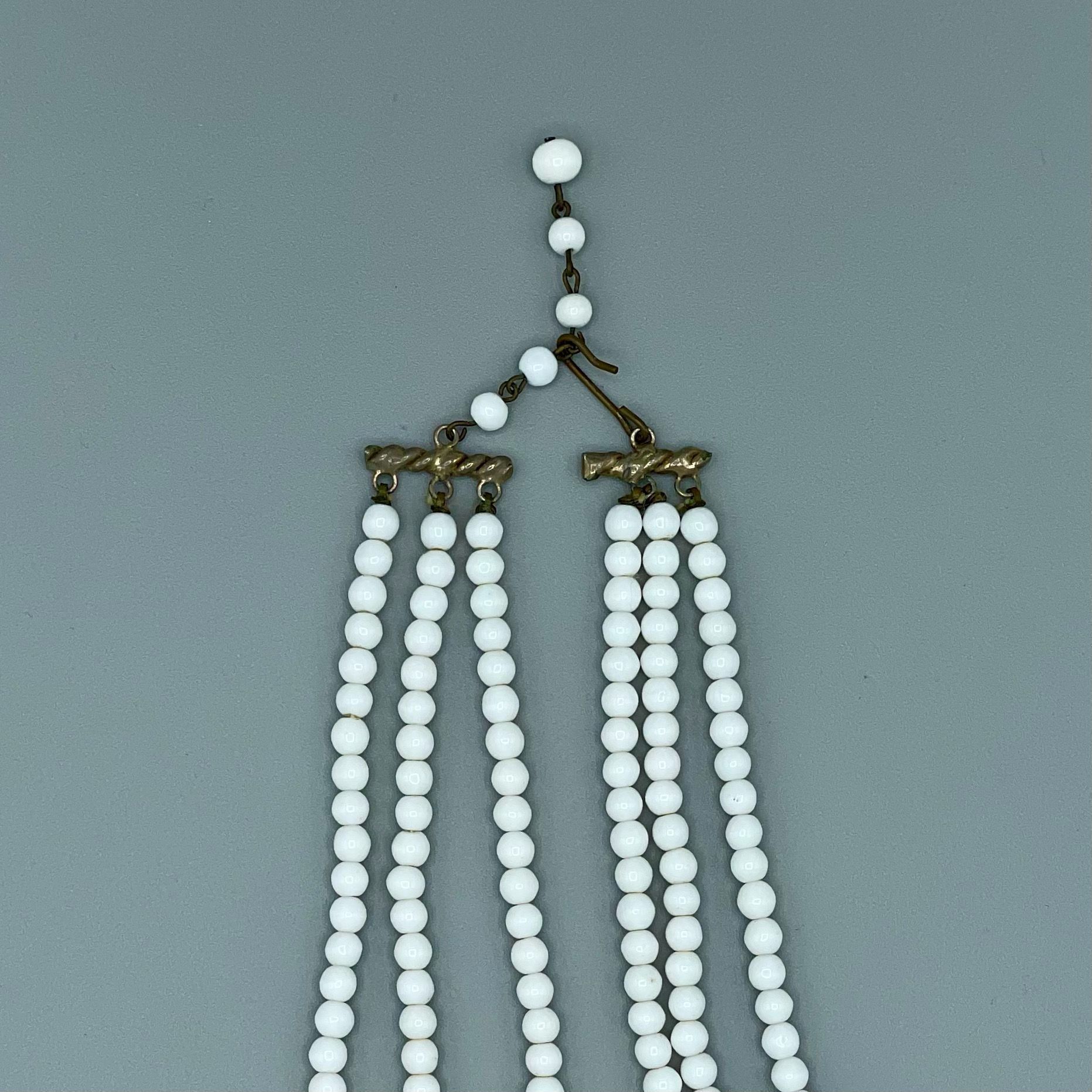
A multi-strand bib- / collar-style necklace of white glass beads, constructed from four parallel strands of small round beads connected by perpendicular elongated white "stick" beads to form an open lattice-like collar that fans out into a wider, more densely beaded lower section. Almost certainly Czech / Czechoslovak in origin, given the characteristic glass-bead vocabulary and the family-recorded provenance: It was acquired through the Czechoslovak-Cuban social networks established in part through Leopoldo Arús Caraballo's professional ties. DESCRIPTION: A bold multi-strand bib / collar-style necklace, dramatic in scale and architectural in construction. The body of the necklace consists of three parallel concentric strands of small white round beads (each strand of beads strung continuously), held in formal parallel arrangement by perpendicular elongated white "stick" or "rice-grain" shaped beads that run across all three strands like the rungs of a ladder. This perpendicular-bead-as-spacer construction creates an open lattice / mesh appearance throughout the bib section. The architecture flows in two parts: UPPER (NECK) SECTION: At the top, the three strands converge into two parallel pairs that emerge from twisted-wire / rope-effect metal end-caps, one on each side. Above these end-caps, additional small round white beads continue the strands up to a clasp at the back of the neck. LOWER (BIB) SECTION: Three strands descend toward the front of the necklace, creating a graduated "fan" or "rays" effect that dramatically widens and densifies the lower half of the necklace into a fully-formed bib that would cover the upper chest when worn. All beads are white opaque glass, characteristic of pressed or molded glass beads rather than lampwork. The round beads are uniform in size and shape; the stick beads are uniform.
2025.1.28
Necklace
The Cabrera Arús family collection
María A. Arús Caraballo collection
2025.1
Belonged to María A Arús Caraballo
Jablonec
Jablonec nad Nisou
Eastern Europe
Bohemia
Czechoslovakia
Europe
The bead form, technique, and combination are highly characteristic of the famous Bohemian / Jablonec nad Nisou glass-bead industry. The Jablonec region (in northern Bohemia, present-day Czech Republic) and its surrounding workshops at Železný Brod, Desná, and other Liberec-region towns produced enormous quantities of pressed-glass beads of every shape and color, exporting to virtually every continent. Czechoslovak state enterprises during the socialist period (Jablonex, Železnobrodské Sklo / Železnobrodská Bižuterie, ŽBS) continued and consolidated this industry. DATE / PERIOD: Estimated mid-to-late 20th century, c. 1960s–1980s. The bib-collar fashion silhouette enjoyed periodic revivals during this period (notably influenced by Egyptian-revival jewelry after the Tutankhamun exhibition tours of the 1960s–1970s); Czechoslovak production for export markets aligned with these fashion cycles. ORIGIN: Czechoslovakia (almost certainly — most likely the Jablonec nad Nisou bead-making region of northern Bohemia, present-day Czech Republic)
MATERIALS: Pressed/molded white opaque glass (round and elongated beads); steel or copper-alloy wire stringing (likely tigertail, beading wire, or similar — color appears dark gray suggesting non-bright finish); small metal end-caps of dark-bronze or oxidized-silver-tone metal (twisted-wire decorative detail visible) TECHNIQUES: Pressed/molded glass beads (a hallmark of the Jablonec industry); multi-strand wire stringing; mechanical end-cap attachment for the strand termination; the perpendicular stick-bead arrangement is the structural feature that gives the necklace its architectural form
Good
María A. Arús Caraballo
owner, purchased from a Czechoslovakian family friend
Jablonec
producer
Havana
Cuba
Caribbean
Central America
purchase
This necklace was reportedly bought from a Czechoslovak visitor to Cuba (the USSR and Czechoslovakia sent many technical advisors, engineers, doctors, and teachers to Cuba in the 1960s–1980s), through Leopoldo's professional Czechoslovak network (the daughter of a Czechoslovak engineer he knew through the Cuban electrical utility). In this case, the object's biography traces a Czechoslovak-Cuban interpersonal exchange rather than a Cuban-Czechoslovak round-trip.