
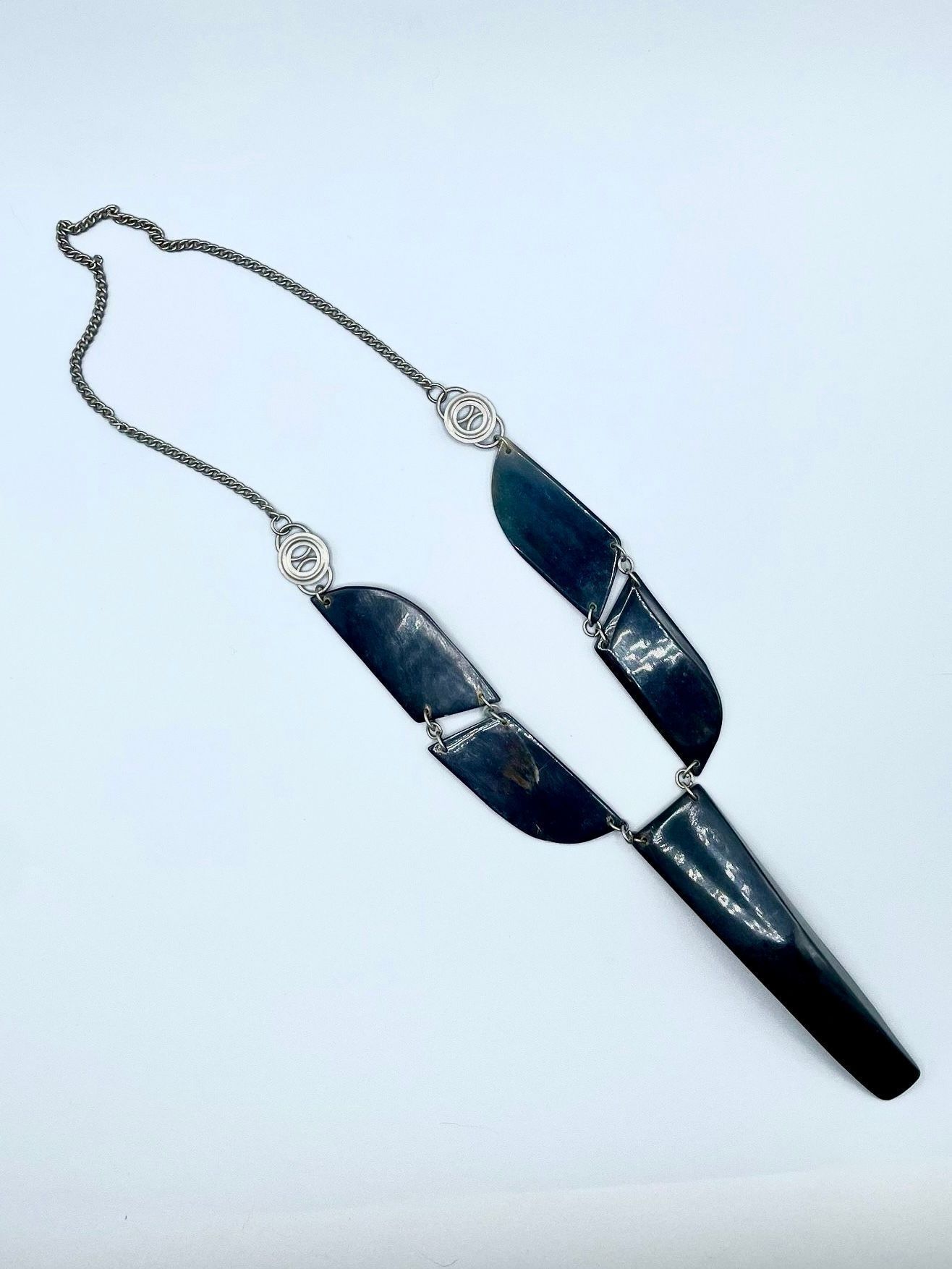
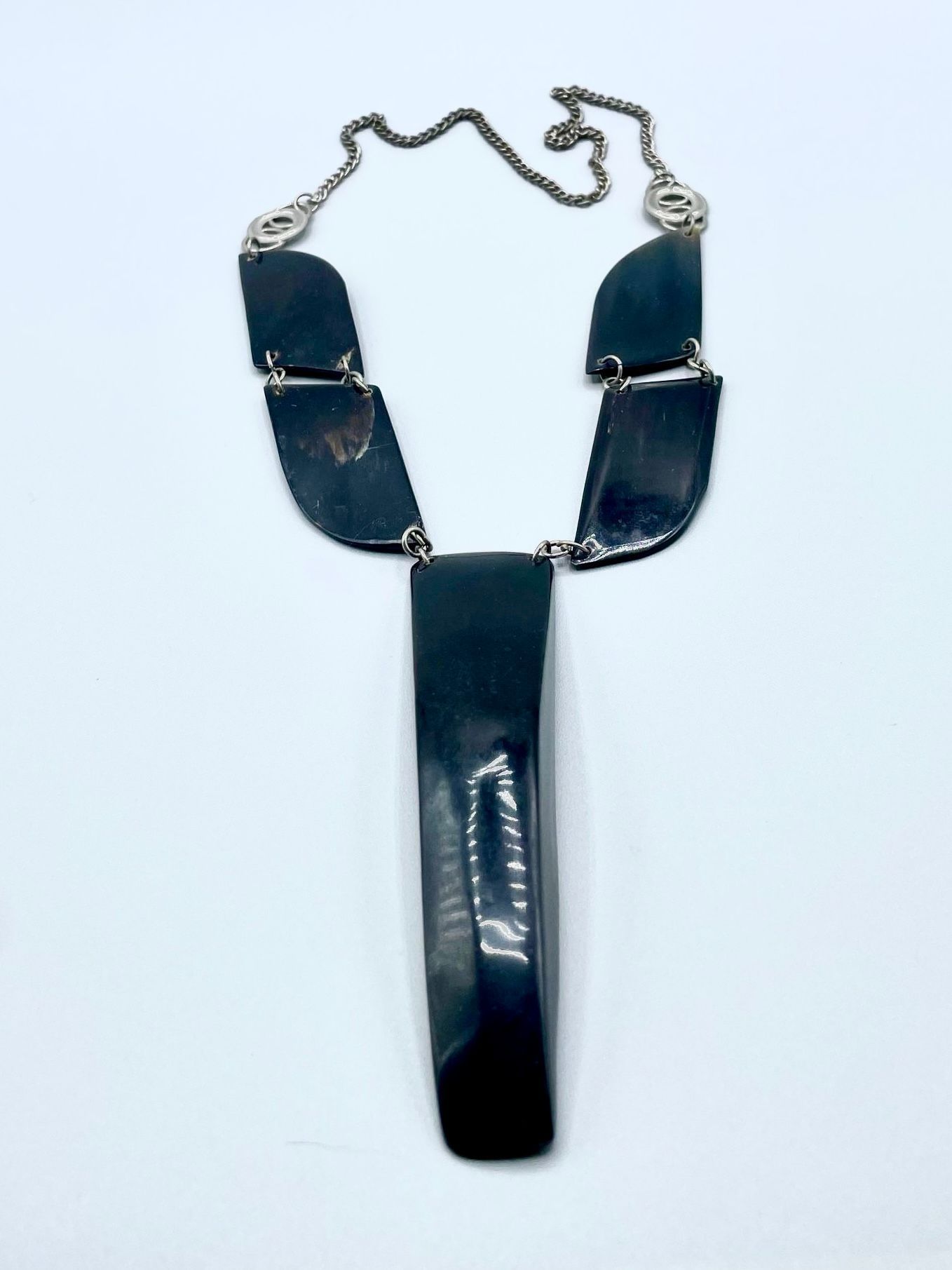
Modernist bib necklace, linked dark horn plates
Jewelry
A bold modernist necklace composed of large, flat, polished plates of a dark brown-black material (reading as horn) joined by metal jump rings into a symmetrical bib, suspended from a silver-tone curb chain with two pierced double-ring (spectacle/interlocking-circle) connector links at the shoulders. Each side has a roughly D-shaped or trapezoidal plate linked to a longer curved blade-like plate; the two sides meet at a central long tapering tongue-shaped pendant plate that hangs well below the others, giving a long central drop. The plates are smooth and glossy with natural tonal variation. The metal links and chain are a tarnished silver tone.
2025.1.85
Necklace
Used frequently by María A. Arús Caraballo.
The Cabrera Arús family collection
María A. Arús Caraballo collection
2025.1
MAKER: Unknown; unmarked. The deliberate, sculptural design suggests a craft/studio or small-workshop maker rather than mass production, but no maker's mark is visible; attribution open. DATE / PERIOD: Not marked; the bold modernist style is characteristic of the 1960s–1970s. ORIGIN: Not established from the object (no mark). If the material is horn and the piece is artisanal, a Cuban origin is plausible but not established.
Bone
MATERIALS: Dark horn (most likely), polished — a dark polished plastic imitating horn cannot be excluded. Silver-tone base-metal chain, jump rings, and connector links. TECHNIQUES: Cut, shaped, and polished flat plates (of horn or similar), pierced and joined with metal jump rings into an articulated bib; suspended from a commercial curb chain with decorative double-ring connectors. Combines hand-worked plates with ready-made findings.
Good
María A. Arús Caraballo
owner
Havana
Cuba
Caribbean
Central America
use, purchase
This is a sculptural modernist bib necklace built from large polished horn plates linked into a symmetrical, articulated drop — a confident piece of design that stands apart from the manufactured costume jewelry recorded around it and reads as studio/craft work. The bold geometry and scale are characteristic of 1960s–70s modernist jewelry, the basis for the tentative dating. No maker's mark is visible, so maker and origin are open; horn is worked in many craft traditions (including in Latin America and the Caribbean), so a Cuban or regional artisanal origin is plausible but must not be asserted without evidence.