
Matryoshka nesting set (3 pieces), Semyonov Style — floral-apron type
Object/Artifact
Three graduated turned-wood nesting dolls, hand-painted over natural varnished wood. The outer doll wears a headscarf and an apron with a red-and-green floral bouquet, with fairly fine facial features (arched brows, rosy cheeks, small mouth) and a dark blue base; it opens at the waist. The middle doll is more sparingly painted (headscarf outline and vertical strokes) and also opens. The innermost is a small solid figure with a minimally painted face. LARGEST DOLL: Pale natural-wood ground with hand-painted decoration in black ink lines and applied colors. The face shows simple black-line eyebrows and eyes with small lashes, an aquiline straight nose, pursed red lips, and round pink-orange cheek spots. The hair is suggested by a brown/red band at the forehead. A black-outlined headscarf or kokoshnik frame surrounds the face. The body is decorated with line-drawn clothing: a V-neck blouse with bow at the throat, sleeves with red horizontal stripes at the upper arms (suggesting traditional embroidered cuffs), and a triangular apron section that fills the front of the body. The apron carries the principal decorative motif: a central cluster of dot-painted flowers / berries in red, green, and yellow — a stylized bouquet, the characteristic Semyonov-style central ornament. The base is painted dark blue, with a thin black border around the bottom rim. MIDDLE DOLL: Same overall form, similar facial decoration (eyebrows, eyes, red mouth, pink cheeks, hair band) but considerably simplified. The body decoration is reduced to a few vertical black lines suggesting clothing folds — no central bouquet, no apron details, no painted base. The wood is mostly bare with only minimal decoration. SMALLEST DOLL: A tiny solid wooden figure (does not open), with the simplest possible face — a few dots for eyes, a red dot mouth, and a small painted hair indication on top. Bare wood otherwise. The whole set displays the typical Semyonov-tradition decorative hierarchy: fully decorated outer doll, progressively simplified interiors, and a tiny "seed" doll at the center.
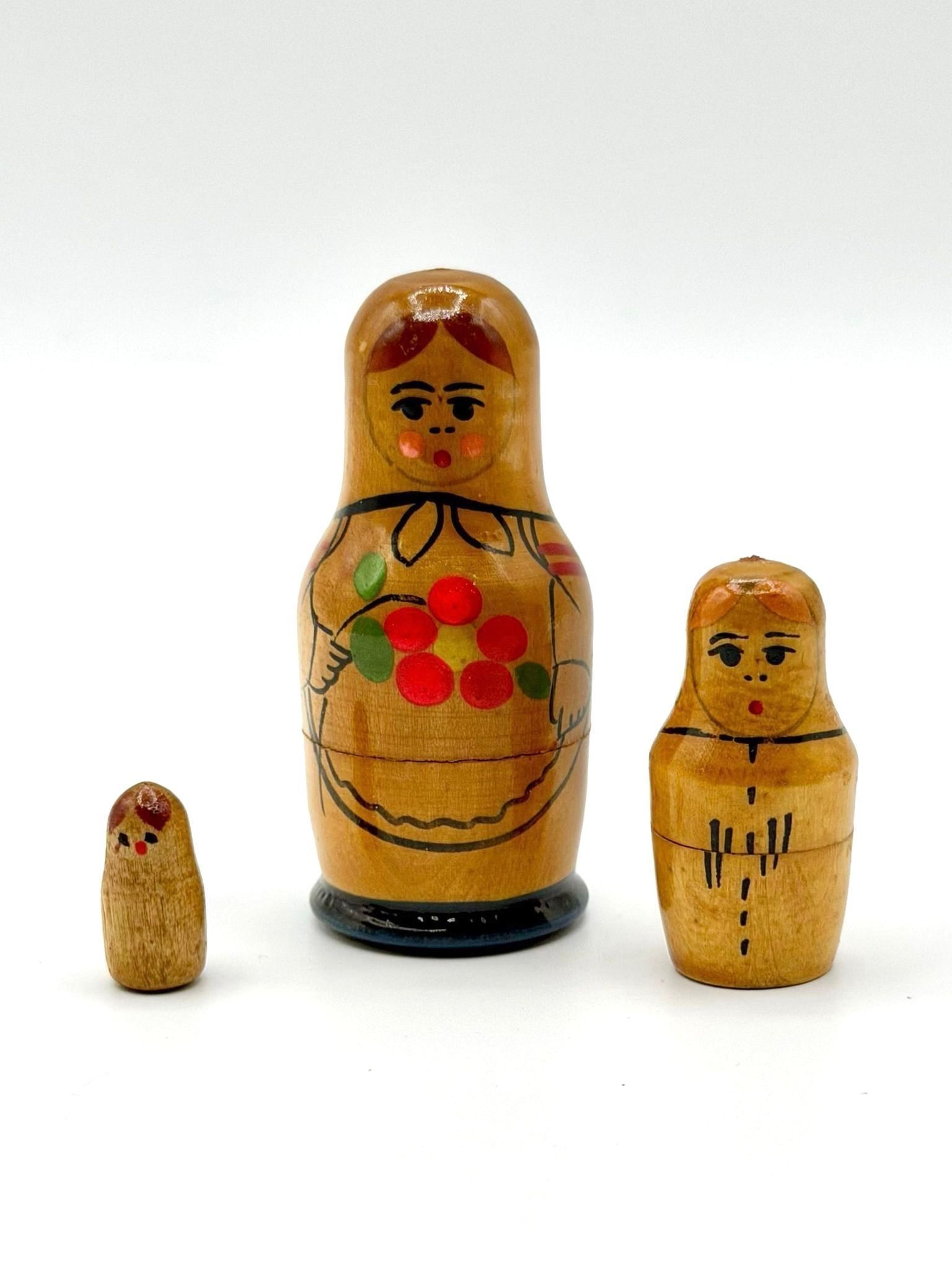
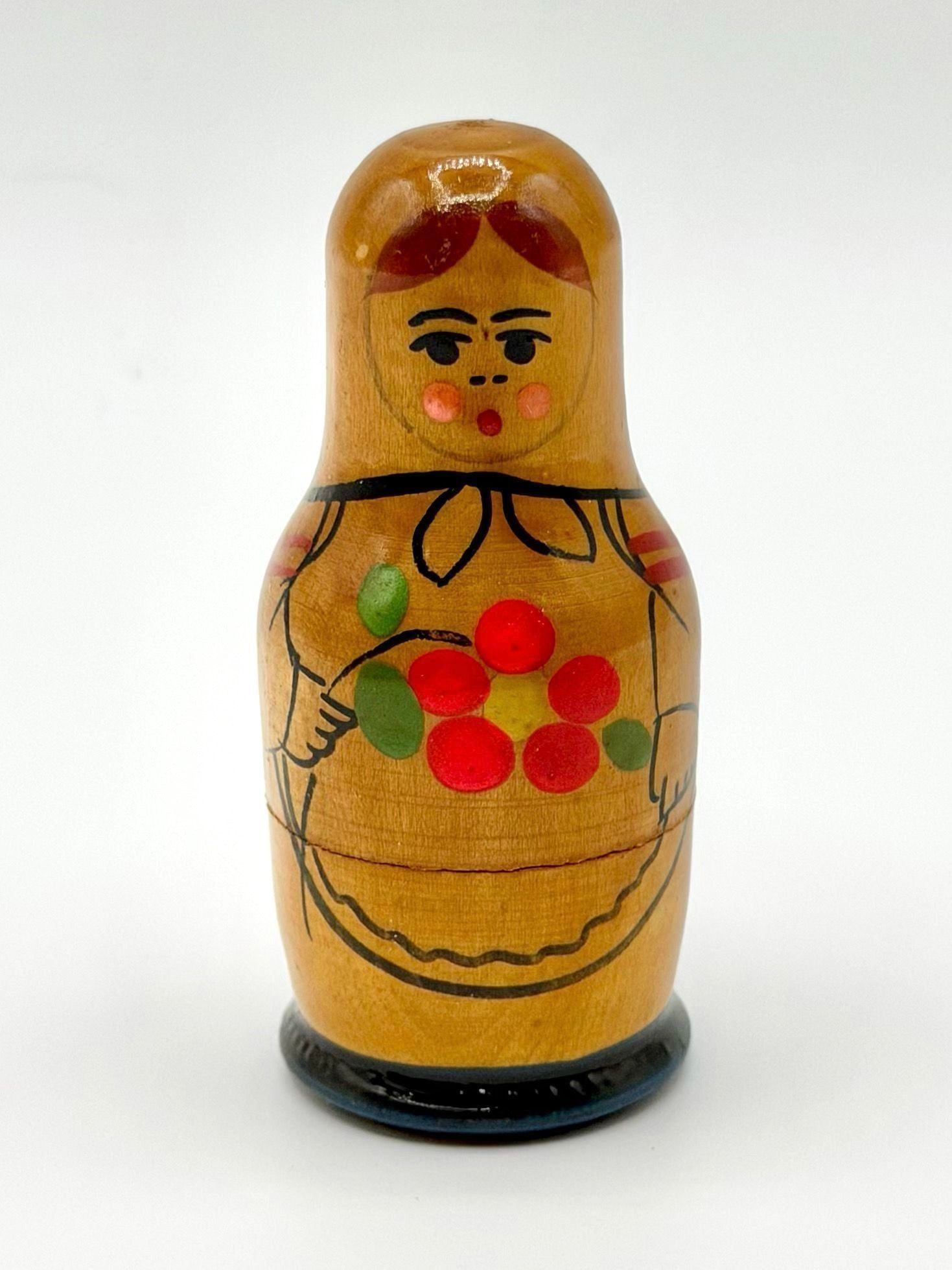
2025.25.19
María Teresa Cornide Hernández collection
2025.25
U.S.S.R.
Eastern Europe
Europe
Unattributed individual painter; mass-produced matryoshka at a Soviet wooden-toy workshop, most likely in the Semyonov region (Nizhny Novgorod Oblast) given the stylistic markers. Soviet-era matryoshkas were generally not signed by individual painters — production was organized through state artels and factories that consolidated formerly individual production after the 1920s–30s. In 1960, on the basis of a Soviet toy artel, the Zagorsk Toy Factory No. 1 was organized; each matryoshka was painted by hand, but the style was unified in accordance with state production standards. Estimated 1960s–1980s. The simplified, mass-produced character of the painting — characteristic of standardized Soviet-era factory production — places this set firmly within the post-1930s Soviet matryoshka tradition rather than the more individualistic pre-revolutionary or early-Soviet production. Without a stamped factory mark on the base (worth checking), a more precise date is not possible. ORIGIN: USSR (most likely Semyonov, Nizhny Novgorod Oblast, Russian SFSR, based on stylistic markers; alternatively Sergiyev Posad / Zagorsk, the other main matryoshka center)
Wood
MATERIALS: Wood (most likely linden / lipa — the standard matryoshka wood; possibly birch, which is characteristic of Semyonov dolls); applied paints (probably gouache or tempera); clear protective lacquer (the slight shine visible on the largest doll's surface suggests a varnish/lacquer finish). TECHNIQUES: Lathe-turned hollow wooden bodies (each doll split horizontally at the waistline into upper and lower halves with a fitted join); hand-painted decoration with line-drawn details and dot-cluster floral motif; clear lacquer finish; solid (non-opening) innermost doll.
Good
Maria T. Cornide Hernández
owner
Havana
Cuba
Caribbean
Central America
use
U.S.S.R.
Eastern Europe
Europe
production
The matryoshka (Russian Матрёшка, a diminutive of the female name Matryona) is the most internationally recognizable Russian/Soviet craft object — a set of hand-painted wooden dolls of decreasing size, designed to nest one inside another. The first Russian nesting doll was created in 1890 at the Children's Education Workshop on the Abramtsevo estate north of Moscow, reportedly inspired by a Japanese nested doll of the Shichi-Fukujin (Seven Lucky Gods) that a Russian monk had brought from a trip abroad. The first matryoshka was a wooden eight-piece set crafted by the toy-maker V. Zvezdochkin from sketches by the artist S. V. Malyutin, who painted it as a girl in a sundress, white apron, and colorful headscarf, holding a black rooster; she was named "Matryoshka" after the popular diminutive of "Matryona". In 1900, Russia exhibited various matryoshka styles at the Paris World Exhibition, where the dolls won a medal and many admirers; by 1911 matryoshkas were being sold in 14 countries; under the Soviet regime after 1930, the emphasis shifted to mass production of standardized nested dolls. The decoration of this set points strongly to the SEMYONOV (Семёновская) regional style rather than the Sergiyev Posad / Zagorsk style — the two main Russian matryoshka traditions. The Semyonov style features a bright yellow or gold background, a more elongated face, delicate eye details, and a large, lush bouquet of roses, daisies, and poppies that fills the entire center of the figure; the Semyonov matryoshka typically has more dolls than the Zagorsk matryoshka. By contrast, the Zagorsk style is "the most canonical, with a round, rosy face, a warm yellow-red background, large flowers on its sarafan, and a white apron." This Cabrera Arús set displays the Semyonov diagnostic features clearly: the natural yellow-wood ground (no white apron), the central flower-and-berry bouquet, the more elongated head, and the blue painted base. Semyonov matryoshka painting is connected with the traditional craft of Merinovo village near the town of Semyonov, in the Nizhny Novgorod region, and was influenced by the Khokhloma-style floral decoration tradition of that area. The typical Semyonov matryoshka, sometimes called "Red Roses," is crafted from birch wood (rather than the linden used by most other matryoshka centers), and depicts a woman with a kokoshnik headdress and a flower cluster as the central decorative motif. Most Soviet matryoshka sets contained 5, 7, or 10 nesting dolls — the canonical Russian "Matryoshka with seven dolls" being the iconic version. Most matryoshka sets contain from 3 to 12 dolls, though some can have many more. This 3-doll set is at the smallest end of the spectrum, indicating either a children's-toy version, a budget tourist-souvenir, or a "starter set" produced for the export market. The simplified painting on the inner dolls also supports the budget/export-grade interpretation. In Cuban Spanish, matryoshkas are called "muñecas rusas" (Russian dolls). They were among the most visible Soviet decorative objects in Cuban households of the 1960s–1980s — alongside Soviet samovars (less common), Soviet glassware, Khokhloma-painted wooden spoons, and other Russian craft objects. They arrived in Cuba through multiple channels: as gifts from Soviet advisors and engineers stationed in Cuba; as souvenirs brought back by Cuban travelers from study trips, conferences, and technical-assistance visits to the USSR; as gifts between Cuban students attending Soviet universities and their host families.