
"Slava" Soviet Tourist Pork Luncheon Meat — Empty Can (340 g)
Object/Artifact
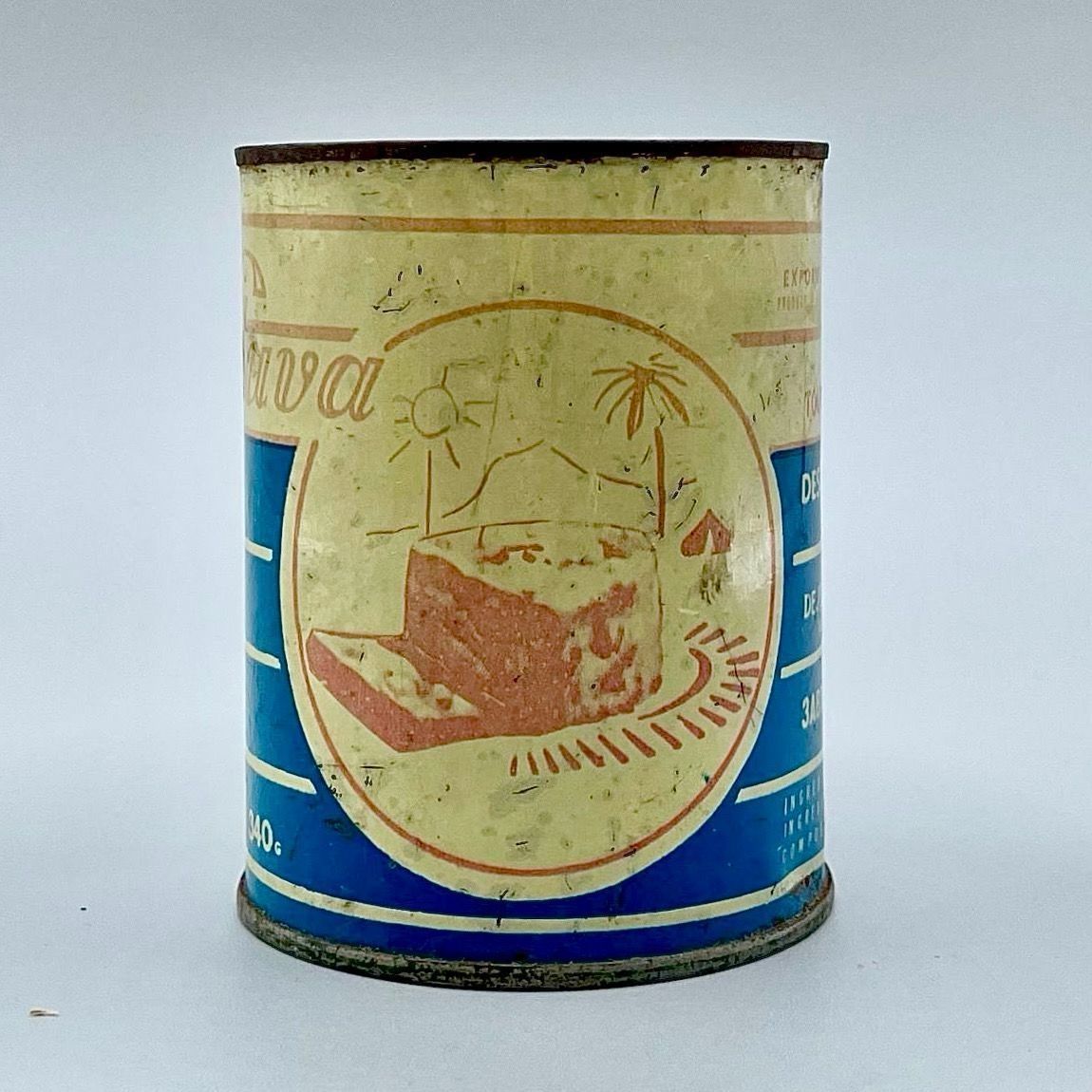
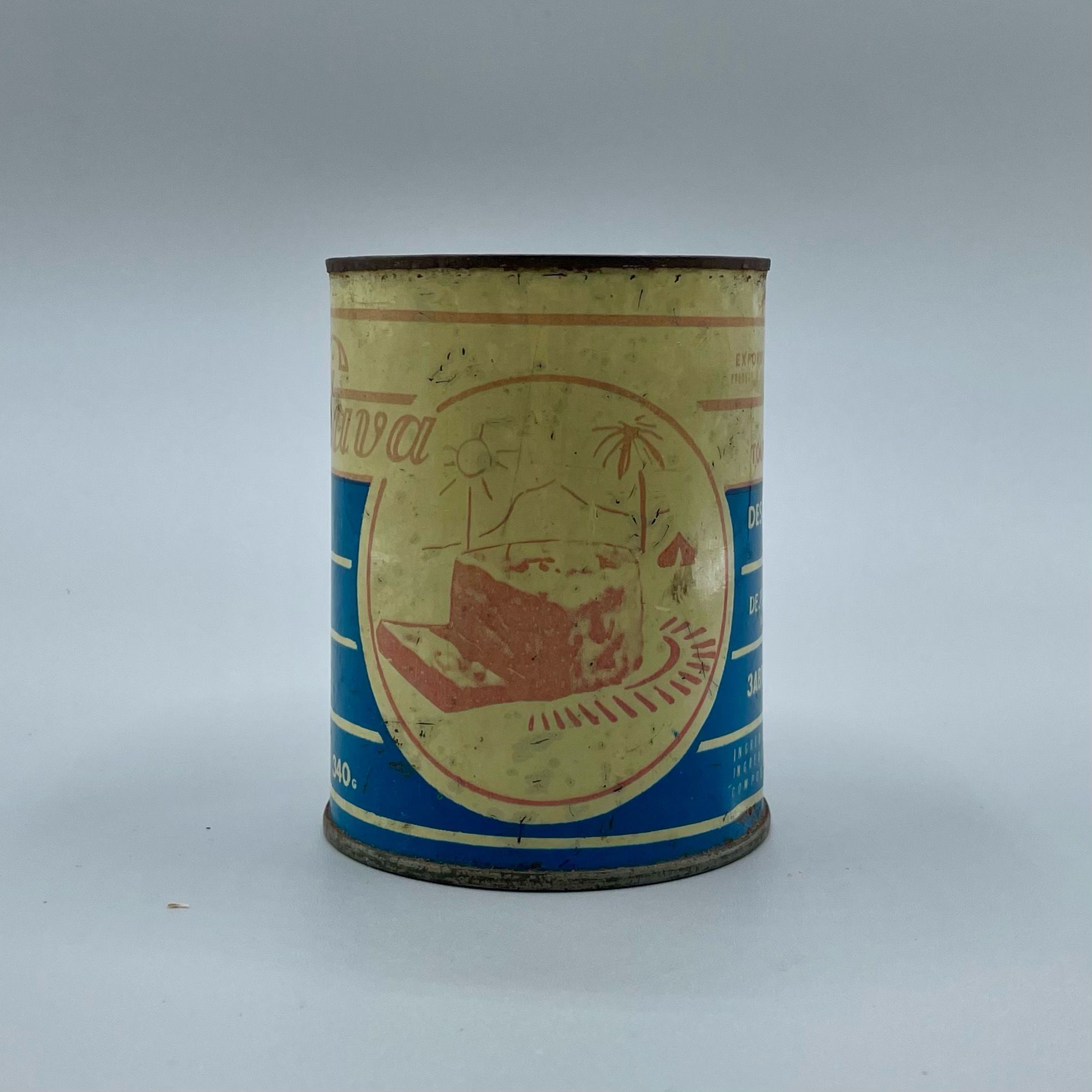
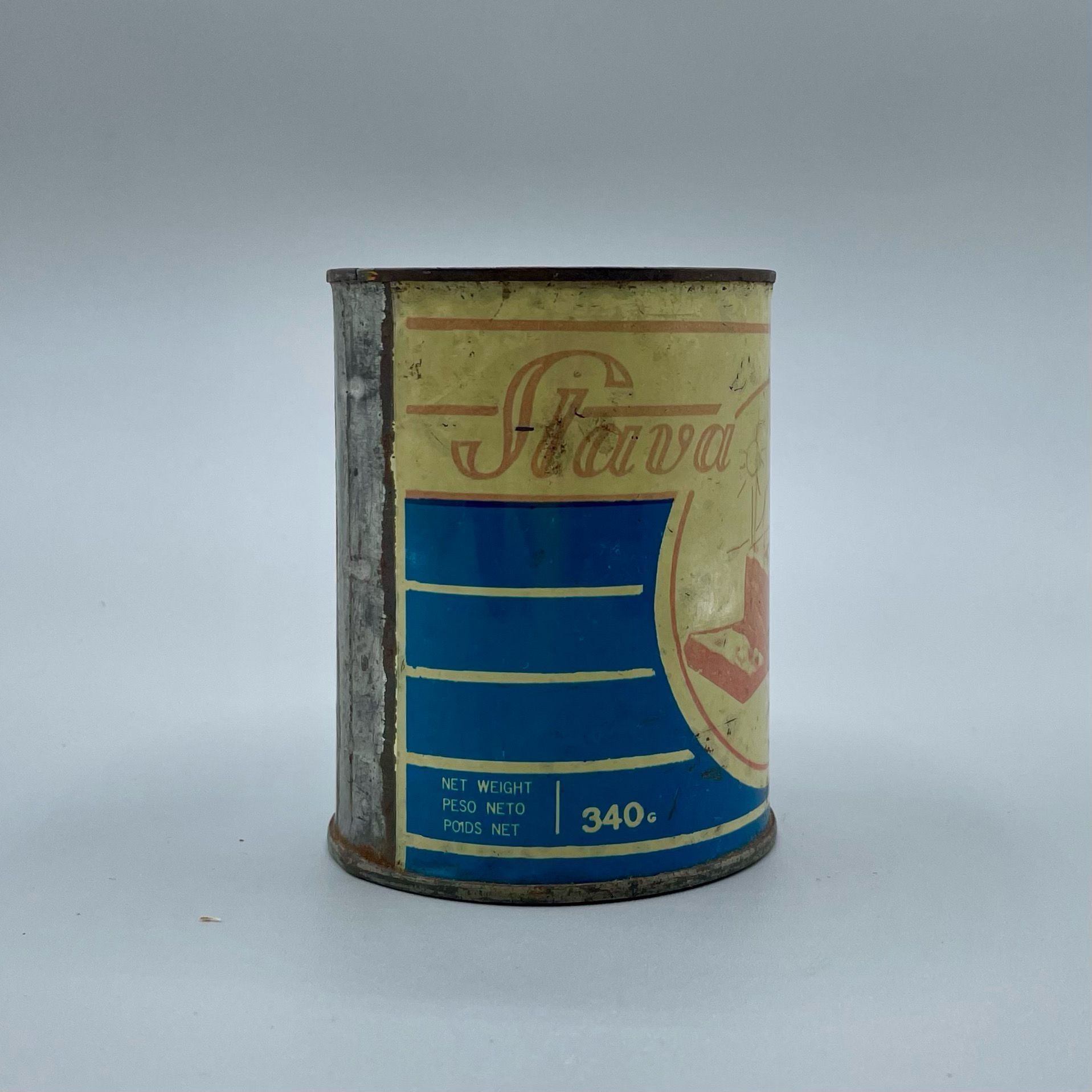
SUMMARY: An empty tin can of Soviet "Slava" brand "tourist pork luncheon meat," 340 g net weight, with trilingual English/Spanish/French labeling marking it as an export product. Manufactured in the USSR for the Soviet "tourist" food category and exported to socialist allies including Cuba. DESCRIPTION: A cylindrical tin can of small luncheon-meat / sardine-can proportions (typical for the 300–340 g format of Soviet tushonka and luncheon-meat products). The body is printed with label in a yellow-and-blue color scheme: Upper portion (yellow ground): A wide horizontal band carries the brand name "Slava" in red script (the Latin transliteration of Russian Слава, meaning "Glory"). Below the brand-name band, a large circular medallion fills most of the front face: yellow ground with a red border, showing a stylized "tourist" travel scene — at left, a tall palm tree; at right, a mountain); at center, the canned meat itself. A small radiant sun or burst element appears above the structure. Around the medallion's rim, faded text reads "EXPORT" and continues with product-description elements ("Tourist pork luncheon meat" and the net-weight specification). Lower portion (blue ground): A second wide horizontal band in blue, with cream/yellow rule lines bordering it top and bottom. The blue panel carries text in horizontal stripes, including the multi-line trilingual net-weight statement at lower right: "NET WEIGHT / PESO NETO / POIDS NET / 340 g" — English, Spanish, French. A blank cream/yellow side panel on the right edge runs vertically, carrying additional regulatory text. The brand name "Slava" appears again as a repeated script wordmark across the top of the label. The can is empty.
2025.11.66
2025.11
Purchase
U.S.S.R.
Eastern Europe
Europe
Unidentified Soviet state food-processing enterprise under the USSR Ministry of Food Industry. Soviet canned meat was produced at multiple state meat-processing combines distributed across the Soviet republics; the specific producing combine would normally be indicated by a small numeric code stamped on the can lid or base (a three-letter code indicating the republic, plant number, and shift). ORIGIN: USSR (Soviet Union; specific producing republic unknown — possibly Russian SFSR, Ukrainian SSR, or Belarusian SSR, the main canned-meat producers)
Front face (transcribed): - "Slava" (brand name, in red script — Latin transliteration of Russian Слава, "Glory") - Within / around the circular medallion: "EXPORT" and "TOURIST PORK LUNCHEON MEAT" (the existing record notes a typo "lungheon" on the can — a common Soviet-export English misspelling worth confirming on close inspection) - "340 g" / "340 grams" net weight indicated in the medallion border Lower (blue) panel: - "NET WEIGHT" (English) - "PESO NETO" (Spanish) - "POIDS NET" (French) - "340 g" Right side panel: additional text (producer attribution, country of origin "Made in USSR," and ingredients statement — please confirm by close inspection) Languages on packaging: English, Spanish, French (trilingual — the standard Soviet export-label scheme for non-Russian-speaking markets, including Latin America)
tin
Fair
U.S.S.R.
Eastern Europe
Europe
Production
This empty can is a material trace of one of the most culturally resonant Soviet-Cuban consumer relationships of the twentieth century: the everyday presence of Soviet canned meat in the Cuban household diet. Throughout the years leading up to the Special Period (1986–1988), the second-highest food import coming to Cuba from COMECON members was canned meat, and 63% of these food imports were directly supplied by Russia/USSR. From 1968 until the dissolution of the Soviet Union, rationed Soviet canned meat consumption continued to be a staple at the Cuban dinner table (https://mundanemilitarisms.com/jess/jess_canned_meat.html). In Cuban memory, carne rusa was ubiquitous — served in cafeterias, schools, and workplaces, integrated within the Cuban diet, hardly identifiable as exotic. While most recall that carne rusa was purchasable por la libre (at regular stores), some also recall that it was offered on the libreta (the rationing card) at certain points (https://cubacounterpoints.com/archives/1959.html). The "Slava" brand is one specific Soviet brand within this broader carne-rusa category. The specific designation "Tourist pork luncheon meat" places this product within a documented Soviet food category. Tushonka (Russian тушёнка, from "to braise") is a canned stewed meat especially popular in Russia and the former Eastern Bloc; for the people of the Soviet Union, tushonka was a part of military and tourist food supplies; at some extreme periods of time it could be bought only with food stamps (https://en.wikipedia.org/wiki/Tushonka). The "tourist" branding meant products formulated for hikers, campers, and travelers — shelf-stable, calorie-dense, portable. The export-marked "Slava" can is therefore a Soviet "tourist food" product also exported to socialist allies. The tourist iconography on the label (palm tree, pyramidal or arched architectural element, sun) reinforces the "exotic warm destination" theme — the visual register of Soviet tourist imagery directed at warm-climate destinations (Crimea, the Caucasus, Central Asia, and by extension export markets like Cuba). "Slava" is the Latin-script transliteration of Russian Слава (Glory). It was a relatively common brand-name choice in Soviet export consumer goods, evoking Soviet patriotic/heroic vocabulary while being pronounceable for non-Russian-speaking markets. ("Slava" was also famously the name of a Soviet wristwatch brand, a Soviet champagne, and various other consumer-goods brands — the same word does not indicate the same producer.) Soviet products — canned meat, peas, Russian nesting dolls — for Cubans mark "a moment of access to different kinds of worldly goods, a period of generosity, largesse from the Soviet Union," as the literary scholar Jacqueline Loss has written (https://theworld.org/stories/2015/01/27/russiacubagn). The disappearance of carne rusa after 1991 (the Soviet Union's dissolution coinciding with the start of Cuba's Período Especial) made it a deeply nostalgic object in Cuban memory. Today in Miami's Cuban-American communities, carne rusa is among the most sought-after products in Russian-Cuban specialty stores, alongside Soviet perfumes and Russian crafts — a vehicle for "ostalgia," the nostalgia specifically for the Eastern (Ost) past (https://theworld.org/stories/2015/01/27/russiacubagn).