
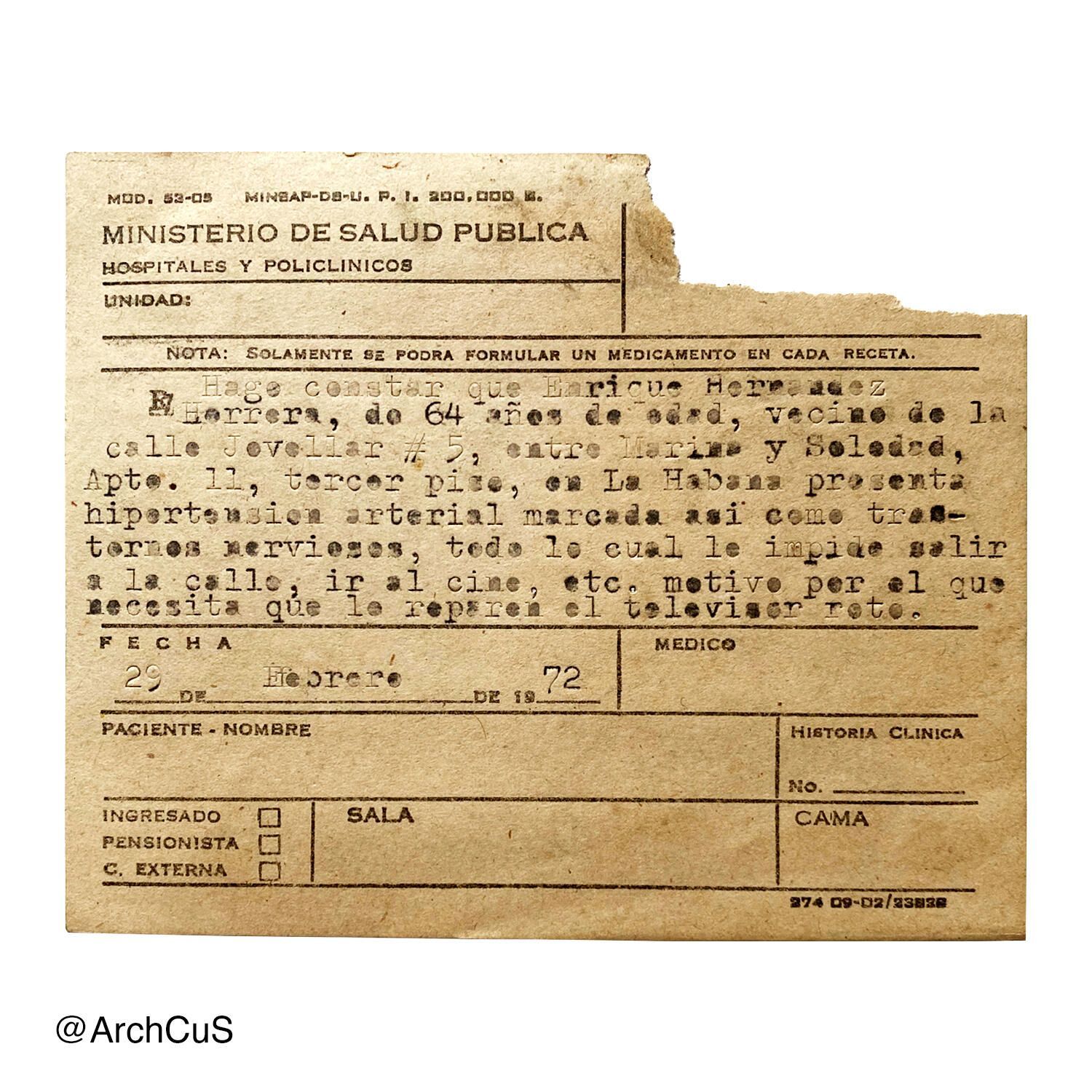
MINSAP Mod. 53-05, completed — physician's certificate requesting a television repair
Object/Artifact
A single small sheet of a pre-printed Cuban public-health form (a prescription/clinical slip), completed by typewriter. The printed structure includes a ministry header, a "UNIDAD" line, a printed notice about prescriptions, a free-text body, and a footer grid of fields (date, physician, patient name, clinical-history number, admission-status checkboxes, ward, bed). The typed body is not a drug prescription but a signed-style certifying statement: it attests that a 64-year-old male patient, resident at a Havana address, suffers from marked arterial hypertension and nervous disorders that keep him from going out (including to the cinema), and that he therefore needs his broken television set repaired. The footer is dated by typewriter. The upper-right corner is torn away with paper loss.
2025.1.193
Filled and archived by Leopoldo Arús Gálvez
The Cabrera Arús family collection
Leopoldo Arús Gálvez collection
2025.1
Leopoldo Arús Gálvez
1972
1970s
Havana
Cuba
Caribbean
Central America
Modelo 53-05
Maker: Pre-printed form issued by the Ministerio de Salud Pública (MINSAP), Cuba (Hospitales y Policlínicos). Completed by Leopoldo Arús Gálvez. Date: 29 February 1972 (typed in the FECHA field). Note: 1972 was a leap year, so the date is valid as written.
Inscription
surface
MOD. 52-05 MINSAP-DS-U. P. I. 200,000 K. MINISTERIO DE SALUD PUBLICA HOSPITALES Y POLICLINICOS UNIDAD: NOTA: SOLAMENTE SE PODRA FORMULAR UN MEDICAMENTO EN CADA RECETA FECHA MEDICO PACIENTE-NOMBRE HISTORIA CLINICA No. INGRESADO PENSIONISTA C. EXTERNA SALA CAMA 274 09-D2/23838
Spanish
MOD. 52-05 MINSAP-DS-U. P. I. 200,000 K. MINISTRY OF PUBLIC HEALTH HOSPITALS AND POLYCLINICS UNIT: NOTE: ONLY ONE DRUG MAY BE FORMULATED ON EACH PRESCRIPTION. DATE PHYSICIAN PATIENT-NAME MEDICAL HISTORY No. ADMITTED PENSIONER EXTERNAL ROOM BED 274 09-D2/23838
Ink
Note
surface
Hago constar que Enrique Hernandez Herrera, de 64 años de edad, vecino de la calle Jovellar #5, entre Marina y Soledad, Apto. 11, tercer piso, en La Habana presenta hipertensión arterial marcada así como trastornos nerviosos, todo lo cual le impide salir a la calle, ir al cine, etc. motivo por el que necesita que le reparen el televisor roto. 29 de Febrero de 1972
Spanish
I hereby state that Enrique Hernandez Herrera, of 64 years of age, resident of Jovellar Street #5, between Marina and Soledad, Apt. 11, third floor, in Havana, presents marked arterial hypertension as well as nervous disorders, all of which prevents him from going out in the street, to the movies, etc., which is why he needs to have his broken television set repaired. February 29, 1972
Printed
typed
Printed (header): "MOD. 53-05 MINSAP-DS-U. P.I. 200,000 E." / "MINISTERIO DE SALUD PUBLICA" / "HOSPITALES Y POLICLINICOS" / "UNIDAD:". Printed (notice): a statement that only one medication may be prescribed per prescription. Printed (footer field labels): "FECHA," "MEDICO," "PACIENTE – NOMBRE," "HISTORIA CLINICA No.," "INGRESADO / PENSIONISTA / C. EXTERNA" (checkboxes), "SALA," "CAMA." Printed (bottom-right code): "274 09-02/23838" (approximate; partly indistinct). Typewritten: the certifying narrative (paraphrased above; full verbatim transcription available on request) and the date "29 de Febrero de 1972." Footer patient/ward/bed fields appear left blank.
1
Paper
Materials: Low-grade wood-pulp paper (browned); typewriter ribbon ink; letterpress-printed form. Technique: Letterpress-printed form completed with a manual typewriter.
Fair
Leopoldo Arús Gálvez
owner, creation
Havana
Cuba
Caribbean
Central America
creation
The document is a striking example of bureaucratic improvisation under conditions of scarce goods and services: an official medical form is repurposed to manufacture a health justification for prioritizing a household television repair. The logic — that the patient's confinement at home (unable to go out or to the cinema) makes a working TV a quasi-medical necessity — illustrates how official documentation was mobilized to resolver everyday problems. Although 1972 predates the Período Especial, it reflects the same broader culture of paperwork-based workarounds for limited consumer services.