
Jupiter-9 (Юпитер-9) 85mm f/2 Soviet Camera Lens
Object/Artifact
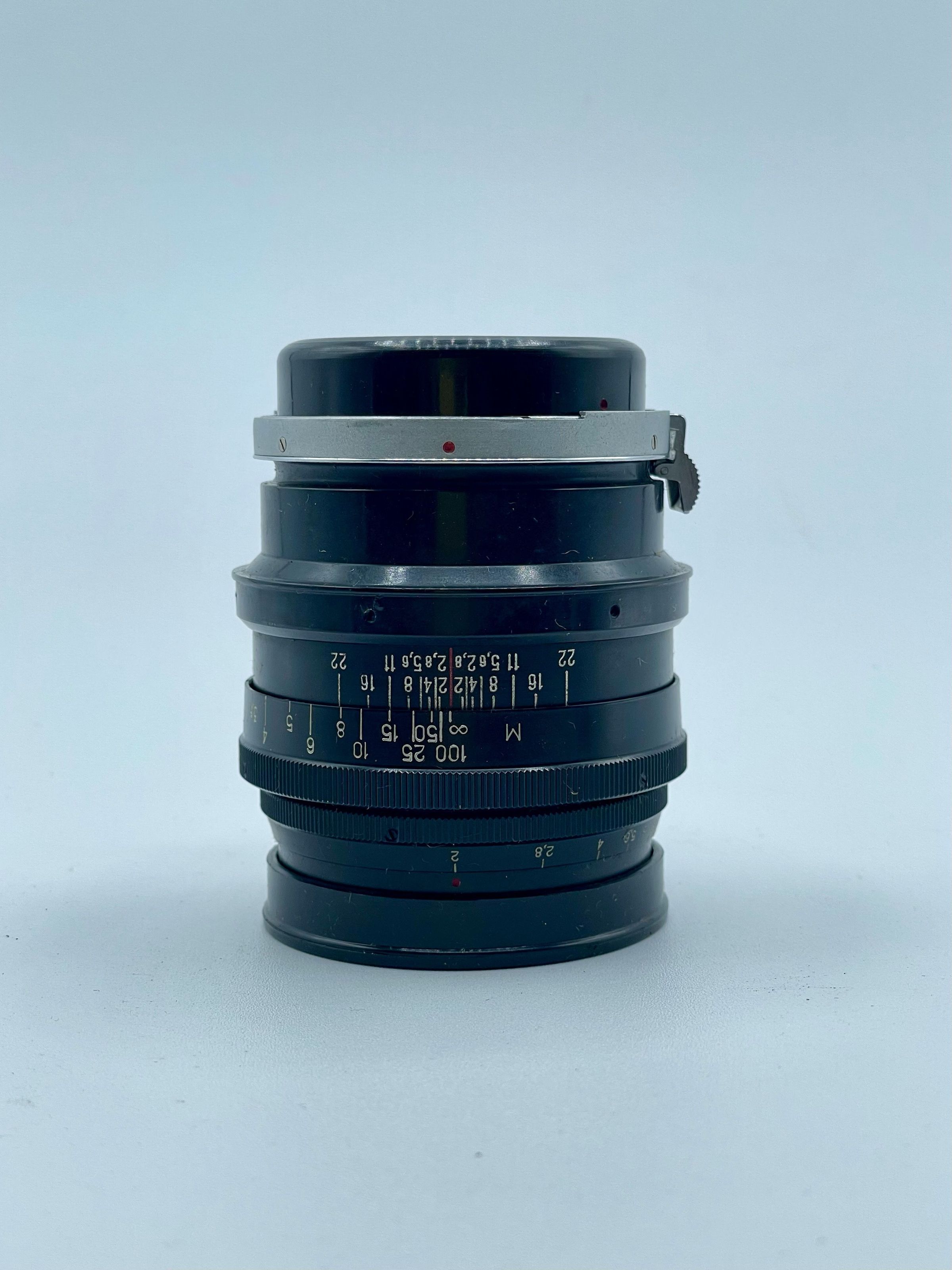
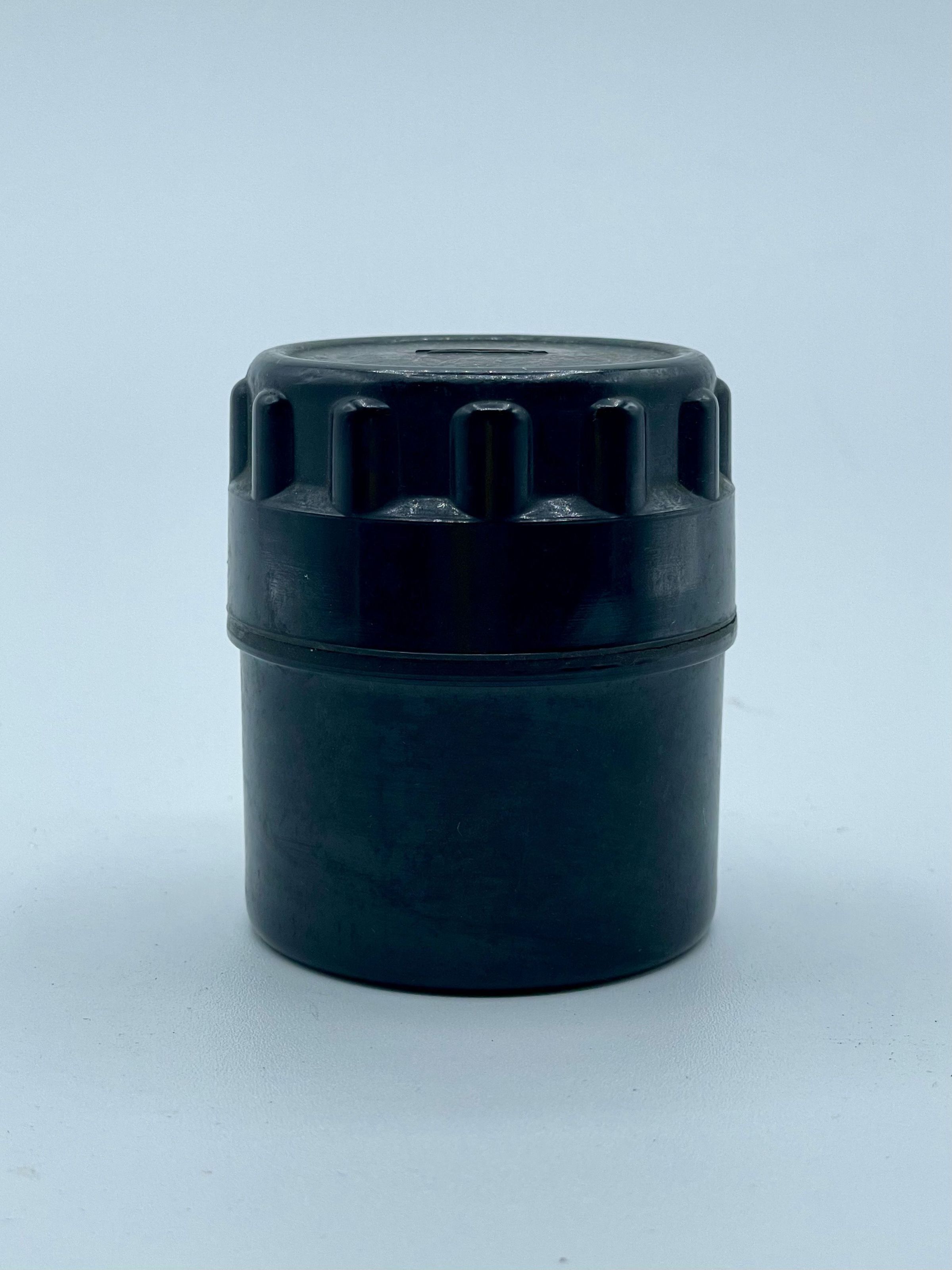
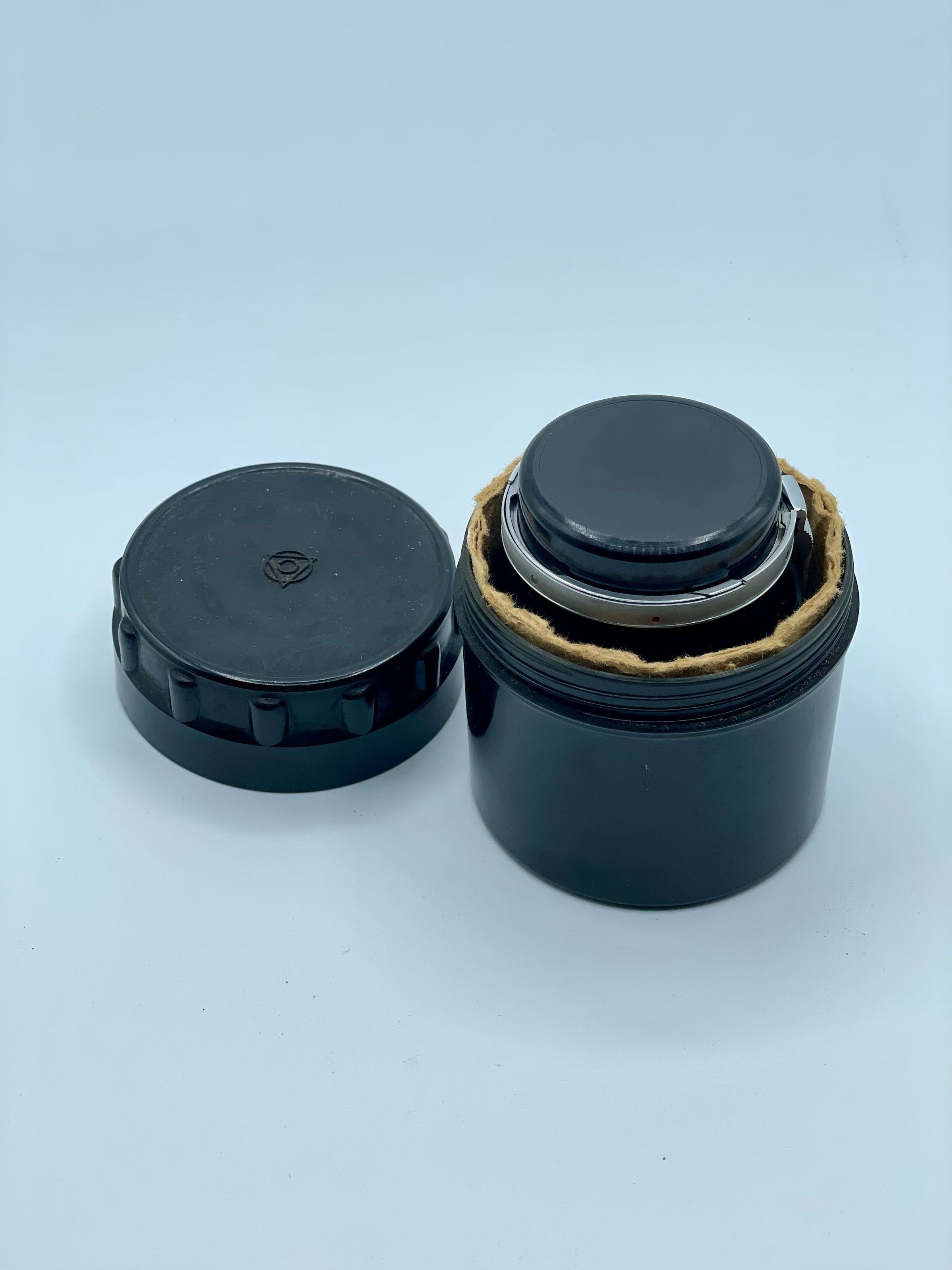
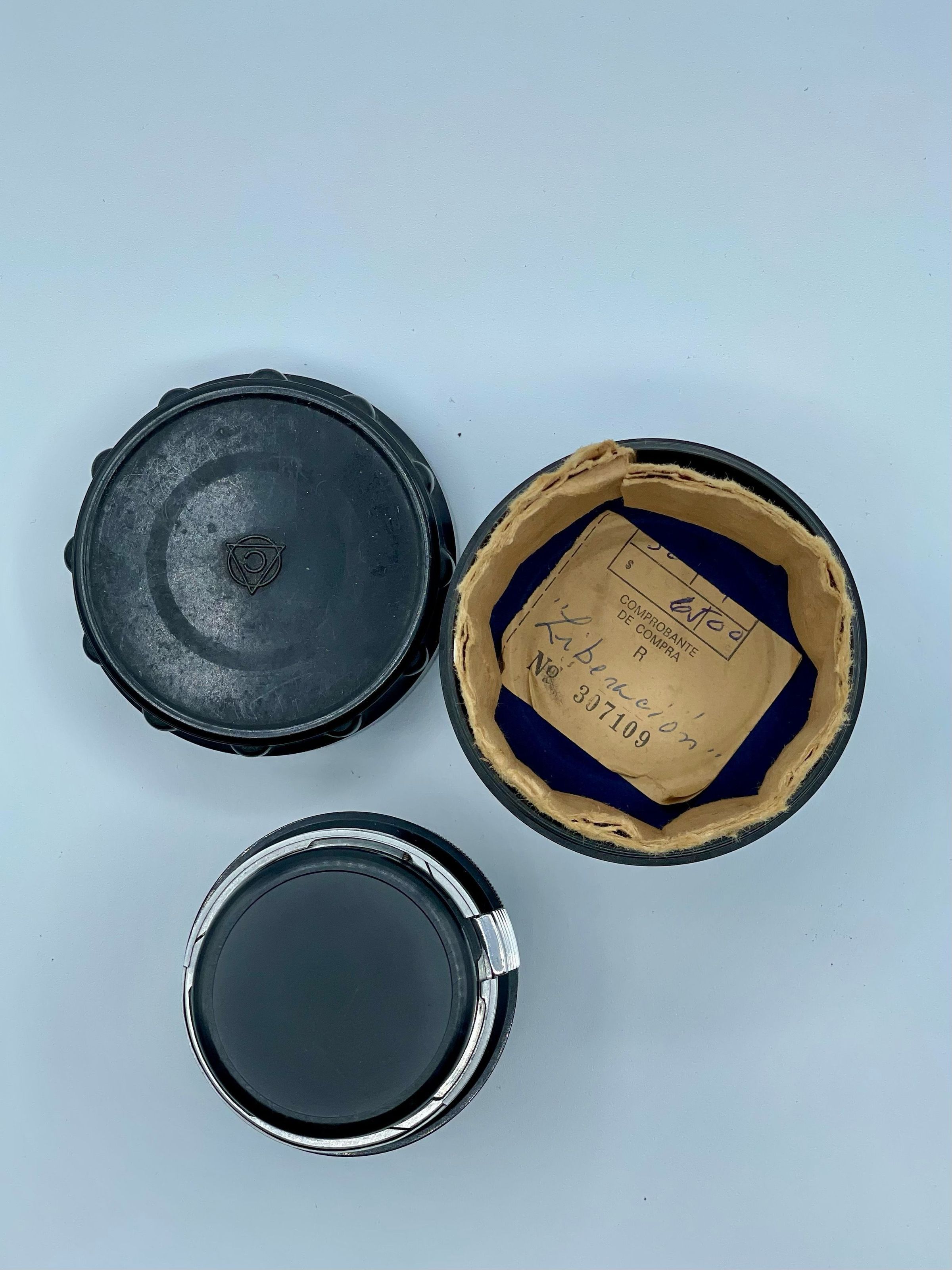
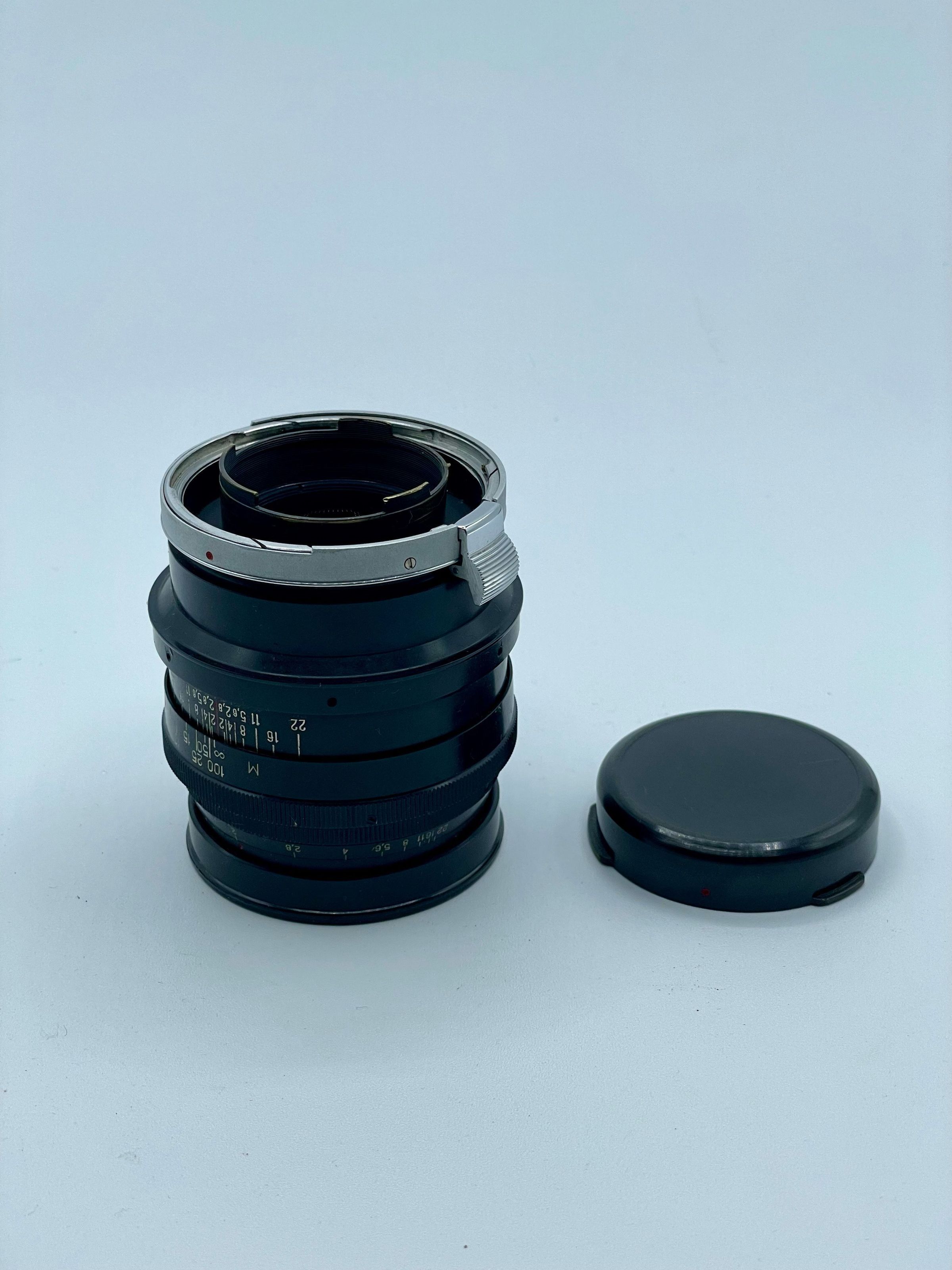
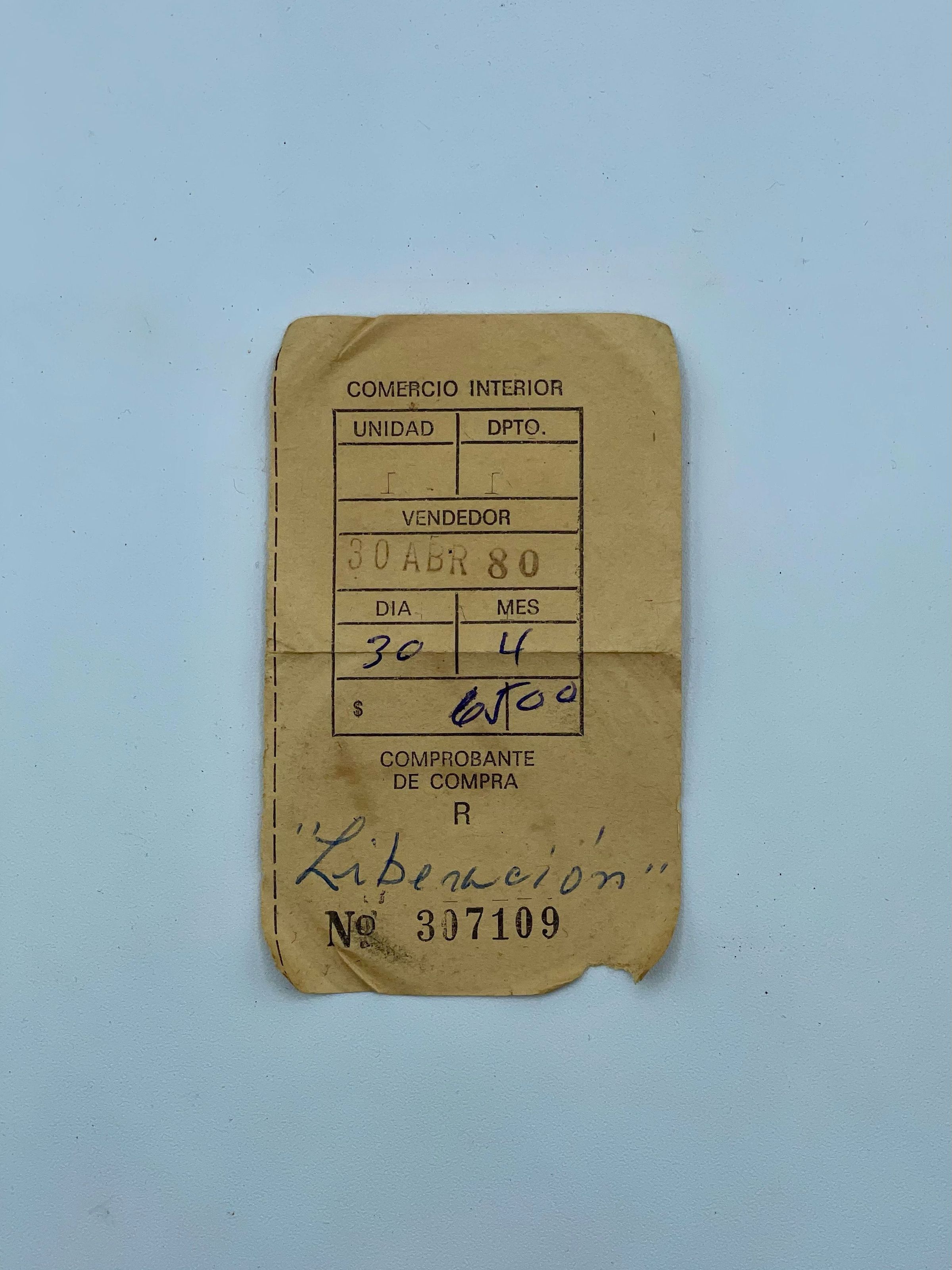
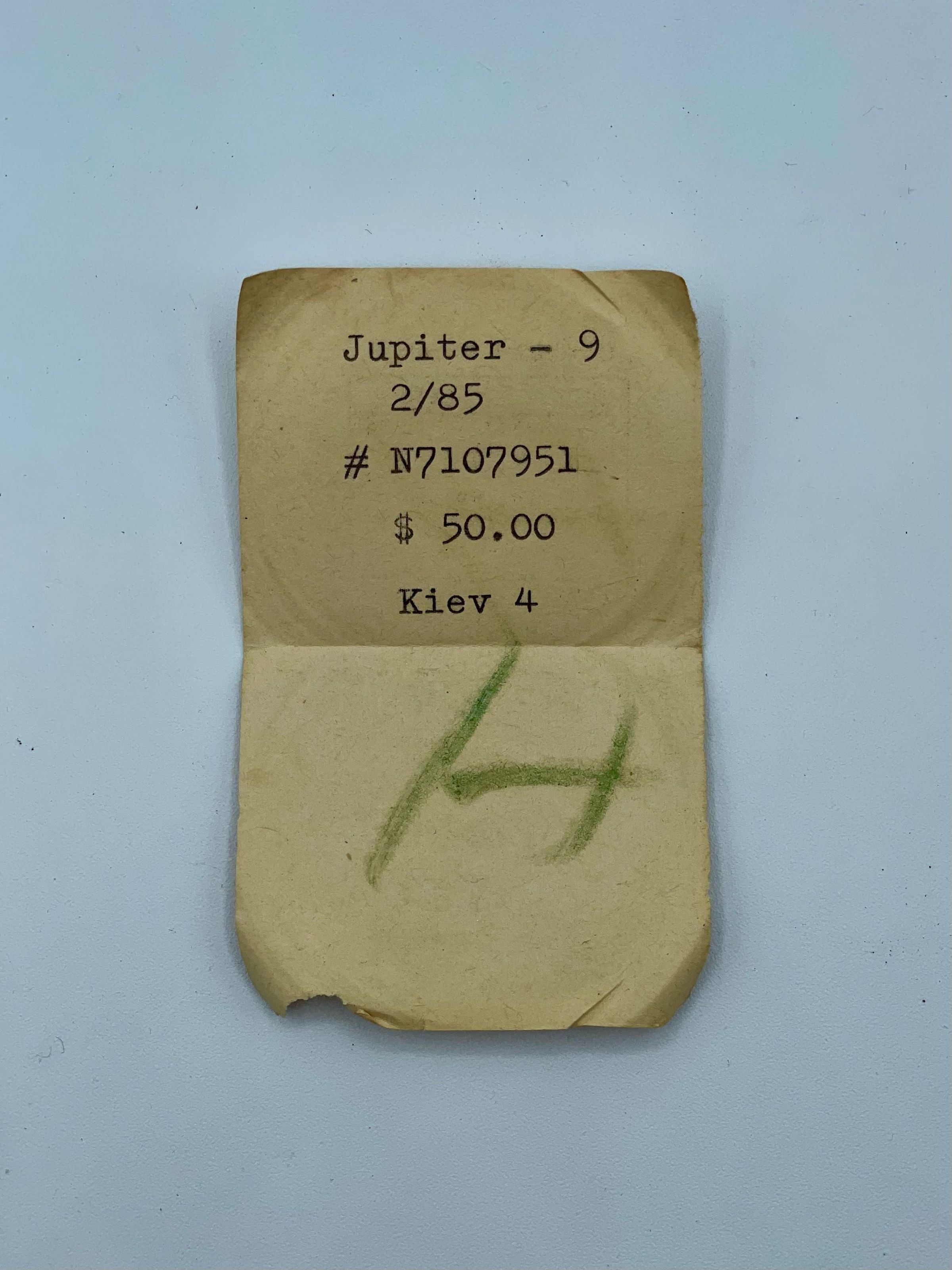
A black-finish LZOS Jupiter-9 (Юпитер-9) 85mm f/2 telephoto/portrait lens in Kiev (Contax bayonet) mount, manufactured in the USSR c. 1971; complete with original cylindrical hard-plastic storage case, front and rear caps, and a typed owner's identification label on a re-used 1980 Cuban retail receipt. A short, heavy cylindrical camera lens in black metal with a polished aluminum/chrome top section housing the Kiev/Contax-type bayonet mount. The body is finished in black enamel or black anodized metal, with engraved white scales for aperture and focus distance. The lens has multiple knurled control rings for focus and aperture. The classic 1960s–1970s LZOS Jupiter-9 form: short, dense, and unmistakably Soviet in build quality and machining character. The lens is accompanied by: - A small flat black plastic front lens cap (push-on style) - A black plastic rear cap for the Kiev/Contax mount, with the small triangular LZOS factory logo embossed on its underside - An original cylindrical hard-plastic two-piece storage case in black (vertically-ribbed cap unscrewing from a smooth cylindrical base), lined inside with brown kraft paper or thick cardboard padding - A typed owner's identification label (typewritten on the back of a Cuban retail receipt) - The Cuban retail receipt that backs the typed label, dated April 30, 1980
 Jupiter-9 (Юпитер-9) 85mm f/2 Soviet Camera Lens
 Jupiter-9 (Юпитер-9) 85mm f/2 Soviet Camera Lens - Image 2
 Jupiter-9 (Юпитер-9) 85mm f/2 Soviet Camera Lens - Image 3
 Jupiter-9 (Юпитер-9) 85mm f/2 Soviet Camera Lens - Image 4
 Jupiter-9 (Юпитер-9) 85mm f/2 Soviet Camera Lens - Image 5
 Jupiter-9 (Юпитер-9) 85mm f/2 Soviet Camera Lens - Image 6
 Jupiter-9 (Юпитер-9) 85mm f/2 Soviet Camera Lens - Image 7
2025.1.11
tographic equipment of Leopoldo Arús Gálvez
The Cabrera Arús family collection
Leopoldo Arús Gálvez collection
2025.1
Bought by Leopoldo Arús Gálvez
LZOS
1971
1970s
Lytkarino
Moscow Oblast
Eastern Europe
U.S.S.R.
Europe
Jupiter-9. PT7580
The sales receipt inside was not original. Purchasing info typed by owner in the back of the receipt.
On the lens body: - Focus-distance scale (white engraved figures): "100 25 10 5 / 50 15 8 6 ... ∞ M" — note the "M" for метры (meters) - Aperture scale (white engraved figures): "11 5.6 2.8 2 / 16 8 4 2.8 5.6 11 / 22 ... 22" — the duplicated aperture scale on the depth-of-field markings is a characteristic of preset/double-ring aperture lenses On the rear cap: Small triangular embossed logo at the center — this is the LZOS factory mark (a stylized triangle, sometimes described as "the eye"). Confirms LZOS as the maker. On the typed owner's label: "Jupiter - 9 2/85 # N7107951 Kiev 4 $50.00" With a handwritten green-pencil mark resembling "H" below Decoding: - "Jupiter - 9" = lens model - "2/85" = f/2 maximum aperture, 85mm focal length (German-style notation, standard for Soviet lens labels) - "# N7107951" = serial number. In Soviet equipment, the first two digits of the serial number give the last two digits of the manufacturing year — so "71" = manufactured in 1971. - "Kiev 4" = the camera body the lens was paired with (Kiev 4, the standard Soviet rangefinder of the period, a copy of the prewar Contax II) - "$50.00" = the owner's typed valuation/price notation (discrepant with the receipt — see below) On the Cuban retail receipt: - Header: "COMERCIO INTERIOR" (Cuban Ministry of Internal Commerce) - Date stamp: "30 ABR 80" = April 30, 1980 - Handwritten date in cells: "DIA 30 / MES 4" (= day 30, month 4 = April 30) - Price: "$65.00" (sixty-five Cuban pesos) - "COMPROBANTE DE COMPRA R" (purchase receipt, retail copy) - Handwritten store name in cursive: "Liberación" - Receipt number: "Nº 307109"
- Lens: machined metal (aluminum and brass alloys typical of LZOS construction), optical glass, black anodized/enameled finish - Case: hard thermoset plastic (Bakelite-family) or rigid thermoplastic - Caps: rigid plastic (front cap appears thin and flexible; rear cap thicker, stamped/molded) - Receipt and label: paper (kraft-style stock for the receipt; typewriter ink for the label text) TECHNIQUES: - Lens: precision-machined metal components with engraved scales; ground and polished optical glass elements; black anodizing/enameling - Case: two-part screw-thread cylindrical container, injection or compression molded - Label: typewriter-typed text on paper
Very Good
Leopoldo Arús Gálvez
owner
LZOS
producer
Havana
Cuba
Caribbean
Central America
purchase
Lytkarino
Moscow Oblast
Eastern Europe
U.S.S.R.
Europe
production
The Jupiter-9 (Юпитер-9, "Yupiter-9") is one of the most famous Soviet portrait lenses. Its optical formula — 7 elements in 3 groups (one front element plus two cemented triplets) with a 15-blade aperture — is a direct copy of the prewar Carl Zeiss Sonnar 85mm f/2 (designed by Ludwig Bertele in the 1930s). The design was transferred to the Soviet Union after World War II under reparations agreements, along with much of the Zeiss Jena production equipment. Production began at KMZ (Krasnogorsk Mechanical Works) in 1948 under the designation "ZK" (Sonnar-Krasnogorsk); the lens was renamed Jupiter-9 in 1951. After the 1960s, production was consolidated at LZOS (Lytkarino Optical Glass Plant), where this example was made. Mount variants were produced for several Soviet camera systems: - M39 thread for Zorki and Fed rangefinders - Kiev/Contax bayonet for Kiev rangefinders (Kiev 2/3/4/5) - M42 screw for Zenit SLRs and the broader M42 ecosystem - Kiev-Automat bayonet (no aperture ring) for Kiev-10/Kiev-15 SLRs This example is the Kiev/Contax bayonet variant, identifiable by the silver mount visible at the top of the lens body in image 1, and confirmed by the owner's "Kiev 4" annotation. Soviet optical manufacturing used a transparent serial-number system in which the first two digits encode the last two digits of the production year. This lens serial N7107951 decodes as: N (likely a factory or batch prefix) — 71 (= 1971) — 07951 (sequence number within the year, suggesting this was unit 7,951 produced in 1971). This places the lens in the early-to-mid LZOS black-finish era. The earlier silver/aluminum finish was phased out by the late 1960s. Among photographers, the Jupiter-9 is prized — even at a discount to its Zeiss original — for the same qualities that made the Sonnar 85/2 famous: a beautiful rendering of out-of-focus areas (the celebrated Sonnar bokeh), warm color rendition, and an unmistakable "vintage" character. The 15-blade aperture (compared to the 5–9 blades typical of modern lenses) produces an unusually circular and smooth out-of-focus highlight, which is the technical basis for the lens's painterly look. The lens has experienced a strong renaissance in the digital era, with mirrorless adapters making Soviet lenses easy to use on contemporary cameras, and it remains a sought-after collector item today. The black two-piece cylindrical case is the standard Soviet hard-plastic lens case of the period — sometimes referred to as a "ZOMZ case" after the Zagorsky Optical-Mechanical Plant (Загорский оптико-механический завод), which produced these cases as standard packaging for several Soviet optical manufacturers including LZOS. The kraft-paper or cardboard interior padding protected the lens against rattling and impact during transport — important given that Soviet retail distribution often involved long-distance shipping under rough conditions. The Cuban receipt is where the object becomes particularly interesting as Cuban material culture. The receipt is from "Liberación," a Cuban state-retail establishment in Havana, dated April 30, 1980, totaling 65 pesos in Cuban pesos. It bears the standard "COMERCIO INTERIOR" header — the Cuban Ministry of Internal Commerce (MINCIN) under which all state-retail outlets operated. However, a different purchasing info was typed by owner in the back of the receipt. This means: - The April 30, 1980 / 65-peso receipt does NOT document the lens's purchase by Leopoldo Arús Gálvez. - The typed "$50.00" in Leopoldo's own notation is probably the resell price he paid for the lens in the informal market (on February 1985).