
LP record "La canción, un arma de la revolución" — Movimiento de la Nueva Trova (Areíto/EGREM 12″ 33⅓ rpm LP, LDA-3464)
Audio Recording
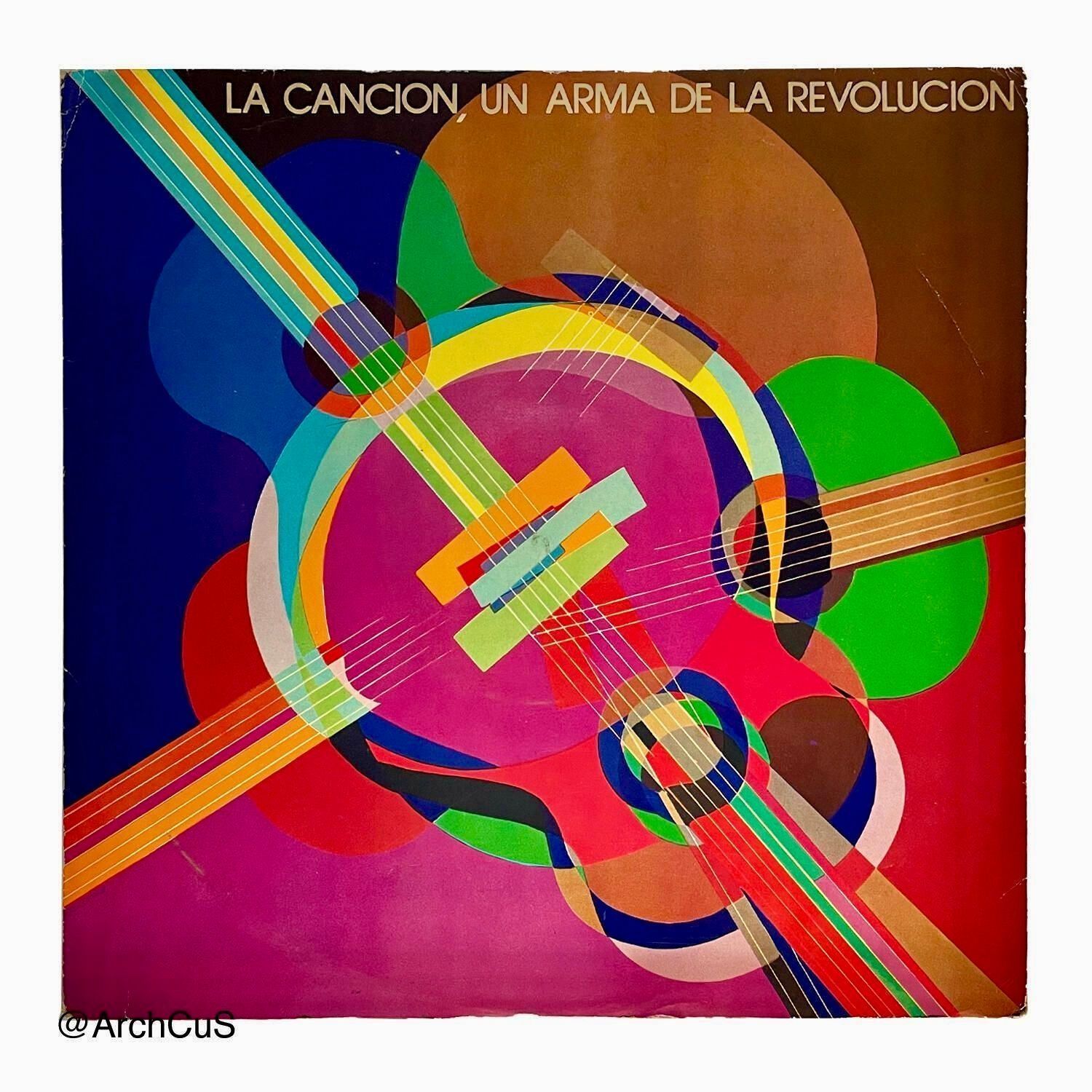
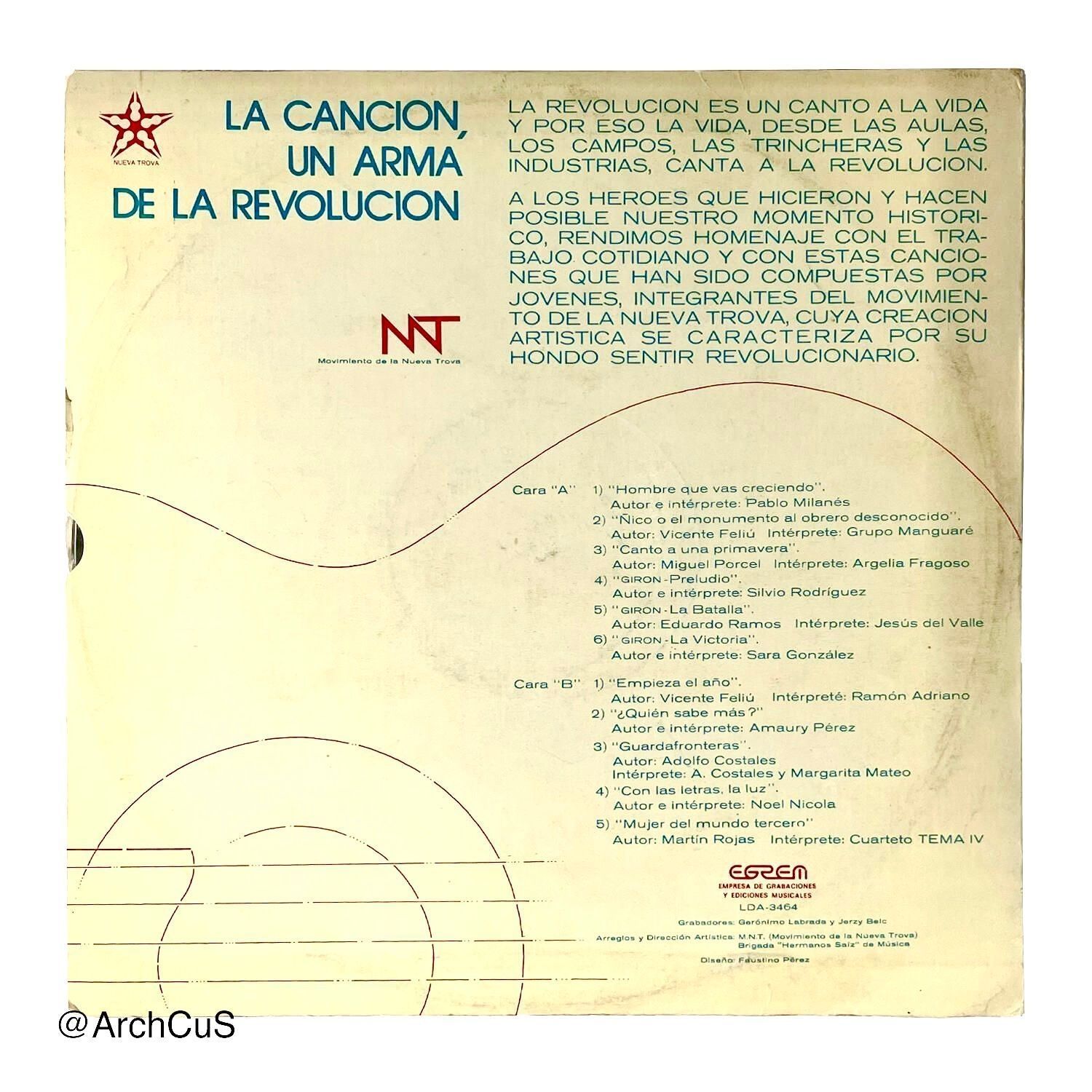
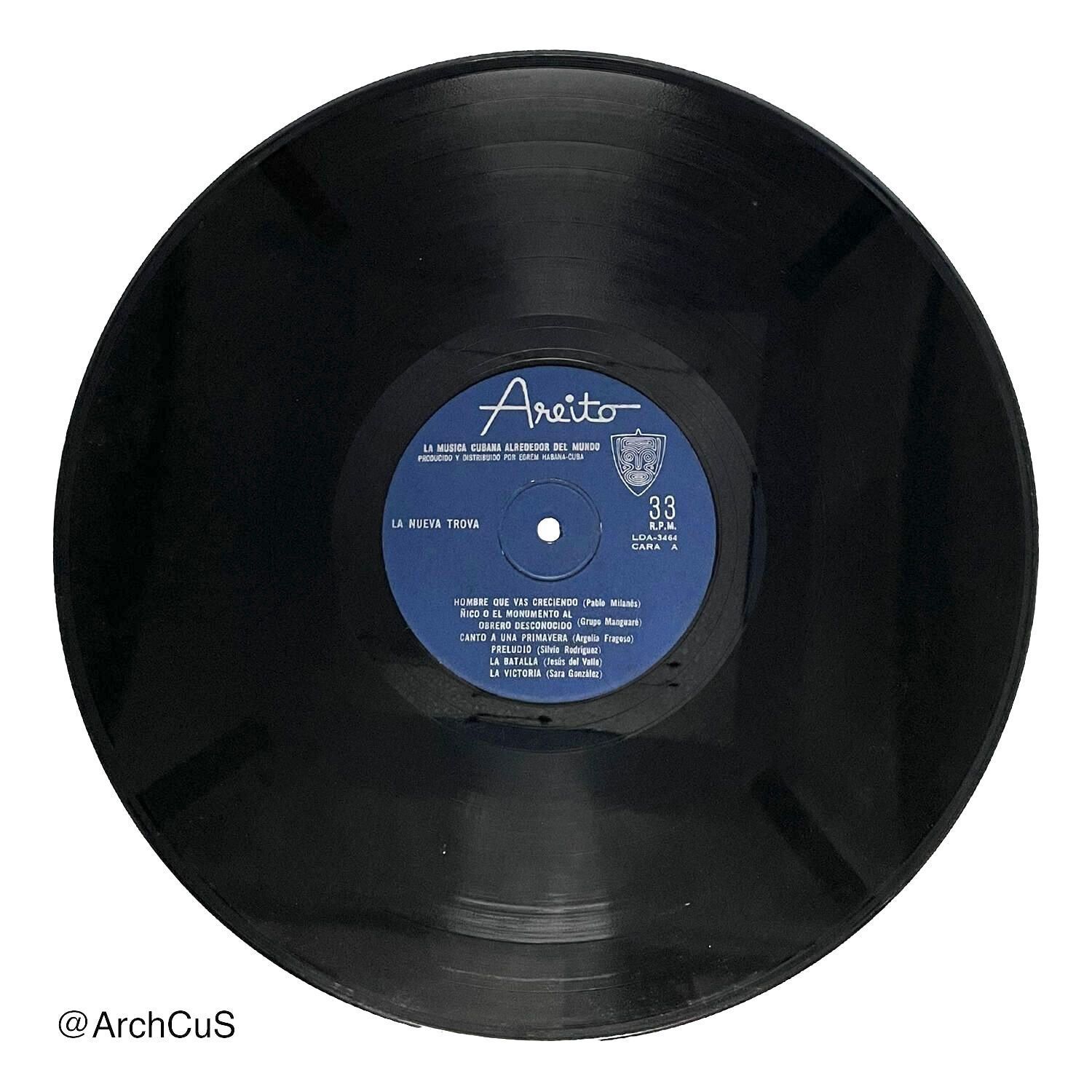
A 12-inch, 33⅓ rpm long-play vinyl record in a printed paper sleeve, produced and distributed by EGREM on its Areíto label. It is a collective anthology of the Cuban Nueva Trova, gathering eleven songs by the movement's young singer-songwriters. Side A: "Hombre que vas creciendo" (Pablo Milanés); "Ñico o el monumento al obrero desconocido" (Vicente Feliú, performed by Grupo Manguaré); "Canto a una primavera" (Miguel Porcel, performed by Argelia Fragoso); and a three-part Girón suite on the Bay of Pigs — "Preludio" (Silvio Rodríguez), "La Batalla" (Eduardo Ramos, performed by Jesús del Valle), "La Victoria" (Sara González). Side B: "Empieza el año" (Vicente Feliú / Ramón Adriano); "¿Quién sabe más?" (Amaury Pérez); "Guardafronteras" (Adolfo Costales, with Margarita Mateo); "Con las letras, la luz" (Noel Nicola); "Mujer del mundo tercero" (Martín Rojas, performed by Cuarteto Tema IV). The blue Areíto disc label reads "La Nueva Trova," "33 R.P.M.," "LDA-3464."
 LP record "La canción, un arma de la revolución" — Movimiento de la Nueva Trova (Areíto/EGREM 12″ 33⅓ rpm LP, LDA-3464)
 LP record "La canción, un arma de la revolución" — Movimiento de la Nueva Trova (Areíto/EGREM 12″ 33⅓ rpm LP, LDA-3464) - Image 2
 LP record "La canción, un arma de la revolución" — Movimiento de la Nueva Trova (Areíto/EGREM 12″ 33⅓ rpm LP, LDA-3464) - Image 3
2025.1.306
A foundational document of the Nueva Trova at the moment of its institutionalization within the state cultural apparatus. The album was produced by EGREM-Areíto in 1974 on the occasion of the III Encuentro Juvenil de Amistad between Cuba and the USSR, gathering young exponents of the Movimiento de la Nueva Trova Cubana — among them Pablo Milanés, Manguaré, Argelia Fragoso, Silvio Rodríguez, Jesús del Valle, Sara González, Ramón Adriano, Amaury Pérez, Adolfo Costales, Margarita Mateo, Noel Nicola, and Tema IV. Many of these artists had emerged from the Grupo de Experimentación Sonora del ICAIC under Leo Brouwer, and the Movimiento de la Nueva Trova itself had only just been formally constituted (December 1972). The title and the back-cover manifesto make the ideological program explicit: the Revolution as "a song to life," sung "from the classrooms, the fields, the trenches, and the industries," with these songs composed by young people "whose artistic creation is characterized by their deep revolutionary feeling." The track list bears this out — a suite on the victory at Playa Girón, songs on the literacy campaign ("Con las letras, la luz"), border defense ("Guardafronteras"), labor, and Third World solidarity ("Mujer del mundo tercero"). The framing occasion — a Cuba-USSR youth friendship encounter — ties the record directly to the Soviet alliance, and the cover by Faustino Pérez, a leading figure of revolutionary Cuban graphic design, gives the movement a bold visual identity. A small but telling production detail: one of the two recording engineers, Jerzy Belc, was a Polish technician working at EGREM — a trace of the socialist-bloc technical exchange running through the Cuban record industry.
33 RPM Record
The Cabrera Arús family collection
Leopoldo Arús Gálvez collection
2025.1
Gerónimo Labrada
Sound engineer
Jerzy Belc
Sound engineer
Movimiento de la Nueva Trova
Artistic Direction
Brigada "Hermanos Saíz" de Música
Artistic Direction
Faustino Perez
Designer
Areíto
EGREM
1974
Havana
Cuba
Caribbean
Central America
Spanish
The front cover is a vivid Orphist/constructivist composition of overlapping multicolored guitars; the back carries a red Nueva Trova star, the "MNT — Movimiento de la Nueva Trova" emblem, a revolutionary manifesto text, and credits: recording by Gerónimo Labrada and Jerzy Belc; arrangements and artistic direction by the M.N.T. and the Brigada "Hermanos Saíz" de Música; design by Faustino Pérez.
LDA-3464
Hombre que vas creciendo
Pablo Milanés
Composer
Pablo Milanés
Singer
Spanish
Ñico o el monumento al obrero desconocido
Vicente Feliú
Composer
Grupo Manguaré
Band
Spanish
Canto a una primavera
Miguel Porcel
Composer
Argelia Fragoso
Singer
Spanish
GIRON - Preludio
Silvio Rodríguez
Composer
Silvio Rodríguez
Singer
Spanish
GIRON - La Batalla
Eduardo Ramos
Composer
Jesús del Valle
Singer
Spanish
GIRON - La Victoria
Sara González
Composer
Sara González
Singer
Spanish
Empieza el año
Vicente Feliú
Composer
Ramón Adriano
Singer
Spanish
¿Quién sabe más?
Amaury Pérez
Composer
Amaury Pérez
Singer
Spanish
Guardafronteras
Adolfo Costales
Composer
Margarita Mateo
Singer
Spanish
Con las letras, la luz
Noel Nicola
Composer
Noel Nicola
Singer
Spanish
Mujer del mundo tercero
Martín Rojas
Composer
Cuarteto TEMA IV
Band
Spanish
Inscription
Back cover.
La revolucion es un canto a la vida y por eso la vida, desde las aulas, los campos, las trincheras y las industrias, canta a la revolucion. A los heroes que hicieron y hacen posible nuestro momento historico, rendimos homenaje con el trabaja cotidiano y con estas canciones que han sido compuestas por jovenes, integrantes del movimiento de la nueva trova, cuya creacion artistica se carateriza por su hondo sentir revolucionario.
Spanish
The revolution is a song to life and that is why life, from the classrooms, the fields, the trenches and the industries, sings to the revolution. To the heroes who made and make our historical moment possible, we pay tribute with their daily work and with these songs that have been composed by young people, members of the Nueva Trova movement, whose artistic creation is characterized by their deep revolutionary feeling.
31 cm
30.5 cm
album cover, plastic sleeve, vinyl
Good
Leopoldo Arús Gálvez
owner
Movimiento de la Nueva Trova
artist
Havana
Cuba
Caribbean
Central America
recording, production, acquisition, use
Movement context: the Movimiento de la Nueva Trova was formally founded in December 1972, so this 1974 LP is an early institutional release of the movement; several artists trace to the Grupo de Experimentación Sonora del ICAIC (1969–1977, directed by Leo Brouwer).