
"Sputnik" Chrome Double-Edge Razor Blade Wrapper
Object/Artifact
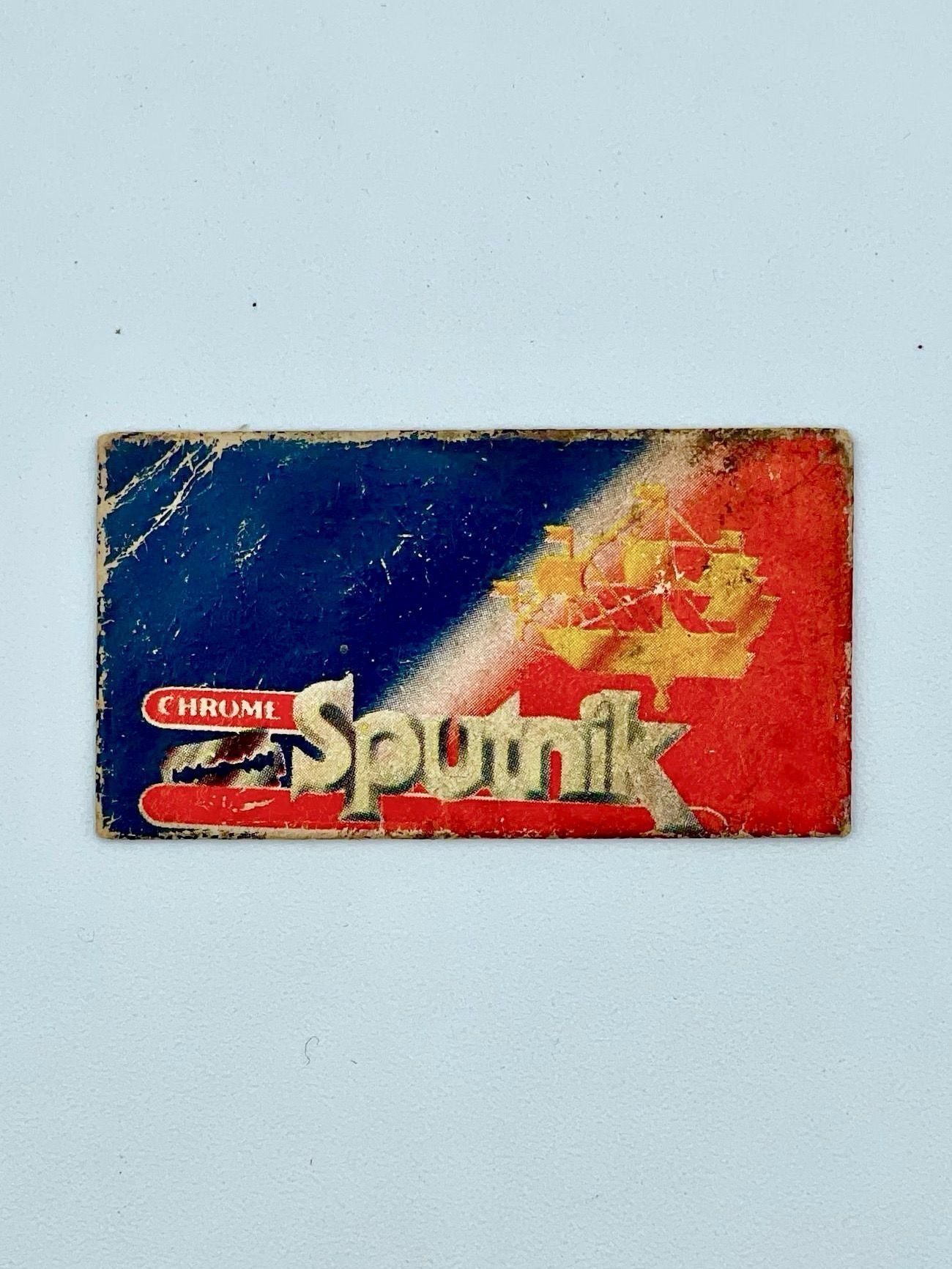
An individual paper wrapper for a single "Sputnik" chrome-plated double-edge safety razor blade, manufactured in Leningrad by LMO "Leninets" (Ленинградское машиностроительное объединение "Ленинец"). The blade itself is no longer present; only the printed paper wrapper survives. Sputnik and Neva were SISTER PRODUCTS from the same factory, sharing the historical-Russian-sailing-ship visual motif as part of a unified Leningrad-maritime brand-family heritage. The ship on the Sputnik wrapper is a continuity element with the Neva brand and with the broader Leningrad-maritime visual tradition. The Sputnik name was extended from this maritime tradition (the Russian word "Спутник" meaning "fellow traveler" / "companion" — applicable to ships as well as satellites) onto the 1957 satellite achievement, and the ship-imagery was eventually superseded on later Sputnik packages by Sputnik-satellite imagery. DESCRIPTION: A single small rectangular paper wrapper, printed in multi-color lithography on lightweight paper. The wrapper would have originally been folded around a single double-edge razor blade and sealed at the back; in this object, the wrapper survives intact but the blade itself is no longer present. PRINTED FACE: Multi-color lithograph showing: - Dark navy/cobalt blue ground covering the upper portion - A diagonal red band/sash crossing from upper-left to lower-right of the design - Center: a stylized rendering of a HISTORICAL SAILING SHIP — a three-masted vessel rendered in gold/yellow tones, shown with billowing sails, multiple masts with full rigging, and a dramatic silhouette characteristic of late-medieval / early-modern European sailing vessels. The form is ambiguous between a Russian historical naval vessel of the Petrine era and a generic "Age of Sail" ship; the depiction is romanticized rather than precise — emphasizing the dramatic profile and the suggestion of a "voyage" or "exploration" - Lower-left: a red banner with "CHROME" lettering — indicating the blade coating - Lower-center: "Sputnik" brand name in stylized scripted/decorative lettering, white/cream against the diagonal red band Heavy wear visible across the wrapper face: creasing along the original fold lines, edge abrasion, surface scuffing, color loss especially at the edges, possible discoloration from age and handling.
2025.1.36
The Cabrera Arús family collection
2025.1
Leningrad Machine-Building Association "Leninets"
Leningrad
U.S.S.R.
Eastern Europe
Europe
DATE / PERIOD: c. 1960s–1970s. The dating range is bounded by: (1) the post-1957 Sputnik-name period (the brand was named after the October 4, 1957 satellite launch); and (2) the pre-1991 USSR period. The historical-sailing-ship imagery on this specific wrapper variant is documented in vintage-razor-blade collector sources as belonging to the EARLIER Sputnik packaging design, before a later redesign replaced the ship with imagery of the Sputnik satellite itself. This suggests the wrapper is most likely from the 1960s to early 1970s, before the visual rebranding shift.
Printed face: - "CHROME" — red banner at lower left (blade coating designation, in Latin script) - "Sputnik" — stylized brand-name lettering (in Latin script) - Historical sailing ship — gold/yellow graphic Languages: The text is all in Latin script ("CHROME," "Sputnik") — distinguishing this from the Neva box, which uses fully Cyrillic labeling. The Latin-script lettering on the Sputnik wrapper may indicate: (a) an export-oriented packaging design intended for international markets where Latin script is preferred, or (b) a stylistic choice within the Soviet branding canon to use Latin lettering for a brand intended to convey cosmopolitan / modern associations (consistent with the Sputnik / cosmic-age theme). Both interpretations are plausible.
Fair
Leopoldo Arús Gálvez
owner
Leningrad Machine-Building Association "Leninets"
producer
Havana
Cuba
Caribbean
Central America
use
Leningrad
U.S.S.R.
Eastern Europe
Europe
production
This entry catalogs an INDIVIDUAL BLADE WRAPPER, not an outer box and not a blade. The wrapper is the small paper packet that originally contained a single double-edge razor blade within a multi-blade outer box (a typical 5-blade Soviet outer box would have held five such wrappers, each containing one blade). At some point in the household's use of this product, the wrapper was separated from both its blade and its outer box, and it survived as a single paper artifact. Perhaps indicative of the symbolic weight of the Spunik.
The Sputnik brand name draws on the dual valence of the Russian word "Спутник" — meaning both "satellite/artificial companion" (the 1957 cosmic achievement) AND "fellow traveler / companion" (the older Russian word, applied to ships, traveling companions, and any "joining-presence"). The packaging visualizes the latter, older meaning, while the brand name evokes the former, newer meaning. The two readings co-exist productively — not as paradox but as polysemy. The exact historical ship depicted on the Sputnik wrapper could be: - The Neva — historically the name of one of the first Russian round-the-world voyage ships (the Imperial Russian Navy sloop "Neva," which along with the "Nadezhda" completed the first Russian circumnavigation, 1803-1806 under Yuri Lisyansky and Adam Johann von Krusenstern). - A generic "Age of Sail" Russian/Petrine-era vessel — Russia's 18th-century naval modernization under Peter the Great is the foundational moment of Russian maritime identity; many Soviet consumer goods used Petrine-era sailing-ship imagery to invoke this heritage.
The Sputnik name in Soviet consumer culture. Following the October 4, 1957 launch of Sputnik 1, the word "Спутник" rapidly acquired enormous symbolic value across Soviet consumer-goods branding. Sputnik became the standard Soviet brand-name signifier of "modern," "advanced," "scientifically progressive," and "Soviet cosmic achievement." Hundreds of Soviet consumer products were named Sputnik in the late 1950s through 1980s: chocolates, cigarettes, vacuum cleaners, watches, radios, hotels, restaurants, ice cream, candies, and razor blades. The Sputnik name became to Soviet consumer culture roughly what "Atomic" or "Space-Age" became to American consumer culture in the same period. The Sputnik razor blade wrapper is a small but specific example of this brand-name phenomenon.