
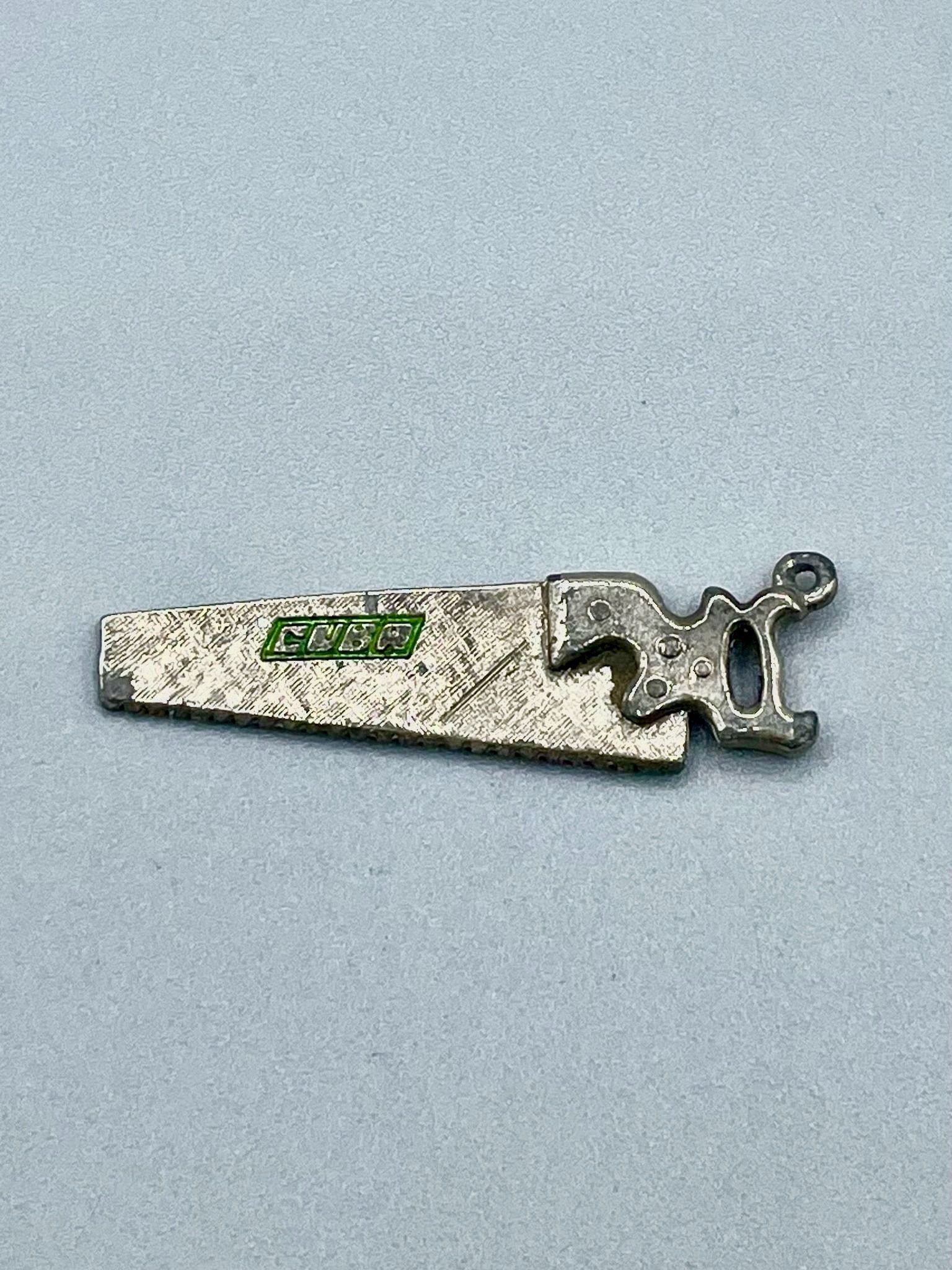
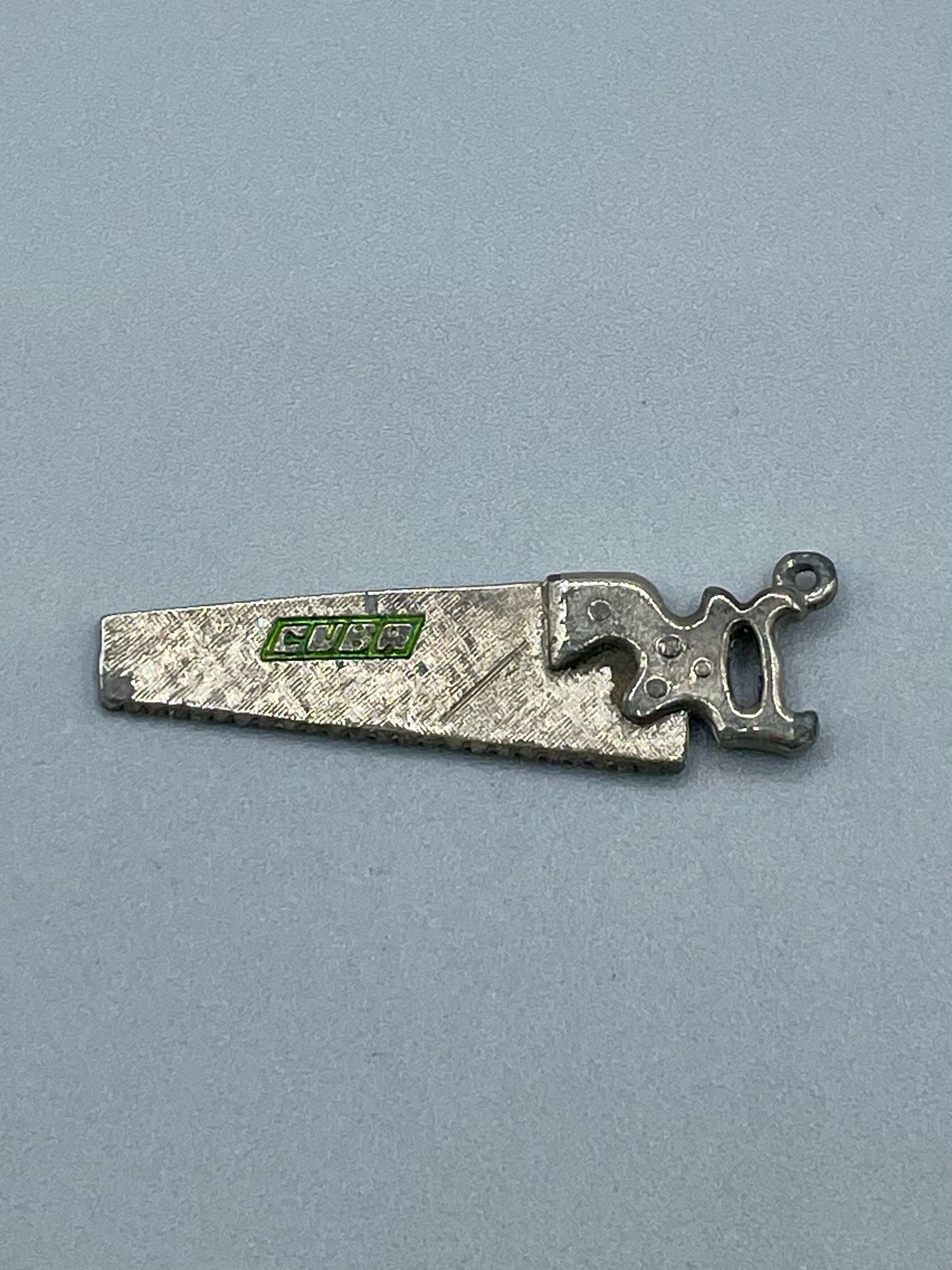
"CUBA" souvenir keychain fob, miniature handsaw
Object/Artifact
A small cast-metal charm/fob in the shape of a carpenter's handsaw (a panel saw), complete with a toothed blade, a shaped open handle, and imitation handle rivets, with a small suspension loop at the top of the handle for attaching to a key chain (the chain and ring are not present). The blade is stamped/engraved with crosshatch texture and carries the word "CUBA" in raised letters filled with green enamel/paint within a rectangular panel. The metal is a silver-tone alloy, worn and lightly tarnished. It is the pendant portion of a novelty souvenir keychain.
2025.1.69
Used as a keychain and later kept as a souvenir.
The Cabrera Arús family collection
2025.1
MAKER: Unknown; unmarked as to manufacturer. A mass-produced tourist-souvenir charm; the producing workshop is not identified. DATE / PERIOD: Not dated; 20th century. Cast novelty souvenir charms of this kind are broadly mid-to-late twentieth century; no closer date can be fixed from the object. ORIGIN: Cuba (souvenir, marked "CUBA"). Place of manufacture not separately indicated but the piece is a Cuba-branded tourist item. Acquisition: acquired in Cuba (standing default; consistent with the souvenir marking).
"CUBA" in raised letters with green fill, in a rectangular panel on the blade. No maker's mark visible. Languages: "CUBA" (place name).
MATERIALS: Cast metal (white-metal/pewter or zinc alloy) with green enamel or paint fill in the "CUBA" lettering. TECHNIQUES: Die-cast or molded metal charm with relief detail (saw teeth, handle, rivets, crosshatch texture) and color-filled raised lettering; pierced suspension loop.
Fair
Havana
Cuba
Caribbean
Central America
preservation
This is the pendant of a novelty keychain, cast as a miniature carpenter's handsaw (a panel saw) and marked "CUBA" in green on the blade. Its reading is genuinely open between two plausible interpretations, which the object itself does not decide. The first is that it is a generic tourist souvenir: a stock charm form customized with a destination name, of the kind sold to visitors, in which case the saw has no Cuban-specific meaning and is simply an everyday object rendered in miniature. The second is that the saw functions as an emblem of labor — of carpentry, the building trades, or the working class more generally — or even of a specific trade union or state/workplace organization. The latter reading is well grounded in twentieth-century political iconography, in which hand tools commonly stand for workers (as in the Soviet hammer and sickle), and in the post-1959 Cuban context, where the islandwide trade-union federation (the Central de Trabajadores de Cuba, or CTC) and numerous unions and workplaces issued pins, badges, and keychains using worker-and-tool imagery. On the internal evidence, the souvenir reading is the more economical: the blade carries only the place name "CUBA," with no union name, organizational acronym, slogan, congress date, or CTC mark of the type labor commemoratives usually bear, and a bare country name is characteristic of the souvenir trade; moreover, the saw is depicted realistically as a specific tool rather than schematized into the stylized emblem an organization would typically adopt. Even so, the labor/union/working-class reading cannot be excluded and should be recorded as a real possibility, because a saw is a natural member of the visual vocabulary of labor and because Cuban union and workplace insignia of this kind exist. No specific institution can be named from the object, so no institutional history is asserted here.