
Cuban School Notebook
Object/Artifact
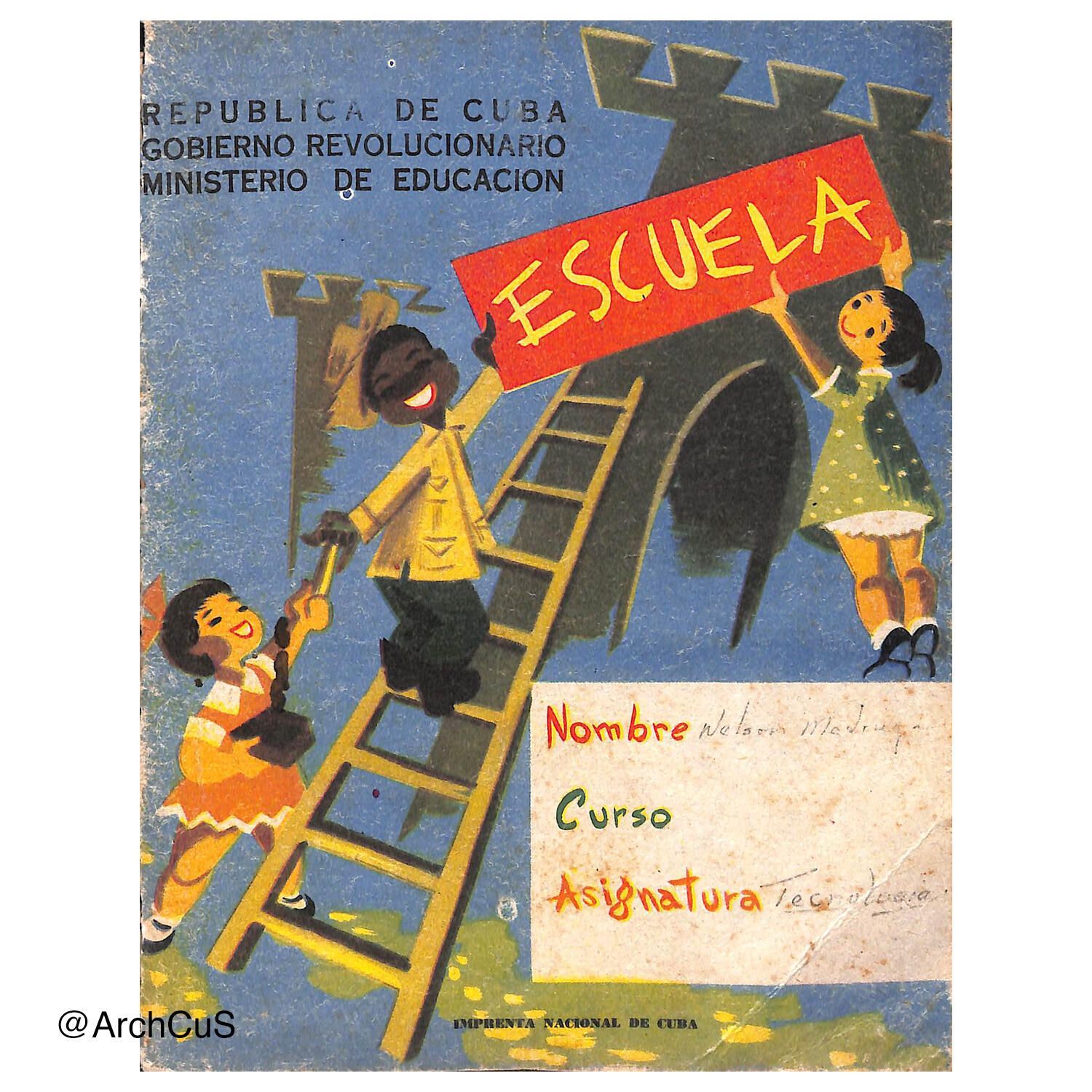
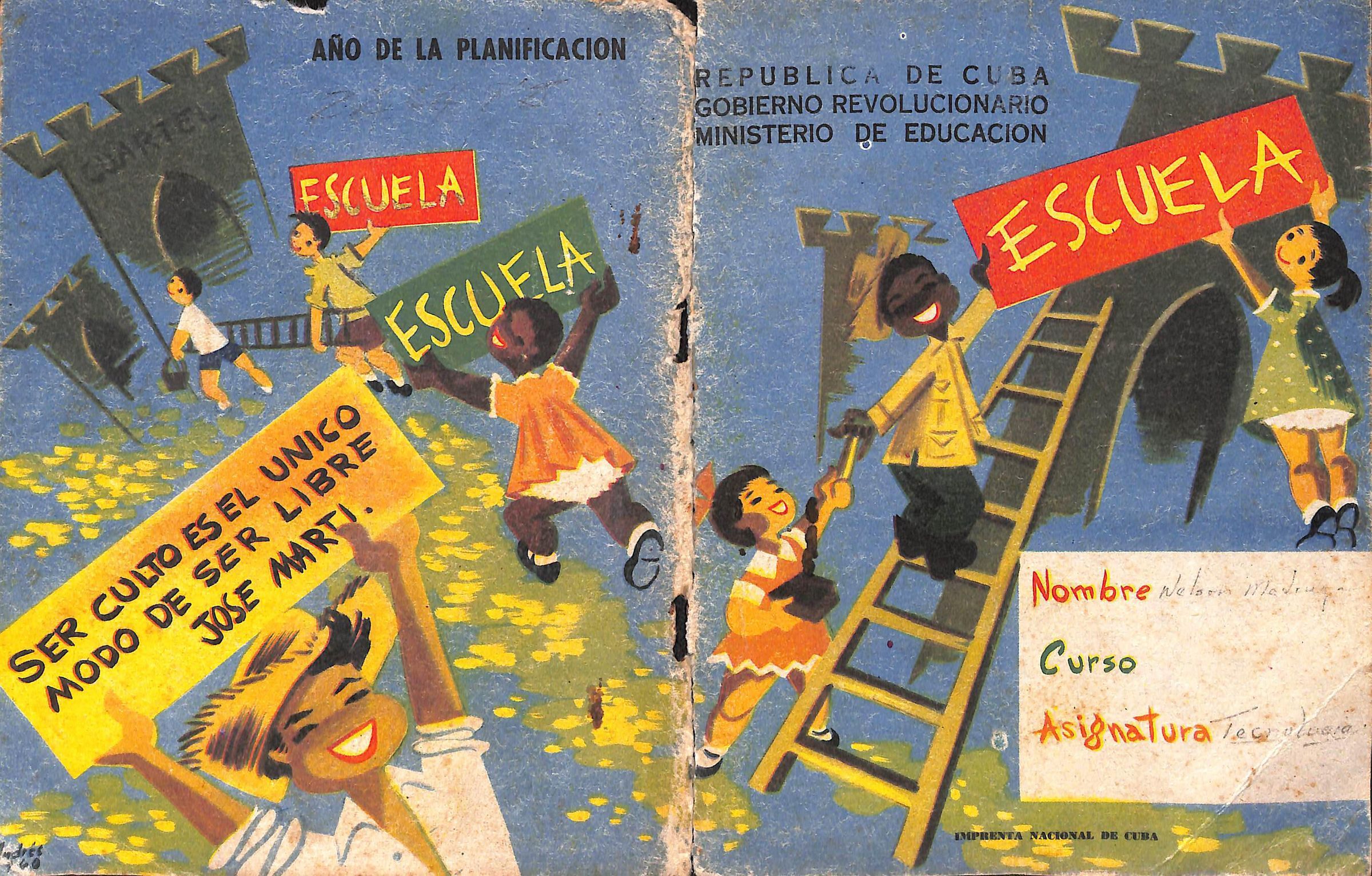
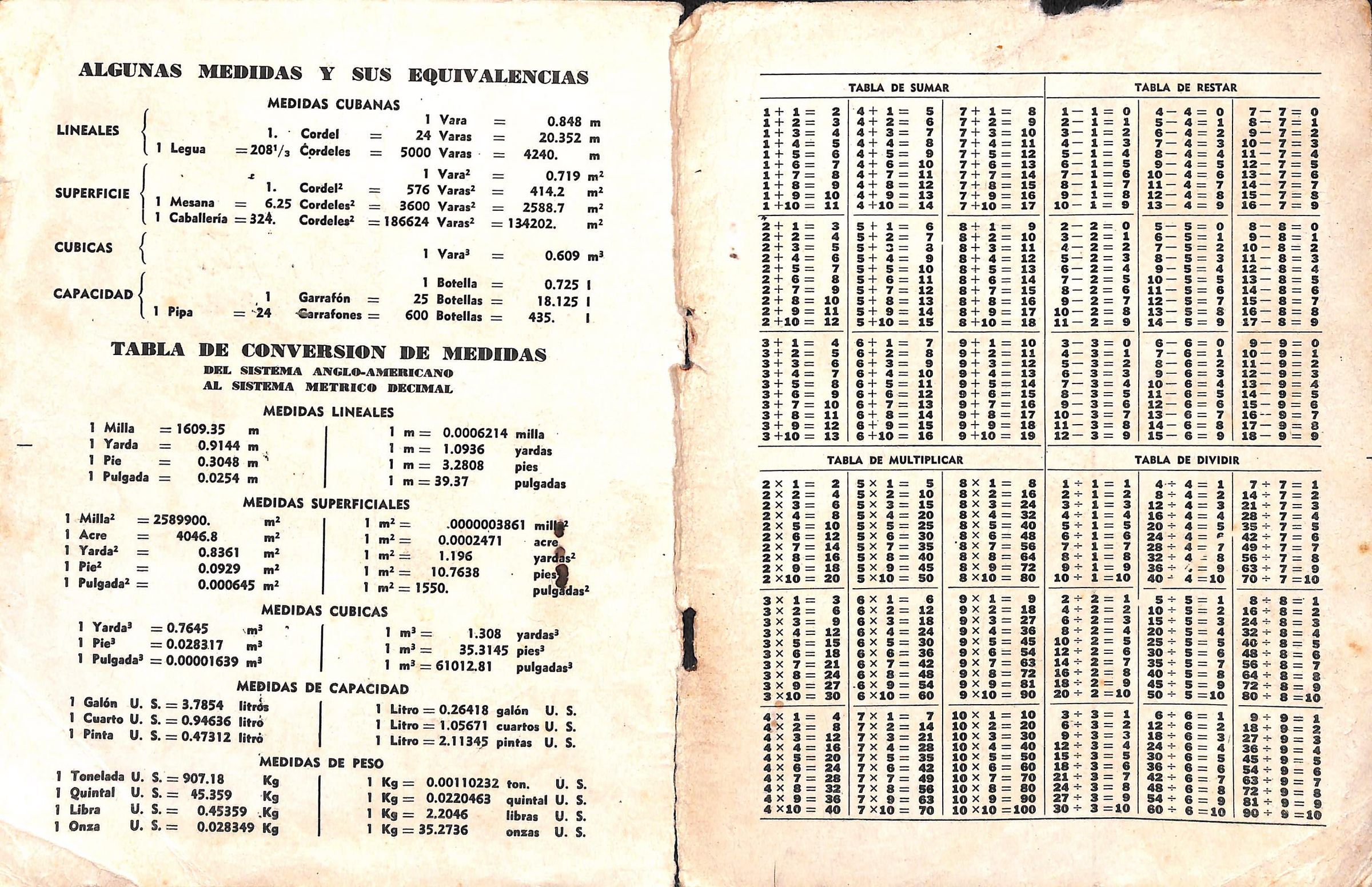
SUMMARY: Cover of a used Cuban primary-school exercise notebook issued by the Revolutionary Government's Ministry of Education and printed by the Imprenta Nacional de Cuba during the "Año de la Planificación" (1962). The illustrated cover celebrates the post-literacy-campaign expansion of schooling; the inside covers carry measurement-conversion and arithmetic tables. The notebook is inscribed with a pupil's name (Nelson Madruga). DESCRIPTION: A soft-cover school exercise notebook (cuaderno escolar). The front and back covers show a color illustration in a mid-century children's-book style: smiling children in a green-and-blue landscape carry placards reading "ESCUELA" (School) and climb ladders toward castle-like structures labeled "CUARTEL" (Barracks); a large yellow placard quotes José Martí, "SER CULTO ES EL ÚNICO MODO DE SER LIBRE" (To be educated is the only way to be free). Across the top, in the fornt: "AÑO DE LA PLANIFICACIÓN" and "REPÚBLICA DE CUBA / GOBIERNO REVOLUCIONARIO / MINISTERIO DE EDUCACIÓN." A printed fill-in box on the cover provides lines for "Nombre," "Curso," and "Asignatura," completed in handwriting (Nombre: Nelson Madruga; Asignatura: Tecnología). The publisher imprint reads "IMPRENTA NACIONAL DE CUBA." The inside front cover prints a table of measurement conversions ("Algunas medidas y sus equivalencias," including traditional Cuban units — varas, cordeles, caballerías, botellas, garrafones — and Anglo-to-metric conversions); the inside back cover prints arithmetic tables (addition, subtraction, multiplication, division). The notebook shows heavy use and age: worn, chipped, and darkened cover edges, a split spine, and toning of the paper.
2025.1.17
Kept in the Arús Caraballo household
Owner saved the covers after notebook was used.
The Cabrera Arús family collection
2025.1
Notebook cover was kept by owner.
Andrés García Benítez
illustrator
Imprenta Nacional de Cuba
1961
1960s
issued by the Ministry of Education. Andrés García Benítez's illustration dated 1960.
back cover
AÑO DE LA PLANIFICACION CUARTEL ESCUELA ESCUELA SER CULTO ES EL UNICO MODO DE SER LIBRE JOSE MARTI.
Spanish
YEAR OF PLANNING GARRISON SCHOOL SCHOOL BEING EDUCATED IS THE ONLY WAY TO BE FREE JOSE MARTI.
Ink
front cover
REPUBLICA DE CUBA GOBIERNO REVOLUCIONARIO MINISTERIO DE EDUCACIÓN ESCUELA Nombre (Nelson Madruga) Curso Asignatura (Tecnología) IMPRENTA NACIONAL DE CUBA
Spanish
REPUBLIC OF CUBA REVOLUTIONARY GOVERNMENT MINISTRY OF EDUCATION SCHOOL Name (Nelson Madruga) Course Subject (Technology) NATIONAL PRINTING PRESS OF CUBA
Ink
Pencil
Inside the front cover there is a table with conversion measurements; inside the back cover there the same addition, subtraction, multiplication and division tables as in the back cover of the Ideal notebook.
Front cover (printed, transcribed exactly): - "AÑO DE LA PLANIFICACIÓN" - "REPÚBLICA DE CUBA / GOBIERNO REVOLUCIONARIO / MINISTERIO DE EDUCACIÓN" - "ESCUELA" (repeated, on placards) - "CUARTEL" (on the castle/fortress structures) - "SER CULTO ES EL ÚNICO MODO DE SER LIBRE / JOSÉ MARTÍ" - "IMPRENTA NACIONAL DE CUBA" Front cover (handwritten, transcribed): - "Nombre: Nelson Madruga" - "Curso: [blank/illegible]" - "Asignatura: Tecnología" Interior: printed measurement-conversion tables (front) and arithmetic tables (back). Language: Spanish. English translation (as in the record): "Year of Planning / Garrison / School / Being educated is the only way to be free — José Martí. // Republic of Cuba / Revolutionary Government / Ministry of Education / School / Name (Nelson Madruga) / Course / Subject (Technology) / National Printing Press of Cuba."
17 cm
12 cm
2
Paper
Color-lithographed/offset printed cover; letterpress or offset printed interior tables; bound exercise book; handwritten inscriptions (ink and pencil)
Poor
Ministry of Education
issuer
Imprenta Nacional de Cuba
Gobierno Revolucionario
Andrés García Benítez
illustrator
Havana
Cuba
Caribbean
Central America
use
Pioneros: Building Cuba's Socialist Childhood
The Cuban Revolutionary Government assigned an official commemorative name to each calendar year since 1959. "Año de la Planificación" (Year of Planning) was the official designation for 1962. This makes the notebook firmly datable to 1961, even though the cover-illustration signature carries the date "60" — not a contradiction, just the lead time between artwork and the print run. This notebook is a direct material trace of one of the Cuban Revolution's signature projects: the transformation of mass education. 1961, the immediately preceding year, was the "Año de la Educación," during which the famous Campaña Nacional de Alfabetización (National Literacy Campaign) mobilized roughly a quarter-million volunteer teachers (brigadistas). The 1962 "Año de la Planificación" notebook belongs to the immediate aftermath, when the newly nationalized education system (the Ministry of Education had taken control of private and religious schools) was being consolidated and standardized. The cover iconography is pure revolutionary pedagogy: children marching with "ESCUELA" banners toward (and converting) the "CUARTEL" (military barracks) — a direct visual reference to one of the Revolution's most repeated slogans and policies, the conversion of military barracks into schools (most famously the Moncada barracks in Santiago, converted into the "Ciudad Escolar 26 de Julio" school city in 1960). The image dramatizes "swords into schoolhouses." "Ser culto es el único modo de ser libre" ("To be educated/cultured is the only way to be free") is one of José Martí's most-cited lines and became a central slogan of the revolutionary education project. Its presence on a state-issued school notebook ties the everyday object to the ideological program of the era. (Martí, Cuba's independence hero and national apostle, was claimed across the political spectrum, and the Revolution made his educational maxims foundational to its schooling discourse.)
The inclusion of measurement-conversion tables is itself historically telling. The front-cover table lists traditional Cuban units (vara, cordel, caballería, mesana, botella, garrafón, pipa) alongside metric and Anglo-American (U.S.) equivalents — documenting a moment when Cuba still used a mix of Spanish-colonial, U.S., and metric measures, and the state was promoting metric standardization. The arithmetic tables on the back endpaper are standard pedagogical aids, as also observed in the Ideal notebook in this collection.
The handwritten name personalizes the object. "Madruga" is a Cuban surname. The subject "Tecnología" (Technology) suggests this was used for a technology/practical-skills class and is an example of the early effort to educate technocrats for the industrialization goal.