
EP record "Abakuá" (Areíto/EGREM 7″ 33⅓ rpm gatefold EP, EPA-6219)
Audio Recording
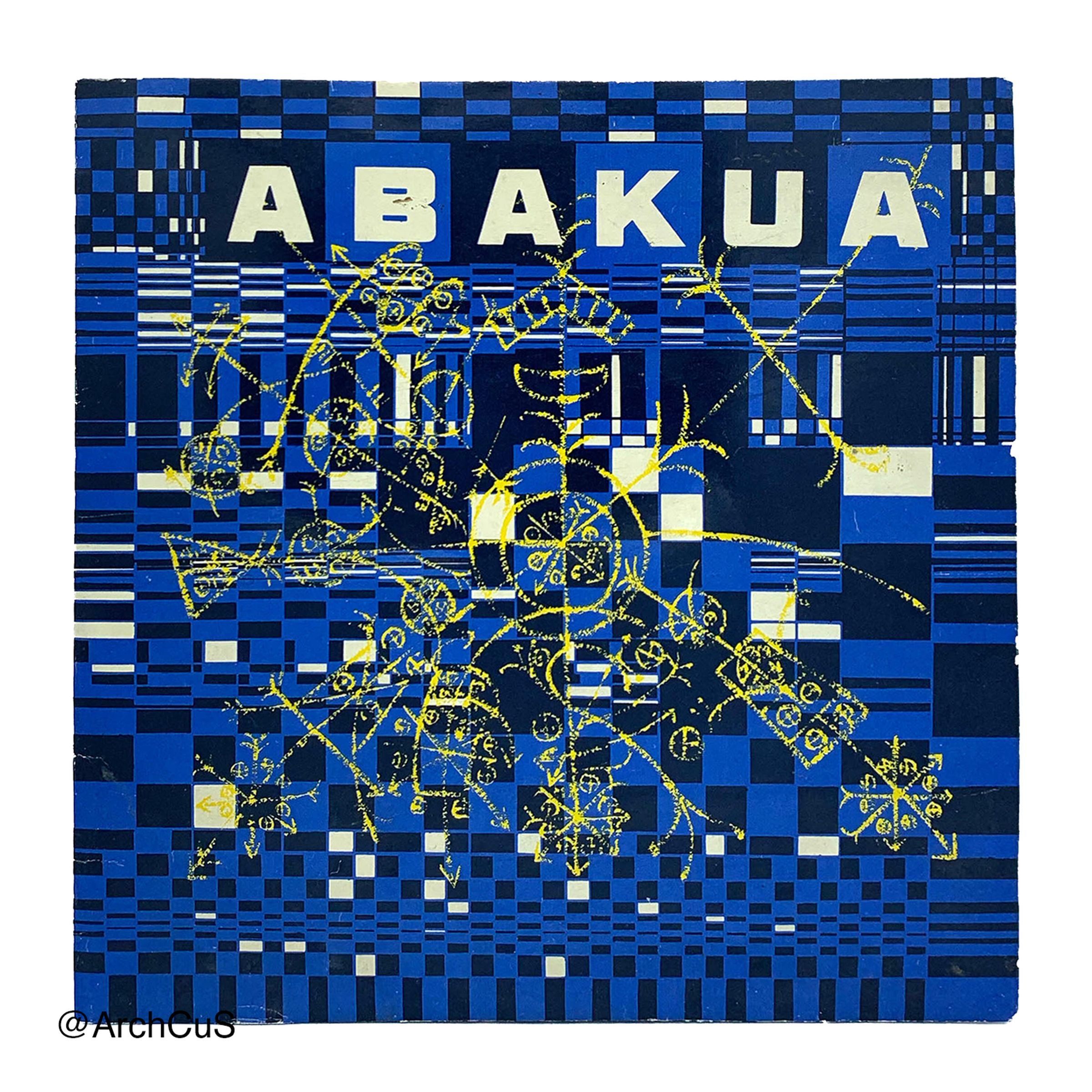
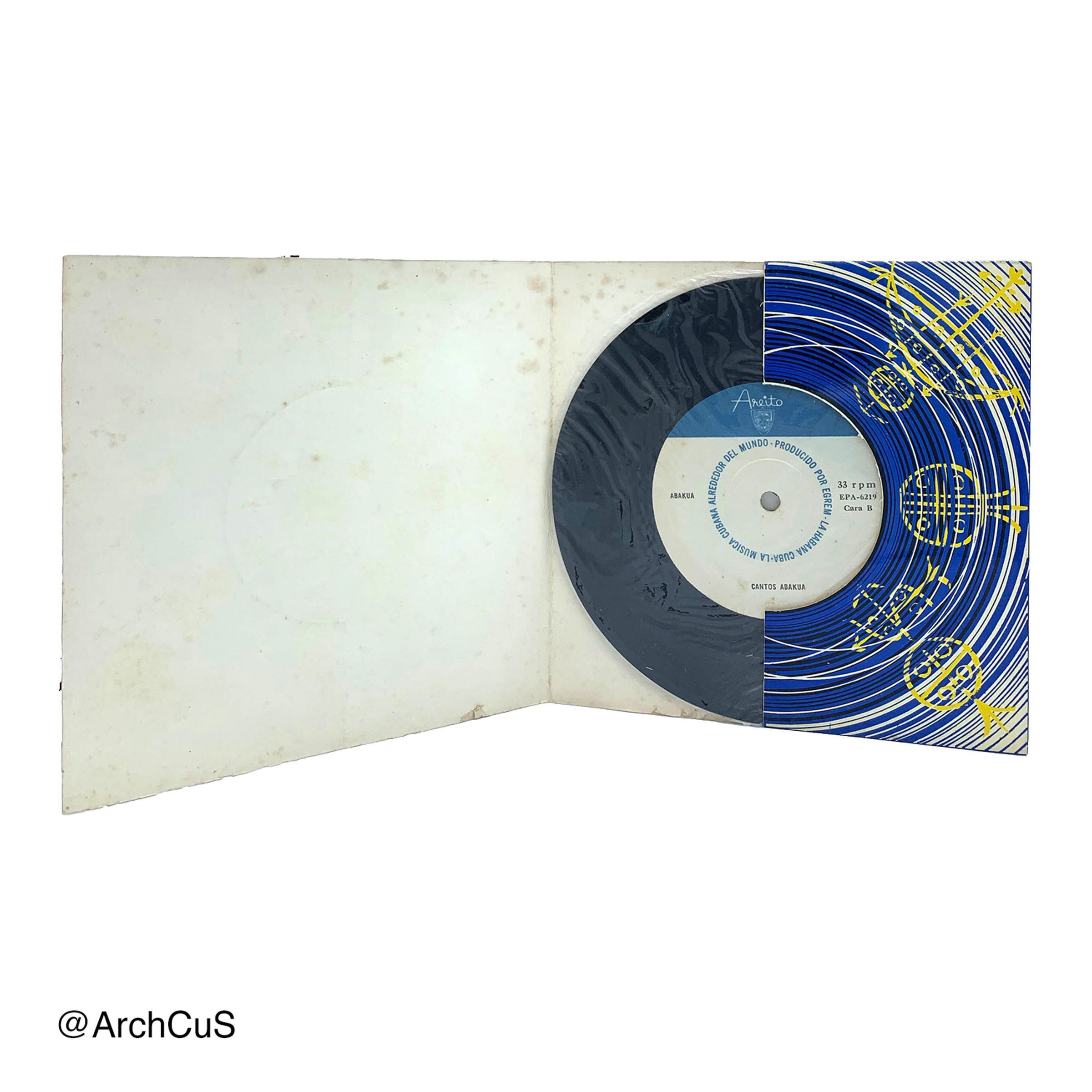
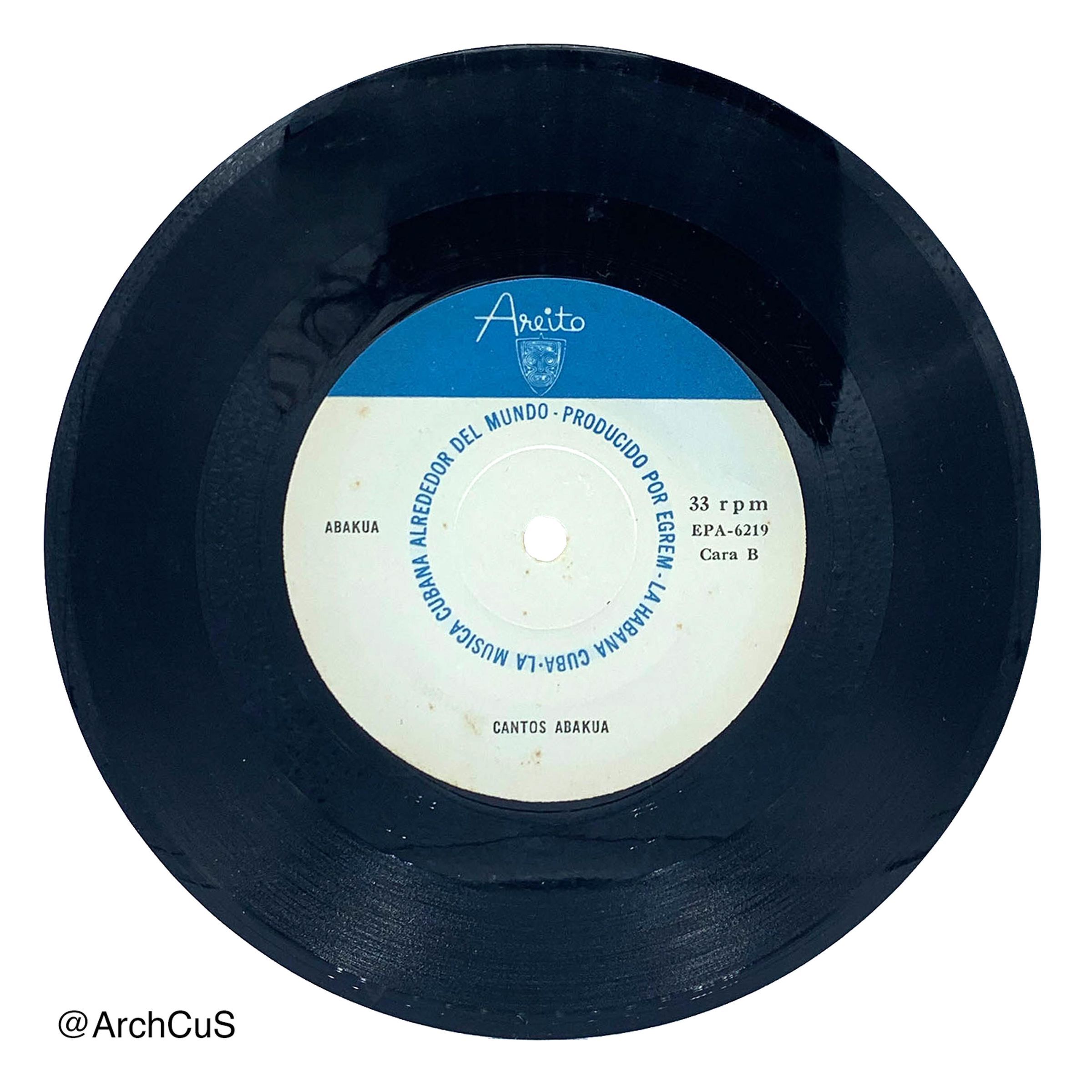
A 7-inch, 33⅓ rpm extended-play vinyl record in a gatefold paper sleeve, produced by EGREM on its Areíto label in collaboration with the Academia de Ciencias de Cuba (Instituto de Etnología, Centro de Estudios Africanistas). It is an ethnomusicological release documenting the ceremonial music of the Abakuá, the Afro-Cuban men's initiatory society: a sample of ritual material including a parla or narration (enkame), several chants (cantos), and procession marches. The blue Areíto disc label is marked "ABAKUA," "CANTOS ABAKUA," "33 rpm," "EPA-6219."
2025.1.291
The Abakuá is a men's initiatory society derived from the West African Ékpè societies of the Cross River region, founded in Havana in 1836; more precisely it took shape around 1836 in the town of Regla near Havana, where a group of Afro-Cubans founded a brotherhood inspired by the Ekpe society, descended from the Ékpè/Ngbe "leopard" associations of the Cross River region of southeastern Nigeria and southwestern Cameroon, its members also known as ñáñigos. The liner notes (by María Teresa Linares, the same musicologist behind the Sucu-Sucu EP) lay out the society's sacred narrative — the legend of Sikán, the woman who discovered the secret and was sacrificed; the Ekue friction drum; the ritual officers (Ekueñón, Morua); the Sese-Eribo drum — and reproduce chant texts in the Abakuá liturgical language. The cover translates the society's anaforuana signs (a graphic system related to Cross River nsibidi) into bold op-art. The record belongs to a deliberate EGREM/Academia de Ciencias series on Afro-Cuban folklore.
33 RPM Record
The Cabrera Arús family collection
Leopoldo Arús Gálvez collection
2025.1
Dennys Moreno
Designer
Areíto
1967
Cuba
Caribbean
Central America
Yoruba
EPA-6219
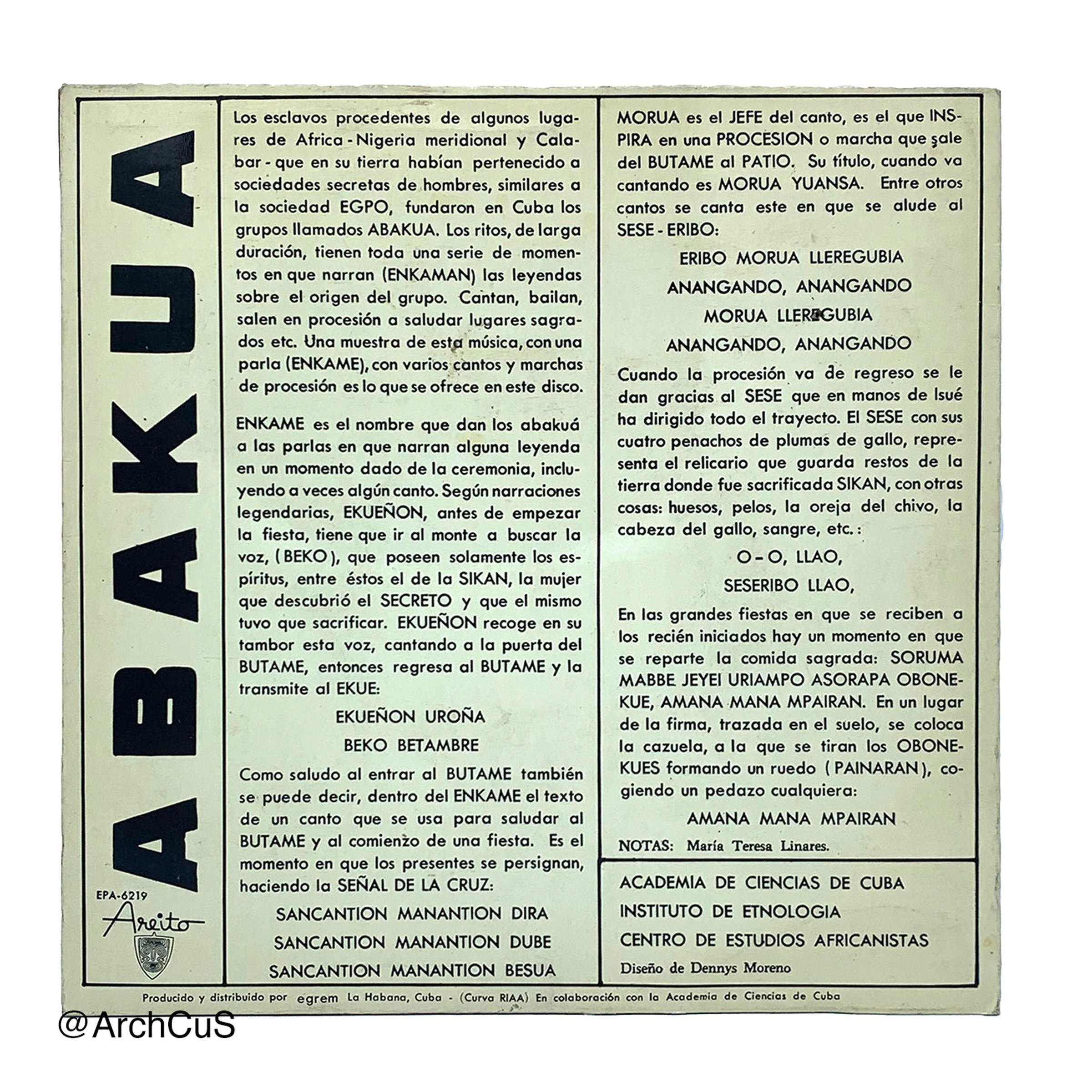
The front cover is a striking modernist design — a dense blue, black, and white woven/checkerboard op-art grid (evoking the checkered costume of the íreme masked dancers) overlaid with bright-yellow anaforuana (the society's ritual signature glyphs), with "ABAKUA" in white block capitals; design by Dennys Moreno. The gatefold interior repeats the pattern; the back carries extensive ethnographic liner notes by María Teresa Linares explaining the society's origins, ritual roles, and chant texts, and credits the Academia de Ciencias de Cuba, Instituto de Etnología, and Centro de Estudios Africanistas.
Produced, mastered, and pressed by EGREM in Havana (La Habana), Cuba, in collaboration with the Academia de Ciencias. The field-recording locale is not stated on the sleeve; Abakuá practice is concentrated in Havana (notably Regla and Guanabacoa), Matanzas, and Cárdenas, so the recordings were presumptively made within the Havana–Regla Abakuá milieu. Dating: the catalog number EPA-6219 falls between the Clara y Mario EP (EPA-6193, c. 1969–70) and the Sucu-Sucu EP (EPA-6263, c. 1970), so best dated c. 1970. Part of the same Academia de Ciencias / Instituto de Etnología ethnomusicology series.
Enkame
Cantos abakua
Inscription
Back of album cover
Los esclavos procedentes de algunos lugares de Africa —Nigeria meridional y Calabar— que en su tierra habían pertenecido a sociedades secretas de hombres, similares a la sociedad EGPO, fundaron en Cuba los grupos llamados ABAKUA. Los ritos, de larga duración, tienen toda una serie de momentos en que narran (ENKAMAN) las leyendas sobre el origen del grupo. Cantan, bailan, salen en procesión a saludar lugares sagrados, etc. Una muestra de esta música, con una parla (ENKAME), con varios cantos y marchas de procesión, es lo que se ofrece en este disco. ENKAME es el nombre que dan los abakuá a las parlas en que narran alguna leyenda en un momento dado de la ceremonia, incluyendo a veces algún canto. Según narraciones legendarias, EKUEÑON, antes de empezar la fiesta tiene que ir al monte a buscar la voz, (BEKO), que poseen solamente los espíritus, entre estos el de la SIKAN, la mujer que descubrió el SECRETO y que él mismo tuvo que sacrificar. EKUEÑON recoge en su tambor esta voz, cantando a la puerta del BUTAME, entonces regresa al BUTAME y la transmite al EKUE: EKUEÑON UROÑA BEKO BETAMBRE Como saludo al entrar al BUTAME también se puede decir, dentro del ENKAME el texto de un canto que se usa para saludar al BUTAME y al comienzo de una fiesta. Es el momento en que los presentes se persignan, haciendo la SEÑAL DE LA CRUZ: SANCANTION MANANTION DIRA SANCANTION MANANTION DUBE SANCANTION MANANTION BESUA MORUA es el JEFE del canto, es el que INSPIRA en una PROCESION o marcha que sale del BUTAME al PATIO. Su título, cuando va cantando es MORUA YUANSA. Entre otros cantos se canta este en que se alude al SESE-ERIBO: ERIBO MORUA LLEREGUBIA ANANGANDO, ANANGANDO MORUA LLEREGUBIA ANANGANDO, ANANGANDO Cuando la procesión va de regreso se le dan gracias al SESE que en manos de Isue ha dirigido todo el trayecto. El SESE con sus cuatro penachos de plumas de gallo, representa el relicario que guarda restos de la tierra donde fue sacrificada SIKAN, con otras cosas: huesos, pelos, la oreja del chivo, la cabeza del gallo, sangre, etc.: O - O, LLACO, SESERIBO LLAO, En las grandes fiestas en que se reciben a los recién iniciados hay un momento en que se reparte la comida sagrada: SORUMA MABBE JEYEI URIAMPO ASORAPA OBONEKUE, AMANA MANA MPAIRAN. En un lugar de la firma, trazada en el suelo, se coloca la cazuela, a la que se tiran los OBONEKUES formando un ruedo (PAINARAN), cogiendo un pedazo cualquiera: AMANA MANA MPAIRAN
Spanish
Slaves from some parts of Africa—Southern Nigeria and Calabar—who in their land had belonged to secret societies of men, similar to the EGPO society, founded groups called ABAKUA in Cuba. The rites, of long duration, have a whole series of moments narrating (ENKAMAN) the legends about the origin of the group. They sing, dance, go out in procession to sacred places, etc. A sample of this music, with a speech (ENKAME), with various songs and processional marches is offered in this album. ENKAME is the name that the Abakuá give to the narration of some legend at a given moment of the ceremony, sometimes including a song. According to legendary narrations, EKUEÑON, before starting the party, has to go to the mountain to look for the voice, (BEKO), which only the spirits possess, among them that of the SIKAN, the woman who discovered the SECRET and whom he had to sacrifice. EKUEÑON picks up this voice in his drum, singing at the door of the BUTAME, then returns to the BUTAME and transmits it to the EKUE: EKUEÑON URONA BEKO BETAMBRE As a greeting when entering the BUTAME you can also say, within the ENKAME, the text of a song that is used to greet the BUTAME and at the beginning of a party. It is the moment in which those present cross themselves, making the SIGN OF THE CROSS: SANCTION MANANTION WILL SAY SANCTION MANANTION DUBE SANCANTION MANANTION BESUA MORUA is the CHIEF of the song, he is the one who INSPIRE in a PROCESSION or march that leaves the BUTAME to the PATIO. His title, when he is singing, is MORUA YUANSA. Among other songs, this one is sung in which the SESE-ERIBO is alluded to: ERIBO MORUA LLEREGUBIA ANANGANDO, ANANGANDO MORUA LLEREGUBIA ANANGANDO, ANANGANDO When the procession returns, thanks are given to SESE, which in Isue's hands has directed the entire journey. The SESE with its four plumes of rooster feathers, represents the reliquary that keeps remains of the land where SIKAN was sacrificed, with other things: bones, hair, the goat's ear, the rooster's head, blood, etc.: O - O, LLACO, SESERIBO LLAO, In the great parties in which the newly initiated are received, there is a moment in which the sacred food is distributed: SORUMA MABBE JEYEI URIAMPO ASORAPA OBONEKUE, AMANA MANA MPAIRAN. In one place on the signature traced on the ground, the pot is placed and OBONEKUES are thrown into it, forming a ring (PAINARAN), taking any piece: AMANA MANA MPAIRAN
18 cm
18 cm
vinyl, record case
Case
Good
Leopoldo Arús Gálvez
owner
Academia de Ciencias
María Teresa Linares
Havana
Cuba
Caribbean
Central America
acquisition
Sources consulted: the object's own liner notes (María Teresa Linares); scholarship and reference works on the Abakuá (founded Regla/Havana 1836; derived from Ékpè/Ngbe of the Cross River; anaforuana/nsibidi; potencias in Havana, Matanzas, Cárdenas; Lydia Cabrera's foundational studies).
Format note: unusually for the EPA series, this disc runs at 33⅓ rpm (most EPA EPs are 45 rpm) and comes in a gatefold sleeve — both worth recording.