
Rick-rack braid trim, golden-yellow
Object/Artifact
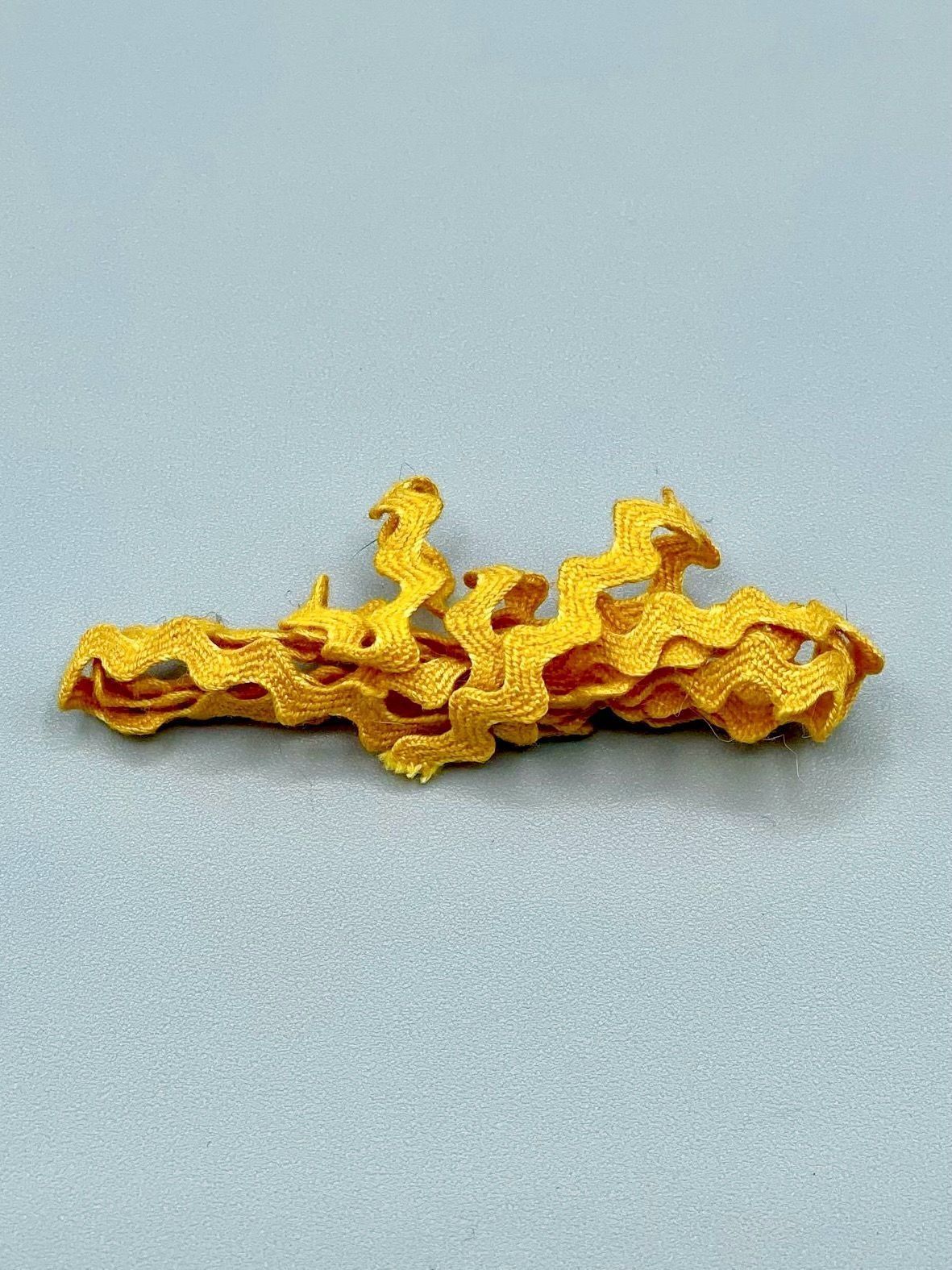
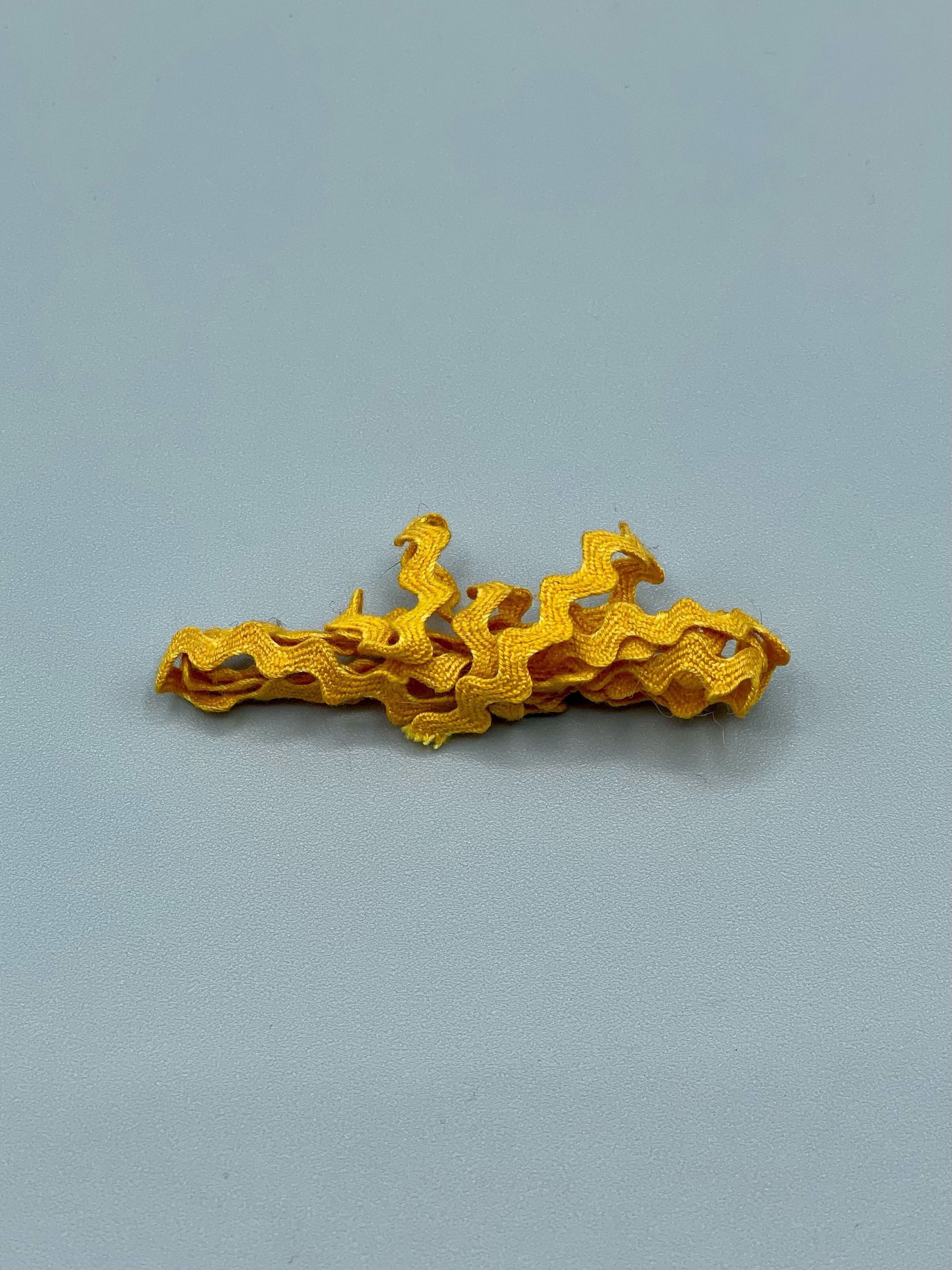
A loose hank of golden-yellow rick-rack — a narrow flat braid woven in a continuous zigzag (serpentine) form, used as a decorative edging or applied trim. The piece is a single length, tangled and folded on itself, with frayed cut ends and a few loose threads. The braid has a soft sheen and the regular chevron profile characteristic of rick-rack. It is a cut length or remnant of yardage rather than a finished article.
2025.1.51
sewing materials of María A. Arús Caraballo
The Cabrera Arús family collection
Gertrudis Caraballo Gálvez collecition
2025.1
U.S.S.R.
Eastern Europe
Europe
MAKER: Unknown; unmarked. Rick-rack is a generic commodity trim; no maker's mark, selvedge lettering, or label is present or expected on the braid itself. DATE / PERIOD: Late 1970s or 1980s.
MATERIALS: Woven textile braid; the visible sheen suggests rayon (viscose) or mercerized cotton, possibly with some synthetic content. Fiber identification is not certain from the image. TECHNIQUES: Rick-rack is produced by a specialized braiding/weaving process that sets the yarns into a fixed, repeating zigzag, yielding a flat braid with finished edges along its full length; no separate hem or selvedge finishing is needed, and there is no distinct "right/wrong" patterned face.
Good
María A. Arús Caraballo
owner
Havana
Cuba
Caribbean
Central America
purchase
This is ordinary rick-rack braid, a staple sewing trim used to edge and decorate clothing and household linens. Unlike the figured ribbons recorded earlier in this work, rick-rack is a structural braid rather than a patterned woven band, so there is no motif, selvedge mark, or weave colorway to analyze; its identity is fully accounted for by its form. As a generic, mass-produced notion it carries no features that would localize a maker or country, and none should be inferred. The braid was bought in Cuba and dates to the late 1970s or 1980s.