
"Нева" (Neva) Soviet Double-Edge Razor Blade Box
Object/Artifact
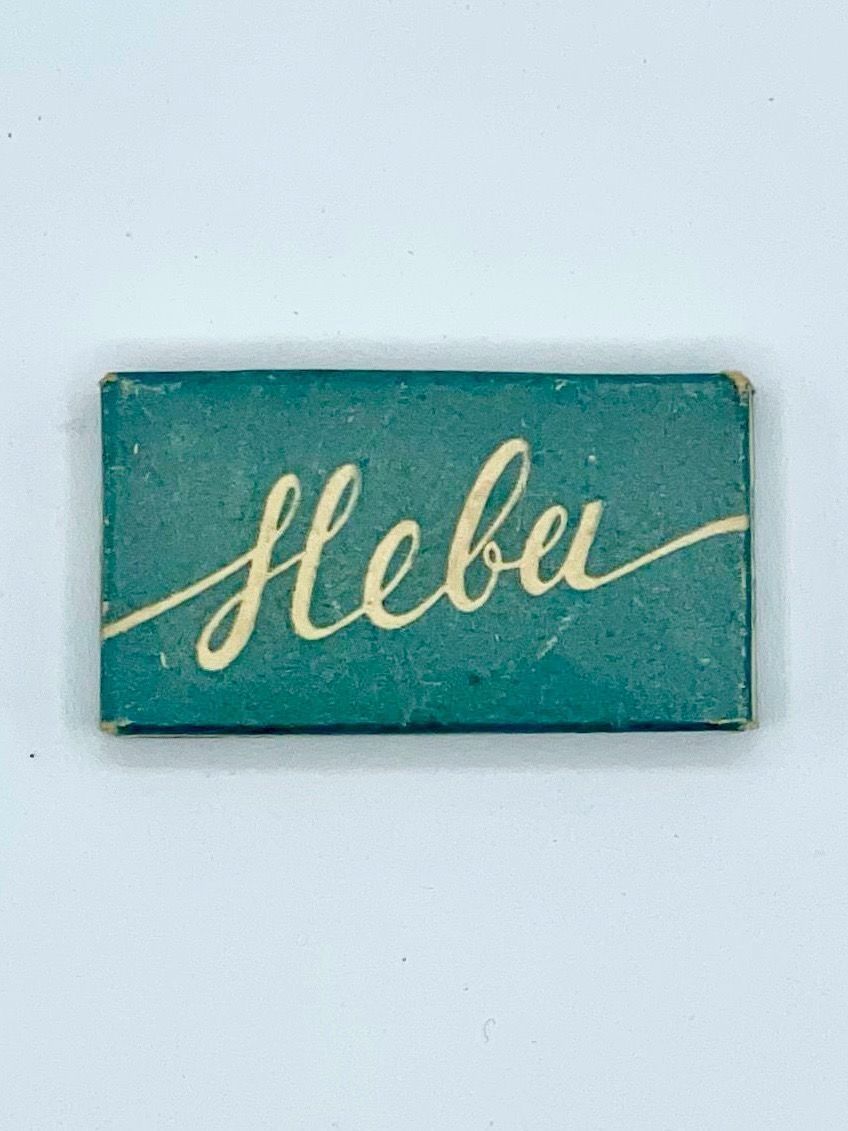
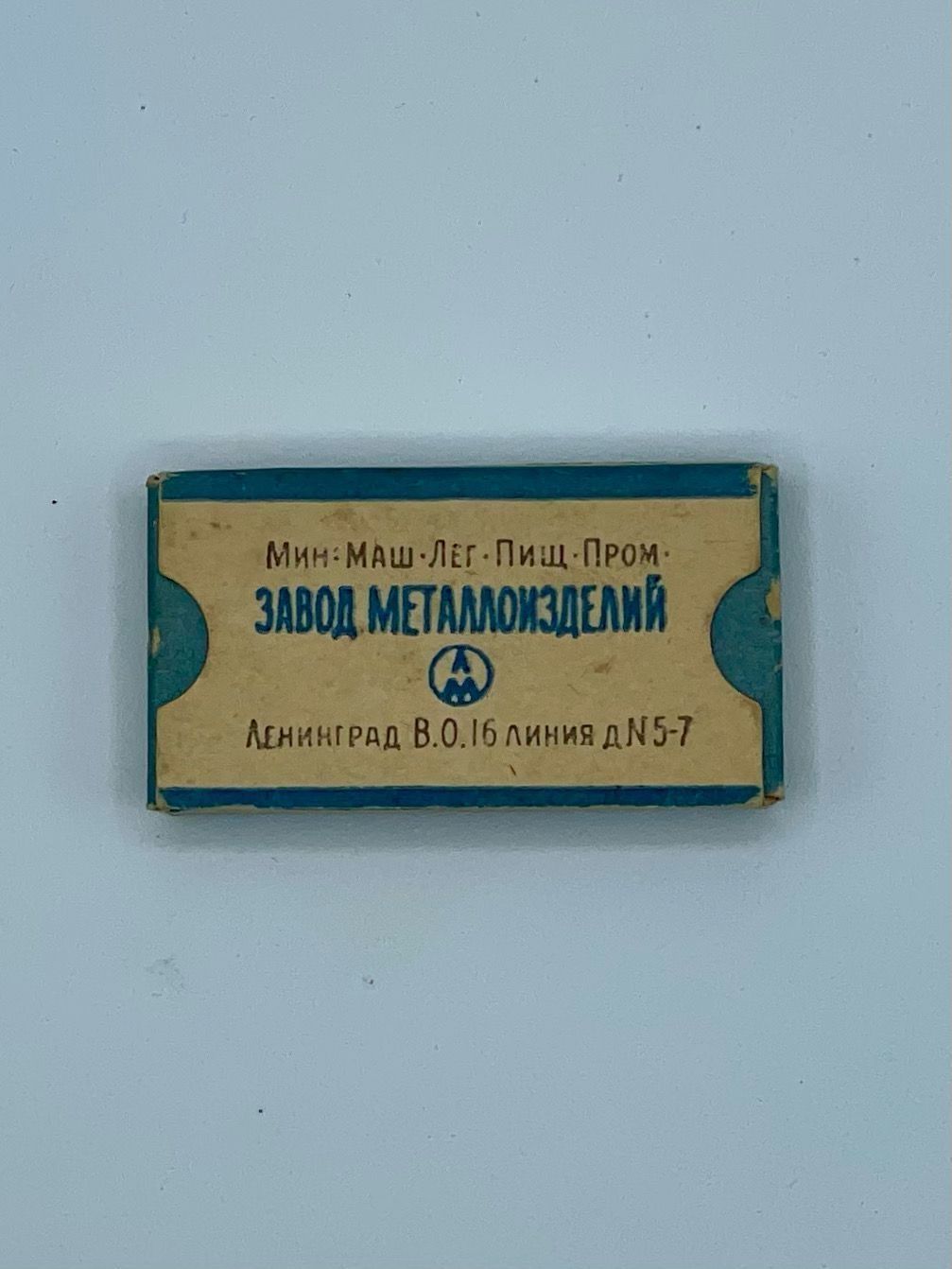
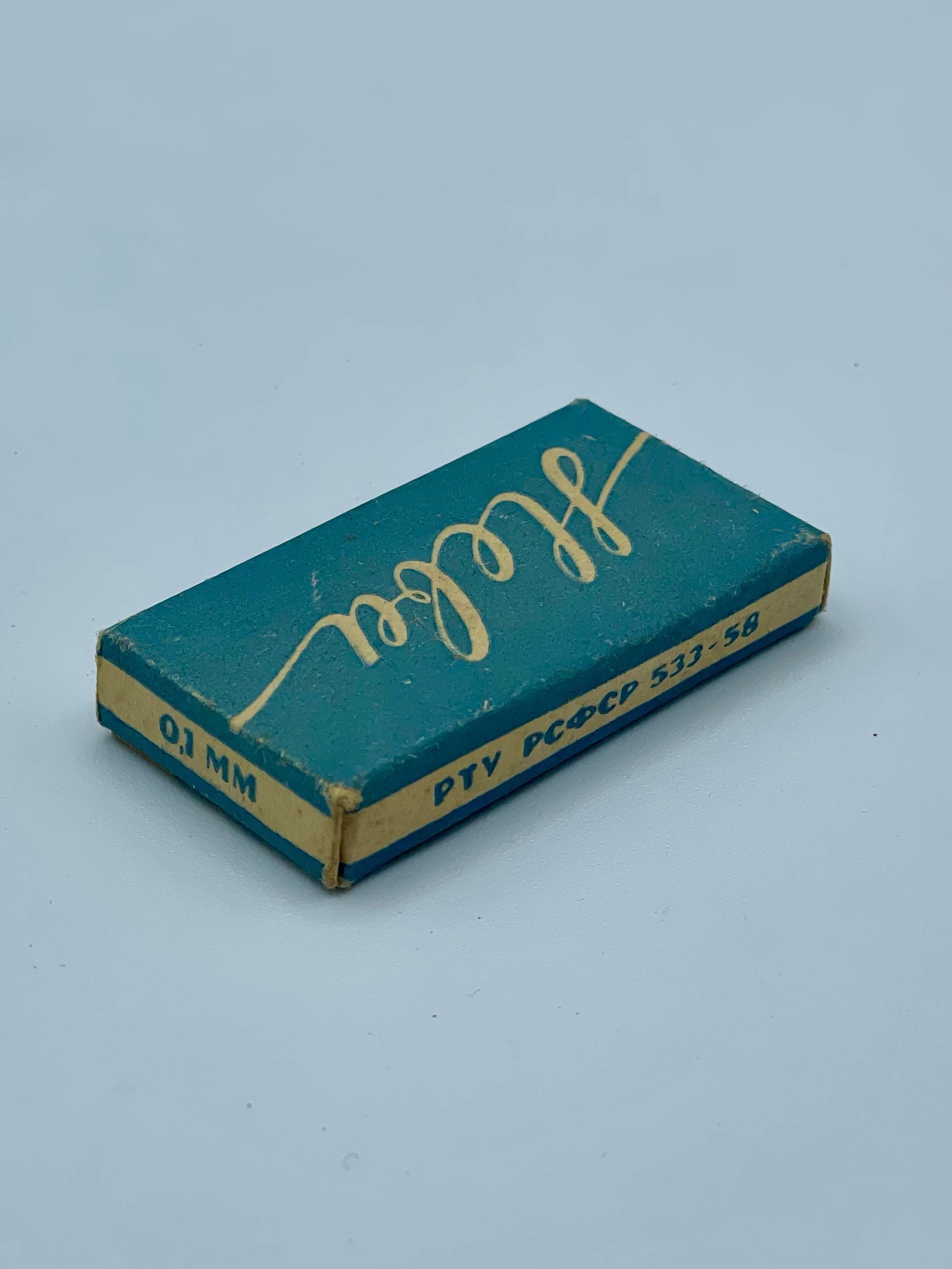
A small cardboard slide-box for "Нева" (Neva) brand double-edge safety razor blades, manufactured at the Завод металлоизделий (Metalware Factory) on Vasilievsky Island, Leningrad, USSR. Bears the brand name in flowing white cursive on a dark teal/blue ground (the river-Neva calligraphic logo); the ministerial designation "Мин·Маш·Лег·Пищ·Пром·" (Ministry of Machine-Building for Light and Food Industry); the manufacturer's address ("Leningrad V.O. 16th Line, House No. 5-7"); the blade specification (0.1 mm); and the Soviet technical-standard number (РТУ РСФСР 533-58, indicating the standard was adopted in 1958). DESCRIPTION: FRONT FACE / TOP (image 1): A dark teal-blue or petrol-blue painted/printed ground. Across the center, the brand name "Нева" (Neva) is rendered in a flowing white/cream cursive hand-drawn script — the letters connected in a single sweeping stroke ending in a horizontal flourish. The script style is restrained and elegant, characteristic of mid-twentieth-century Soviet calligraphic logo design. There is no other text on this primary face — the brand name alone fills the visual field. BACK FACE / OTHER MAJOR FACE: A cream/white rectangular label set against the dark teal/blue ground, with multiple lines of Russian Cyrillic text and a small central emblem: - Top line: "Мин·Маш·Лег·Пищ·Пром·" (with dot separators between syllables) — the abbreviated form of "Министерство машиностроения для легкой и пищевой промышленности" (Ministry of Machine-Building for Light and Food Industry), one of the Soviet industrial ministries - Middle line: "ЗАВОД МЕТАЛЛОИЗДЕЛИЙ" (Factory of Metal Goods / Metalware Factory) in larger bold lettering - Central emblem: A small circular mark - Bottom line: "Ленинград В.О. 16 линия д. № 5-7" (Leningrad, V.O., 16th Line, House No. 5-7) — the specific factory address. "В.О." abbreviates "Васильевский Остров" (Vasilievsky Island), the historic Leningrad district that uses the unique "линия" (line) numbered-street system instead of conventional street names. EDGE / BOTTOM PANEL (image 3): On the long edges of the box, additional technical-regulatory markings: - "0,1 мм" (0.1 mm) — the blade thickness, in Russian Cyrillic - "РТУ РСФСР 533-58" — the Soviet technical standard designation: "РТУ" = "Республиканские Технические Условия" (Republican Technical Conditions, the RSFSR-level standards designation, below the all-Union ГОСТ standard), "РСФСР" = Российская Советская Федеративная Социалистическая Республика (Russian Soviet Federative Socialist Republic — the largest Soviet republic), "533-58" = standard number 533, adopted in year '58 (1958). The box, unopened, contains the blades.
2025.1.34
The Cabrera Arús family collection
2025.1
Zavod Metalloizdelii
Leningrad Machine-Building Association "Leninets"
1960s
Leningrad
U.S.S.R.
Eastern Europe
Europe
The Soviet technical-standard designation "РТУ РСФСР 533-58" places the standard's adoption in 1958, giving a clean terminus post quem — the box itself was produced no earlier than 1958, and likely sometime in the 1960s. The brand name "Нева" and the Leningrad-VO factory location are stable across the period.
Front face (printed): - "Нева" (Neva) — white/cream cursive script Back face / interior label (printed): - "Мин·Маш·Лег·Пищ·Пром·" — abbreviated ministry name - "ЗАВОД МЕТАЛЛОИЗДЕЛИЙ" (Metalware Factory) - Small circular factory emblem - "Ленинград В.О. 16 линия д. № 5-7" (Leningrad, Vasilievsky Island, 16th Line, House No. 5-7) Long edge / bottom (printed): - "0,1 мм" (0.1 mm blade thickness) - "РТУ РСФСР 533-58" (Soviet technical standard, RSFSR, № 533, adopted 1958) Languages: All text in Russian (Cyrillic script). No bilingual labeling — this is a domestic Soviet consumer product, NOT a custom-branded export product.
Cardboard
Good
Leopoldo Arús Gálvez
owner
Leningrad Machine-Building Association "Leninets"
producer
Havana
Cuba
Caribbean
Central America
use
The brand name "Нева" (Neva). The Neva is the major river of Leningrad / Saint Petersburg — flowing from Lake Ladoga past the Hermitage, the Peter and Paul Fortress, and the Admiralty before emptying into the Gulf of Finland. The river is so culturally central to Leningrad identity that "Neva" functioned, in Soviet consumer-goods branding, as a shorthand for "made in Leningrad" — a small piece of urban-civic identity embedded in the product. Many Leningrad-produced Soviet consumer goods (cigarettes, perfumes, candies, small appliances) used "Нева" or similar local-river names as their brand. The flowing cursive logo evokes the river's curves and the city's lyrical self-image. The Vasilievsky Island address. "Ленинград В.О. 16 линия д. № 5-7" gives an extraordinarily specific factory location. Vasilievsky Island (Васильевский Остров, locally "В.О.") is one of the largest and oldest islands in Saint Petersburg, located in the delta of the Neva. Its eastern half was developed in the 18th century under Peter the Great's original plan as a grid of canals; when the canals were filled in, they became "линии" (lines) — numbered streets unique to Vasilievsky Island, running perpendicular to the three main longitudinal avenues (Bolshoy, Sredny, and Maly Prospekts). The 16th Line is one of the canonical Vasilievsky lines, located in the south-central part of the island. House No. 5-7 indicates a specific industrial address near the southern end of the line, in the historically industrial section of Vasilievsky Island. The Metalware Factory (Завод металлоизделий) at this address was one of many small consumer-goods producers concentrated in this Leningrad industrial district. The Soviet ministerial system. The "Мин·Маш·Лег·Пищ·Пром·" abbreviation refers to one of the Soviet industrial ministries responsible for machinery serving the light and food industries — likely "Министерство машиностроения для легкой и пищевой промышленности и бытовых приборов" (Ministry of Machine-Building for Light, Food, and Household-Appliance Industries), known as "Минлегпищемаш" in some configurations. This ministry was reorganized several times during the Soviet period; the abbreviation on this box does not pin down the exact period but places the production within the era of the Soviet planned-economy industrial-ministry system (roughly 1953-1991). The ministry attribution indicates that the factory was a state enterprise within the centralized Soviet industrial system, producing standardized consumer goods to fulfilled state planning targets. The technical-standard designation "РТУ РСФСР 533-58." This is a precise Soviet regulatory marking. "РТУ" stands for "Республиканские Технические Условия" (Republican Technical Conditions) — a category of Soviet technical standards below the all-Union "ГОСТ" (state standard) level, applied to products manufactured for republic-level distribution within a specific Soviet republic. "РСФСР" identifies the standard as RSFSR-level (the Russian republic). "533-58" indicates standard number 533, adopted in year '58 (1958). This standard would have governed the specifications (blade dimensions, steel grade, edge geometry, packaging) of double-edge razor blades produced for distribution within the RSFSR. The standard's 1958 adoption gives a clean terminus post quem for the box: it was produced no earlier than 1958.