
"Admiral" No. 20 double-edge razor blade with wrapper
Object/Artifact
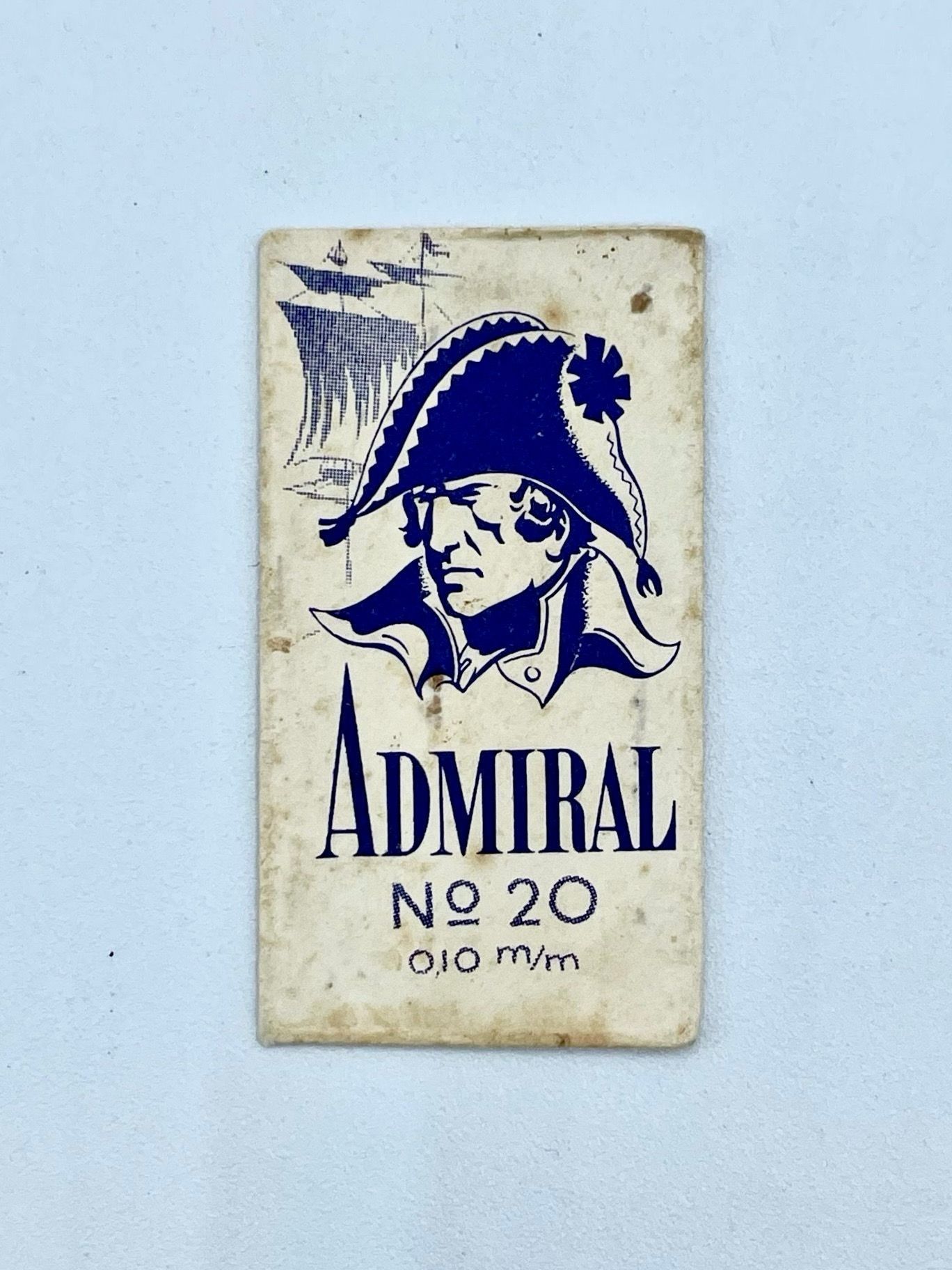
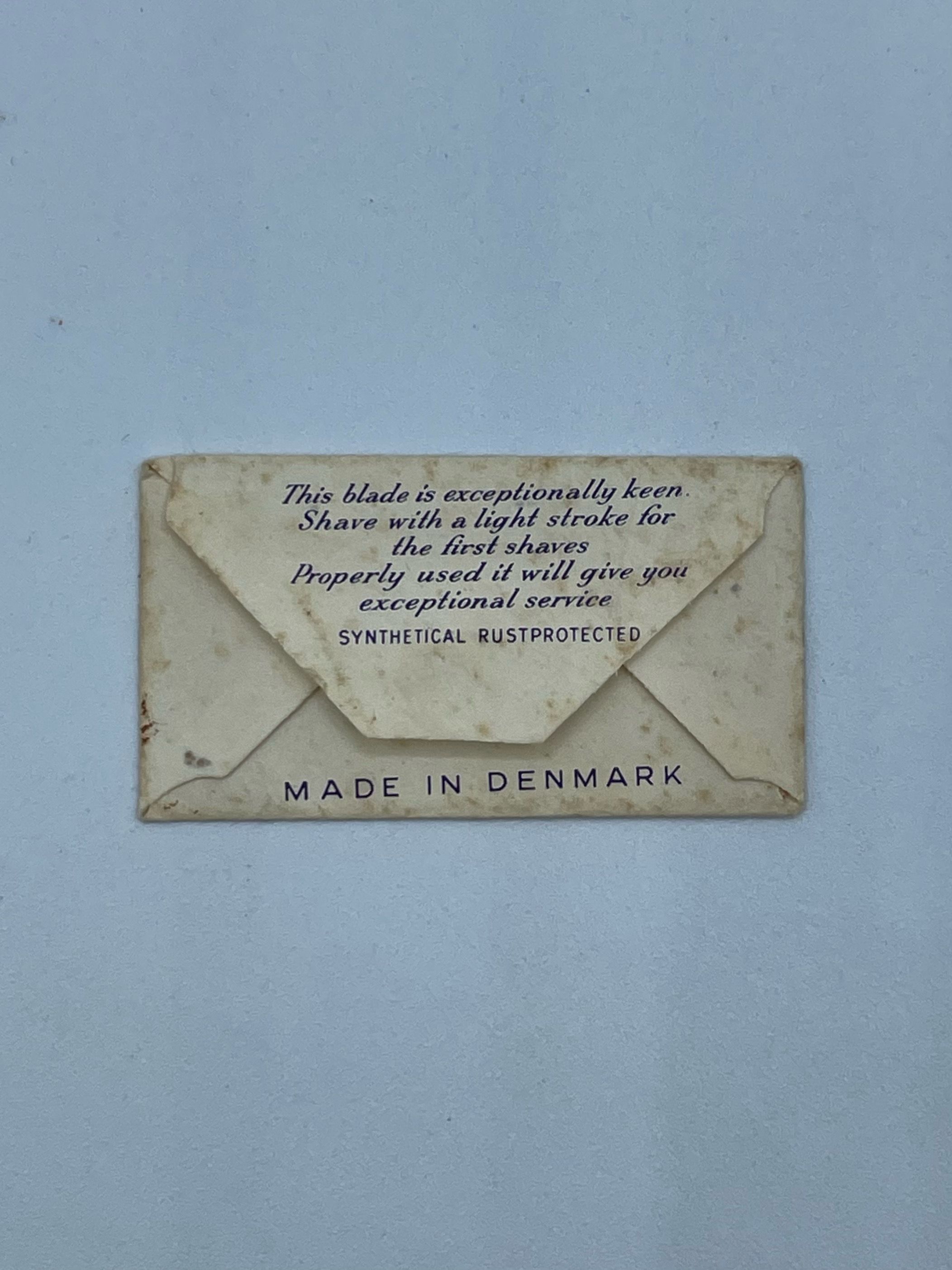
A double-edge razor blade of the "Admiral" brand, retained in its printed paper wrapper. The wrapper is printed in blue on white paper and marked "MADE IN DENMARK," with a naval officer in a bicorne hat above a sailing ship, the brand name "ADMIRAL," a product designation "Nº 20," and a blade-thickness marking "0,10 m/m." DESCRIPTION: A single double-edge (DE) safety razor blade retained in its individual envelope-style paper wrapper, the wrapper shown front and back. The front carries a blue monochrome illustration of a naval commander shown bust-length, wearing a fore-and-aft bicorne hat with a side cockade or rosette, set against a halftone background of a square-rigged sailing ship. Below the portrait, in tall serif capitals, is the brand name ADMIRAL, beneath it "Nº 20," and beneath that "0,10 m/m" (a blade-thickness specification of 0.10 mm, written with the European decimal comma). The reverse shows the closed envelope-fold of the wrapper with printed use instructions in a script face, a line reading "SYNTHETICAL RUSTPROTECTED," and the country of origin "MADE IN DENMARK." The blade is enclosed within the wrapper; it is not separately pictured in the images.
2025.1.39
The Cabrera Arús family collection
2025.1
Denmark
MAKER: Brand name "Admiral." The specific Danish manufacturer is not identified in available reference sources. The wrapper marking gives only the brand and country of origin, with no firm name or factory address visible. DATE / PERIOD: Not marked; undated. Physical and textual evidence suggests a mid-twentieth-century date, most plausibly the 1940s–1950s (possibly into the early 1960s). The emphasis on rust protection ("SYNTHETICAL RUSTPROTECTED") points to a carbon-steel blade rather than stainless, since carbon-steel blades required rust-proofing and predate the widespread adoption of stainless double-edge blades; the metric thickness marking with a decimal comma and the period lettering style are consistent with this window. This date is an estimate from the object, not a documented attribution.
Wrapper front: illustration of a bicorne-hatted naval officer with a sailing ship behind; "ADMIRAL"; "Nº 20"; "0,10 m/m". Wrapper reverse: "This blade is exceptionally keen. Shave with a light stroke for the first shaves. Properly used it will give you exceptional service"; "SYNTHETICAL RUSTPROTECTED"; "MADE IN DENMARK". Languages: English only on the visible faces. The phrasing "SYNTHETICAL RUSTPROTECTED" is non-idiomatic English and reads as a direct rendering from Danish, consistent with packaging produced in Denmark for an English-language export market. No Danish-language text is visible.
Good
Leopoldo Arús Gálvez
owner
Havana
Cuba
Caribbean
Central America
use
The object belongs to the large mid-century category of individually wrapped double-edge safety razor blades, in which each blade was folded into a printed paper sleeve carrying brand imagery on one face and use instructions on the other. The "Admiral" naval-officer-and-sailing-ship motif is a typical example of the maritime and military branding common to the genre, where heroic or authoritative figures suggested reliability and a close, "keen" shave. The product designation "Nº 20" denotes a model or grade within an Admiral line, and "0,10 m/m" specifies the blade gauge (0.10 mm), a standard double-edge thickness. The strongest interpretive clue is the phrase "SYNTHETICAL RUSTPROTECTED." Rust protection was a selling point for carbon-steel blades, which corrode readily; once stainless-steel double-edge blades became widespread, rust-proofing language fell away. This favors a carbon-steel blade and a date before the stainless transition, supporting the mid-century estimate above. The decimal-comma metric marking and the awkward English construction together indicate a Danish maker packaging for export. Targeted searches did not locate documentation specific to the "Admiral No. 20" Danish brand, so the maker remains unidentified pending better sources; the brand attribution here rests on the wrapper itself rather than external confirmation. As period context only, and not as a link to this brand, Danish manufacturers were actively producing and patenting razor-blade packaging in this era: a Danish patent for razor-blade packaging (DK73603C, "Pakning til barberblade") was filed in 1949 and granted in 1952, which situates a domestic Danish blade-packaging industry in the right period. This is offered to frame the object, not to attribute it.