
"Venceremos" Double-Edge Razor Blade Box
Object/Artifact
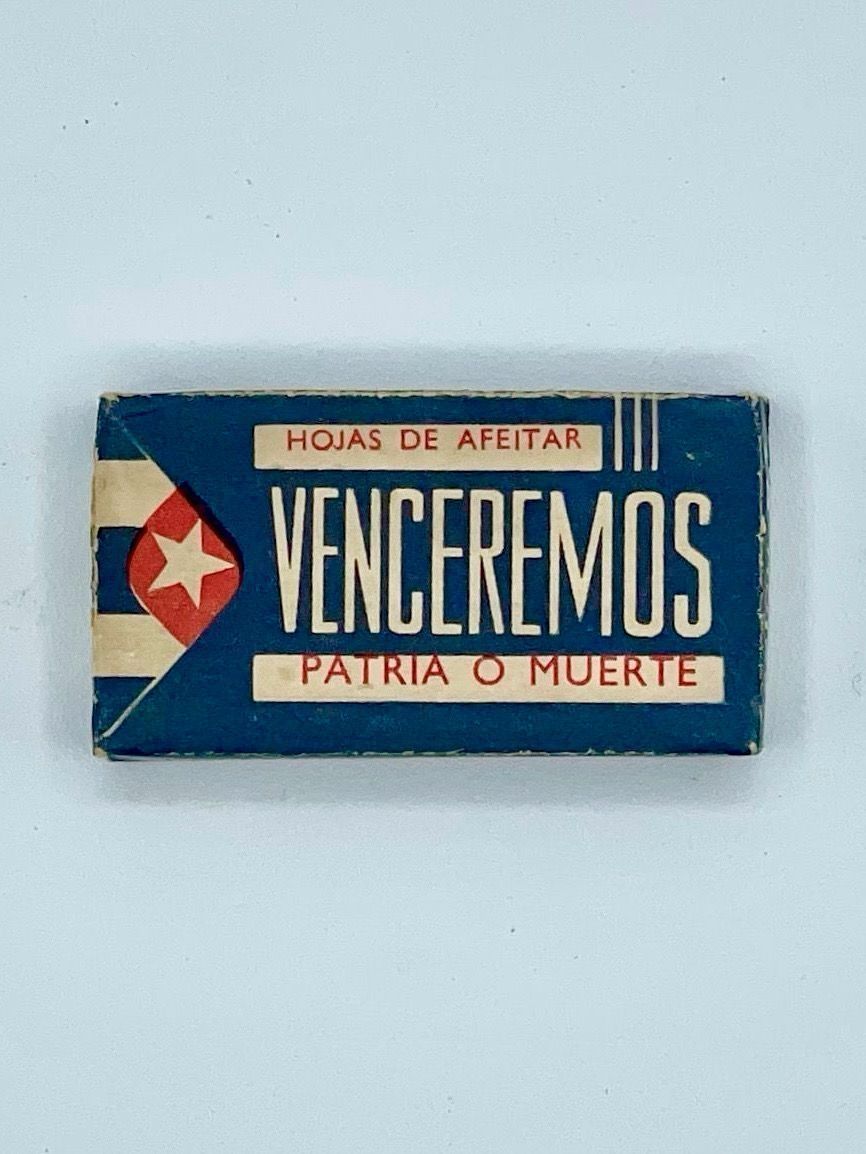
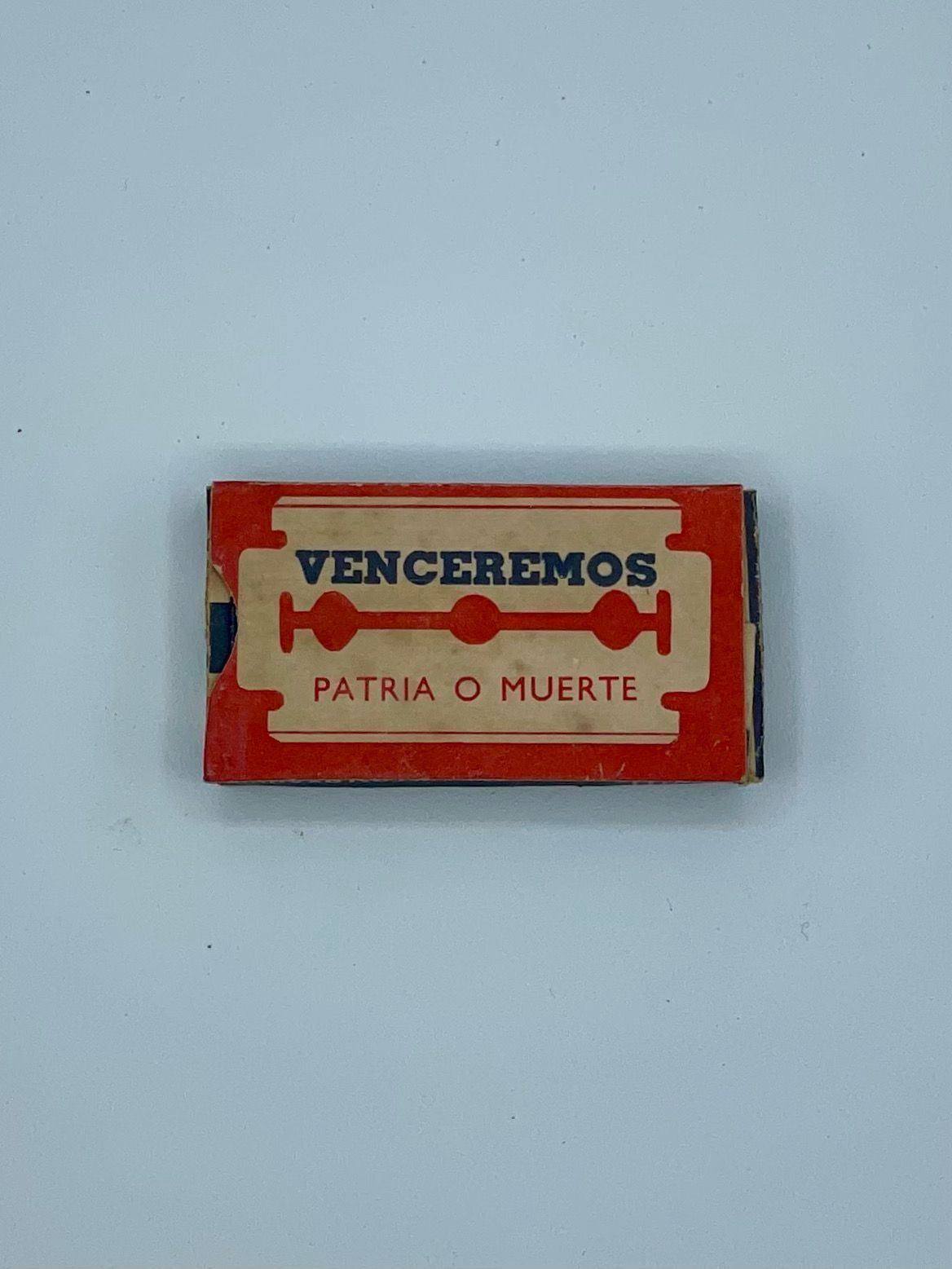
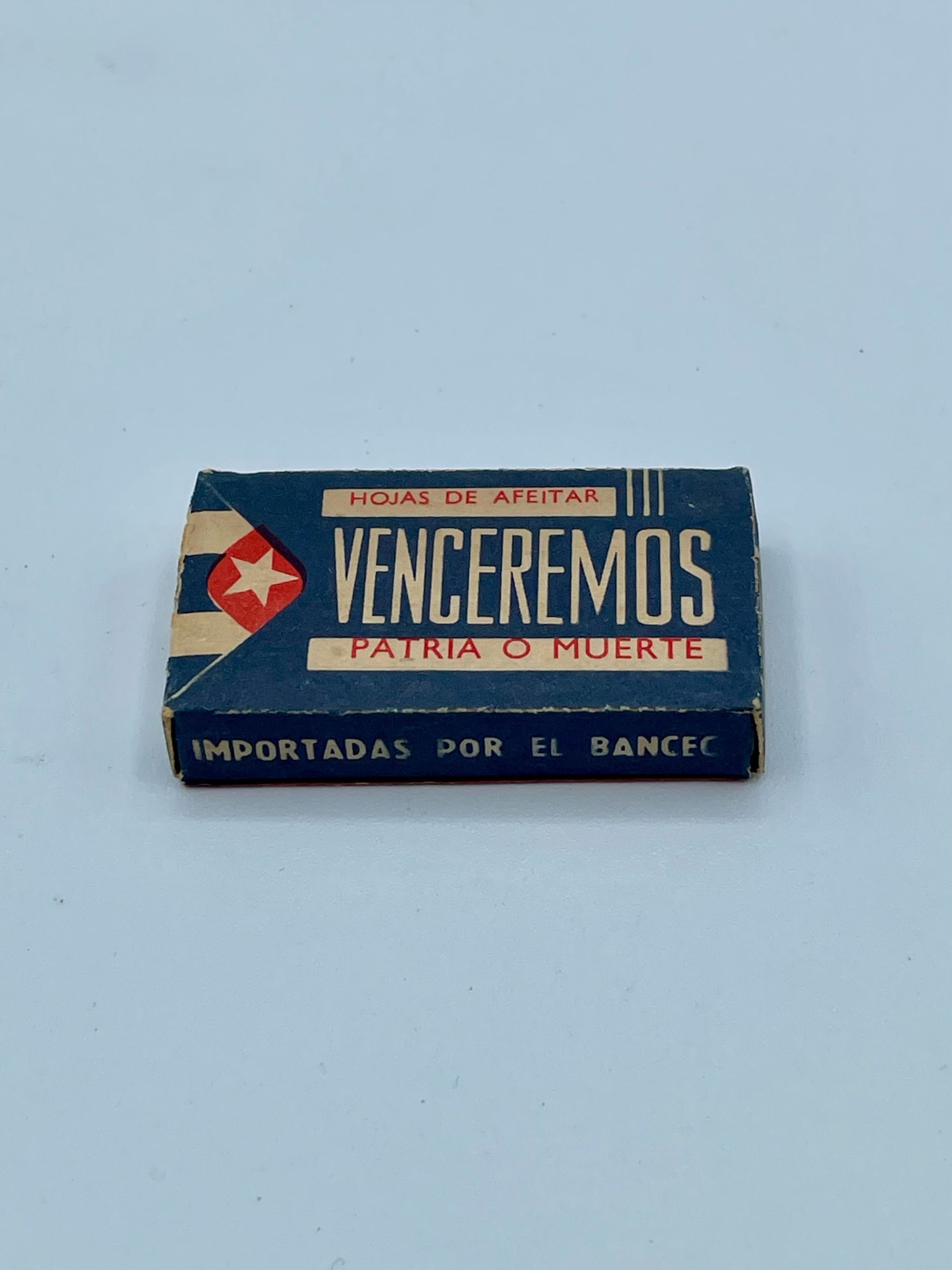
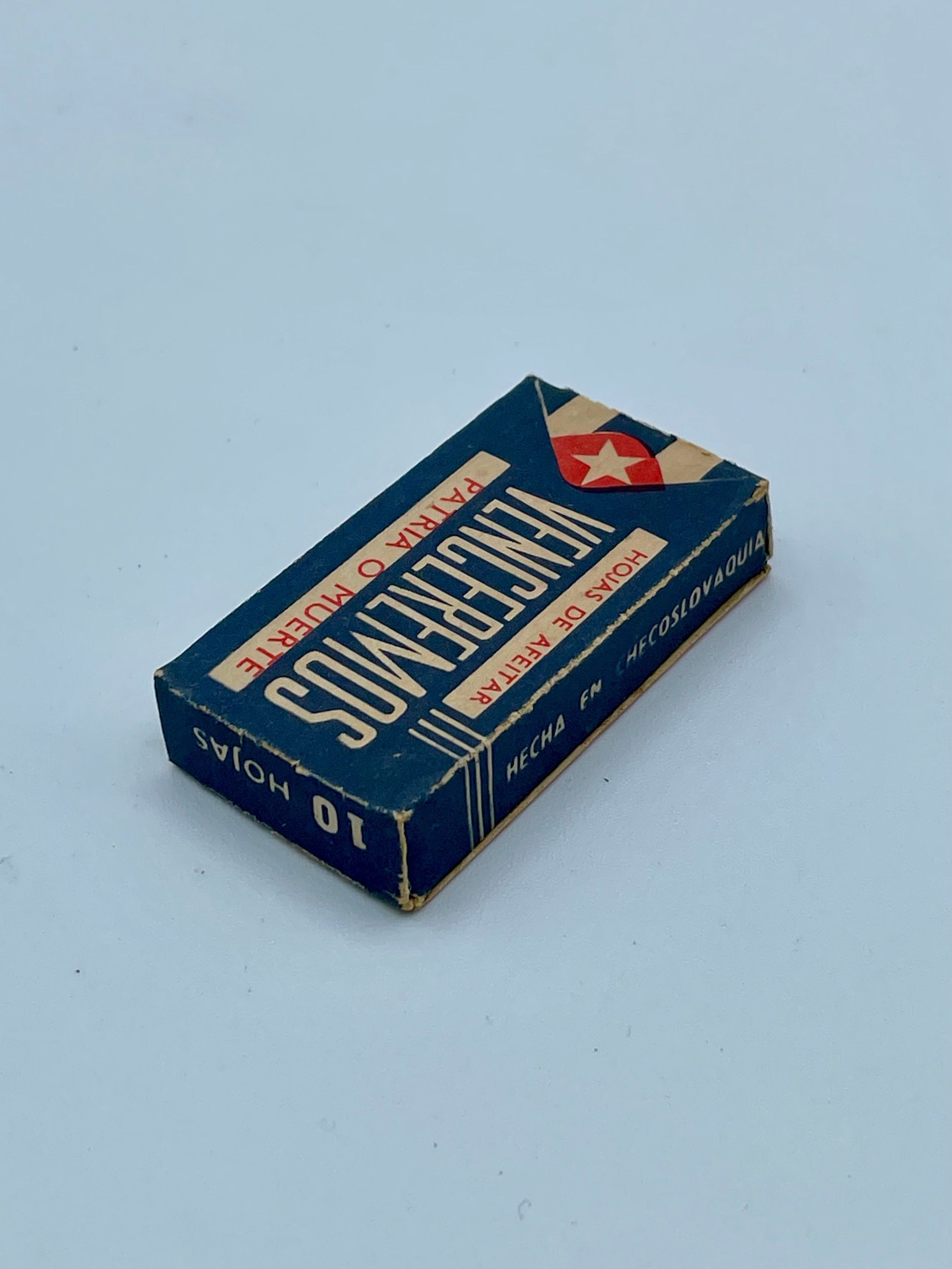
A small cardboard box for "Venceremos" brand double-edge safety razor blades, manufactured in Czechoslovakia and imported into Cuba by BANCEC (Banco para el Comercio Exterior de Cuba). The box bears the Cuban flag, the revolutionary slogan "PATRIA O MUERTE, VENCEREMOS," the importer designation "IMPORTADAS POR EL BANCEC," and the country-of-origin marking "HECHA EN CHECOSLOVAQUIA." The combination of the BANCEC institutional name and the canonical post-La-Coubre revolutionary slogan dates this object to a remarkably narrow window: between approximately March 1960 and February 1961. DESCRIPTION: A small rectangular cardboard slide-box of standard double-edge razor blade dimensions (approximately 8 × 4 × 1.5 cm estimated), printed in multi-color lithography: FRONT FACE: Dark blue ground. At the left edge, a stylized rendering of the Cuban flag — the red triangle with white five-pointed star on the hoist side, and the alternating blue-and-white horizontal stripes extending to the right. Across the body of the box, on a cream/beige banner: "HOJAS DE AFEITAR" (Razor Blades) in red lettering at the top, "VENCEREMOS" in large dark navy block lettering below it (the brand name), and "PATRIA O MUERTE" (Homeland or Death) in red lettering at the bottom — the two halves of Fidel Castro's canonical revolutionary closing phrase ("¡Patria o Muerte, Venceremos!"). Three vertical stroke marks (||| — likely a stylized typographic element or volume mark) appear above and beside the lettering. BACK FACE: A red-bordered cream/beige label that shows "VENCEREMOS" lettering above a red silhouette of a classic double-edge razor blade — the standard blade-shape with the central slot, lobed mounting cutouts, and two long blade edges. "PATRIA O MUERTE" below. LONG EDGE: Continued navy ground. "IMPORTADAS POR EL BANCEC" (Imported by BANCEC) in cream/light-color lettering on the navy ground — the importer designation. On the long edge: "HECHA EN CHECOSLOVAQUIA" (Made in Czechoslovakia) in cream/light-color lettering — the country-of-origin marking. SIDE EDGE: "10 HOJAS" (10 blades) — the quantity. The box is unopened. It contains all its blades.
2025.1.33
The Cabrera Arús family collection
2025.1
circa 1960
1960s
Czechoslovakia
Eastern Europe
Europe
MAKER / ARTIST: Manufactured in Czechoslovakia — specific Czechoslovak razor-blade enterprise not identified on the packaging. Czechoslovak razor blade production during this period was state-organized; candidate factories include the Sandrik enterprise in Dolné Hámre (Slovakia) and other socialized metallurgical works that produced shaving consumables for both domestic and export markets. The packaging was almost certainly designed for the specific Cuban export market — the Spanish-language text, Cuban national symbols, and Cuban revolutionary slogans all indicate this was a custom-branded export product, NOT a generic Czechoslovak blade repackaged in Cuba. IMPORTER: BANCEC — Banco Para el Comercio Exterior de Cuba (Bank for Foreign Trade of Cuba). See Research Notes for institutional history. Bancec was empowered to act as the Cuban Government's exclusive agent in foreign trade. DATE / PERIOD: c. March 1960 – February 1961. This dating follows from two converging institutional facts: (1) Bancec was established by Law No. 793, of April 25, 1960, as the legal successor to the Banco Cubano del Comercio Exterior (Cuban Foreign Trade Bank); and (2) On February 23, 1961, by Law No. 930, Bancec was dissolved and its capital was split between Banco Nacional and "the foreign trade enterprises or houses of the Ministry of Foreign Trade." After February 23, 1961, imports were no longer "por el BANCEC" but by the new MINCEX (Ministerio de Comercio Exterior) enterprises. The "Patria o Muerte" slogan was canonized by Fidel Castro at the funeral oration for victims of the La Coubre explosion on March 5, 1960. The intersection of these two windows gives a maximal range of approximately March 1960 to February 1961, a roughly 11-month window. (Some allowance for residual BANCEC-branded packaging being depleted slightly after dissolution is conceivable, but the cleanest reading is that this object dates squarely from inside the BANCEC institutional period.)
Front face (printed): - Cuban flag graphic (red triangle with white star + blue-and-white stripes) - "HOJAS DE AFEITAR" (Razor Blades) — red - "VENCEREMOS" (We Shall Overcome) — dark navy block lettering, the brand name - "PATRIA O MUERTE" (Homeland or Death) — red - "|||" decorative vertical strokes Back face (printed): - "VENCEREMOS" - Red razor-blade silhouette - "PATRIA O MUERTE" Long sides (printed): - "IMPORTADAS POR EL BANCEC" (Imported by BANCEC) — cream lettering on navy - "HECHA EN CHECOSLOVAQUIA" (Made in Czechoslovakia) Short end (printed): - "10 HOJAS" (10 Blades) Languages: All printed text in Spanish, with Cuban-Spanish orthography. No Czech-language text — the packaging is fully customized for Spanish-language end-users, with the country-of-origin marking translated into Spanish ("CHECOSLOVAQUIA") rather than presented in the original Czech ("ČESKOSLOVENSKO") or in a generic English ("CZECHOSLOVAKIA"). This is a fully Spanish-localized export package.
Cardboard
Good
Leopoldo Arús Caraballo
owner
BANCEC
Havana
Cuba
Caribbean
Central America
use
Czechoslovakia
Eastern Europe
Europe
production
La Coubre explosion
Two institutional and rhetorical facts converge in its packaging to produce a narrow dating window and a rich Cold-War cultural-historical reading: Fact 1: "Patria o Muerte, ¡Venceremos!" as a slogan. The phrase that gives this brand its name was made canonical by Fidel Castro at the March 5, 1960 funeral oration for the victims of the La Coubre ship explosion in Havana harbor. Castro's "Patria o Muerte, Venceremos!" closing of that speech became the signature ritual conclusion of his oratory and the most-reproduced political slogan of the Cuban Revolution. Any consumer packaging bearing this slogan must therefore date from after March 5, 1960. Fact 2: Bancec was established by Law No. 793, of April 25, 1960, as the legal successor to the Banco Cubano del Comercio Exterior (Cuban Foreign Trade Bank), a trading bank established by the Cuban Government in 1954 and jointly owned by the Government and private banks. The bank was capitalized at 6,000,000 pesos ($6,000,000) and its purpose was "to contribute to, and collaborate with, the international trade policy of the Government and the application of the measures concerning foreign trade adopted by the 'Banco Nacional de Cuba,'" Cuba's central bank (Banco Nacional). Bancec acted as the Cuban Government's sole agent for foreign trade for less than ten months. On February 23, 1961, by Law No. 930, Bancec was dissolved and its capital was split between Banco Nacional and "the foreign trade enterprises or houses of the Ministry of Foreign Trade," which was established by Law No. 934 the same day. A consumer good imported "POR EL BANCEC" must therefore have been imported between approximately late spring 1960 and February 23, 1961. The "Venceremos" blade box is therefore not just a shaving consumable. It is witness to the speed of Cuban-COMECON integration in the first revolutionary year. Within months of the canonization of the "Patria o Muerte" slogan, Czechoslovak razor-blade factories were producing custom-branded Cuban-revolutionary consumer goods in Spanish-language packaging for export to Cuba. Within months of BANCEC's establishment as Cuba's foreign-trade bank, that bank was importing Czechoslovak-made Cuban-revolutionary blades into Cuban retail.
The Czechoslovak end. The specific Czechoslovak factory is not identified on the packaging. The major Czechoslovak razor-blade-producing enterprise of the period was Sandrik (with main works in Dolné Hámre, Slovakia, producing cutlery, blades, and small metal goods under socialist nationalization). Other Czechoslovak metallurgical enterprises also produced shaving blades. Identifying the specific factory would require examination of any blade-wrapper insignia or consultation with Czechoslovak industrial-design and trade-archive sources.