
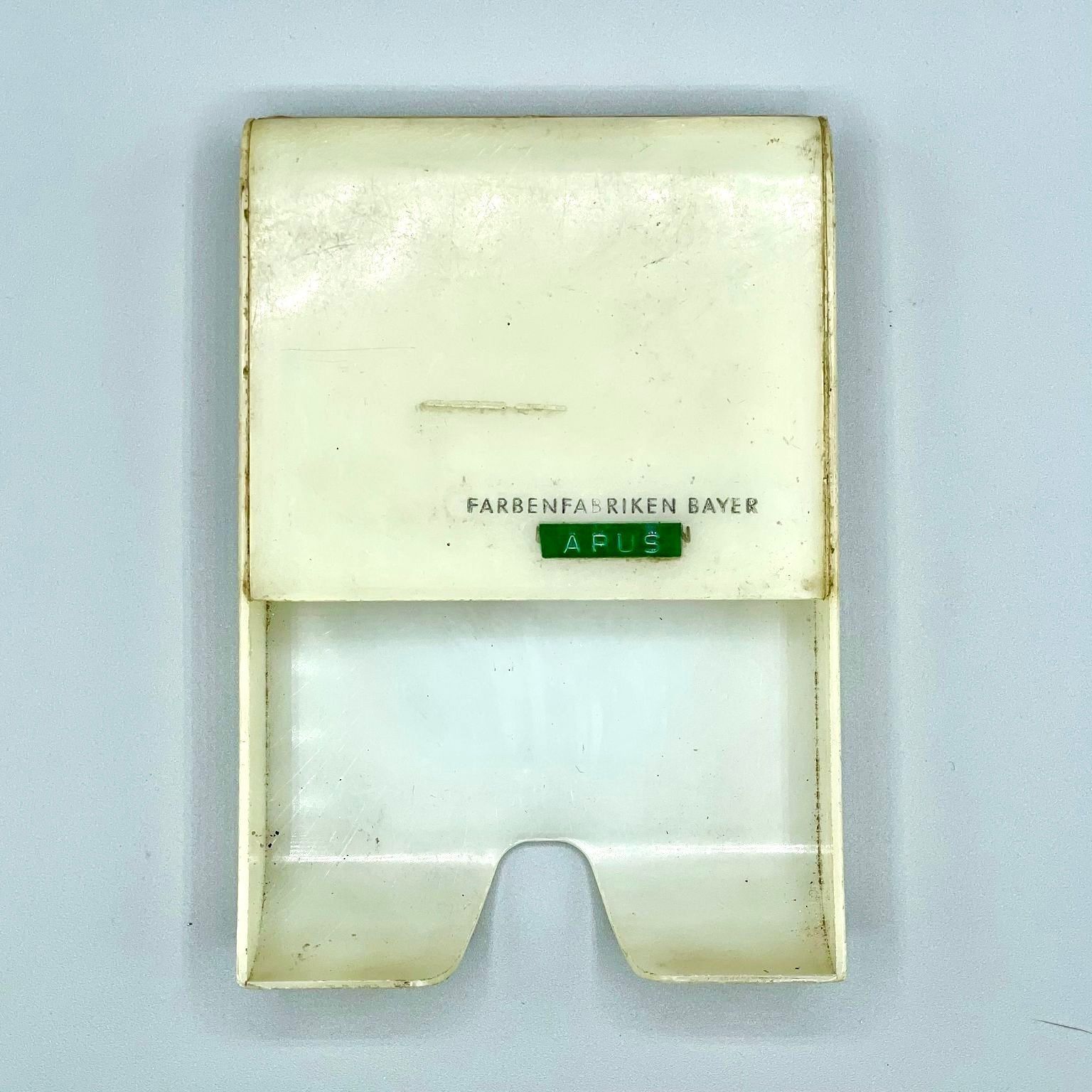
Desk note holder, Farbenfabriken Bayer (owner-marked "Arús")
Object/Artifact
A small cream/ivory rigid-plastic desk note holder: a flat rectangular stand with a solid upright back panel and a shallow front pocket to hold notes, cards, or memo slips, with a U-shaped thumb-notch cut into the front lip for easy removal of the contents and a horizontal slot embossed in the back panel. A branded promotional accessory rather than a container for a product. The back panel is marked "FARBENFABRIKEN BAYER," with a small green applied label beneath reading "Arús" — added by the owner. Empty; the plastic is scuffed and lightly soiled.
2025.1.214
Desk item in the home office of Leopoldo Arús Gálvez
The Cabrera Arús family collection
Leopoldo Arús Gálvez collection
2025.1
Farbenfabriken Bayer AG
Leverkusen
F.R.G.
Central Europe
Europe
Date: Circa 1951–1972 (from the company name); cannot be confirmed within the 1959–1990 range and may fall partly outside it (the 1951–1958 portion predates the collection's start). No explicit date on the object. Flagged for resolution.
"FARBENFABRIKEN BAYER" (brand, on the back panel). Green applied label "Arús" — owner's surname, added later (provenance mark). No date, lot, or country line; faint embossed slot/line on the back panel.
Materials: Molded rigid plastic (cream/ivory); applied green owner's label. Technique: Injection-molded plastic; printed/molded brand mark; owner-applied label.
Fair
Leopoldo Arús Gálvez
owner
Havana
Cuba
Caribbean
Central America
use
Leverkusen
F.R.G.
Central Europe
Europe
production
A branded desk note/card holder — an advertising or office giveaway carrying the Farbenfabriken Bayer name, of the kind pharmaceutical and chemical firms distributed to offices, pharmacies, and clinics. Not product packaging; cataloged as a promotional desk accessory.
The "Farbenfabriken Bayer" name brackets the object to 1951–1972 (the firm became "Bayer AG" in 1972). This is the firmest date evidence and the reason the range fit is uncertain: the 1951–1958 portion lies before the collection's 1959 start, so the holder cannot be confirmed in range without narrowing the date.