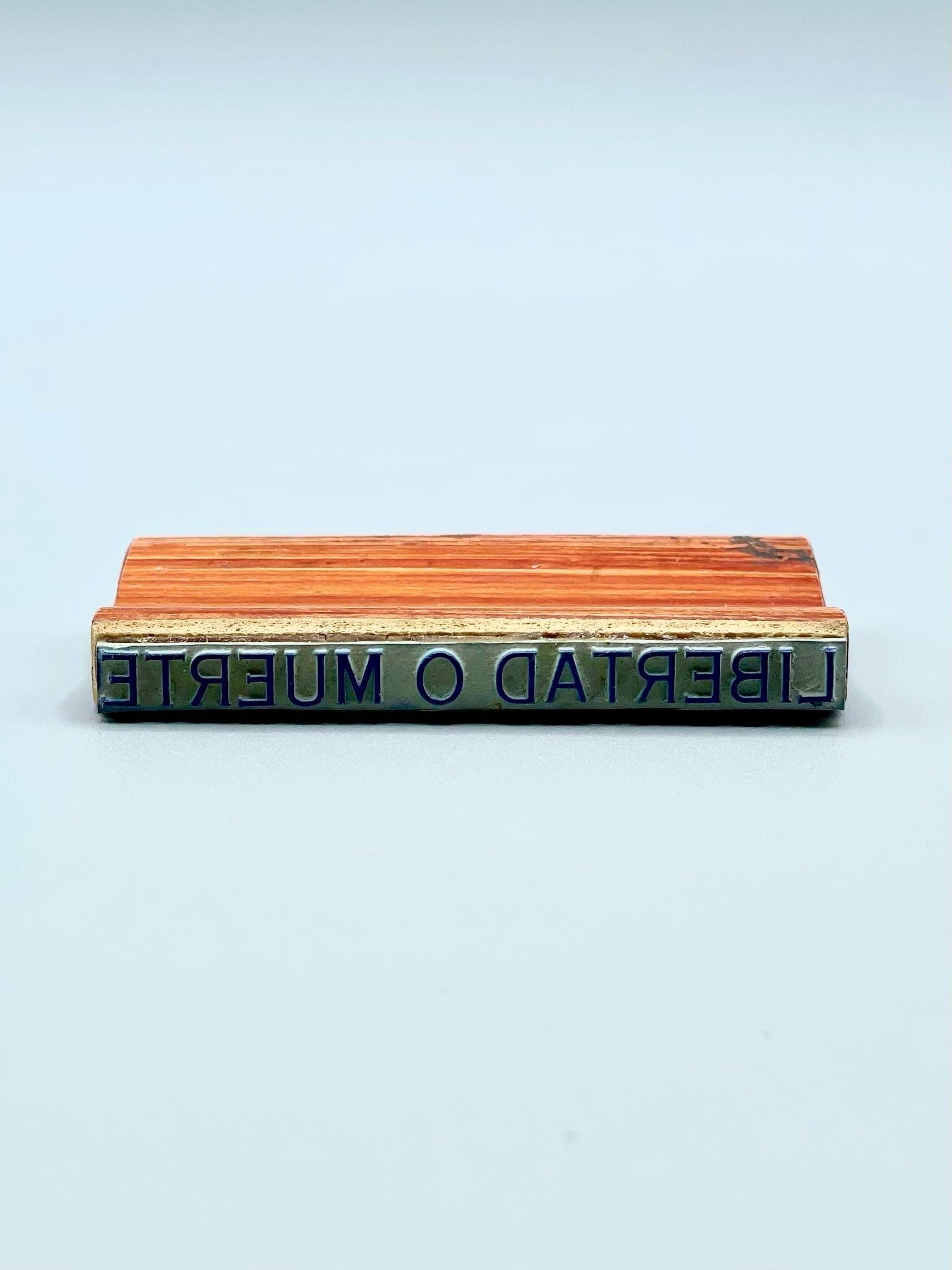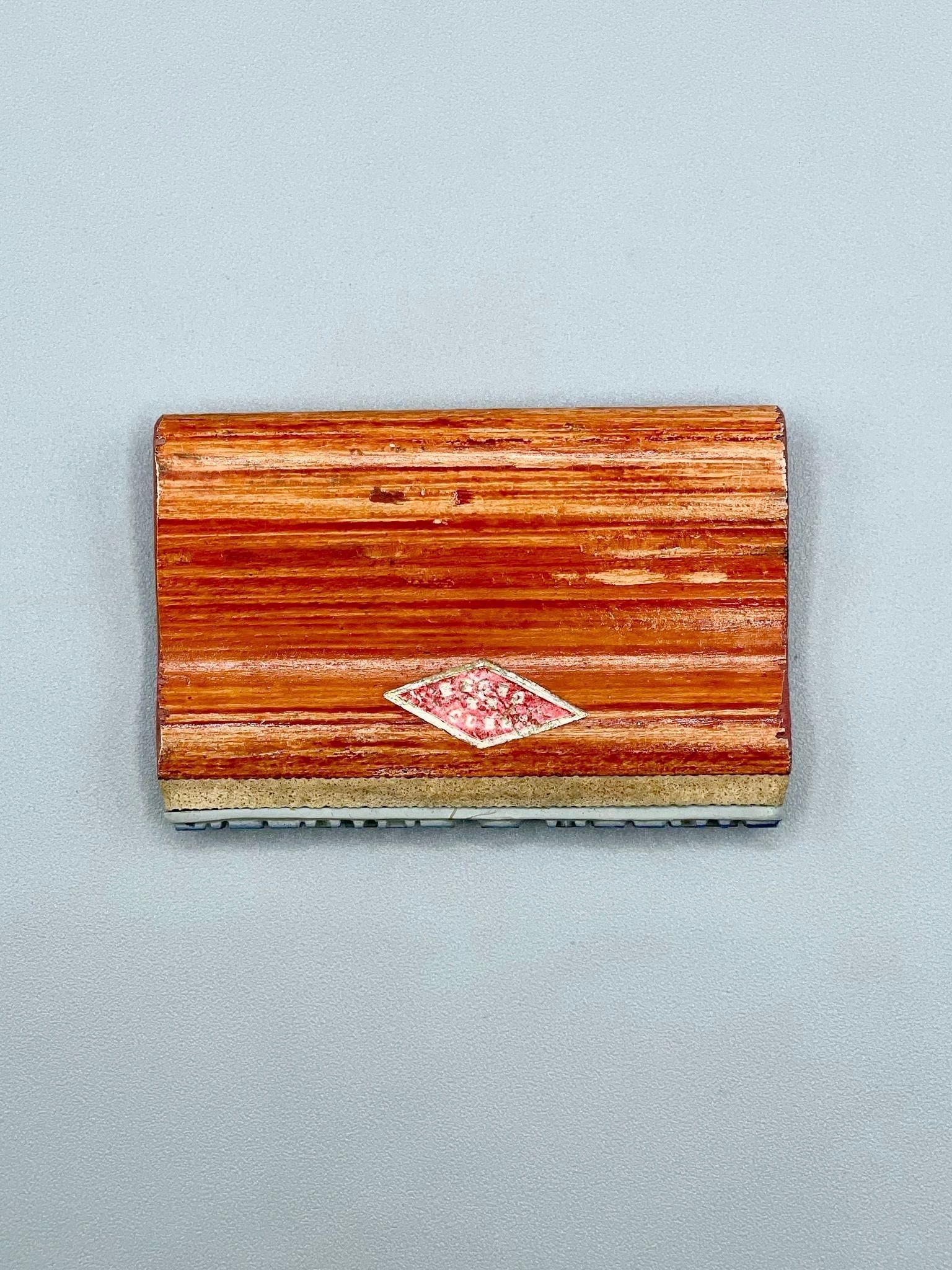
Hand rubber stamp reading "LIBERTAD O MUERTE"
2025.1.103
Kept by Leopoldo Arús Gálvez
The Cabrera Arús family collection
2025.1
circa 1959
Cuba
CaribbeanCentral America
Date Circa late 1950s–1960 (tentative), based on the slogan's political currency; possibly later if used as a deliberate historical echo. Straddles the collection's 1959 lower bound — see date-range note. No explicit date on the object.
Printing die (mirror-reverse, reads in impression as): LIBERTAD O MUERTE. Top of handle: a diamond-shaped paper label reported to read "Hecho en Cuba" (faint, partly illegible). Blue ink residue present on the die.
Materials Wood (handle/mount); vulcanized rubber (printing die); foam/sponge (cushion layer); paper (label); residual ink (blue). Possible metal fasteners (not visible). Technique Turned/shaped and varnished wooden handle; molded/vulcanized rubber die with raised lettering, mounted on a foam cushion and adhered to the handle; applied paper label.
Good
Leopoldo Arús Gálvez
owner
Havana
Cuba
CaribbeanCentral America
use
A Cuban-made rubber hand stamp bearing the slogan "Libertad o Muerte" ("Liberty or Death"). The phrase originates as a rallying cry of Cuba's 19th-century independence wars against Spanish colonial rule, associated with the mambises and the struggles begun in 1868 and renewed in 1895. It re-entered Cuban political discourse as an echo of that independence tradition and was used by Castro's revolutionary movement before "Patria o Muerte" was adopted as the official motto in 1960. The phrasing on this stamp — the older "Libertad o Muerte" rather than the post-1960 "Patria o Muerte" — is therefore consistent with the earliest revolutionary period, while also remaining available for later deliberate invocation of the independence-era motto. The slogan additionally has a wider hemispheric history (the Haitian Revolution's "Liberté ou la mort"; Uruguay's "Libertad o Muerte"), but the "Hecho en Cuba" label fixes this object's manufacture in Cuba. As a domestically produced object carrying a patriotic motto, it documents the everyday political and material culture of the period.
Boundary object — date plausibly close to the 1959 lower bound and not confidently placed inside or outside it. The use of "Libertad o Muerte" rather than the post-1960 "Patria o Muerte" associates the slogan with the insurrectionary and early-revolutionary moment, which straddles the 1959 boundary: pre-1959 insurrectionary use would fall outside the range, while 1959–1960 use would fall inside it. A later commemorative use is also possible.
María A. Cabrera Arús
12/01/2025
María A. Cabrera Arús
06/04/2026