
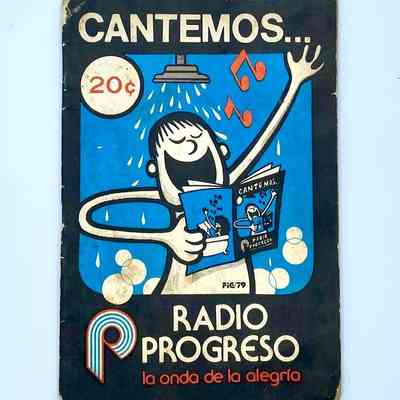
"Cantemos…" — song-lyric booklet (cancionero), Radio Progreso
Saddle-stitched paper songbook with a color-printed cover on a black ground (limited palette of black, blue, white, and red-orange). The cover cartoon shows a figure singing joyfully in a shower — showerhead raining drops, musical notes, soap bubbles, one arm flung up — holding an open copy of this same "Cantemos…" booklet, a recursive image that reprints the cover in miniature. The title "CANTEMOS…" runs across the top in white; a circular "20¢" price roundel sits at upper left; the lower zone carries the Radio Progreso logo (a stylized rainbow-striped "P") with "RADIO PROGRESO" and the slogan "la onda de la alegría." Signed "FiG/79" at lower center. Interior not shown.
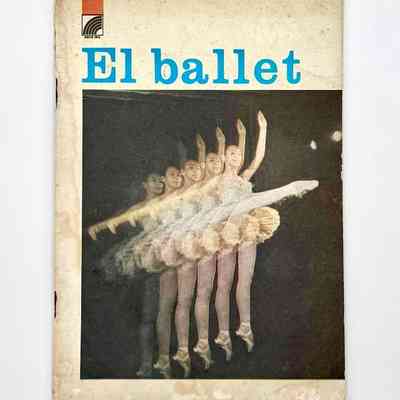
"El ballet" — Colección Arco Iris (Editorial Gente Nueva, 1979)
Children's illustrated educational booklet on ballet, from the Arco Iris series. Front cover: title "El ballet" in blue over a color photograph of ballet dancers in white tutus posed in a receding line on a dark stage; the "ARCO IRIS" rainbow logo with an orange tab at upper left. Back cover (light blue): a color photograph of a single ballerina in a white tutu in arabesque, an emblem at upper right (the International Year of the Child, 1979), and the full credits/colophon with the Gente Nueva logo. Saddle-stitched.
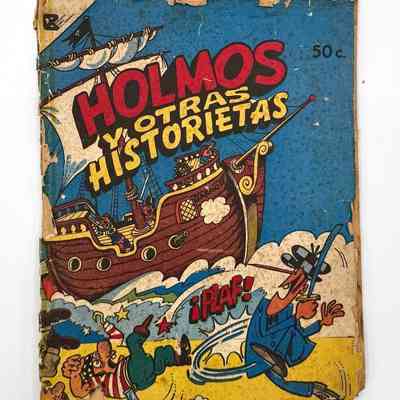
"Holmos y otras historietas" (Cuban humor comic)
Saddle-stitched comic booklet. Color cover with a slapstick scene: a cartoon pirate ship named "GARROTE" crashing through waves with comic pirates aboard, and a tall detective figure (blue suit and hat) being knocked flying, with a red "¡PLAF!" sound effect. Title "HOLMOS / Y OTRAS / HISTORIETAS" in red and yellow display lettering; publisher logo and "EDITORIAL PABLO DE LA TORRIENTE" at upper left; price "50 c." at upper right. Cover is heavily worn (interior not photographed).
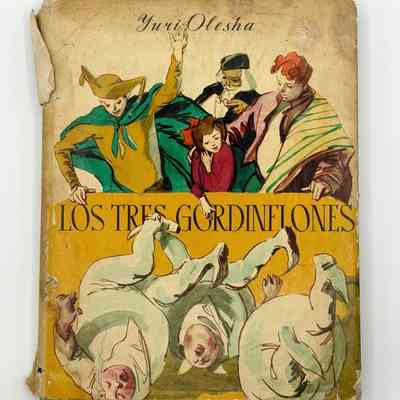
"Los tres gordinflones" (The Three Fat Men), by Yuri Olesha — Gente Nueva / Editorial Progreso, 1974
Illustrated children's book (hardcover with pictorial dust jacket), Spanish translation of Yuri Olesha's Soviet novel. The jacket depicts story characters — an acrobat in a green neckerchief, a girl in a red dress, a red-haired man, and a scholar above an ochre title band, with the three fat men tumbling below — under the title "LOS TRES GORDINFLONES" and the author's name "Yuri Olesha." Cloth binding visible at the spine foot.
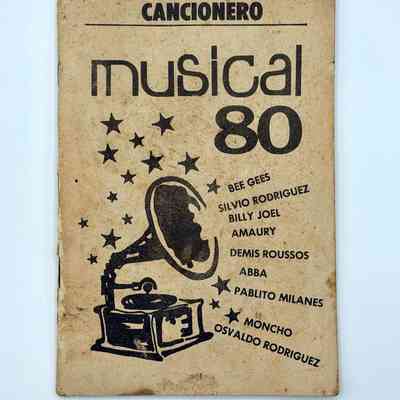
"Musical 80" – song-lyric booklet (cancionero)
Saddle-stitched paper song booklet printed on inexpensive pulp/newsprint stock. The cover, headed "CANCIONERO," carries the large title "musical 80" with a stylized gramophone-and-stars illustration and a printed roster of featured artists: Bee Gees, Silvio Rodríguez, Billy Joel, Amaury, Demis Roussos, ABBA, Pablito Milanés, Moncho, Osvaldo Rodríguez. Interior pages reproduce the lyrics of songs by these artists alongside halftone press photographs; the sample interior leaf (page 48) features a Bee Gees group photograph above printed lyrics to two of the group's songs ("Too Much Heaven," printed "To Much Heaven," and "Stayin' Alive"). Pages are numbered (cover paginated "1"; sample interior "48"), indicating a booklet of roughly four dozen-plus pages. The booklet juxtaposes imported Anglo-European pop with Cuban nueva trova. (Printed lyric text not transcribed in this record.)

"Sherlock Holmes" — Colección Minihistorietas (Cuban comic)
Saddle-stitched comic booklet. Color cover depicting a Sherlock Holmes scene: Holmes (deerstalker, cape, pipe) with a companion and a woman entering a room where a bearded man lies dead on the floor and a green snake rears over the body — consistent with an adaptation of "The Speckled Band." A black "MINIHISTORIETAS" corner banner with the publisher logo and "EDITORIAL PABLO DE LA TORRIENTE" at upper left; title "SHERLOCK HOLMES" in red at top; price "70 c." lower left; artist signature "Domingo García '86" lower center. Interior not photographed.
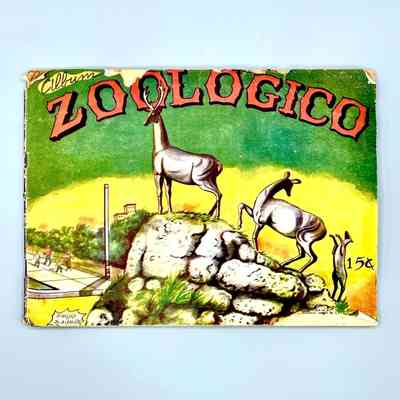
"Álbum Zoológico" — collectible postalita album (Ediciones Mariví)
Landscape-format saddle-stitched paper album for Cuban postalitas (collectible trading cards), into which a numbered series of animal cards was pasted on interior text pages. Front cover bears a color-illustrated zoo scene — antlered and leaping deer/antelope on a rocky outcrop above a zoo path with strolling visitors and a background tower — beneath the display title. Back cover carries a marine illustration (large shark, free diver with speared fish, reef fish, octopus, coral) representing the album's aquarium section. The published series comprised 192 numbered cards spanning mammals, fish, reptiles, amphibians, invertebrates, and birds drawn from Havana's zoo and aquarium (per cataloged series description).
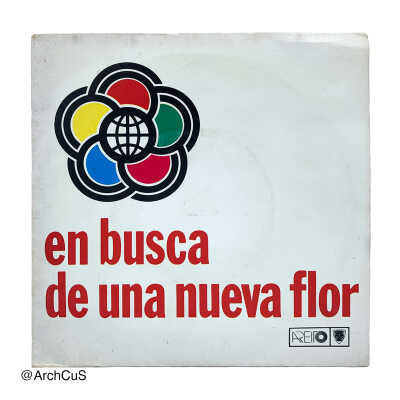
7″ single — En busca de una nueva flor (theme song of the XI World Festival of Youth and Students), Argelia Fragoso / Orquesta EGREM (Areíto 45-7053), jacket and disc
A 7-inch (45 rpm) stereo single with its printed paper picture sleeve. Front sleeve: white ground with the festival emblem — a stylized flower of colored petals (red, yellow, green, blue) ringing a black-and-white globe/grid device — above the title "en busca de una nueva flor" in red; the Areíto logo lower right. Back sleeve: the song's full lyric at left (not reproduced here — see Research Notes), and at right the side-by-side credits, catalog/format line, and recording-studio line; a handwritten "Arús" across the top and a red ring stamp at upper right. Disc: black vinyl with a light-blue label printed with an allover "CUBA 78" and festival-emblem motif; Side B ("CARA B") shown; a handwritten "Arús" on the label.
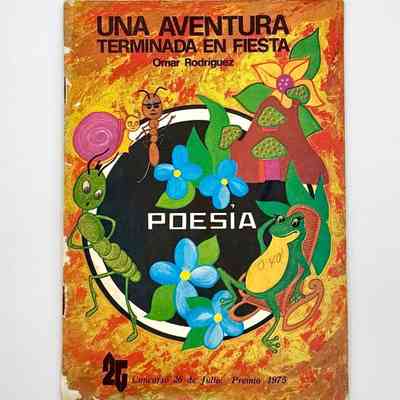
Children's poetry booklet — "Una aventura terminada en fiesta", by Omar Rodríguez (Editorial Gente Nueva, 1978)
A thin saddle-stitched (stapled) children's poetry chapbook with color-illustrated card covers. The front cover, in a bright naïve/painterly style — a grasshopper, an ant in sunglasses, a snail, a frog, blue flowers, and a mushroom-house around a dark oval — carries the title "UNA AVENTURA TERMINADA EN FIESTA," the author "Omar Rodríguez," the genre "POESÍA," a stylized "26" device, and "Concurso 26 de Julio. Premio 1975." The back cover continues the illustration and bears the imprint and credits.
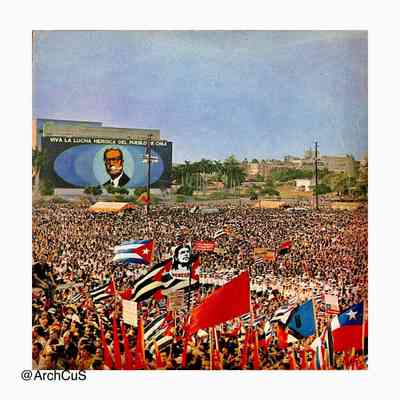
EP jacket (sleeve only) — Canción de los C.D.R. / Marcha del 26 de Julio (Areíto EPA-6432)
A 7-inch EP picture sleeve. Front: a color photograph of a mass rally in a large Havana plaza, with a huge billboard reading "VIVA LA LUCHA HEROICA DEL PUEBLO DE CHILE" above a memorial-style portrait of a bespectacled man; the crowd carries Cuban and Chilean flags, red banners, and a large banner bearing the well-known Guevara ("Venceremos/Vencer") image. Back: dark brown ground with the two-sided track listing, performer and composer credits, the CDR "con la guardia en alto" emblem, the Areíto logo, catalog number, and a design credit.
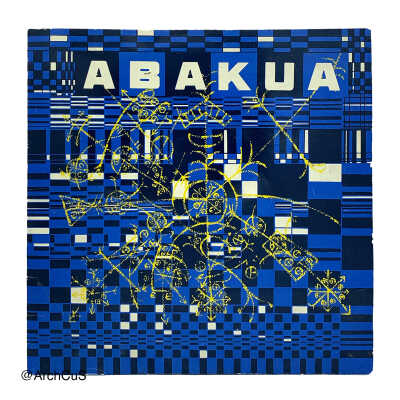
EP record "Abakuá" (Areíto/EGREM 7″ 33⅓ rpm gatefold EP, EPA-6219)
A 7-inch, 33⅓ rpm extended-play vinyl record in a gatefold paper sleeve, produced by EGREM on its Areíto label in collaboration with the Academia de Ciencias de Cuba (Instituto de Etnología, Centro de Estudios Africanistas). It is an ethnomusicological release documenting the ceremonial music of the Abakuá, the Afro-Cuban men's initiatory society: a sample of ritual material including a parla or narration (enkame), several chants (cantos), and procession marches. The blue Areíto disc label is marked "ABAKUA," "CANTOS ABAKUA," "33 rpm," "EPA-6219."
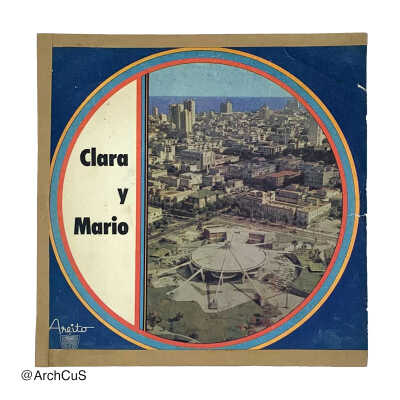
EP record "Clara y Mario" (Areíto/EGREM 7″ 45 rpm EP, EPA-6193)
A 7-inch, 45 rpm extended-play vinyl record in an illustrated paper sleeve, produced and distributed by EGREM on its Areíto label. It is a two-song bolero single by the Cuban duo Clara y Mario: side A "Que Pena Me Da," side B "¿Por Qué Me Has Olvidado?" (credited on the disc label as a bolero by Francisco Olivera). The blue Areíto disc label carries the Taíno cemí device, the EGREM slogan "La música cubana alrededor del mundo," "45 rpm," "EPA-6193."
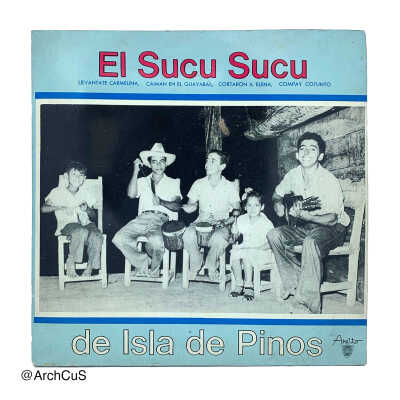
EP record "El Sucu-Sucu de Isla de Pinos" (Areíto/EGREM 7″ 45 rpm EP, EPA-6263)
A 7-inch, 45 rpm extended-play vinyl record in an illustrated paper sleeve, produced by EGREM on its Areíto label in collaboration with the Academia de Ciencias de Cuba. It is an ethnomusicological release — four in-situ field recordings documenting the sucu-sucu, a son-family genre and dance native to Isla de Pinos, with comparative Caribbean examples. Side A: "Levántate Carmelina" (sucu-sucu) and "Caimán en el Guayabal" (son); Side B: "Cortaron a Elena" (a Puerto Rican plena) and "Compay Cotunto" (sucu-sucu). The blue Areíto disc label carries the Taíno cemí device, the EGREM slogan, "45 rpm," "EPA-6263."

EP record "Les Enfants du Pirée and Other Tunes" — Karel Vlach and His Orchestra (Supraphon SUL 33 200)
A 7-inch, 45 rpm extended-play vinyl record in its illustrated paper picture sleeve, issued by Supraphon, the Czechoslovak state record label. The disc carries four instrumental dance-band arrangements by the Czech bandleader Karel Vlach and his orchestra, all cast as foxtrots: "Dancing in the Dark" (Arthur Schwartz), "I Got It Bad" (Duke Ellington), "Les Enfants du Pirée" (Manos Hadjidakis, a slow foxtrot), and "Rockin' Chair" (Hoagy Carmichael). The front sleeve pairs a tinted photo of a young woman with a stylized blue rendering of a harbor and moored caïque boats — a visual nod to Piraeus, the Greek port named in the title track. The back lists the program and cross-promotes three other Supraphon releases (Gery Scott with the Brázda/Brom orchestras, SUK 33385; Karel Krautgartner, SUED 1040-M; Karel Vlach, SUH 23291), and is marked "Made in Czechoslovakia" with a copyright caution citing the Czechoslovak Copyright Act of 1953. The disc label shown (B-side, matrix 45/1142) bears the Supraphon lyre-and-lion device, "EP 45," and the BIEM mark. Sleeve toned and edge-worn; disc appears intact.
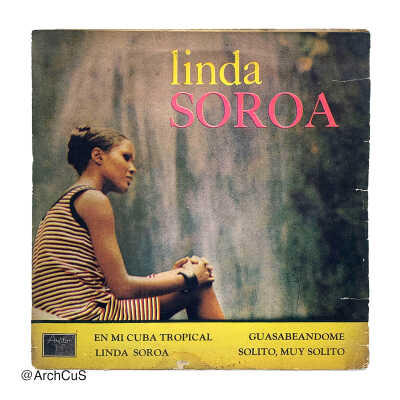
EP record "Linda Soroa" — Ramón Veloz with the guitars of Ojeda (Areíto/EGREM 7″ 45 rpm EP, EPA-6133)
A 7-inch, 45 rpm extended-play vinyl record in its illustrated paper sleeve, produced and distributed by EGREM on its Areíto label (the red-and-white disc label bears the Taíno cemí device and the slogan "La música cubana alrededor del mundo"). It collects four numbers in the Cuban guajira / música campesina idiom sung by Ramón Veloz, accompanied by "las guitarras de Ojeda." Side A: "En Mi Cuba Tropical" (guajira-son, by Roberto de Moya) and "Linda Soroa" (guajira, by Roberto Font); Side B: "Guasabeándome" (son montuno) and "Solito, Muy Solito" (guajira montuno), both by Sergio G. Siaba. The front cover shows a young woman in a red-and-white striped sleeveless top, seated in profile with her hands clasped over one knee, before a soft-focus green cascade — an image evoking Soroa, the Pinar del Río waterfall-and-orchid resort named in the title track. The back credits the color illustration to "Divulgación INIT," the sleeve design to Noelvis (Díaz), gives the catalog number EP-6133, and notes "Producido y distribuido por egrem – La Habana – Cuba – (Curva RIAA)." Condition: heavily aged and edge-worn sleeve, foxed and stained; a pencilled "225" (likely a price or inventory mark) appears on the back.
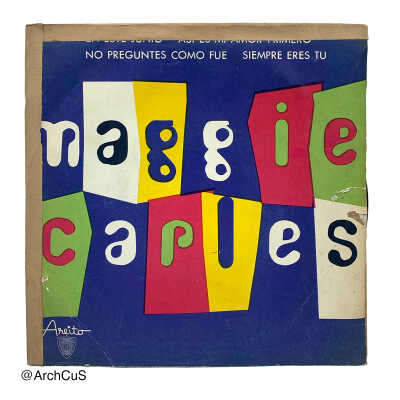
EP record "Maggie Carlés" (Areíto/EGREM 7″ 45 rpm EP, EPA-6152)
A 7-inch, 45 rpm extended-play vinyl record in an illustrated paper sleeve, produced and distributed by EGREM on its Areíto label. Four songs by the Cuban singer Maggie Carlés, all tagged on the sleeve and label as shake (the 1960s beat/go-go dance genre). Side A: "En Este Junio" (Juan Almeida) and "Así Es Mi Amor Primero" (Eddy Gaytán); Side B: "No Preguntes Cómo Fue" (Eddy Gaytán) and "Siempre Eres Tú" (José Pedroso). The red-and-white Areíto disc label carries the Taíno cemí device, the EGREM slogan "La música cubana alrededor del mundo," "45 rpm," "EPA-6152."
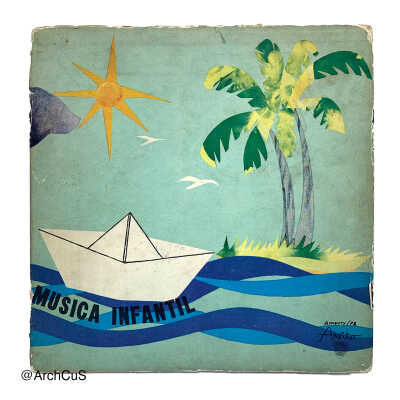
EP record "Música Infantil," Vol. VII (Areíto/EGREM 7″ 45 rpm EP, EPA-6366)
A 7-inch, 45 rpm extended-play vinyl record in an illustrated paper sleeve, produced and distributed by EGREM on its Areíto label — the seventh volume of a numbered Música Infantil (children's music) series. Six children's songs, performed by the credited interpreter "Amigo" with the Orquesta I.C.R. under artistic-musical director Carlos Ansa. Side A: "El Gallo Ciriaco" (Adelaida Suárez), "Qué Lindo es Sembrar" (C. Torriente–W. Riquelme), "El Chinito" (credited to Cri-Cri); Side B: "Las Mascaritas" (Gloria Agramonte), "El Barquito de Papel" (C. Torriente–E. Almanza), "El Mono Tilingo" (Wilfredo Riquelme); arrangements by E. Almanza, W. Riquelme, and Carlos Ansa. The light-blue Areíto disc label bears the Taíno cemí device, "45 R.P.M.," "EPA-6366."
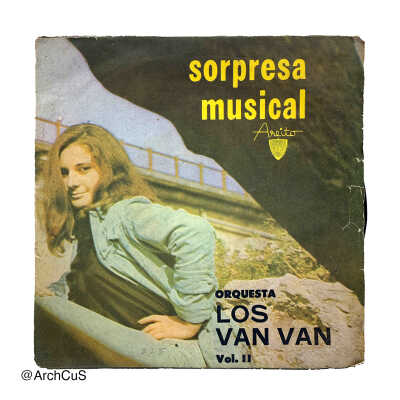
EP record "Sorpresa Musical" — Orquesta Los Van Van, director Juan Formell, Vol. II (Areíto/EGREM 7″ 45 rpm EP, EPA-6169)
A 7-inch, 45 rpm extended-play vinyl record in its illustrated paper sleeve, produced and distributed by EGREM on its Areíto label, part of EGREM's "Sorpresa Musical" EP series. It holds four numbers by the Orquesta Los Van Van under its founder-director Juan Formell: side A "Marilú" and "Laura Chancleta," side B "La Compota" (credited on the disc label as songo, by J. Formell) and "La Bola de Humo" (songo, by Evaristo Aparicio). The red-and-white Areíto disc label carries the Taíno cemí device, the EGREM slogan "La música cubana alrededor del mundo," "45 rpm," "Cara B," "EPA-6169," and "Vol. 2."
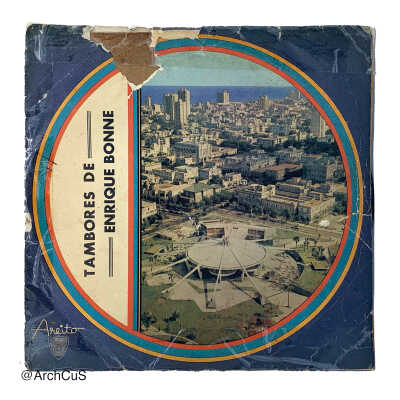
EP record "Tambores de Enrique Bonne" (Areíto/EGREM 7″ 45 rpm EP, EPA-6301)
A 7-inch, 45 rpm extended-play vinyl record in its illustrated paper sleeve, produced and distributed by EGREM (Empresa de Grabaciones y Ediciones Musicales), Cuba's state recording enterprise, on its principal label Areíto — whose logo is a stylized Taíno cemí (idol) mask. The recording presents Enrique Bonne's percussion ensemble (the "Tambores de Enrique Bonne," directed by Bonne). Side A is "Como Arrullo de Palma," a son composed by Ernesto Lecuona, arranged by Enrique Bonne, with soloist Reins (Reinaldo) Maceo; Side B is "Cuando Viene el Tren," a fantasía by Bonne. The disc label carries the EGREM slogan "La música cubana alrededor del mundo," the catalog number EPA-6301, "45 rpm," and "Cara A." The front sleeve frames, inside concentric colored rings, a color aerial photograph of Havana's Vedado district dominated by the circular, spider-roofed Coppelia ice-cream pavilion. The back repeats the title and program, credits sleeve design to Noelvis Díaz, and notes "Producido y distribuido por egrem / La Habana, Cuba – (Curva RIAA)." Condition: heavily worn — front sleeve creased, edge-torn, and with old tape repair at the top corner; the back bears a handwritten ink dedication and a pencilled price, "$4.00."
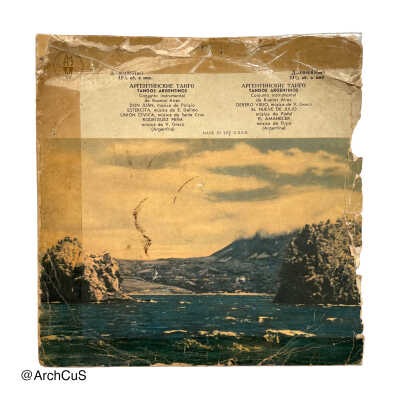
EP record "Tangos Argentinos" (Аргентинские танго) — Conjunto instrumental de Buenos Aires (MK / Soviet pressing, 33⅓ rpm, Д-004082 / Д-004083)
A small-format 33⅓ rpm vinyl gramophone record (likely a 25 cm / 10-inch disc) in a paper sleeve, manufactured in the USSR and carrying the blue "МК" label with its stylized bird device. It collects classic Argentine guardia vieja tangos performed by an unnamed "Conjunto instrumental de Buenos Aires," with bilingual Russian/Spanish credits. Side A (Д-004082): "Don Juan" (música de Ponzio), "Estercita" (E. Delfino), "Unión Cívica" (Santa Cruz), "Rodríguez Peña" (V. Greco). Side B (Д-004083): "Derecho Viejo" (printed "Derero Viejo," V. Greco), "El Nueve de Julio" (Padula), "El Amanecer" (Firpo). The disc label notes "Made in the U.S.S.R.," "33⅓ об. в мин.," the technical spec "ТУ 35," matrix "ХП 558-63," price group ("Третья гр., 0-80"), and a hand-etched runout "Д004082/4-1." One sleeve face reproduces the bilingual track lists over a scenic lake-and-mountains photograph (with the Aprelevka plant's "АЗ" torch emblem); the other is a Mezhdunarodnaya Kniga promotional back listing "Best USSR Variety Orchestras on Soviet Gramophone Records" (Druzhba, the Leningrad and Estonian Radio orchestras, Eddie Rozner, Oleg Lundstrem, the Moscow Variety Theatre and Uzbekistan orchestras).
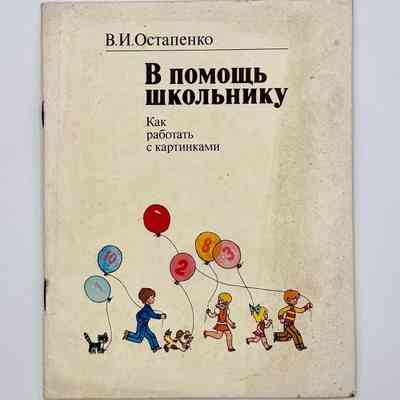
Kak rabotat' s kartinkami (How to Work with Pictures) — methodological guide to V pomoshch' shkol'niku, by V. I. Ostapenko (Russkiy Yazyk, Moscow, 1980)
Soviet Russian-language methodological booklet (teacher's guide) accompanying the picture-based teaching aid «В помощь школьнику» (In Aid of the Schoolchild). Cover: author "В. И. Остапенко" above the title "В помощь школьнику / Как работать с картинками," with a color illustration of five children — plus a cat and a dog — running while holding numbered balloons (1, 2, 3, 8, 10). The title page repeats author and title with the subtitle "(Методические рекомендации к учебному пособию «В помощь школьнику»)" and the imprint "Москва, Издательство «Русский язык», 1980." Saddle-stitched pamphlet.
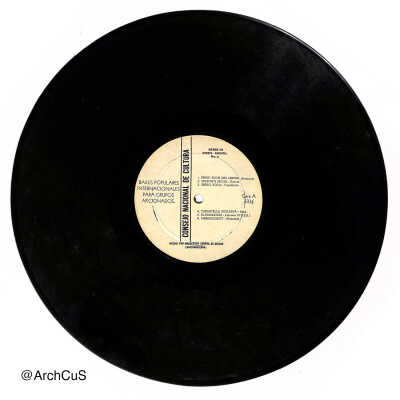
LP disc — Bailes Populares Internacionales para Grupos Aficionados, Serie III (Europa–América) No. 2 (Consejo Nacional de Cultura)
A 12-inch (33⅓ rpm) black vinyl disc with a plain cream label. The label identifies an instructional/educational record of international folk dances for amateur groups, issued by the Consejo Nacional de Cultura and pressed by the nationalized Cuban record plant.
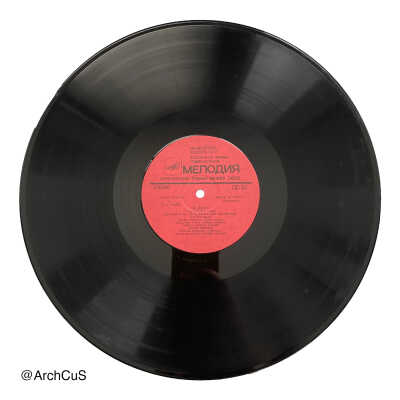
LP disc — Liszt, Piano Concerto No. 1, Lazar Berman / Vienna Symphony Orchestra / Carlo Maria Giulini (Melodiya С10-08985)
Black vinyl 12-inch (33⅓ rpm) stereo disc with a red Melodiya label. The visible side carries Liszt's Piano Concerto No. 1 in E-flat major. This disc belongs to a different release than the jacket that holds it.

LP jacket (sleeve only) — Liszt, Piano Concertos, Valentina Kameníková / Brno State Philharmonic Orchestra / Jiří Bělohlávek (Supraphon 1 10 2085)
Printed paperboard LP jacket. Front: a full-bleed reproduction of a Pieter Bruegel the Elder painting (a summer harvest landscape), overprinted with the title and performers in green and blue lettering; Supraphon logo and catalog number at upper right. Back: title banner, side/track listing, performer credits, recording data, production credits, and a multilingual (English/German/French/Russian) musicological sleeve note on Liszt's concertos. The disc currently inside is not the matching disc (see mismatch note).

LP record "Bill Haley & The Comets" (Polskie Nagrania "Muza" 12″ 33⅓ rpm LP, SX 2417)
A 12-inch, 33⅓ rpm long-play vinyl record in a printed paper sleeve, manufactured by Polskie Nagrania on its "Muza" label — the Polish state record company — and licensed from GNP-Crescendo Records (USA). It collects twelve rock and roll numbers performed by Bill Haley & The Comets: Side A — "I'm Walkin'," "High Heel Sneakers," "Blue Suede Shoes," "Tossin' and Turnin'," "Flip Flop and Fly," "Whole Lotta Shakin' Goin' On"; Side B — "C.C. Rider," "Lawdy Miss Clawdy," "Bring It On Home to Me," "Personality," Haley's own "Crazy Man Crazy," and Chuck Berry's "Rock and Roll Music." The cream Polskie Nagrania/Muza disc label reads "POLSKIE NAGRANIA," "muza," "ZAIKS," "S 33," "SX 2417 A," "GNP - CRESCENDO RECORDS," "Made in Poland." Condition: worn; a blue "409" stamp and a pencilled "L70" on the back.

LP record "Come Fly with Me" — Frank Sinatra with Billy May and his Orchestra (Capitol W920), Cuban pressing "Hecho en Cuba por Panart Nacionalizada"
A 12-inch, 33⅓ rpm long-play vinyl record in a printed paper sleeve — a Cuban-manufactured pressing of Frank Sinatra's 1958 Capitol concept album of travel songs, arranged and conducted by Billy May. The white Cuban "Capitol Discos" disc label (blue Capitol oval, "Alta Fidelidad / Long Playing") gives the catalog number W-920 and is stamped "Hecho en Cuba".
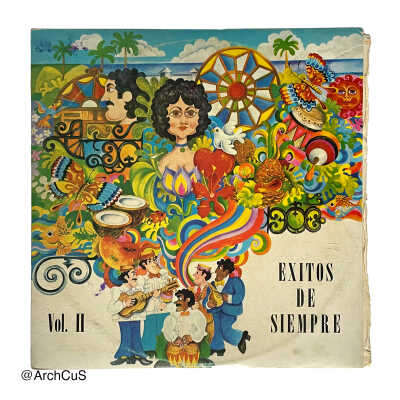
LP record "Exitos de siempre Vol. II" (Guamá / EGREM, LDG-2018)
Compilation of "All Time Hits" of Cuban music. A 12-inch vinyl long-playing record (33⅓ rpm), with its printed cardboard sleeve. The front of the sleeve (first image) carries a vivid, psychedelic-influenced color illustration of a Cuban scene — a stylized woman and man, a son/trova ensemble of musicians with guitar, tres, maracas, and bongó/conga, a Ferris wheel, palms, tropical fruit, butterflies, birds, a radiant sun-face, and a rainbow — with the title "EXITOS DE SIEMPRE" and "Vol. II" lettered at lower right and left. The disc (second image) bears a red label with the "Guamá" script logo and the line "LA MÚSICA CUBANA ALREDEDOR DEL MUNDO / Producido y distribuido por EGREM, Habana – Cuba," marked "33 RPM," "LDG-2018," "CARA A," and the side-A track list. The back of the sleeve (third image) prints the full program for both sides with composers and performers, the EGREM/Guamá logo, "Estudios de Grabación: Egrem, Habana, Cuba," and the catalogue number LDG-2018. The sleeve is worn — edge-split, soiled, foxed, with handwriting and an ink stamp/mark at the upper corners. The disc shows surface/playing wear. Contents (per sleeve): Cara A — Fefita (José Urfé; Orq. Antonio Ma. Romeu), Cubanita (Rodrigo Prats; Abelardo Barroso), Juramento (Miguel Matamoros; Trío Matamoros), Flor de Yumurí (Jorge Anckermann; Barbarito Díez), Frutas del Caney (F. B. Caignet; Ramón Veloz), El Manisero (Moisés Simons; Orq. Enrique Jorrín). Cara B — Masacre (Silvio Contreras; Orq. Antonio Ma. Romeu), Alborada (Celia Romero; Abelardo Barroso), Olvido (Miguel Matamoros; Trío Matamoros), El Erial (Sindo Garay; Barbarito Díez), Amorosa Guajira (Jorge A. González Allué; Ramón Veloz), La Engañadora (Enrique Jorrín; Orq. Enrique Jorrín).
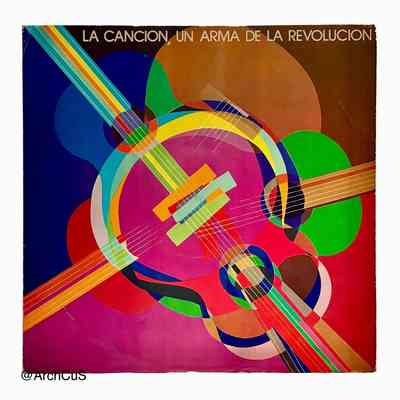
LP record "La canción, un arma de la revolución" — Movimiento de la Nueva Trova (Areíto/EGREM 12″ 33⅓ rpm LP, LDA-3464)
A 12-inch, 33⅓ rpm long-play vinyl record in a printed paper sleeve, produced and distributed by EGREM on its Areíto label. It is a collective anthology of the Cuban Nueva Trova, gathering eleven songs by the movement's young singer-songwriters. Side A: "Hombre que vas creciendo" (Pablo Milanés); "Ñico o el monumento al obrero desconocido" (Vicente Feliú, performed by Grupo Manguaré); "Canto a una primavera" (Miguel Porcel, performed by Argelia Fragoso); and a three-part Girón suite on the Bay of Pigs — "Preludio" (Silvio Rodríguez), "La Batalla" (Eduardo Ramos, performed by Jesús del Valle), "La Victoria" (Sara González). Side B: "Empieza el año" (Vicente Feliú / Ramón Adriano); "¿Quién sabe más?" (Amaury Pérez); "Guardafronteras" (Adolfo Costales, with Margarita Mateo); "Con las letras, la luz" (Noel Nicola); "Mujer del mundo tercero" (Martín Rojas, performed by Cuarteto Tema IV). The blue Areíto disc label reads "La Nueva Trova," "33 R.P.M.," "LDA-3464."
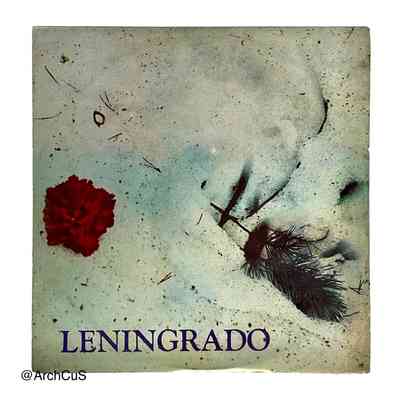
LP record "Leningrado" — music by Juan Almeida (EGREM/Discos Siboney 12″ 33⅓ rpm stereo LP, LD-3672)
A 12-inch, 33⅓ rpm stereo long-play vinyl record in a printed paper sleeve, produced by EGREM on its Discos Siboney label. The album presents music composed by Juan Almeida. Side A is a single extended instrumental, "Leningrado," orchestrated and directed by Rafael Somavilla and performed by an all-star solo lineup: Chucho Valdés (piano), Paquito D'Rivera (alto saxophone), Arturo Sandoval (trumpet, printed "Antonio Sandoval"), Pablo Menéndez (solo guitar), and the rumba group Los Papines, with the Orquesta EGREM. Side B holds six Almeida songs — "La Lupe," "El Campesino José," "El Arriero," "El Balsero del Toa," "Te Canta Mi Tambor," "Marinero Quiero Ser" — each orchestrated by a different arranger (Pedro Coto, Raúl Gómez, Enriqueta Almanza, Juan Pablo Torres, Rolando Baró, Francisco García "Caturla"). The cream Siboney disc label, with a snow-and-pine photo inset, reads "EGREM – Discos Siboney – LD-3672 – 33 R.P.M."
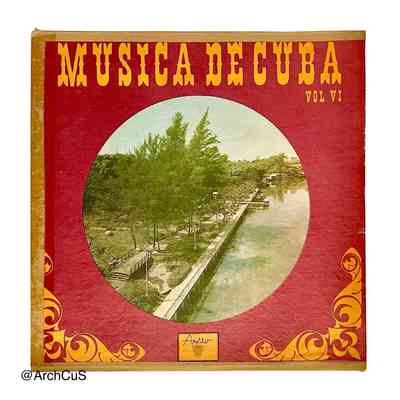
LP record "Música de Cuba", Vol. VI (instrumental) (Areíto/EGREM 12″ 33⅓ rpm LP, LDA-3334, 1969)
A 12-inch, 33⅓ rpm long-play vinyl record in a printed paper sleeve, produced and distributed by EGREM on its Areíto label — the sixth volume of a numbered instrumental "Música de Cuba" series. It presents canonical Cuban repertoire in orchestral instrumental versions, performed by three ensembles keyed on the back by a dot system: the Orquesta del Festival (directed by Gonzalo Roig), the Orquesta EGREM (directed by Emilio Peñalver), and the Orquesta Cubana de Música Moderna (directed by Rafael Somavilla). Side A: "Quiéreme Mucho" (Gonzalo Roig), "Suavecito" (Ignacio Piñeiro), "La Comparsa" (Lecuona), "Martha" (Moisés Simons), "Me Siento Libre" (Raúl Gómez), "Mentira Salomé" (Ignacio Piñeiro). Side B: "Siboney" (Lecuona), "Las Perlas de tu Boca" (Eliseo Grenet), "Tres Lindas Cubanas" (Antonio María Romeu), "¡Ay! Mamá Inés" (Grenet), "Esto es Cubano" (Emilio Peñalver), "Cuba, Qué Linda es Cuba" (Eduardo Saborit). The cream Areíto disc label (globe motif, cemí) reads "Música de Cuba Vol. VI," "33 rpm," "LDA-3334."
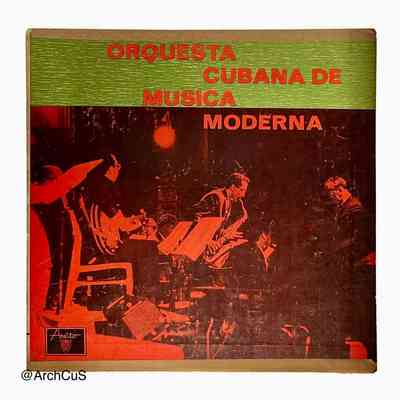
LP record "Orquesta Cubana de Música Moderna" (Areíto/EGREM 12″ 33⅓ rpm LP, LD-3273)
A 12-inch, 33⅓ rpm long-play vinyl record in a printed paper sleeve, produced and distributed by EGREM on its Areíto label. It is the debut album of the Orquesta Cubana de Música Moderna (OCMM), a big band/jazz orchestra directed by Armando Romeu, recorded live at the group's first concert. Side A: "El Manisero" (Moisés Simons), "Room 43" (Ken Jones), "The Man I Love" (Gershwin), "Voy Abajo" (Henry Mancini). Side B: "Pastilla de Menta" (Toombs), "Requiem" (Rafael Somavilla), "Mi Guajirita / Guantanamera" (R. Gómez / J. Fernández). The blue Areíto disc label, with its globe motif, reads "Orquesta Cubana de Música Moderna — Dir. Armando Romeu," the EGREM slogan, and "LD-3273."
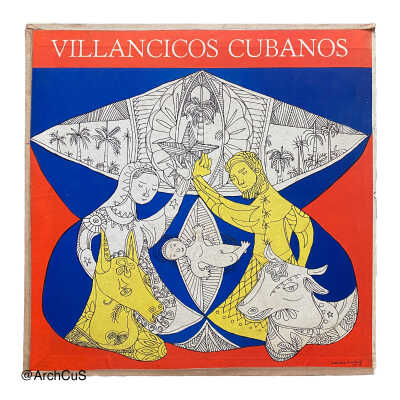
LP record "Villancicos cubanos" — Coro de Madrigalistas, directed by Manuel Ochoa (Puchito 12″ 33⅓ rpm LP, SP-112; matrix ICD-251)
A 12-inch, 33⅓ rpm long-play vinyl record in a printed paper sleeve, issued on Puchito — a Cuban independent label — and "Hecho en Cuba por Impresora Cubana de Discos, S.A." It is a collection of Cuban villancicos (Christmas carols) in art-music settings, performed by the Coro de Madrigalistas under Manuel Ochoa, with soloists Carmelina Rosell (soprano), Marta Pérez (mezzo-soprano), and Laurence Davis (piano). The program ranges from two 18th-century villancicos by Esteban Salas ("Una Nave Mercantil," 1791; "Pues Logra Ya") to twentieth-century Cuban settings by Olga de Blanck, Edgardo Martín, Harold Gramatges, César Pérez Sentenat, Gisela Hernández, Roberto Marín, and Carlo Borbolla, among others — many in a creolized idiom ("Villancico Criollo," "Navidad Guajira," "Al Niño le Gusta el Son," "Son de Navidad," "Guajiro Canta"). The yellow Puchito "High Fidelity" disc label gives the catalog number SP-112. A "$2.95" price sticker, a "Ministerio de Educación – Dirección Gral. de Cultura" stamp, and "207"/"44" annotations on the back.
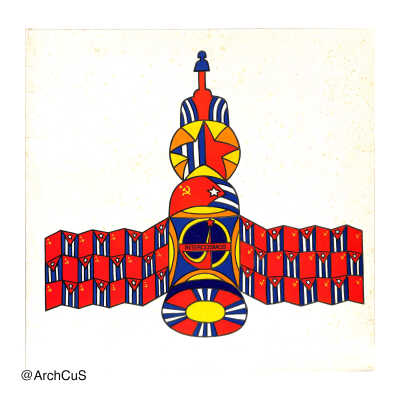
LP record album (jacket), "Vuelo Espacial Conjunto Cubano-Soviético" — EGREM LD-3896
Jacket of a 12-inch LP, a 1980 Cuban musical homage to the first joint Cuban-Soviet crewed space flight. Front cover: a bold flat-color illustration of a stylized orbital spacecraft captioned "INTERCOSMOS," its symmetrical solar-array wings built from rows of alternating Soviet and Cuban flags, crowned with hammer-and-sickle, red star, and Cuban-flag motifs. Emblem panel: the official mission logo — a stylized red-and-blue star device in a circle — arced with "VUELO ESPACIAL CONJUNTO." Photographic panel: a color montage of Soviet space history (Yuri Gagarin in his helmet; Sputnik; a Salyut station marked «САЛЮТ СССР»; Soyuz engine cluster; a rocket launch; cosmonaut training; a recovered «СССР» descent capsule). Back cover: dedication text, full track list, and production credits. Heavy cream paperboard, offset-printed.
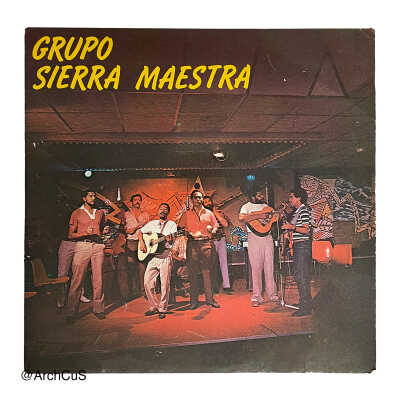
LP record album – "Desde aquí", Grupo Sierra Maestra
LP "Desde aquí" by Grupo Sierra Maestra.
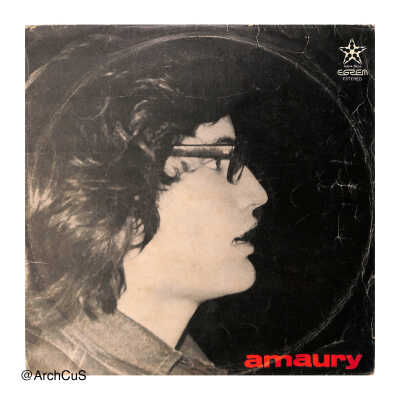
LP record album — Amaury Pérez, Amaury (EGREM / Areíto, LD-3580), jacket and disc
A 12-inch (33⅓ rpm) stereo long-playing vinyl record with its printed paperboard jacket. Front jacket: a high-contrast black-and-white profile portrait photograph (presumably of the artist) within a dark circular vignette on a black ground; the title "amaury" in red, lower right; the "Nueva Trova / EGREM / Estéreo" star device, upper right. Back jacket: cream ground with black text — title "amaury," the two-side track listing with composer credits, performer/production credits, the EGREM logo, format/catalog line, a circular blue inventory stamp ("36"), and a faint handwritten number. Disc: black vinyl with the light-colored Areíto label (Taíno device).
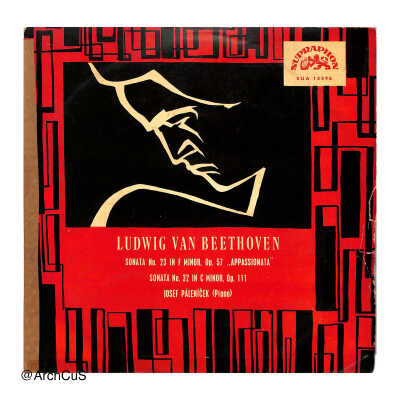
LP record album — Beethoven, Appassionata (Op. 57) & Sonata No. 32 (Op. 111), Josef Páleníček, piano (Supraphon SUA 10096), jacket and disc
A 12-inch (33⅓ rpm) mono LP with its printed paperboard jacket. Front jacket: a bold red/black graphic design with a stylized cream line-drawing of Beethoven's profile against a black panel, over an angular "keyboard/cityscape" pattern; a red title band below carries composer, works, and performer; a Supraphon paper logo sticker with catalog number at upper right. Back jacket: trilingual (English/German/French) musicological note on the two sonatas and a short performer biography, plus a copyright caution; Supraphon logo and catalog number; handwritten inventory marks. Disc: black vinyl with the blue Supraphon label; Side 1 shown (Appassionata).
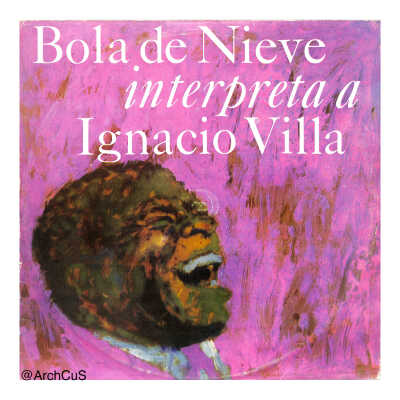
LP record album — Bola de Nieve interpreta a Ignacio Villa (Areíto / EGREM, LD-3214), jacket and disc
A 12-inch (33⅓ rpm) LP with its printed paperboard jacket. Front jacket: a painted portrait — a profile of the singer with eyes closed, mid-song — in greens/ochres against a magenta-pink brushed ground; the title set in white serif and italic lettering across the top ("Bola de Nieve / interpreta a / Ignacio Villa"). Back jacket: title repeated; two-column track listing (Cara A / Cara B) with genre tags; a Spanish liner essay; EGREM logo, catalog number, format, production line, and design credit; a handwritten name and inventory marks. Disc: black vinyl with the light-blue Areíto label (Taíno device)
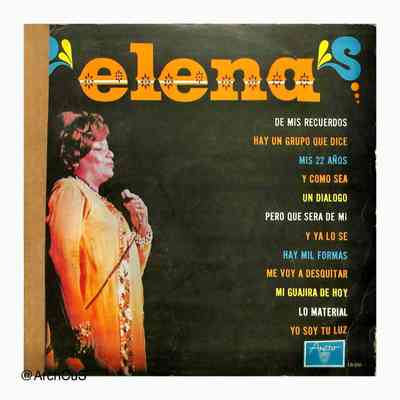
LP record album — Elena Burke, Elena (Areíto LD-3297), jacket and disc
A 12-inch (33⅓ rpm) long-playing vinyl record with its printed paperboard jacket. Front jacket: black ground; the stylized title "elena's…" in orange with blue and yellow droplet/floral accents across the top; at left, a color photograph of the singer in profile in a gold/orange beaded gown, singing into a handheld microphone; at right, a list of the twelve track titles in alternating orange/blue/yellow/white; the Areíto label device and catalog number lower right. Back jacket: cream ground; the title "elena" set vertically in blue at left; full track listing with genre tags and composer credits; Areíto device, catalog number, design credit, and EGREM production/distribution line. Disc: black vinyl, light-blue-and-white Areíto label with the EGREM globe device
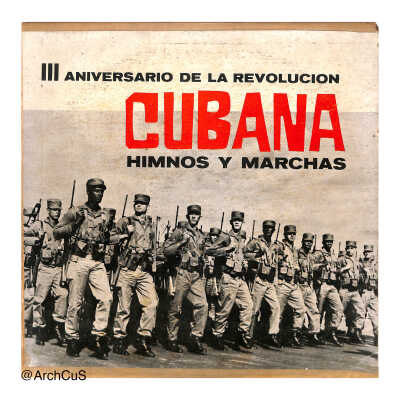
LP record album — III Aniversario de la Revolución Cubana: Himnos y Marchas (Imprenta Nacional de Cuba, INC-1007), jacket and disc
A 12-inch (33⅓ rpm) long-playing vinyl record with its printed paperboard jacket. Front jacket: a black-and-white photograph of uniformed soldiers marching with rifles shouldered, beneath the title set in black and red — "III ANIVERSARIO DE LA REVOLUCION CUBANA" / "HIMNOS Y MARCHAS," with "CUBANA" in large red letters. Back jacket: a black-and-white photograph of a vast crowd filling the Plaza de la Revolución around military vehicles (tanks marked 820, 822, 800, 821); a red title banner; a paragraph of liner text; performer/director credits; the full two-side track listing; and the printer's line. A retail price stamp ("$3.60") and a handwritten/stamped inventory number (appears "374," partly legible) are present. Disc: black vinyl with a patriotic label (blue arc lettering over a red-and-white stylized map of Cuba and musical staff)

LP record album — Mussorgsky, Pictures at an Exhibition, Sviatoslav Richter, piano (Melodiya С10-04771-2), jacket and disc
A 12-inch (33⅓ rpm) stereo LP with its printed paperboard jacket. Front jacket: a large black-and-white profile photograph of the pianist (bespectacled, in formal dress); his name in pink/magenta in Latin and Cyrillic ("Sviatoslav RICHTER / Святослав РИХТЕР"); the work title in red in English and Russian ("M. Mussorgsky / PICTURES AT AN EXHIBITION" / "М. Мусоргский / КАРТИНКИ С ВЫСТАВКИ"); a red-bordered inset color portrait of the composer; Melodiya logo at upper right. Back jacket: performer photo; bilingual (Russian/English) liner essay on the suite; full movement listing; recording and restoration credits; Melodiya logo, catalog/format line, copyright, and "Made in USSR." Disc: black vinyl with the red Melodiya stereo label (Aprelevka plant)

LP record jacket — Bolshoi Theatre Violinists Ensemble (Ансамбль скрипачей Большого театра СССР), dir. Yuli Reyentovich (Melodiya)
This compilation of performances by the Bolshoi Theatre Violinists Ensemble hosts ten pieces recorded in the Grand Hall of Moscow Conservatory between 1981 and 1982. Tracks 1-4 are on Side 1 and tracks 5-10 are on Side 2. Front of a printed paperboard LP jacket. A color photograph shows the ensemble — about twenty musicians in formal black, holding violins and bows — standing across a theater stage before tall draped curtains lit blue, with chandeliers. Title text appears top and bottom in two languages: English in white across the top ("BOLSHOI THEATRE VIOLINISTS ENSEMBLE / Artistic director Yuli Reyentovich") and Russian in blue/violet across the bottom ("АНСАМБЛЬ СКРИПАЧЕЙ БОЛЬШОГО ТЕАТРА СССР / Художественный руководитель Юлий Реентович"). The Melodiya logo and ministry line are at upper right.
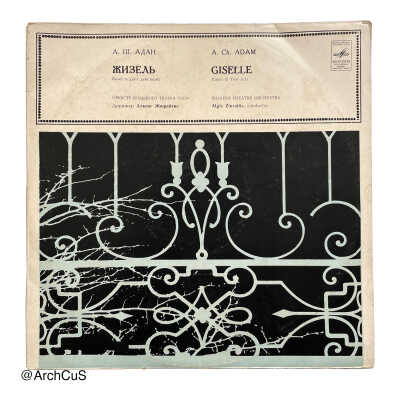
LP record set (2 discs) — Adolphe Adam, Giselle (Жизель), Bolshoi Theatre Orchestra, cond. Algis Žiuraitis (Melodiya СМ 03231-4)
A boxed/double 12-inch (33⅓ rpm) stereo LP set of the complete ballet, with bilingual (Russian/English) printed paperboard covers. • Front cover: a decorative two-color design (pale blue on black) of scrolling wrought-iron grillework, beneath a bordered title block giving composer, title, and performers in Russian and English; Melodiya logo at upper right. • Inner/back panels: full track listings for both acts — one panel in Russian, one in English (“Bolshoi Theatre Version”) — with orchestra, soloists, conductor, and recording-engineer credits; a further panel carries the Melodiya logo and the set’s catalog/format line. • Disc (one shown): black vinyl with the blue Melodiya stereo label The vinyl includes the Bolshoi Theatre Orchestra's performance of the ballet "Giselle," a story of love, death, and loss. Act One commences with the Entrance of Albert, a nobleman who disguises himself as a peasant to win over the heart of the young and beautiful Giselle. However, Albert's deceit causes Giselle to die of heartbreak at the end of Act One. Act Two features Giselle's interaction with the Wilis, spirits of women betrayed by their lovers. Despite Albert's betrayal, Giselle saves him from the Wilis' vengeance, allowing her to rest in peace. The Overture through the Waltz and Dance of Giselle and Albert are on Side 1; the rest of Act One is on Side 2; Myrtha's entrance and Scene through the Entrance and Scene of Albert are on Side 3; the rest of Act Two is on Side 4.
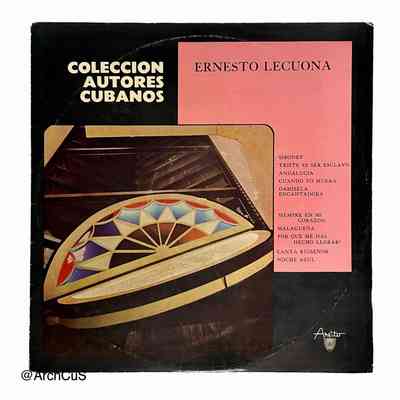
LP record, Ernesto Lecuona ("Colección Autores Cubanos") — Areito / EGREM
A 12-inch 33⅓ rpm long-playing record in a printed paperboard jacket, a posthumous compilation of compositions by Cuban composer Ernesto Lecuona performed by various artists. The front jacket has a black ground with "COLECCION AUTORES CUBANOS" (upper left) and "ERNESTO LECUONA" on a pink panel (upper right), over a color photograph of a Cuban stained-glass fanlight (medio punto) and timber roof; the right panel lists the song titles, and the Areito label logo appears at lower right. The reverse, on cream stock, repeats the artist name, pairs each title with its performer, carries a biographical text on Lecuona, and gives production and catalog data. A purple rubber retail stamp ("Miralda / Galiano 213 – Habana") and a handwritten price ("10.00") appear on the back — a Havana record-shop mark.
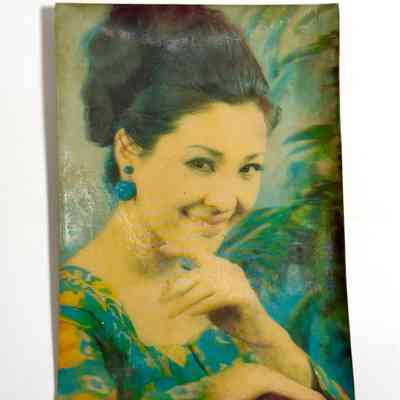
Lenticular "Winking Girl" Postcard (IMCO Stereo Card), with Spanish manuscript message
A lenticular ("3-D"/animated) novelty postcard with a studio portrait of a smiling young woman, her hair in a high bouffant updo, wearing a green-and-yellow floral off-the-shoulder dress and a large turquoise drop earring, posed with her hand near her chin against a soft green-and-blue painterly background. The vertically ribbed lenticular lens animates the image so that, when tilted, the woman appears to wink — the "winking girl" being one of the most popular commercial lenticular postcard motifs of the late 1960s–1970s. The flat photograph shows the characteristic lens ridging and slight rainbow sheen. The reverse is a printed lenticular-card blank used as a postcard, filled with a handwritten message in green ink. Printed marks: "BRIEFPORTO" (German for "postage") in the upper-right stamp box, and "IMCO STEREO CARD" stamped at the lower center — identifying the lens-card manufacturer (IMCO, a German/Western European maker of stereo/lenticular cards). The manuscript message, in Spanish, opens with a greeting addressing several people (tentatively "...Andrés, María y Claudio...") and reads in part: "Aquí va esta postal; si la mueven, verán cómo guiña un ojo..." ("Here is this postcard; if you move it, you'll see how she winks an eye..."), continuing with further remarks (partly illegible, including a line ending "...Se tiene que hacer un buen despojo[?]"), then "Saludos a todos por esa[r]. Un abrazo de," dated "6-2-70" at lower left and signed (tentatively) "Ramón" at lower right. The card is unposted (no stamp or postmark) and is heavily age-toned and stained.
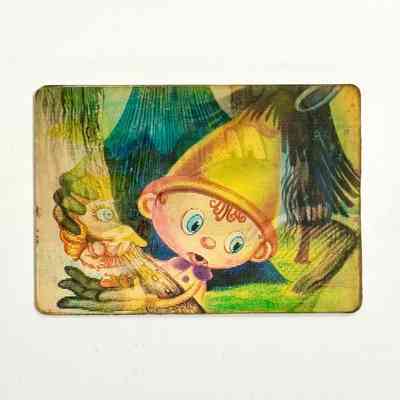
Lenticular ("stereo-vario") pocket calendar, 1985 — Soviet export for the Cuban (Spanish-language) market
Small rectangular lenticular pocket-calendar card with rounded corners and a finely ribbed lens surface. The picture side carries an interlaced ("flip") color illustration that alternates between two children's fairy-tale scenes depending on viewing angle: (1) a wide-eyed child in a pointed pixie/gnome cap amid toadstools and foliage, with a small cursive Cyrillic word worked into the artwork; (2) a fluffy big-eyed kitten beside a duck among pond reeds, with a small dark animal peering from a burrow at the rear. The reverse carries a printed 1985 calendar: twelve months in Spanish (enero–diciembre) in four rows of three, weekday columns lettered L M M J V S D (lunes–domingo, week beginning Monday), with Sundays/holidays in red, all within a dotted diamond border.
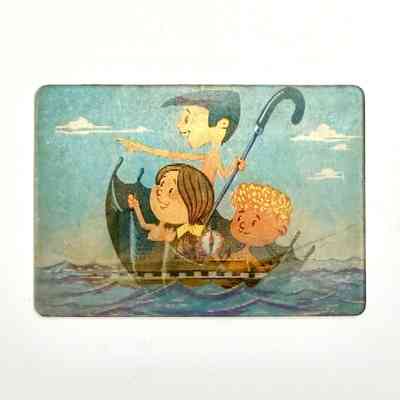
Lenticular ("stereo-vario") pocket calendar, 1987 — Soviet export for the Cuban (Spanish-language) market
Small rectangular lenticular pocket-calendar card with rounded corners and a finely ribbed lens surface. The picture side flips between two interlaced frames: (1) a three-masted, square-rigged sailing ship under full pale-yellow sail on blue swells; (2) three cartoon children riding in an inverted umbrella used as a boat — one standing and pointing ahead while gripping the umbrella's hooked handle as a mast — over the same stylized waves. The umbrella handle "ghosts" faintly through the sky of the ship frame, confirming the two images share a single interlaced lens. The reverse carries a printed 1987 calendar: twelve months in Spanish (enero–diciembre) in four rows of three, weekday columns lettered L M M J V S D (lunes–domingo, week beginning Monday), with Sundays/holidays in red, all within a dotted diamond border.
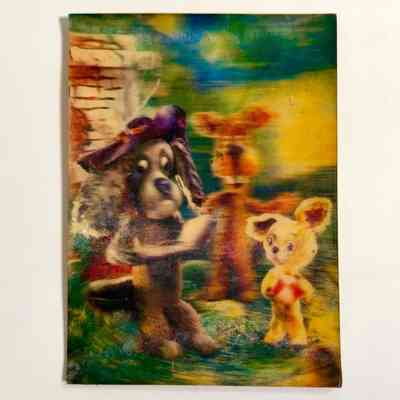
Lenticular ("tercera dimensión") 3-D postcard — «Hasta luego, Barranquilla»
A small lenticular (ridged "3-D" / stereoscopic) postcard whose front shows a still from a Soviet animated puppet production, captioned on the reverse as "Hasta luego, Barranquilla" ("See you later, Barranquilla"). The image depicts three puppet/animated characters in a colorful outdoor setting: at left, a shaggy long-haired dog wearing a plumed, broad-brimmed hat and a cape (a swashbuckler/musketeer costume); at center, a brown teddy-bear-like figure; and at right, a small pale rabbit or hare with a red marking. The lenticular lens surface produces the illusion of depth and gives the image its characteristic vertical ridging and slight blur in a flat photograph. The card has no divided message area visible and appears to be a pictorial souvenir card rather than a mailing card. The reverse is printed in Spanish and carries: the title line "MUÑEQUITOS «HASTA LUEGO, BARRANQUILLA»"; "Pintor N. Vinogradova" (artist N. Vinogradova; printed with an accidental space as "Vin ogradova"); "Foto de tercera dimención V. Generalov" (third-dimension/lenticular photography by V. Generalov; "dimención" is a printer's misspelling of "dimensión"); "Hecho en la URSS" (Made in the USSR); and a copyright line "© VBPK." The card is heavily age-toned and foxed overall, with edge wear and small losses at the lower-left corner. This is a Soviet-manufactured souvenir postcard produced in Spanish specifically for export to Spanish-speaking allied markets — principally Cuba, the USSR's closest partner in Latin America. Soviet state publishers issued large quantities of Spanish-language printed matter (postcards, books, magazines) for Cuban distribution throughout the 1960s–1980s as part of cultural-diplomatic exchange. Lenticular "3-D" postcards depicting beloved Soviet animated-puppet characters were popular novelty items, and Soviet animation (Soyuzmultfilm and related studios) was widely broadcast and merchandised in Cuba, where "muñequitos rusos" (Russian cartoons) became a defining feature of childhood for the revolutionary generations.
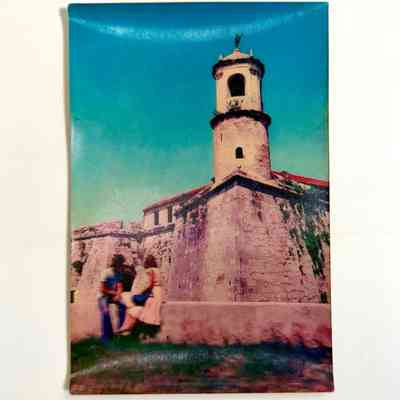
Lenticular 3-D tourist postcard — Castillo de la Real Fuerza, Havana (printed in Pyongyang, DPRK)
A lenticular ("3-D") pictorial postcard showing the watchtower (garita/torre de la vigía) of the Castillo de la Real Fuerza in Old Havana, crowned by its emblematic bronze weathervane, La Giraldilla. The vertically ribbed lenticular lens gives the image stereoscopic depth and the characteristic fine ridging visible in a flat photograph. The composition looks up at the cylindrical tower against a graded blue sky; three small figures (apparently young people in 1970s dress) are seated on the masonry terrace at lower left, against the fortress's sloping limestone wall. The reverse is a printed postcard back in the Spanish-and-English bilingual convention, headed "TARJETA POSTAL," with a vertical divider labeled "REPÚBLICA DE CUBA," a dotted stamp box, and three address rules. The caption reads "CASTILLO DE LA FUERZA / Ciudad de La Habana / LA FUERZA CASTLE / Havana City." Centered at the foot is the printer's line "Impreso en Pyongyang, RPDC" (Printed in Pyongyang, DPRK — i.e., the Democratic People's Republic of Korea). The card is unposted and heavily age-toned, with overall browning and edge wear.
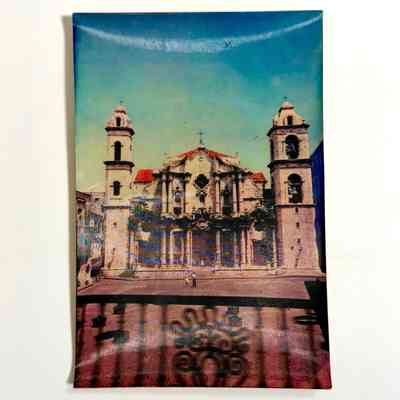
Lenticular 3-D tourist postcard — Plaza de la Catedral / Havana Cathedral (printed in Pyongyang, DPRK)
A lenticular ("3-D") pictorial postcard showing the Catedral de San Cristóbal de La Habana (Havana Cathedral) and its plaza. The ribbed lenticular lens produces stereoscopic depth, with the cathedral's distinctive asymmetrical Baroque façade and its two unequal bell towers rising against a graded blue-green sky; the foreground shows the open paving of the Plaza de la Catedral, with the deep relief of the lenticular image exaggerating the recession of the square. Surface ridging and a slight rainbow sheen are visible, characteristic of the lenticular medium. The reverse matches Record 1 in design: "TARJETA POSTAL" heading, vertical "REPÚBLICA DE CUBA" divider, dotted stamp box, and address rules. The caption reads "PLAZA DE LA CATEDRAL / Ciudad de La Habana / CATHEDRAL SQUARE / Havana City," with the printer's line "Impreso en Pyongyang, RPDC" at the foot. The card is unposted, heavily toned, and shows cracking/creasing to the reverse stock.
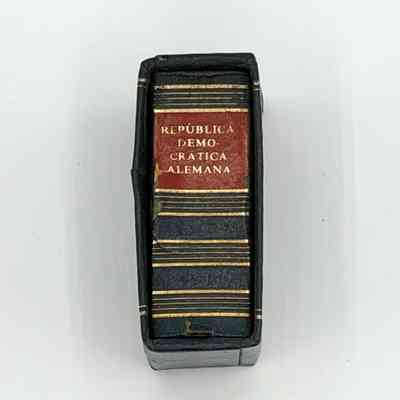
Miniature Book, República Democrática Alemana (German Democratic Republic promotional minibook), with slipcase
Spanish-language GDR promotional miniature book, República Democrática Alemana, in a matching slipcase. Navy leather-grain binding with gilt rules and a red gilt-lettered spine label; navy slipcase with gilt double rules and the gold-tooled GDR state emblem (hammer and compass within a wreath of grain). Illustrated throughout with color photographic plates documenting the GDR. Front leaves carry a handwritten ink dedication; the colophon credits the publisher, designers, and numerous photographers and GDR picture agencies.

Postcard: V. I. Lenin Volga Hydroelectric Power Station, Tolyatti — with Spanish manuscript message
A color photographic postcard showing the Volga Hydroelectric Station (Волжская ГЭС им. В. И. Ленина) at Tolyatti on the Volga River, with the long horizontal powerhouse and spillway dam crossing the frame, ranks of transmission towers and power lines fanning out across the water, and the Kuybyshev Reservoir ("Zhiguli Sea") behind; green planted embankments and a lattice crane occupy the foreground. The image is a slightly muted, characteristically Soviet offset color print. The undivided-style back carries printed Russian captions and publisher data, a stamp box, and a Spanish-language manuscript message in blue ink. The printed caption reads "Тольятти. Волжская ГЭС им. В. И. Ленина / Фото Б. Круцко" (Tolyatti. Volga Hydroelectric Station named after V. I. Lenin / Photo by B. Krutsko), with imprint "Издательство «Планета». Москва, 1972" (Planeta Publishing House, Moscow, 1972) and the publisher's logo. Technical/print codes appear in the upper-right box: "А02545-72 / 8в-174 / Ц. 3 к. / З. 1110 / Тип. № 5" (the "Ц. 3 к." indicating a price of 3 kopecks), and the card is numbered "10" at lower right, indicating one card from a set. The handwritten message, in Spanish, reads: "Esta es la Hidroeléctrica del Volga aquí en Toghliati [Tolyatti] tiene 22 turbinas de 100,000 kilowatts cada una. ¡un Fenómeno!" ("This is the Volga hydroelectric station here in Tolyatti; it has 22 turbines of 100,000 kilowatts each. A phenomenon!"). The card is unposted (no stamp or postmark) and shows light staining at the right edge.
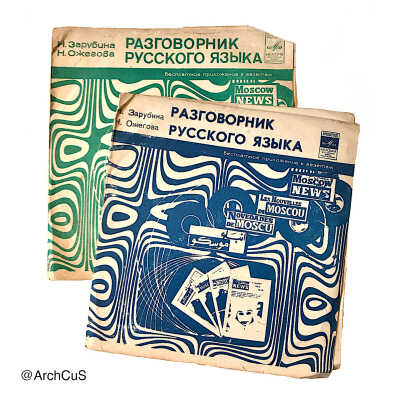
Records for Разговорник русского языка (Russian Language Phrasebook) — Moscow News / Melodiya audio course (green and blue variants)
Two records and their paper 7-inch record sleeves for a Soviet Russian-language audio phrasebook by N. Zarubina and N. Ozhegova (Н. Зарубина, Н. Ожегова), issued on the Melodiya label as a free supplement to the Moscow News newspaper and its foreign-language editions. The fronts carry a psychedelic op-art wave design — one in green, one in blue — with the Cyrillic title, the authors' names, "бесплатное приложение к газетам" (free supplement to the newspapers), the Melodiya logo, and the mastheads of the paper's editions (Moscow News, Les Nouvelles de Moscou, Novedades de Moscú, and an Arabic edition). The sleeve's backs bear a multilingual notice (Russian, English, French, Spanish, Arabic) stating that in 1975–1976 the weekly serialized the phrasebook across 6 records sent to subscribers, distributed via V/O Mezhdunarodnaya Kniga (Moscow). Both sleeves are aged and worn, with toning, soiling, and edge/corner wear.
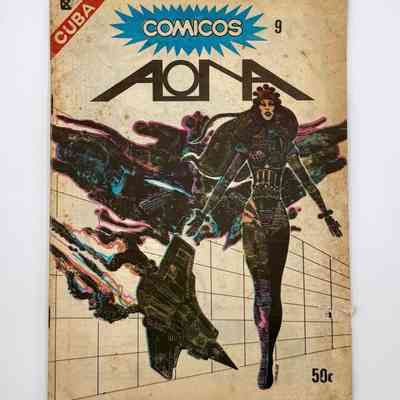
Revista Cómicos, No. 9 (Cuban comics magazine) — cover feature "Alona" by Rafael Morante
Saddle-stitched comics magazine. Color cover with a Morante science-fiction illustration: the heroine Alona, long-haired and armored, striding forward with a stylized spacecraft and psychedelic energy forms across a perspective grid. Blue starburst masthead "COMICOS" with issue number "9" at upper right; stylized "ALONA" title; a red "CUBA" corner banner with the publisher logo and "EDITORIAL PABLO DE LA TORRIENTE" at upper left; price "50c" lower right; artist signature "Morante" near the figure's feet. Interior not photographed.
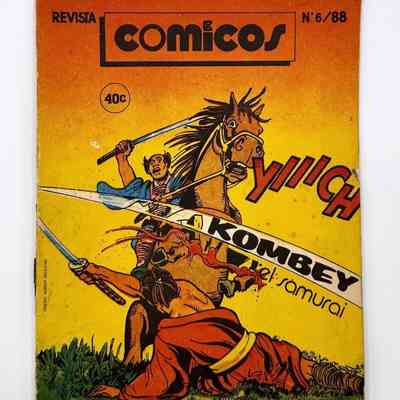
Revista Cómicos, Nº 6/88 (Cuban comics magazine) — cover feature "Kombey y el samurai"
Saddle-stitched comics magazine. Color cover (orange-to-yellow ground) showing a samurai on a rearing horse cutting down a falling opponent with a bloodied blade — a Kombey el Samurai scene. Masthead "REVISTA CÓMICOS" in a stylized logo box; issue "Nº 6/88" at upper right; price "40c" in a circle; cover feature lettering "KOMBEY y el samurai" and "YIIICH" (a second feature/battle-cry). Design credit "DISEÑO: HUBERT DELESTRE" along the left edge; cover-artist signature "Luis Lorenzo" lower left. Interior not photographed.
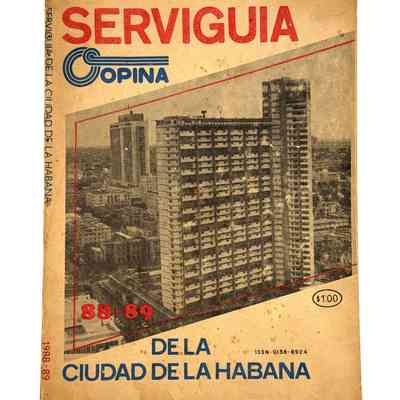
Serviguía Opina de la Ciudad de La Habana, 1988–89 (Havana services directory)
Softcover services directory/guidebook for the city of Havana, cover-titled "SERVIGUIA · OPINA · DE LA CIUDAD DE LA HABANA · 88-89," priced $1.00. The interior title page reads "SERVI-GUIA OPINA — Directorio General de Servicios, Ciudad de La Habana," alphabetized by service type and street, dated Enero 1989 (edition closed 1988). Contents list state services available to Havana's population (drawn from Poder Popular and central-state organisms), with sections including emergency services ("Servicios de Urgencia" — ambulancia, bomberos, patrulla PNR, taxis, etc., illustrated with line drawings) and a consumer-education page on reading electricity meters ("No lo pierda de vista"). The back cover carries a colour advertisement for the Banco Popular de Ahorro featuring the mascot "Ahorrito" ("Asegure su deseo, INCREMENTE su cuenta de ahorro… El banco de la familia cubana"). Manuscript annotation in ink on the emergency-services page (a phone number for "Matutino").
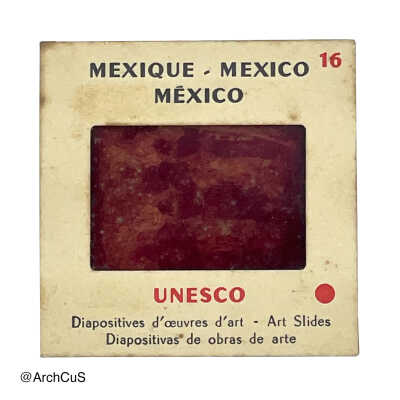
UNESCO "Mexique – Mexico – México" Art Education Slide Set
A 1962 UNESCO trilingual art-education slide set of 30 numbered 35mm color transparencies reproducing artworks from Mexico, produced for UNESCO by Publications Filmées d'Art et d'Histoire, Paris. Part of UNESCO's "Art Slides / Diapositives d'œuvres d'art / Diapositivas de obras de arte" educational series.
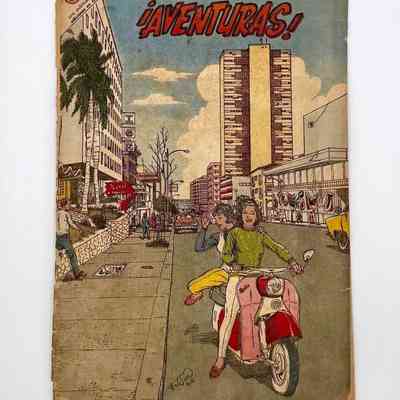
¡Aventuras! (Cuban adventure comic, Ediciones en Colores) — eight issues
Comic books / historietas (serial publication); print on paper. Newsstand-format adventure comics, color-printed covers over newsprint interiors, saddle-stitched. Each cover carries the ¡AVENTURAS! logo and the publisher device "EC / una publicación de ediciones en colores" in the upper-left corner. Subjects span urban romance, Western/indigenous, samurai, circus, and underwater-adventure genres. Included loose interior leaf (image 8) is a three-tier Spanish-language comics page. Included: 1- Cover: Havana street (Vedado/La Rampa), two women on a motor scooter, boy waving; "Nelson '65"; 1965 2- Cover: Two men fighting by a tree; "EN ESTE NÚMERO: EL CAPITÁN RASMI"; "Domingo García"; 1965 3- Cover: Two indigenous men in river rapids, storm; "Robe '66" (Roberto Alfonso Cruz); 1966 4- Cover: Warrior on rearing white horse grap; "Luis '66" (tentative); 1966 5-Cover: Samurai sword fight, Japanese setting; 1966 6- Cover: Boy fleeing a lion outside "GRAN CIRCO"; "Robe '66" (Roberto Alfonso Cruz); 1966 7- Cover: Two scuba divers underwater, knife, moray eel; "Newton"; 1966 8- (not a cover) interior page, Sherlock Holmes story; Adaptation of Conan Doyle's "The Adventure of the Sussex Vampire"; undated