
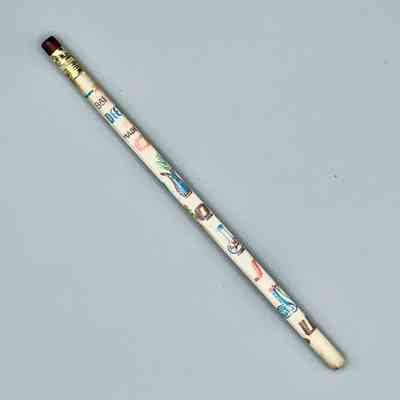
"Deer Brand" (鹿牌) pencil
Round wood-cased pencil with a brass-colored crimped ferrule and red rubber eraser; opposite end blunt/unsharpened. Cream/ivory barrel printed with a multicolored illustrated-alphabet motif — Latin letters paired with small object illustrations (a plant/carrot, a bottle, a waterbird, etc.) — with the maker's imprint near the ferrule. Both images are the same single pencil rotated to two sides.
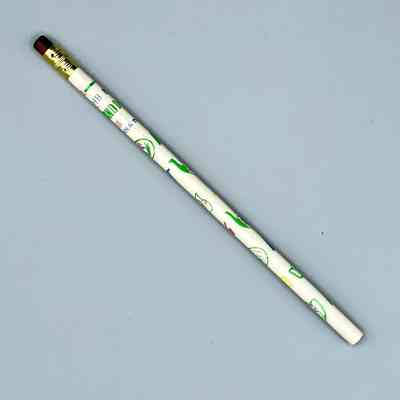
"Deer Brand" (鹿牌) pencil No. 868, HB grade — foliate design
Round wood-cased pencil with a brass-colored crimped ferrule and red rubber eraser; opposite end blunt/unsharpened. White/cream barrel printed with scattered small green foliate/plant motifs and red/blue accents, plus the maker's imprint and a red leaping-deer trademark near the ferrule. Both images are the same single pencil rotated to two sides.
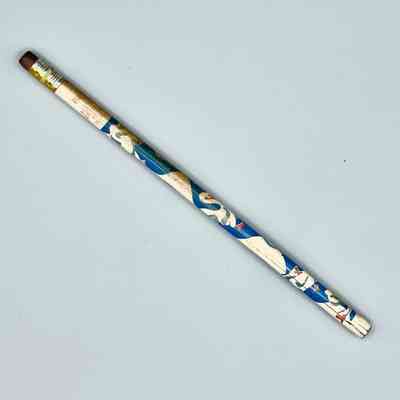
"Great Wall" pencil with swan-and-water design, HB grade
Round wood-cased pencil with a brass-colored crimped ferrule and red rubber eraser; opposite end blunt/unsharpened. Cream/natural barrel printed with a pictorial design of white swans on blue water with red accents. A faint red maker's imprint survives near the ferrule (a small framed logo, the grade, and a few abraded lines). Two images: the object and a screenshot of its CatalogIt record.
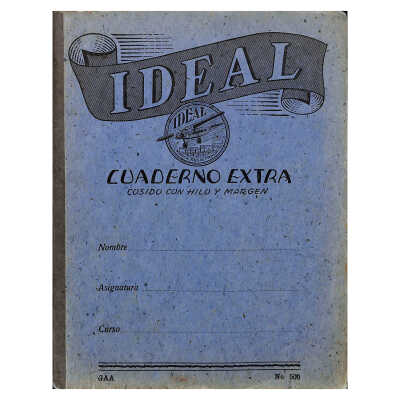
"Ideal" school exercise notebook (Cuaderno Extra No. 500)
Blue speckled‑pulp paper‑covered school exercise notebook (cuaderno), sewn binding with a reinforced spine. Front cover printed in black: a ribbon/banner reading "IDEAL"; a circular trademark with an aircraft over a factory and "IDEAL / MARCA REGISTRADA"; "CUADERNO EXTRA / cosido con hilo y margen"; and blank fill‑in fields "Nombre," "Asignatura," "Curso." Foot of cover: "GAA" (left) and "No. 500" (right).
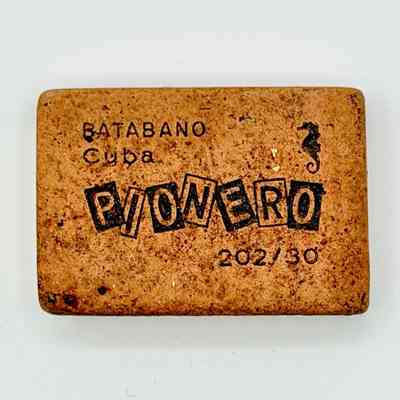
"PIONERO" rubber eraser (grade no. 202)
A small rectangular rubber eraser with rounded edges, the surface aged to a soiled tan/brown with darker staining at one corner and a worn, finely pitted texture. One face is marked in black: "BATABANO / Cuba" at upper left, a seahorse (caballito de mar) device at upper right, the brand "PIONERO" across the center in mixed boxed/ransom-style capitals, and "202/30" at lower right. The markings identify a Cuban-made school/office eraser; the discoloration and surface wear are consistent with an aged, used rubber eraser (Cuban erasers of this type were known to harden with age).
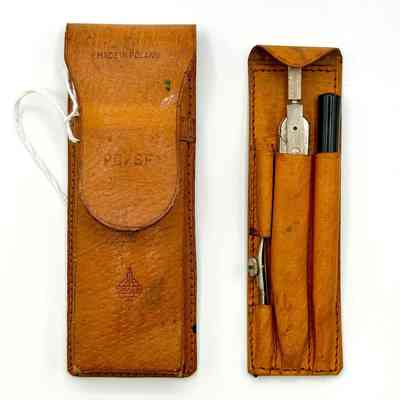
"SKALA" drafting instrument set in leather case — drawing compass with accessories
A compact cased drawing-instrument set. The stitched tan leather slip case has a fold-over flap and holds, in two leather sleeves, a metal precision drawing compass (cyrkiel) fitted with a knurled lengthening bar and a center-wheel (knurled screw) adjustment, plus a short black cylindrical accessory tube (likely a container/holder for spare points or leads). The case flap is embossed with the maker's marks.
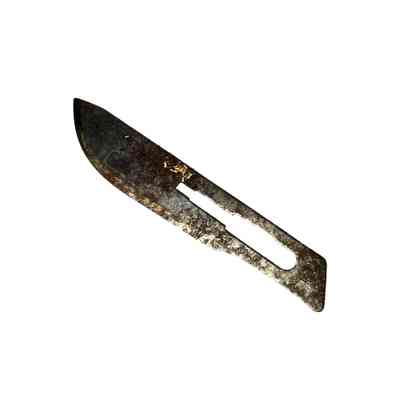
"SMIC" scalpel/surgical blade, loose, No. 10
A single curved, pointed steel blade of scalpel "belly" type, heavily corroded. Stamped lettering survives in fragments along the face; the legible portions read "SMIC," accompanied by small star-shaped devices and the number 10.
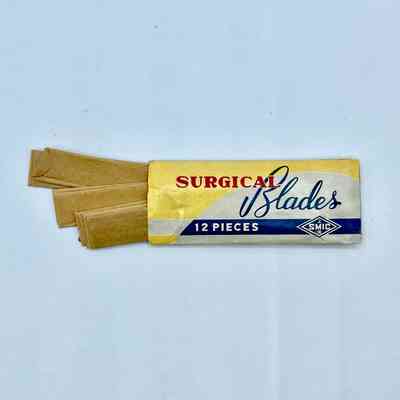
"SMIC" surgical scalpel blades, packet of 12
A small commercial packet of surgical (scalpel) blades, branded SMIC, holding twelve individually wrapped blades. The outer sleeve is printed in yellow, white, and blue with "SURGICAL Blades" and "12 PIECES" in English and a diamond-shaped SMIC logo. Inside are individual blades wrapped in waxed/glassine paper. The packet is the standard mid-century pharmacy/surgical-supply format in which a dozen sterile-wrapped blades were boxed for sale.
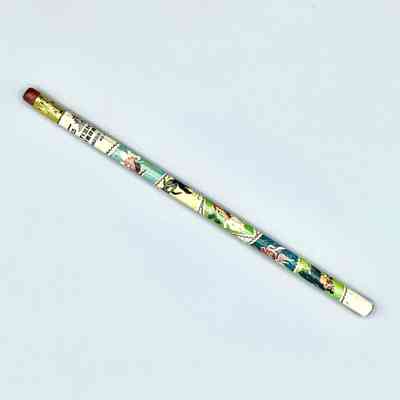
"Temple of Heaven" (Tien Tan / 天壇牌) pencil, HB grade — pictorial barrel
Round wood-cased pencil with a brass-colored crimped ferrule and a red rubber eraser at one end; the opposite end is blunt/unsharpened. Cream/natural barrel printed with a multicolored pictorial design (small figures, goldfish, and foliage) bordered by wavy black rules, with the maker's imprint and pagoda logo near the ferrule end. Both images show the same single pencil rotated to two sides.
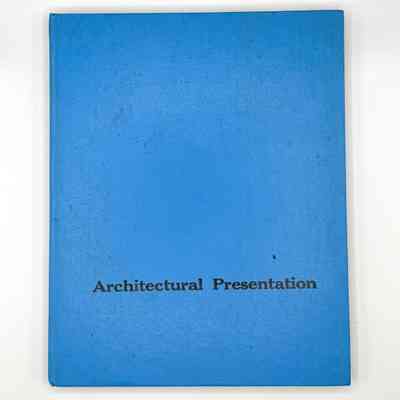
Architectural Presentation in Opaque Watercolor: Theory and Technique (Edición Revolucionaria, Instituto Cubano del Libro)
Belonged to Mariela Payán, who used while studying Architecture in Havana's CUJAE.
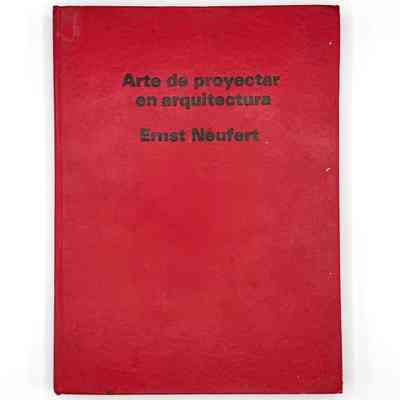
Arte de proyectar en arquitectura, by Ernst Neufert (Edición Revolucionaria), Sixth Reprint, 1987
A large hardcover reference book bound in red leatherette over boards, the front cover stamped in black with the title "Arte de proyectar en arquitectura" and author "Ernst Neufert." This is the Cuban licensed reprint of the Spanish-language edition of Neufert's classic architectural data handbook (originally Bauentwurfslehre), issued by Edición Revolucionaria of the Instituto Cubano del Libro. The title page repeats the author and title with the full descriptive subtitle: "Fundamentos, Normas y Prescripciones sobre Construcción, Instalaciones, Distribución y Programas de necesidades, Dimensiones de edificios, locales y utensilios," and bears the Edición Revolucionaria "eR" device. The verso/copyright leaf records the Cuban reprint history — "Tercera reimpresión, 1977; Cuarta reimpresión, 1981; Quinta reimpresión, 1985; Sexta reimpresión, 1987" — identifying this copy as the sixth reprint of 1987 (the latest listed). It further states that the edition was made under special license: "La presente edición se realiza en virtud de la licencia especial No. 314 de 8 de diciembre de 1986, otorgada por el Centro Nacional de Derecho de Autor, de conformidad con lo dispuesto en el Artículo 37 de la Ley No. 14 de Derecho de Autor de 28 de diciembre de 1977," with the registration code "SNLC: RF 01.30060.1." The facing page carries a "NOTA A LA EDICIÓN CUBANA" signed by the "Departamento de Arquitectura / Facultad de Construcciones," which frames Neufert's significance: it presents "el Neufert" as the most enduring reference work in the field, situates the author within the 1920s German generation that initiated modern architecture, praises the book's rigor on minimum dimensioning, standardization, and spatial optimization, and notes — with a characteristic ideological caveat — that the inclusion of some architectural programs inapplicable to Cuban circumstances does not diminish the book's usefulness. The interior shows significant foxing throughout.
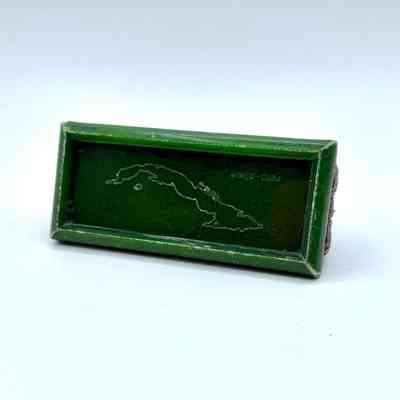
Blackboard eraser, MINED (Cuban Ministry of Education)
A rectangular chalkboard eraser ("borrador de pizarra") with a molded green plastic body. The top face has a recessed panel embossed with the outline map of Cuba and the legend "MINED – CUBA" (upper right); the long edges have a scalloped/wavy molded profile. The underside carries a felt/wool erasing pad (mottled grey-brown, embedded with chalk dust and multicolored lint from use) seated in the plastic base.

Bottle of "Graffis" rubber-stamp ink
A small cylindrical glass bottle of dark glass with a black ribbed screw cap, containing rubber-stamp ink. The paper front label, on a green and black ground, shows a stylized black silhouette of a hand rubber-stamp (gomígrafo) above the text "TINTA PARA GOMIGRAFOS," with the brand "grafis" in script within an oval, and a lower caption "PRODUCTOS DOMESTICOS / CAPDEVILA, LA HABANA" and "HECHO EN CUBA E.J.P.D." The label is abraded and torn, with losses at the upper corner and along the lower edge, and ink staining over the brand oval. Contents is present.
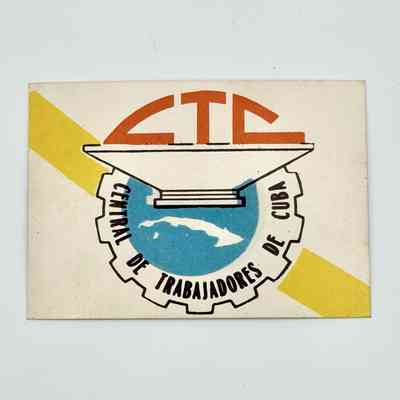
CTC emblem card — Central de Trabajadores de Cuba
A small rectangular printed card bearing the CTC emblem on a white ground: the orange letters "CTC" forming a stylized worker's helmet at the top, over a white anvil, set within a black cogwheel that frames a blue roundel containing the white silhouette of the island of Cuba; the gear is ringed by the legend "CENTRAL DE TRABAJADORES DE CUBA." A yellow diagonal band crosses the field behind the emblem (a printed design element).
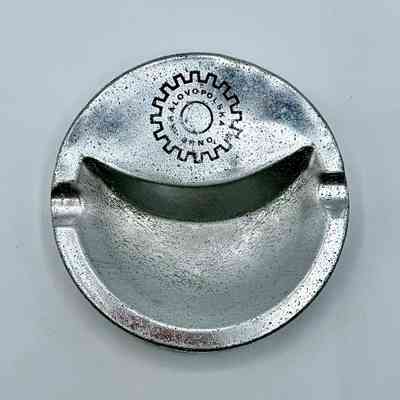
Cast metal advertising ashtray, Královopolská (Brno, Czechoslovakia)
A small circular ashtray of cast light metal (aluminum or a similar silvery alloy), with a shallow bowl, an everted rim, and two cigarette rests notched into the rim. The interior back wall is impressed with the maker's emblem: a toothed cogwheel/gear device encircling the legend "KRÁLOVOPOLSKÁ" with "BRNO" below — the logo of the Královopolská engineering works of Brno. The metal has an unpolished, slightly granular cast surface, now scratched, scuffed, and dulled with use. The form is the standard mid-century round metal ashtray; as a piece carrying a company logo it functioned as promotional/advertising or commemorative ware.
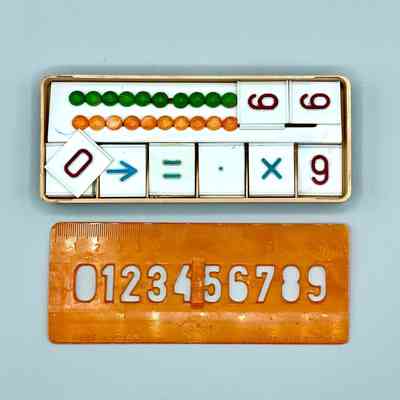
Children's arithmetic and counting set, boxed (bead counters, number/operator tiles, and stencil-ruler)
A boxed numeracy-teaching kit in a shallow cream/tan tray. Components: (a) two horizontal bead-counting rails set in a white plastic base — an upper row of green beads and a lower row of orange beads (approximately ten per row); (b) loose white square tiles bearing molded, color-filled characters — numerals in dark red (0, 6, 9; the 6/9 tiles reversible) and operator symbols in blue/teal (right-pointing arrow "→", equals "=", multiplication dot "·", multiplication sign "×"); and (c) a translucent amber plastic stencil-ruler with an embossed centimeter scale (1–14), die-cut numerals 0–9, and a lower row of die-cut arithmetic symbols. Used together to teach counting and to build simple arithmetic statements.
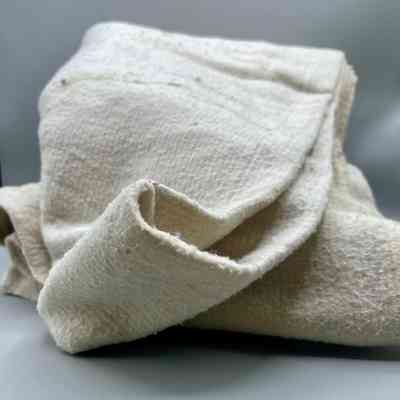
Colcha (blanket/coverlet) from the Escuela al Campo
A coarse, napped off-white/natural (undyed) textile, photographed folded. The surface is soft and brushed/fleecy over a loosely woven, slightly crinkled ground; a hemmed edge is visible. No decoration, border, stripe, or applied label is visible.
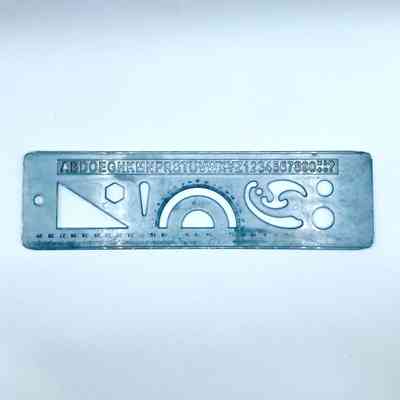
Combination drafting/drawing template-ruler (stencil, protractor, set-square, French curve), translucent plastic
Rectangular multi-purpose drawing template molded in transparent pale-blue-tinted plastic, with a hanging hole at the left end. Along the top runs a row of cut-out stencil characters — most of the alphabet (A B D O E G H K M N P R S T U V W X Y Z, omitting several letters), the digits 1234567890, and a few symbols (a cross, a square, a question mark). The field below combines: a right-triangle (45°) set-square aperture; a hexagon and small circle; a teardrop/exclamation shape; a semicircular protractor graduated 0–180° with an inner semicircular aperture; a French-curve aperture with small circles; and a graduated set of full circles at the right. The lower long edge is a centimeter ruler scale (graduations numbered through ~29 cm).
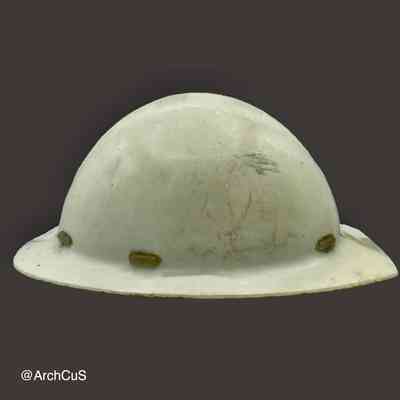
Construction Worker's Hard Hat (Casco de Protección)
A white, full-brim safety helmet of molded white plastic, with a rounded dome crown and a continuous brim encircling the whole hat (as opposed to a front-peak "cap style"). The interior retains its suspension system: a molded plastic crown cradle (web of radiating straps converging on a central boss) attached to a headband, with a oam sweatband (now brown/discolored) around the brow. The interior carries molded text. The hat is a single assembled unit.
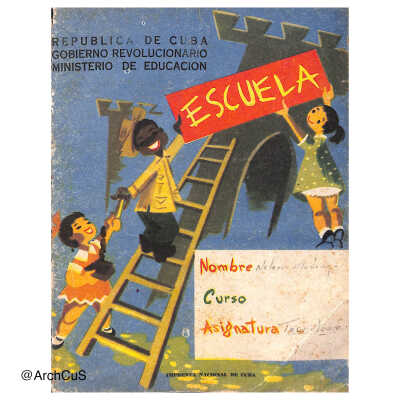
Cuban School Notebook
SUMMARY: Cover of a used Cuban primary-school exercise notebook issued by the Revolutionary Government's Ministry of Education and printed by the Imprenta Nacional de Cuba during the "Año de la Planificación" (1962). The illustrated cover celebrates the post-literacy-campaign expansion of schooling; the inside covers carry measurement-conversion and arithmetic tables. The notebook is inscribed with a pupil's name (Nelson Madruga). DESCRIPTION: A soft-cover school exercise notebook (cuaderno escolar). The front and back covers show a color illustration in a mid-century children's-book style: smiling children in a green-and-blue landscape carry placards reading "ESCUELA" (School) and climb ladders toward castle-like structures labeled "CUARTEL" (Barracks); a large yellow placard quotes José Martí, "SER CULTO ES EL ÚNICO MODO DE SER LIBRE" (To be educated is the only way to be free). Across the top, in the fornt: "AÑO DE LA PLANIFICACIÓN" and "REPÚBLICA DE CUBA / GOBIERNO REVOLUCIONARIO / MINISTERIO DE EDUCACIÓN." A printed fill-in box on the cover provides lines for "Nombre," "Curso," and "Asignatura," completed in handwriting (Nombre: Nelson Madruga; Asignatura: Tecnología). The publisher imprint reads "IMPRENTA NACIONAL DE CUBA." The inside front cover prints a table of measurement conversions ("Algunas medidas y sus equivalencias," including traditional Cuban units — varas, cordeles, caballerías, botellas, garrafones — and Anglo-to-metric conversions); the inside back cover prints arithmetic tables (addition, subtraction, multiplication, division). The notebook shows heavy use and age: worn, chipped, and darkened cover edges, a split spine, and toning of the paper.
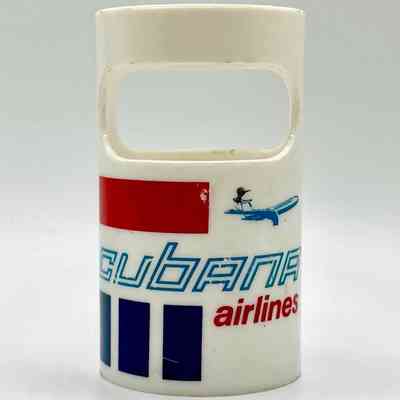
Cubana de Aviación souvenir pen holder
A cylindrical white plastic pen holder with a rectangular cutout, printed with Cubana de Aviación’s classic tricolor livery in red, white, and blue. The branding features the airline’s name in light blue lettering alongside its distinctive bird-and-jet logo. Cubana de Aviación, founded in 1929 and nationalized following the Revolution, produced commercial souvenirs such as this as part of a broader culture of airline promotional merchandise. Objects like this pen holder were sold or distributed as mementos, circulating the airline’s visual identity beyond the aircraft itself and into everyday domestic and office spaces.
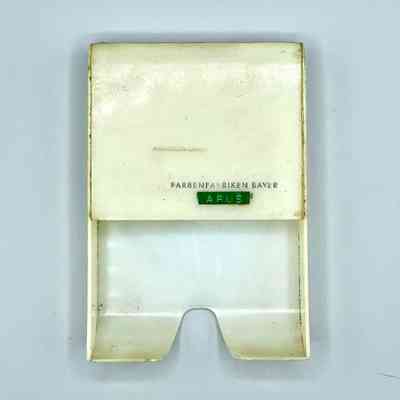
Desk note holder, Farbenfabriken Bayer (owner-marked "Arús")
A small cream/ivory rigid-plastic desk note holder: a flat rectangular stand with a solid upright back panel and a shallow front pocket to hold notes, cards, or memo slips, with a U-shaped thumb-notch cut into the front lip for easy removal of the contents and a horizontal slot embossed in the back panel. A branded promotional accessory rather than a container for a product. The back panel is marked "FARBENFABRIKEN BAYER," with a small green applied label beneath reading "Arús" — added by the owner. Empty; the plastic is scuffed and lightly soiled.
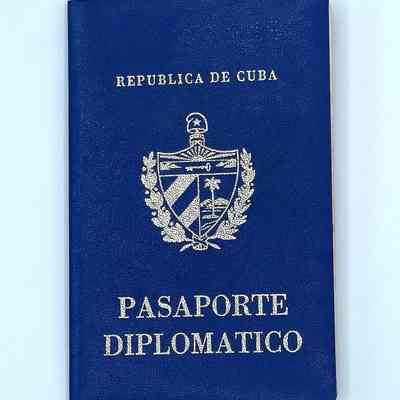
Diplomatic passport, República de Cuba
A Cuban diplomatic passport booklet. Royal-blue cover stock (textured leatherette/coated board) foil-blocked in metallic gold/silver: the upper legend "REPÚBLICA DE CUBA"; the centered national coat of arms of Cuba (shield bearing the royal palm, the key between two headlands beneath a rising sun, the Phrygian-capped staff/star above, flanked by an oak branch and a laurel wreath); and, in larger capitals below, "PASAPORTE DIPLOMÁTICO." Interior pages (bio-data, photograph, visas) are not imaged and not recorded.
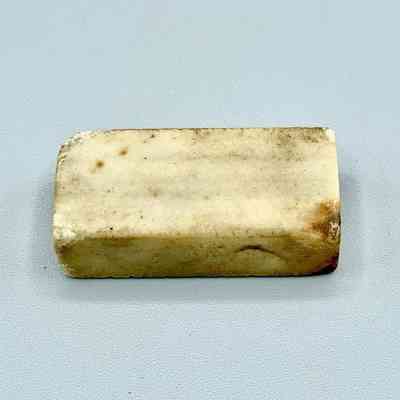
Eraser (rubber/gum), unmarked
A small rectangular block eraser, used, with rounded and slightly chamfered edges and worn corners from use. The material is an off-white to pale cream rubber or gum, now aged to an uneven tan with brown spotting, surface soiling, and darker staining concentrated at one end. The surfaces are matte and slightly powdery/crumbed at the edges. There is no visible printing, brand stamp, or paper band.
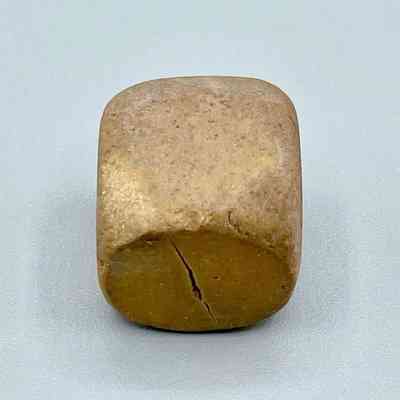
Eraser (rubber/gum), unmarked (worn block)
A small block eraser, heavily used, worn down to a rounded, pebble-like form with smoothly abraded faces and softened edges. Cream/tan color, a deeper ochre-brown from handling, soiling, and absorbed graphite. A short crack/split runs into one worn face. The surface is matte with fine pitting. There is no visible printing, brand, or paper band.
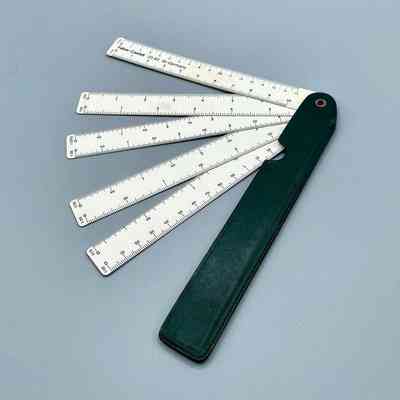
Fan-type pocket reduction-scale ruler, Faber-Castell 20/83
A folding "fan" scale rule: five flat steel scale blades riveted at one end into a green leather case/holder, fanning open like blades of a pocketknife. Each blade is printed in black on a light (white/silvered) ground with paired reduction scales and fine graduations; visible ratios across the blades include 1:20, 1:25, 1:30, 1:33⅓, 1:50, 1:100, 1:110, 1:115, 1:125, 1:130, 1:140, 1:150, and 1:175. The uppermost blade is marked "Faber-Castell 20-83 W.Germany." Closed, the blades nest within the green leather sheath, which has a thumb-notch and a riveted pivot at the head.
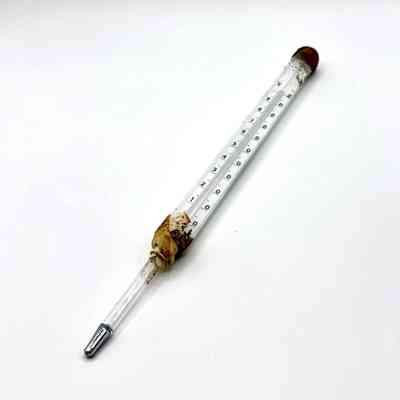
Glass alcoholometer, with paper case
Straight glass‑stem measuring instrument (alcoholometer) with its rolled paper/card storage tube. Clear glass stem encloses an internal enamel (milk‑glass) scale strip graduated 0–100, numerals every 10. Weighted/sealed end fitted with a metal tip; opposite end closed with a brown cork/cap; a paper wrap is wound around the lower stem. Accompanied by a slender cylindrical tube of rolled brown paper/cardstock (case), with a short string loop.
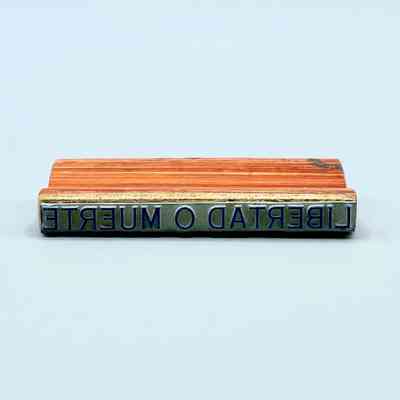
Hand rubber stamp reading "LIBERTAD O MUERTE"
A handheld rubber ink stamp consisting of a shaped wooden handle/block to which a molded rubber printing die is mounted via an intermediate foam/sponge cushion layer. The printing face carries the raised text "LIBERTAD O MUERTE" in capital letters, appearing in mirror-reverse as is normal for a stamp die; blue ink residue on the letters indicates the stamp was used with blue stamp-pad ink. The wooden handle has a reddish/orange varnished finish with a ribbed or grained surface and is rounded along its length for grip. Affixed to the top of the handle is a small red/pink diamond-shaped (lozenge) paper label; the user reports it reads "Hecho en Cuba" ("Made in Cuba"), though the printing is now faint and only partly legible in the image. The stamp shows wear consistent with use, including ink staining of the die and edge wear to the handle finish.
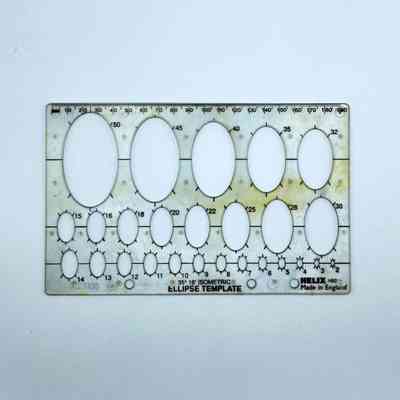
Isometric ellipse drafting template (Helix H82)
Rectangular translucent plastic drafting stencil with cut-out ellipses for drawing in isometric projection. Twenty-six bevelled-edge elliptical apertures are arranged in three registers, each labeled with its major-axis dimension in millimeters; the upper long edge carries a graduated ruler scale. Surface is discolored with amber-brown staining and scattered scuffs but structurally intact. Approx. 200 × 118–125 mm per manufacturer specification (not independently measured).
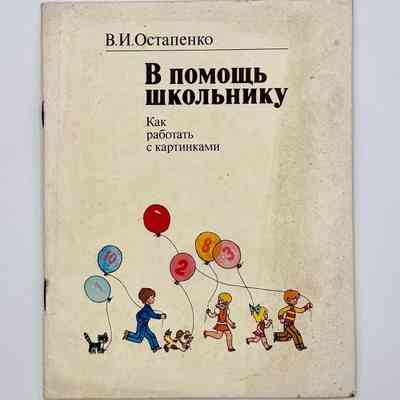
Kak rabotat' s kartinkami (How to Work with Pictures) — methodological guide to V pomoshch' shkol'niku, by V. I. Ostapenko (Russkiy Yazyk, Moscow, 1980)
Soviet Russian-language methodological booklet (teacher's guide) accompanying the picture-based teaching aid «В помощь школьнику» (In Aid of the Schoolchild). Cover: author "В. И. Остапенко" above the title "В помощь школьнику / Как работать с картинками," with a color illustration of five children — plus a cat and a dog — running while holding numbered balloons (1, 2, 3, 8, 10). The title page repeats author and title with the subtitle "(Методические рекомендации к учебному пособию «В помощь школьнику»)" and the imprint "Москва, Издательство «Русский язык», 1980." Saddle-stitched pamphlet.
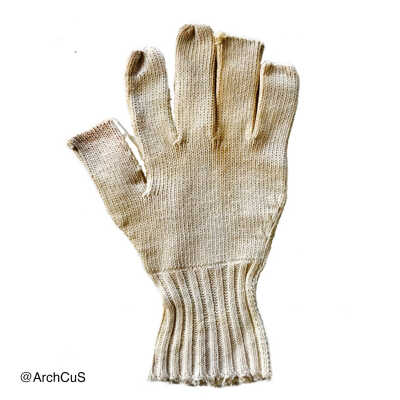
Knitted work gloves
A pair of knitted gloves in undyed natural (ecru/cream) yarn — likely cotton, possibly a cotton blend (fiber unconfirmed). Stockinette-knit hand and fingers with a deep ribbed (knit-purl) cuff; separately knit thumb and fingers, the fingertips open/absent (fingerless — knit so or worn through). The cuff edge is frayed; the body shows soiling and tan/brown discoloration consistent with heavy occupational use. No manufacturer label or mark is visible. Shown laid flat.
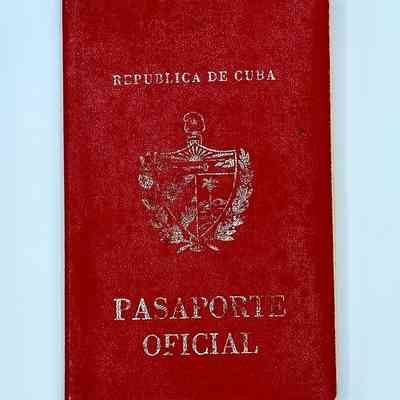
Official passport, República de Cuba — "Pasaporte Oficial"
Front cover of a Cuban official passport booklet. Red cover stock (textured leatherette/coated board), foil-blocked in gold: the upper legend "REPÚBLICA DE CUBA"; the centered national coat of arms of Cuba (palm-bearing shield, key between headlands beneath a rising sun, Phrygian-capped staff above, oak branch and laurel wreath); and below, in capitals, "PASAPORTE OFICIAL." Interior pages (bio-data, photograph, validity, visas) not imaged; interior bearer data recorded internally only and redacted from this record.
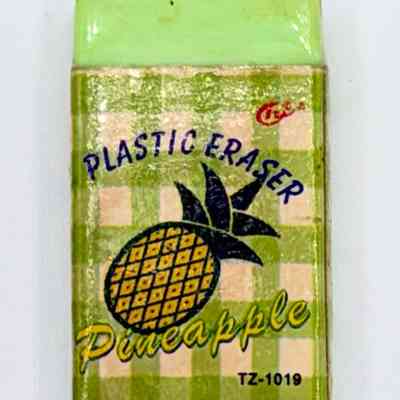
Plastic Eraser, "Pineapple" (TZ-1019), with Printed Paper Sleeve and Cellophane Wrapper
Small rectangular plastic eraser, matte-surfaced and pale green, in its original printed paper sleeve, over-wrapped in clear cellophane. The paper sleeve is printed in a green-and-cream gingham/check pattern with, in dark blue arched lettering, "PLASTIC ERASER"; a dark blue-and-yellow illustration of a pineapple; the word "Pineapple" in yellow script; the product code "TZ-1019" at lower right; and a small red oval brand logo at upper right. The eraser protrudes from the top of the sleeve. Apparently unused, still in its wrapper.
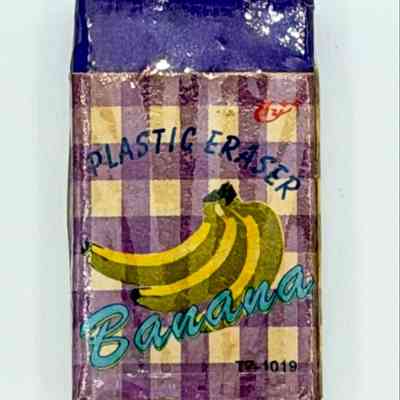
Plastic Scented Eraser, "Banana" (TZ-1019), with Printed Paper Sleeve and Cellophane Wrapper
Small rectangular plastic eraser, matte-surfaced and purple/violet, in its original printed paper sleeve, over-wrapped in clear cellophane. The paper sleeve is printed in a purple-and-cream gingham/check pattern with, in dark blue arched lettering, "PLASTIC ERASER"; a colour illustration of a bunch of yellow bananas; the word "Banana" in light-blue script; the product code "TZ-1019" at lower right; and a small red logo at upper right (same mark as the "Pineapple" variant). The eraser protrudes from the top of the sleeve. Apparently unused, still in its wrapper.
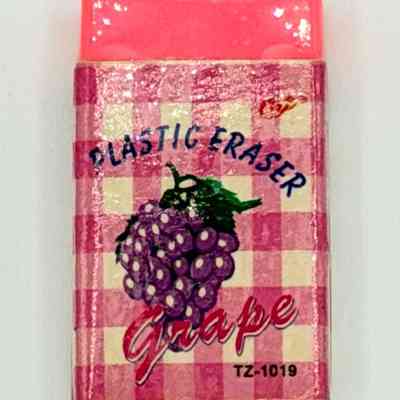
Plastic Scented Eraser, "Grape" (TZ-1019), with Printed Paper Sleeve and Cellophane Wrapper
Small rectangular plastic scented eraser, matte-surfaced and bright pink/coral, in its original printed paper sleeve, the whole then over-wrapped in clear cellophane. The paper sleeve is printed in a pink-and-cream gingham/check pattern with, in dark blue arched lettering, "PLASTIC ERASER"; a color illustration of a bunch of purple grapes with green leaves; the word "Grape" in red script with a white outline; and the product code "TZ-1019" in the lower right. The eraser protrudes from the top of the sleeve. Unused, still sealed in its wrapper.
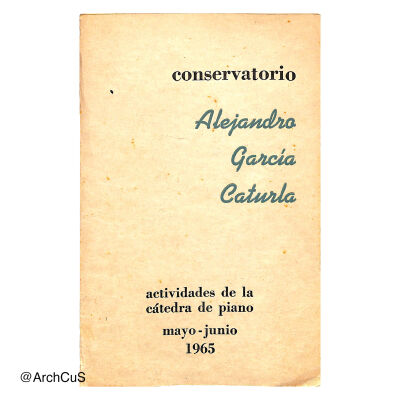
Program booklet — Conservatorio Alejandro García Caturla, piano department activities, May–June 1965
Slim printed pamphlet on cream wove paper, the cover set in two inks: the institutional name "Alejandro García Caturla" in a teal-green script flanked above and below by black type reading "conservatorio" and "actividades de la cátedra de piano / mayo-junio / 1965." A program of the conservatory's piano department for the late spring of 1965.
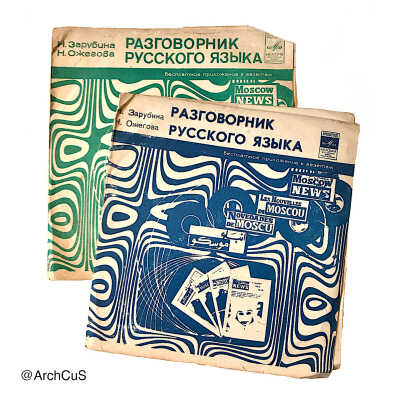
Records for Разговорник русского языка (Russian Language Phrasebook) — Moscow News / Melodiya audio course (green and blue variants)
Two records and their paper 7-inch record sleeves for a Soviet Russian-language audio phrasebook by N. Zarubina and N. Ozhegova (Н. Зарубина, Н. Ожегова), issued on the Melodiya label as a free supplement to the Moscow News newspaper and its foreign-language editions. The fronts carry a psychedelic op-art wave design — one in green, one in blue — with the Cyrillic title, the authors' names, "бесплатное приложение к газетам" (free supplement to the newspapers), the Melodiya logo, and the mastheads of the paper's editions (Moscow News, Les Nouvelles de Moscou, Novedades de Moscú, and an Arabic edition). The sleeve's backs bear a multilingual notice (Russian, English, French, Spanish, Arabic) stating that in 1975–1976 the weekly serialized the phrasebook across 6 records sent to subscribers, distributed via V/O Mezhdunarodnaya Kniga (Moscow). Both sleeves are aged and worn, with toning, soiling, and edge/corner wear.
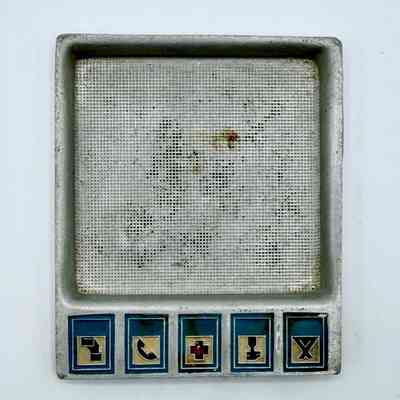
Soviet aluminum desk tray / memo holder with telephone-information pictograms
A small rectangular desk accessory of cast light metal (aluminum or aluminum-type alloy), functioning as a combined memo/note tray. The upper portion is a shallow square well with a finely textured (woven/cross-hatched) base inside a raised rim; below it runs a row of five small square tiles on a blue ground, each bearing a white pictogram: a writing/pointing hand, a telephone handset, a red cross (medical), a stemmed glass or pharmacy-type symbol, and an X/crossed symbol. The reverse has the same textured field and carries an impressed circular maker's mark: a ringed circle enclosing a stylized angular monogram (interlocked "M"/zigzag device) above curved Cyrillic lettering reading "ИОЗОК." The piece shows soiling, spotting, adhesive/residue staining on the lower reverse, a result of having being used as an ashtray.
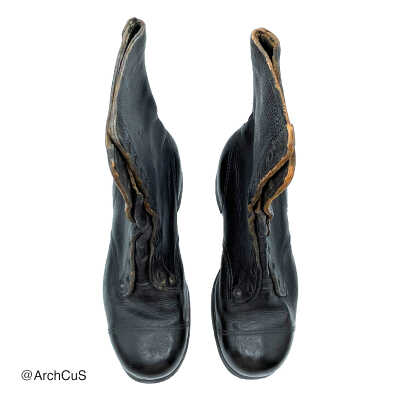
Soviet black leather laced combat/field boots (botas rusas)
Pair of black leather lace-up military/field boots, ankle-to-mid height. Uppers are grained black leather with a stitched toe cap and front eyelet lacing; the stiff shaft leather has curled and folded outward at the top, exposing the tan flesh side and lining. Soles are black rubber with a distinctive molded tread: concentric chevron/angular ridges across the forefoot, a perimeter band of round studs, and a heel set with multiple recessed circular cavities. The sole carries a diamond logo and embossed alphanumerics.
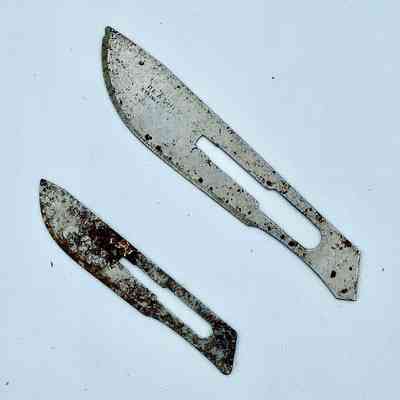
Surgical scalpel blade, size 22
A single steel surgical scalpel blade of the large curved "belly" type, with the standard elongated slot for mounting on a number-4 scalpel handle (top in the image). The face is stamped with the maker's name "FEATHER" (worn, reading as P-E-A-T-H-E…R), "STAINLESS," and "JAPAN," and the blade size "22" is stamped at the lower end. It is a Feather-brand surgical blade made in Japan. The blade is corroded but the maker, "stainless," country, and size remain legible.
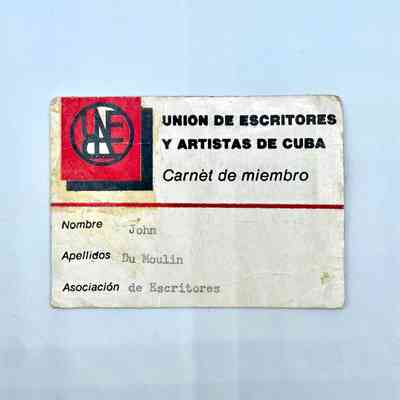
UNEAC membership card (carnet de miembro) — Unión de Escritores y Artistas de Cuba — John Du Moulin, 1999
A worn UNEAC membership card, landscape format. Front: the UNEAC emblem (circular UNEAC monogram) on a red ground with an offset black square at upper left; to the right, "UNION DE ESCRITORES Y ARTISTAS DE CUBA / Carnet de miembro," a red dividing rule, then typed entries: "Nombre: John / Apellidos: Du Moulin / Asociación: de Escritores." Back: a color portrait photo of the member at upper left; "Carnet no. 01813"; "Fecha en que se expide: febrero/99"; a "Firma" (member's signature) and "Presidente" (president's signature) over a circular UNEAC "Presidencia" ink stamp.
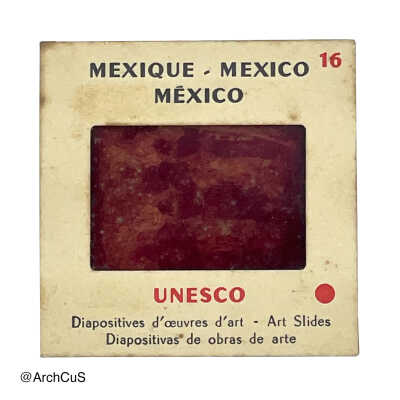
UNESCO "Mexique – Mexico – México" Art Education Slide Set
A 1962 UNESCO trilingual art-education slide set of 30 numbered 35mm color transparencies reproducing artworks from Mexico, produced for UNESCO by Publications Filmées d'Art et d'Histoire, Paris. Part of UNESCO's "Art Slides / Diapositives d'œuvres d'art / Diapositivas de obras de arte" educational series.
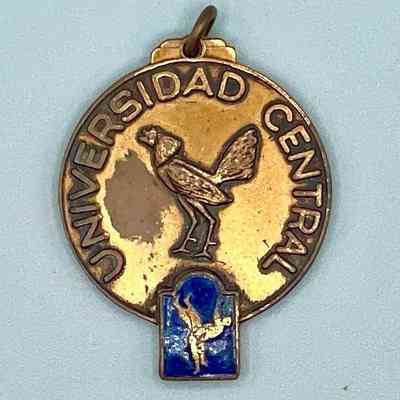
University sports medal — Universidad Central de Las Villas, IV Juegos (1964)
Round gilt-metal medal with an integral suspension loop and jump ring at the top, surmounting a small arch-topped blue-enamel tab at the bottom. The obverse bears the arched legend "UNIVERSIDAD CENTRAL" around the upper rim, a rooster/gamecock (the "Gallo Criollo") struck in relief at center, and the appended blue-enamel tab carrying a gilt figure of an athlete in a dynamic pose. The reverse is a plain field embossed "IV JUEGOS 1964."
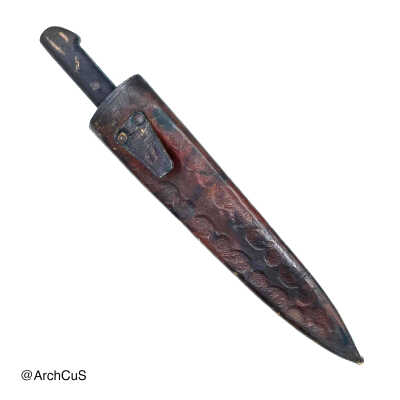
Utility Knife and Tooled-Leather Sheath
Knife: A single-edged steel knife with a broad-bellied blade rising to an upswept (trailing) point, the spine curving up at the tip. The blade is hand-sharpened and heavily worn, with a mottled gray patina, surface pitting, and dark staining; there is no fuller and no visible maker's mark. The flat tang is sandwiched by two wood handle scales — dark/blackened with age and use — secured by metal rivets (a bright brass-colored rivet at the heel and at least one more along the grip), with a rounded butt showing wear to bare wood. Construction is utilitarian and hand-finished, consistent with a shop-made or repurposed kitchen/work knife. Sheath: A close-fitting leather sheath tapering to a point, the front face decorated with stamped/tooled foliate ornament (rosettes, flower heads, and leafy vines) over an oxblood-brown surface. Near the throat, a leather retention keeper/tab is fixed by two metal rivets. The reverse shows a central seam closed with a running stitch in tan thread; the leather is crazed and cracked from age. A faint embossed mark reads "HABANA".
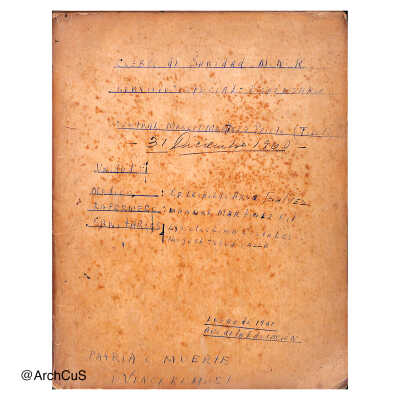
notebook
Blank notebook with handwritten cover meant to serve as a medical-service (dispensary) record/dossier. Edges worn and chipped. The text identifies the unit, station, date, and personnel of a revolutionary-militia health post, closing with the national slogan. No printed matter or maker's mark; entirely manuscript.