

"Dero Iris" Laundry Detergent Bottle — Spanish-Language Export Label
White HDPE plastic detergent jug with an integrated D-handle at the upper shoulder, a tapered body, and a white conical screw cap/pour spout. A circular paper label on the lower front, printed on a red ground with a grey mountain-peak device, reads "DERO IRIS" with Spanish usage instructions, the line "Detergente para lavar tejidos finos," and a net-weight marking. The label is heavily worn, torn, and stained, with losses affecting much of the text. The bottle is empty.
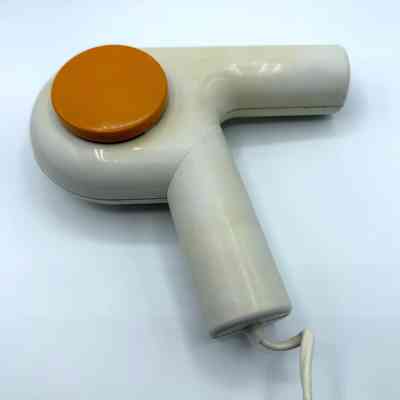
"Diana" handheld (pistol-grip) electric hair dryer – cream with orange accents
Gun/pistol-shaped handheld hair dryer molded in glossy cream/ivory plastic, forming an inverted-L of cylindrical air-outlet barrel and pistol grip. A large round orange intake cap is set into the side of the motor housing, perforated with a grid of intake holes and carrying the embossed brand name at its center. The handle front mounts two round control buttons (one orange, one dark grey/black) between two exposed assembly screws, with a small molded hanging loop at the butt of the grip. A light cloth/plastic-jacketed cord exits the base and ends in a black US-style two-prong (flat-blade) plug.
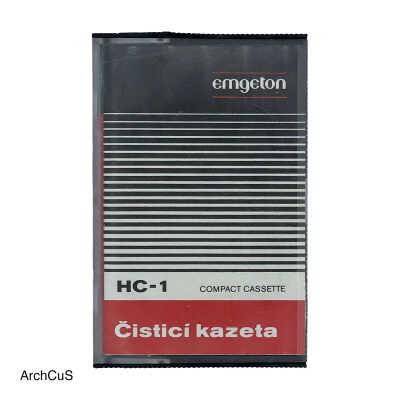
"Emgeton" cassette head-cleaning tape (limpiacabezales) HC-1, in case
A standard Compact Cassette head-cleaning cassette ("čisticí kazeta") in a clear plastic Norelco-style case. The cassette shell is black with a printed label: a red band reading "Čisticí kazeta," a white band with "HC-1 / COMPACT CASSETTE," fine horizontal line graphics with a tape window and a "100 · 50 · 0" counter scale, and the "emgeton" brand. The reverse of the shell warns that that side is not for use and carries a usage-count grid ("Počet použití:" numbered to ~20). The clear case is printed across the top with the manufacturer line and a product/price line; an outer paper J-card with matching "emgeton / HC-1 / Čisticí kazeta" graphics is slipped under the case lid.
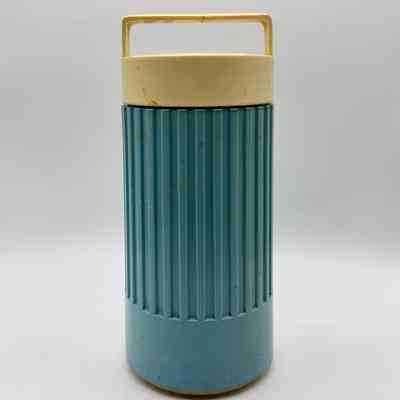
"Krasno" Vacuum Food Jar (3/4 Litre)
SUMMARY: A 3/4-litre Czechoslovak vacuum-insulated food jar ("jídlovka" / vacuum jar) by the state glass-industry conglomerate Sklo Union, branded "Krasno," in light-blue and cream plastic with a Bohemian-glass vacuum insert. Includes the complete original printed cardboard box. Made at the Sklo Union Vsetín plant under the Valašské Meziříčí concern, post-1965. DESCRIPTION: A cylindrical vacuum-insulated food jar (Czech "jídlovka," literally "food-keeper") in two-tone plastic. The outer body has a tall fluted/ribbed light-blue plastic mid-section with a plain (un-ribbed) cylindrical light-blue base; the top closure is a cream-white plastic screw cap with an integral arched carrying handle. Inside, the jar contains a silvered Bohemian-glass vacuum-flask insert, seated within the plastic outer shell. A second interior cap is present separately. The construction is the classic double-walled silvered-glass Dewar flask housed inside a plastic protective shell, with screw-thread closure. The jar is presented with its complete original printed cardboard box.
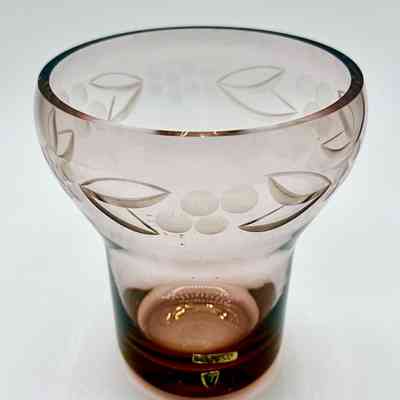
"Kullerkupp" glass vase, smoky rose, designed by Mirjam Maasikas for Tarbeklaas
A small blown-glass flower vase in pale smoky rose/amethyst glass ("suitsuklaas"), with a waisted profile — a flared, rounded upper body drawing in to a narrow waist above a heavy, thick base that reads darker amber where the glass is thickest, with seed bubbles and a pooled center. The upper body carries a wheel-cut (engraved) grapevine band: clusters of grapes (rows of shallow circular cuts) flanked by cut leaves. The rim is plain. The underside bears two gold foil labels: a rectangular "MADE IN U.S.S.R." label and a separate shield/escutcheon-shaped emblem. This is the "Kullerkupp" model. Surface shows age dulling and light wear.
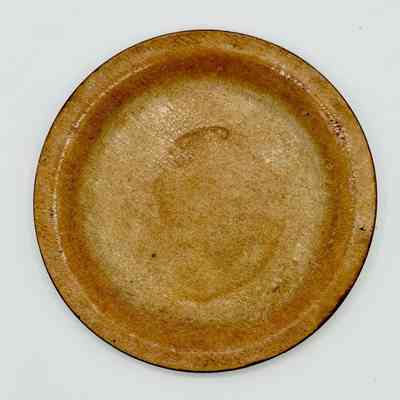
"SIlva" drink coaster, turned-wood — set of four
A set of four small, shallow turned-wood coasters (drink/glass coasters), each a low circular dish with a flat well and a slightly raised rim. The wood is a pale-to-tan close-grained hardwood (birch or similar), finished with a clear sealing coat; surfaces show lathe-turning marks and, on several, water staining, darkening, and one piece heavily scorched/darkened across the well. The underside of at least one coaster is stamped with a circular maker's mark: a triangle device within "REG. TRADE MARK / SILVA / MADE IN SWEDEN." No decoration beyond the wood finish. The four are uniform in form and size, consistent with a manufactured matched set.
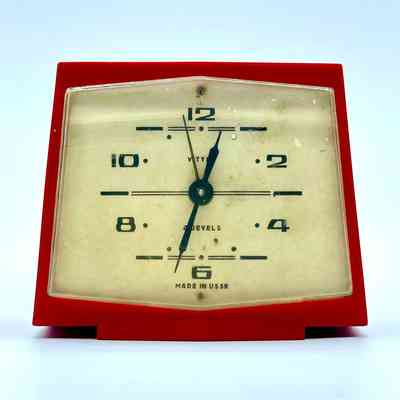
"Vityaz" (Витязь) mechanical alarm clock, red plastic case
A small mechanical wind-up alarm clock in an angular (trapezoidal) red molded-plastic case on a stepped foot. The cream/aged dial has stylized Arabic numerals (12, 2, 4, 6, 8, 10) with dash-and-dot minute markers, slim hands, and printed marks; behind a domed crystal. The reverse is a cream plastic movement back with winding/setting arbors, an embossed alarm-bell icon, a "+/−" fast-slow regulator, and a fold-out wire stand.
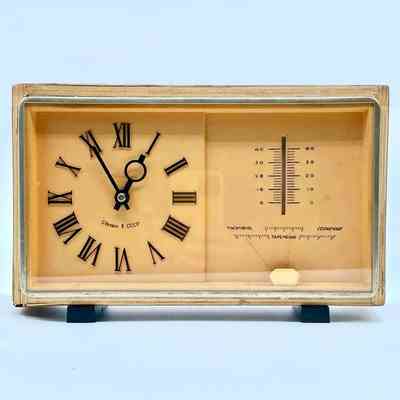
"Маяк" (Mayak) desk clock with thermometer and weather indicator
A rectangular desk clock in a polished wooden case on two dark feet, behind a glass front in a nickel-plated brass bezel. The cream plastic panel carries, at left, a clock dial with Roman numerals, black hands, the cursive maker's name, and "Сделано в СССР"; at right, a vertical thermometer (0–40 °C, doubled scale) above a curved weather-indicator scale reading "ПАСМУРНО / ПЕРЕМЕННО / СОЛНЕЧНО" (overcast / variable / sunny). The reverse is a black-painted metal back plate (now heavily rusted) with the winding arbor and a setting lever.
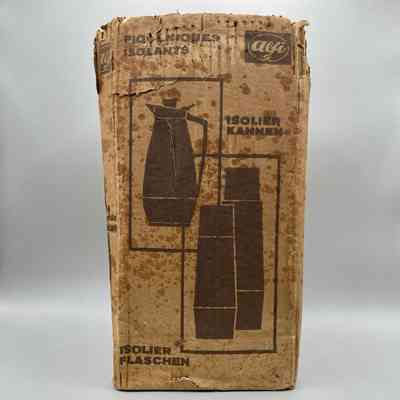
Alfi "DUR" Vacuum Flask with Leather Strap and Original Box
West German Alfi DUR-model vacuum flask (c. late 1950s–mid 1960s) with brown leather carrying strap, retained in its original trilingual (German/French/Spanish) export box. A cream-coloured cylindrical vacuum flask by Alfi, model "DUR," with a ribbed ivory plastic screw cap, a polished aluminum threaded collar, an inner white plastic ring sealing against a honeycomb-textured silver/aluminum inner stopper, and small brass loop clips mounted on either side of the body for the carrying strap. The original brown leather strap, with a metal rivet/buckle, completes the carrier. The body bears a circular paper or printed label with the Alfi script logo in a black square at center, the word "DUR" below in black, the curving legend "WIDERSTANDSFÄHIGER HARTGLASEINSATZ" (German: "resistant hard glass insert") around the top of the label, and "MADE IN WEST GERMANY" along the bottom. The flask body is now heavily stained/discoloured from age and humidity exposure. The original tall rectangular cardboard box, printed in dark brown ink on tan kraft board, carries silhouette illustrations of the Alfi product range (a handled coffee carafe and stacked rectangular flasks/canisters), the Alfi script logo in a dark rectangle, and multilingual product-category and slogan text in three languages (see Markings).
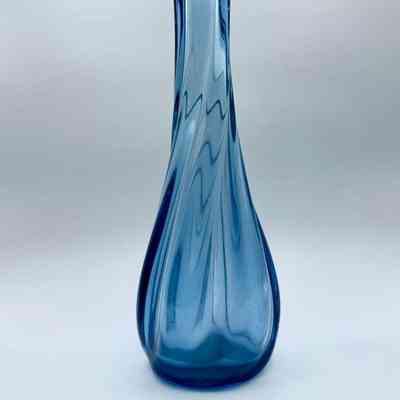
Blue art-glass bud vase, swung/stretched form
A tall, slender decorative vase of translucent blue glass. The body swells to a rounded, teardrop/bulbous base and tapers upward through a long narrow neck that flares at the top into an irregular, undulating multi-lobed rim — the characteristic "swung glass" form, in which a gather of hot glass is spun/swung while molten so the rim opens into wavy points. The surface has soft vertical ribbing/optic swirl that twists up the body, catching light. The glass is a clear cornflower/periwinkle blue, of even color, with some internal bubbles/seeds and minor surface specks visible. No pontil detail or maker's mark is described from this single view. The piece is intact and in good condition.
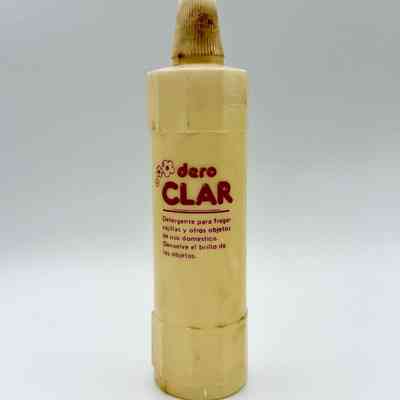
Bottle of "Dero CLAR" dishwashing detergent
A tall, faceted (polygonal-section) cylindrical bottle of cream/ivory plastic with a ribbed conical screw cap (twist/spike-type dispensing cap), containing — or formerly containing — dishwashing detergent. The front is printed in dark red: a small three-flower motif beside lowercase "dero," then "CLAR" in bold, underscored, above the descriptive line "Detergente para fregar vajillas y otros objetos de uso doméstico. Devuelve el brillo de los objetos." The reverse carries the "DERO ®" oval logo, "MODO DE EMPLEO:" with directions (one spoonful of Dero Clar in 4 liters of hot water; wash objects and rinse under running water), and net weight "500 ± 15 g." The "DERO" trademark is also embossed in an oval on the bottle shoulder. The plastic is yellowed/aged with soiling, especially at the cap.

Box for "Oreol" incandescent light bulb
A small rectangular cardboard box that originally held an incandescent light bulb (lamp), printed in an orange/amber and black scheme on buff card. One main face (first image) carries a stylized line drawing of a light bulb, the brand name "OREOL" set vertically within the bulb's outline, and the legend "MADE IN USSR" in orange at the base. One end panel (second image) is printed black with a decorative orange folk-style firebird/peacock-and-scrolls motif. Another face (third image) bears a printed black rectangle within which the bulb's specifications are handwritten in purple ink — reading approximately "127 v 100 w" (voltage and wattage) and "Cap E27/27" (an E27 screw cap), with a portion circled in red crayon/pencil. The box is worn, creased, foxed/soiled, and split along edges. It is the packaging only; whether the bulb is still inside is not evident from these views.
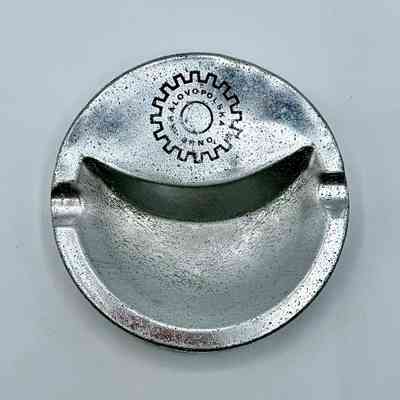
Cast metal advertising ashtray, Královopolská (Brno, Czechoslovakia)
A small circular ashtray of cast light metal (aluminum or a similar silvery alloy), with a shallow bowl, an everted rim, and two cigarette rests notched into the rim. The interior back wall is impressed with the maker's emblem: a toothed cogwheel/gear device encircling the legend "KRÁLOVOPOLSKÁ" with "BRNO" below — the logo of the Královopolská engineering works of Brno. The metal has an unpolished, slightly granular cast surface, now scratched, scuffed, and dulled with use. The form is the standard mid-century round metal ashtray; as a piece carrying a company logo it functioned as promotional/advertising or commemorative ware.
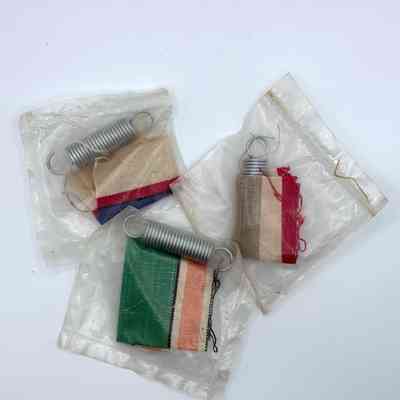
Coil tension spring with striped webbing strip (set of 3)
Three small heat-sealed clear plastic packets, each containing one steel coil tension spring (hooked at both ends) and one short strip of striped woven cotton/canvas webbing — the replacement seat/back sling material and its tensioning spring for folding chairs. Each webbing strip is a different colorway: (1) natural/cream ground with red and blue stripes; (2) natural/cream with a red stripe and dark selvedge; (3) green with black and salmon/peach stripes. Cut webbing ends are frayed with loose threads. The packaging is improvised clear plastic film, crimped/heat-sealed at the edges and unprinted.
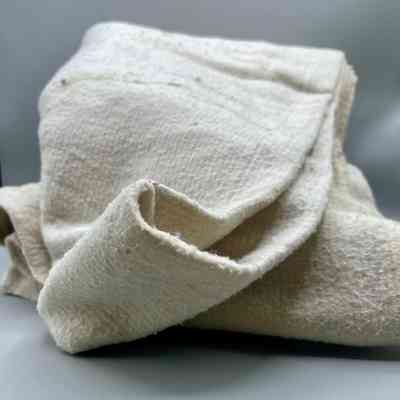
Colcha (blanket/coverlet) from the Escuela al Campo
A coarse, napped off-white/natural (undyed) textile, photographed folded. The surface is soft and brushed/fleecy over a loosely woven, slightly crinkled ground; a hemmed edge is visible. No decoration, border, stripe, or applied label is visible.
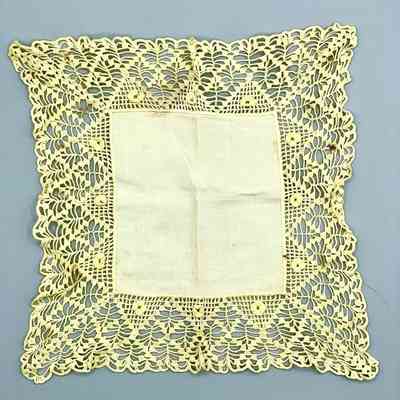
Crochet-bordered square textile (handkerchief or small doily), yellow
Square textile combining a plain woven center panel with a wide hand-crocheted lace border. The center is a fine, loose plain-weave fabric (linen or cotton) in cream/white, hemmed where it joins the lace. Surrounding it is a deep border of openwork crochet lace in ecru thread, worked in a fan/shell-and-mesh pattern with regularly spaced raised floral rosettes (puff/popcorn florets) and finished with a scalloped, looped picot edge at all four sides. Entirely handmade; the lace is symmetrical and densely worked.
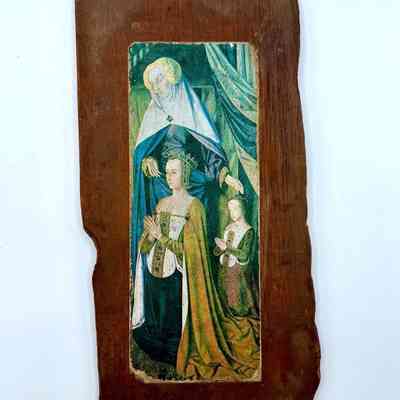
Cuban artisan-market plaque — printed reproduction of a French late-Gothic devotional painting (St. Anne with a crowned woman and a younger female figure), mounted on wood
A rectangular paper print reproducing a late-15th/early-16th-century Northern European (French / Franco-Flemish) devotional painting, adhered to an irregular hand-cut wooden board and varnished, with deliberately abraded edges. The image shows, before a green-blue cloth of honor, an older haloed female saint (St. Anne) veiled in white and blue, standing behind and extending her hands protectively over a crowned young woman in jeweled dress with hands clasped in prayer, and a smaller young female figure, also praying, at right. Bare stained/varnished wood surrounds the print; the board has a live (waney) edge at right and a notched lower-left corner.
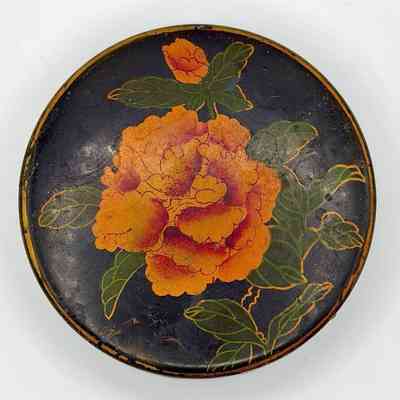
Decorative lidded box with painted peony (East-Asian floral style)
A shallow, round lidded box (covered trinket/keepsake box). The lid is hand-painted with a large orange/coral peony and a bud amid green leaves on a dark near-black (possibly very dark blue) ground, outlined and detailed in gilt/ocher within a gilt rim line. The lid edge and cylindrical base carry a mottled/marbled gold-brown-and-black lacquer finish.
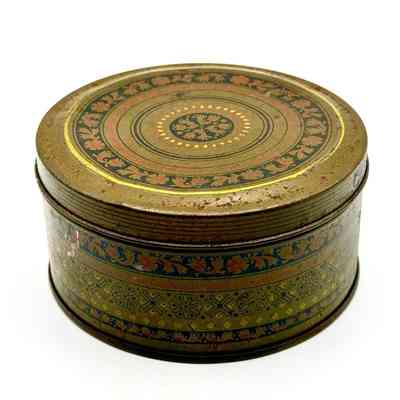
Decorative lithographed tin (round slip-lid canister)
A small round tinplate canister with a stepped slip-on lid, chromolithographed in an Orientalist (Indian/Persian-inspired) ornamental scheme on a gold ground. The lid carries concentric ruled bands around a central foliate rosette medallion set within a ring of diamond/dot motifs, framed by a floral garland border. The body is decorated in horizontal registers of paisley/boteh, rosette, and geometric diaper ornament in red, blue, and gold. The underside is plain bare/tinned metal with corrosion spotting and no printing.
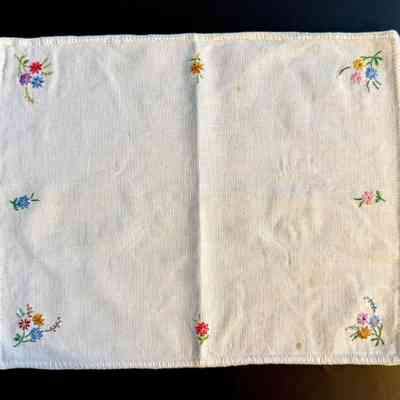
Embroidered Fabric with Polychrome Floral Sprays
Single rectangular fabric of plain-weave cream/white linen (or linen-cotton), hand-embroidered with small multicolored floral sprays — clusters in the four corners and single small flowers at the midpoints of the sides, worked in satin and straight stitches in red, blue, pink, purple, yellow/gold, and green. The edge is finished with a machine overlock/whip stitch in matching cream thread.
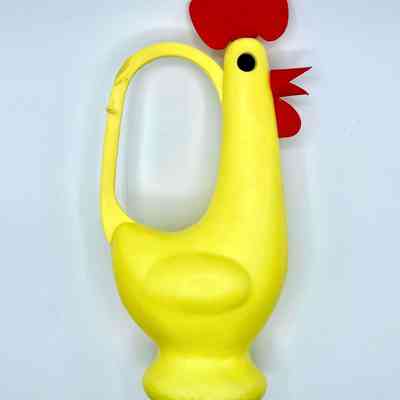
Figural rooster (cockerel) watering can
Stylized standing rooster modeled in yellow plastic on a flared pedestal foot, functioning as a watering can. The upright neck rises to a head with a round inset eye, an applied red comb, an open red beak (the pour spout), and a red wattle. An integrally molded loop handle arches from the back of the neck down to the upper back. The hollow body swells at the breast — with a shallow molded oval panel on the side suggesting a folded wing — and tapers to the footed base. Embossed "Made in GDR" low on the body.
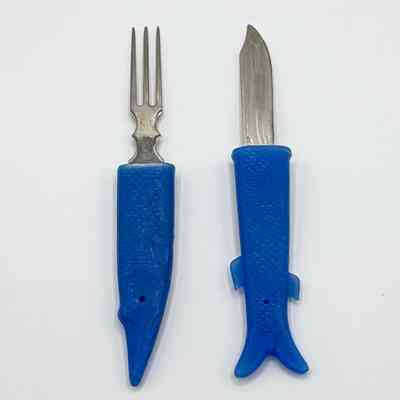
Fish-form (Pike / "Щука") nesting cutlery set (fork and knife)
A two-piece travel/picnic eating set styled as a single fish (a pike). Each utensil has a blue molded-plastic handle modeled in the round as one half of the fish, with incised scales, gill, eye, and fins; the head half terminates in a three-tine stainless-steel fork and the tail half in a stainless-steel knife blade. The handles slot/nest together so that, joined, they form one continuous fish. A clear plastic sleeve holds the joined set. The handles carry the embossed inscriptions: “Г. Киев” (City of Kyiv) and “З•Д• Сокол”, the Sokol state factory, followed by the article code “АРТ• 860•Ч”. The knife blade itself is also marked Киев.
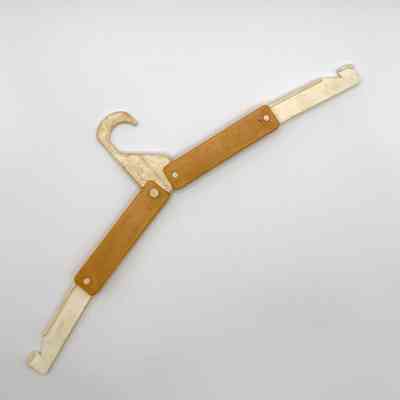
Folding (collapsible) travel clothes hanger
A two-tone molded-plastic collapsible travel/garment hanger. A central cream/white hook unit (curved hook over a flat triangular yoke) carries two caramel/tan plastic arms that pivot on riveted joints; each arm terminates in a cream/white extension tip with an upturned, notched end. The hanger folds compact for packing — arms swung up alongside the hook (image 1) — and opens to a conventional shouldered hanger form with the arms extended to the sides and the notched tips up (image 2). Pivots are secured by white-centered rivets.
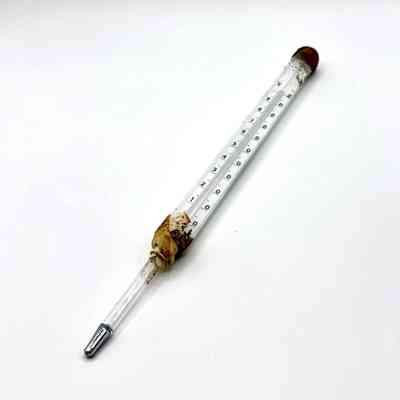
Glass alcoholometer, with paper case
Straight glass‑stem measuring instrument (alcoholometer) with its rolled paper/card storage tube. Clear glass stem encloses an internal enamel (milk‑glass) scale strip graduated 0–100, numerals every 10. Weighted/sealed end fitted with a metal tip; opposite end closed with a brown cork/cap; a paper wrap is wound around the lower stem. Accompanied by a slender cylindrical tube of rolled brown paper/cardstock (case), with a short string loop.
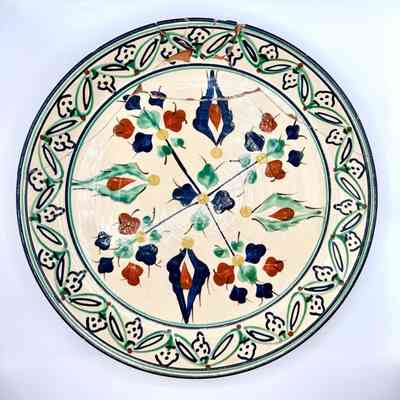
Hand-painted decorative earthenware plate, repaired
A wide, shallow circular earthenware plate decorated in hand-painted majolica/faience style on a cream glaze. The well carries a loose floral/foliate composition in cobalt blue, rust-red, green, and yellow, arranged around the center with a faint painted cross/quartering; the broad rim has a repeating border of leaf-shaped, dotted-flower, and lens motifs in blue and green between blue concentric line bands. The reverse is glazed cream with an unglazed terracotta foot ring (revealing the red earthenware body), a paper "Made in USSR" label, and a twisted-wire hanging loop fitted across the back. The plate has been broken and is held/displayed in its reassembled state. The style draws on the Central Asian and Ukrainian ceramic traditions that Soviet decorative arts absorbed and standardized for export
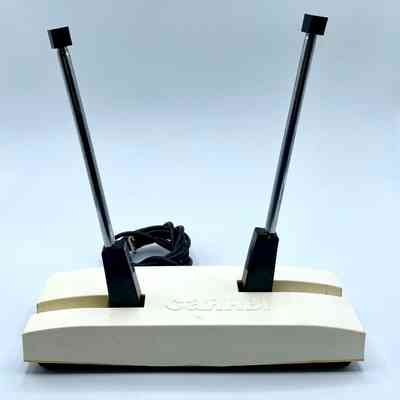
Indoor television antenna, model АТП-6.8 "Саяны" (Sayany)
Soviet adjustable indoor ("rabbit-ear") television antenna. A low cream/ivory plastic base supports two chrome-plated telescoping metal rods set in black plastic pivot blocks, allowing each rod to be extended and angled. The top of the base carries two black sliding controls (the tuning/adjustment function) and the molded brand name; the long side is embossed "Саяны." A two-conductor lead-in cable exits the base. The model designation, descriptive text, year, and a manufacturer's logo are molded into the grey underside.
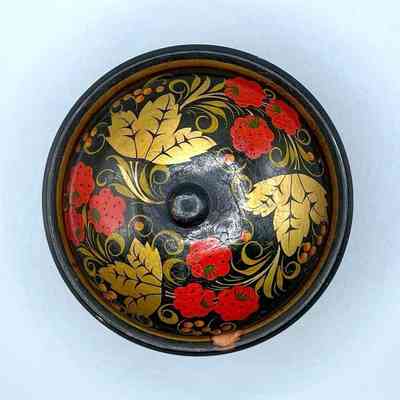
Khokhloma lidded bowl (sugar bowl), Soviet export ware
Turned-wood lidded bowl in the Khokhloma idiom. A hemispherical body sits on a red turned foot-ring; the domed lid carries a small turned black knop. Decoration is the classic Khokhloma scheme — gold leaves and grasses with clustered red/orange berries (rowan and stylized strawberries) and green tendrils scrolling over a black ground, a gilt band below the rim, and red banding at the foot. The lid repeats the berry-and-leaf motif.
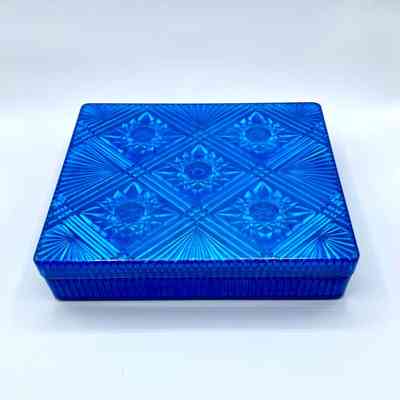
Lidded box of molded blue plastic imitating cut glass
A shallow square two-part box — a base and a telescoping lid — in translucent cobalt-blue plastic molded to imitate cut crystal. The lid top carries a diamond-lattice grid enclosing starburst/hobstar rosettes; the sides are vertically ribbed/fluted; the base interior is molded with a radiating star motif. A decorative/storage (trinket) box.
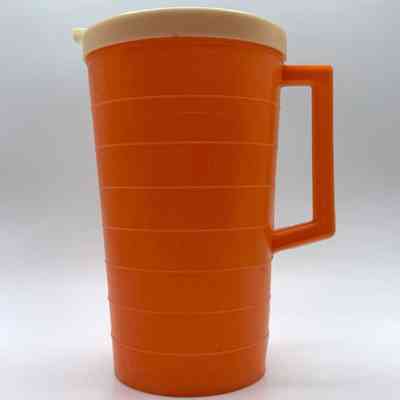
Lidded plastic pitcher, ribbed (orange with ivory lid)
Tall, slightly tapering cylindrical water/beverage pitcher molded in opaque orange plastic, encircled by evenly spaced horizontal rib bands. A squared open-loop handle is molded integrally to one side. The ivory/cream lid snaps over the rim and carries a flip-up pour-spout flap above the lip and a small molded thumb-tab; viewed from above (Image 2) the lid is a plain disc with the spout opening at one edge and a short central tab. A blank, recessed oval cartouche is molded into the upper body near the handle, with no inscription inside it.
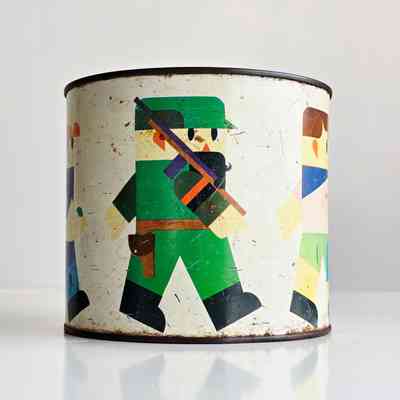
Lithographed Commemorative Tin — "XX Aniversario" (20th Anniversary of the Moncada Assault)
A cylindrical lithographed sheet-metal tin with rolled rims top and bottom. The exterior carries a continuous wraparound frieze of stylized, geometric children cartoon in a flat mid-century graphic style, striding in procession against a cream ground. Among them: one dressed as a soldier with a slung rifle and holstered sidearm; one dressed in blue and green as a militiaman holding a pistol; one with a multicolored beach ball; one dressed like a campesino in a wide yellow/orange straw hat with blue trousers; and one carrying a bag/briefcase printed with the "XX ANIVERSARIO" emblem — two interlocking red X's on a blue ground, "ANIVERSARIO" beneath. Photos courtesy of Estela Estevez and Eira Arrate. Object not in the Cuba Material collection.
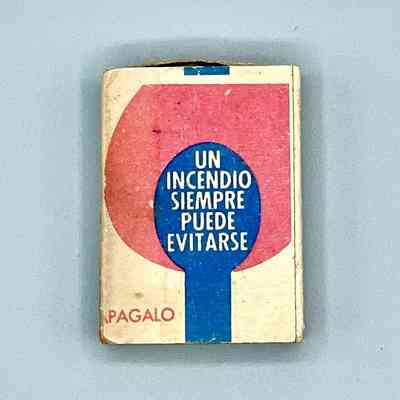
Matchbox, Empresa Cubana del Tabaco (Cubatabaco), with fire-prevention slogan
Small two-piece slide-open box (inner drawer + outer sleeve) of kraft/chipboard, matchbox format. The top panel is printed in red and blue: a red roundel encloses a blue oval bearing white text "UN INCENDIO SIEMPRE PUEDE EVITARSE," set against blue and white bands. One long side panel carries, in blue, "EMPRESA CUBANA DEL TABACO" beside a stylized tobacco-leaf logo lettered "CUBATABACO." A visible end panel is printed "APÁGALO" in red, continuing the safety message. Contents (matches) and the striking surface are not visible in this view.
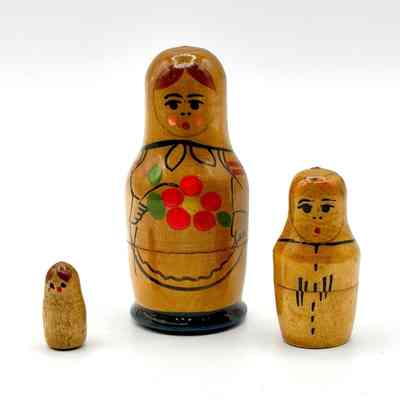
Matryoshka nesting set (3 pieces), Semyonov Style — floral-apron type
Three graduated turned-wood nesting dolls, hand-painted over natural varnished wood. The outer doll wears a headscarf and an apron with a red-and-green floral bouquet, with fairly fine facial features (arched brows, rosy cheeks, small mouth) and a dark blue base; it opens at the waist. The middle doll is more sparingly painted (headscarf outline and vertical strokes) and also opens. The innermost is a small solid figure with a minimally painted face. LARGEST DOLL: Pale natural-wood ground with hand-painted decoration in black ink lines and applied colors. The face shows simple black-line eyebrows and eyes with small lashes, an aquiline straight nose, pursed red lips, and round pink-orange cheek spots. The hair is suggested by a brown/red band at the forehead. A black-outlined headscarf or kokoshnik frame surrounds the face. The body is decorated with line-drawn clothing: a V-neck blouse with bow at the throat, sleeves with red horizontal stripes at the upper arms (suggesting traditional embroidered cuffs), and a triangular apron section that fills the front of the body. The apron carries the principal decorative motif: a central cluster of dot-painted flowers / berries in red, green, and yellow — a stylized bouquet, the characteristic Semyonov-style central ornament. The base is painted dark blue, with a thin black border around the bottom rim. MIDDLE DOLL: Same overall form, similar facial decoration (eyebrows, eyes, red mouth, pink cheeks, hair band) but considerably simplified. The body decoration is reduced to a few vertical black lines suggesting clothing folds — no central bouquet, no apron details, no painted base. The wood is mostly bare with only minimal decoration. SMALLEST DOLL: A tiny solid wooden figure (does not open), with the simplest possible face — a few dots for eyes, a red dot mouth, and a small painted hair indication on top. Bare wood otherwise. The whole set displays the typical Semyonov-tradition decorative hierarchy: fully decorated outer doll, progressively simplified interiors, and a tiny "seed" doll at the center.
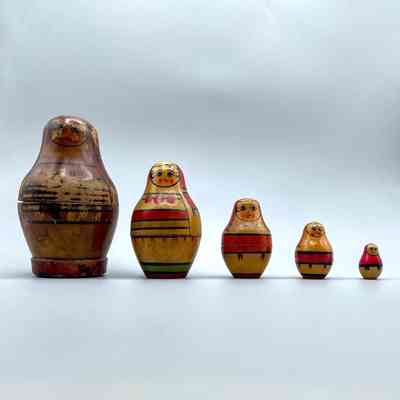
Mordovian matryoshka nesting set (5-piece), Yelnikovsky Woodworking Combine
Five graduated turned-wood nesting dolls, hand-painted, running from a large hollow outer doll to a small solid innermost figure. The four smaller dolls carry the familiar scheme — a red headscarf framing a rosy-cheeked face, with floral/berry sprays and red, black, and green body banding. The largest (outer) doll is heavily worn: its surface is now a rubbed brown lacquer with remnant black horizontal bands and red at the foot, the original face and decoration largely effaced.
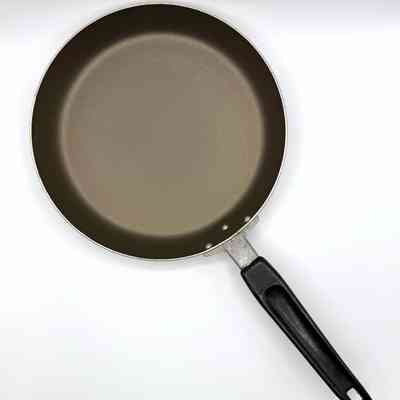
Non-Stick Aluminum Frying Pan (Sartén)
A round frying pan with a spun/pressed aluminum body and a brown/bronze PTFE non-stick interior coating. The straight, slightly flared sidewall rises to a plain rim. A black molded-plastic (phenolic-type) handle with a rectangular hang-hole at its end is fixed to a cast-aluminum bracket, which is riveted to the pan body (rivet heads visible inside). The base is bare spun aluminum showing concentric turning marks. No maker’s mark, brand, or “Made in” stamp is visible on the interior or base.
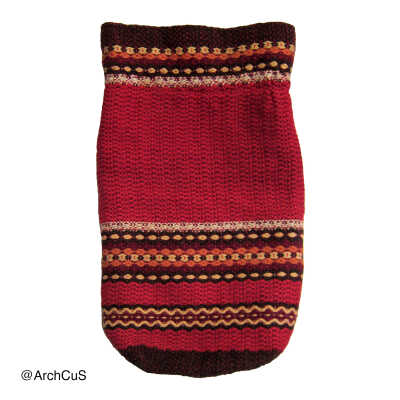
Patterned drawstring pouch
A small soft-sided bag worked in yarn, taller than wide with a rounded base and a slightly gathered top, of the size of a pouch or large purse. It is densely patterned in horizontal bands: a deep red body crossed by repeating decorative borders in burgundy, orange/rust, yellow, and white, including bead-like dotted rows and zigzag/chevron lines, with a dark band at the top edge and graduated stripes toward the base. The banded, multicolor geometric scheme has a folk/Andean-textile character. The piece appears to be a complete made-up bag rather than a remnant, with no handle, strap, or closure.
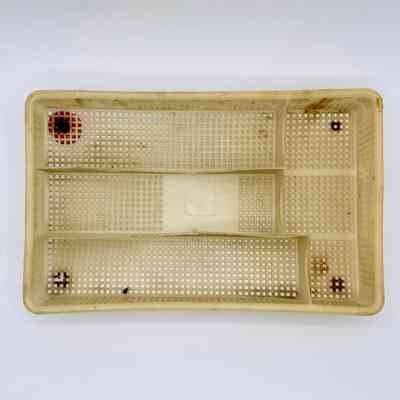
Perforated plastic compartment tray, repurposed as a dish drainer with bottle-cap feet
A rectangular tray of molded cream/ivory plastic with a base of fine square-grid perforation (mesh) and raised internal dividers forming several elongated compartments plus end sections — a form consistent with a cutlery/flatware tray or draining insert. The rim is shallow with rounded corners. Faint molded lettering/numerals appear in the central base panel but are not legible. At one corner (upper left) a red metal crown bottle cap is fixed through the mesh, serving as a foot; the three other corners show circular rust stains and open holes where similar caps were once attached and have since been lost. Per donor information, the owner attached bottle caps at the four corners so the tray could stand raised and function as a drainer for washed dishes; only one cap now remains. The surface is aged, soiled, and discolored.
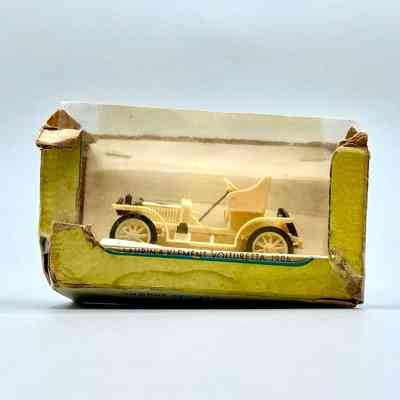
Plastic veteran-car model — "Laurin & Klement Voituretta 1906," IGRA "Old Timer"
A 1:36-scale molded-plastic model of a 1906 Laurin & Klement Voituretta — an open cream/ivory veteran car with spoked wheels and black tires — mounted on a clear plastic display plinth printed with the model name.
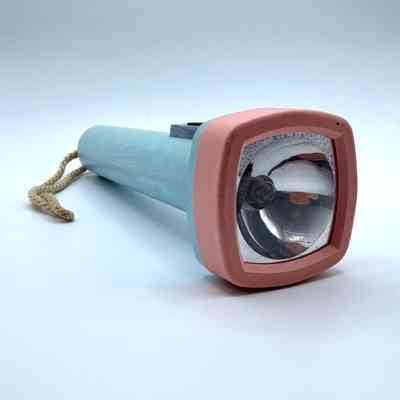
Pocket flashlight (torch) — marbled blue plastic with pink bezel
Hand-held flashlight with a cylindrical barrel molded in marbled pale-blue plastic, widening to a flared rectangular head. The head is fitted with a salmon-pink bezel ring retaining a clear lens over a metal reflector. A slide on/off switch sits midway along the barrel: a raised molded boss with a black ribbed thumb-slider flanked by molded directional arrows. The flat battery end cap is impressed "СДЕЛАНО В СССР" and pierced at center, through which a braided cord wrist loop is threaded and knotted on the inside.
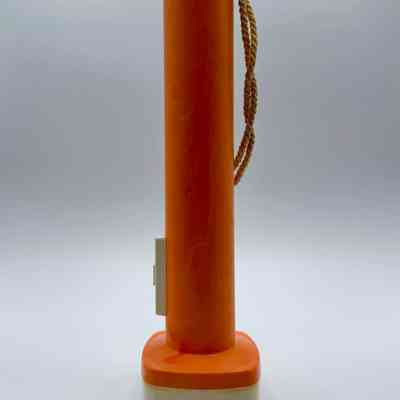
Pocket flashlight (torch) — marbled orange plastic with cream head
Hand-held flashlight with a cylindrical barrel molded in marbled orange plastic, set into a flared rectangular head/reflector housing finished in cream/ivory plastic. A white plastic slide on/off switch is mounted on the barrel. The flat battery end cap is impressed "СДЕЛАНО В СССР" and pierced at center, through which a braided cord wrist loop is threaded and knotted on the inside. Same flat rectangular-reflector form as the collection's blue-and-pink Soviet torch.
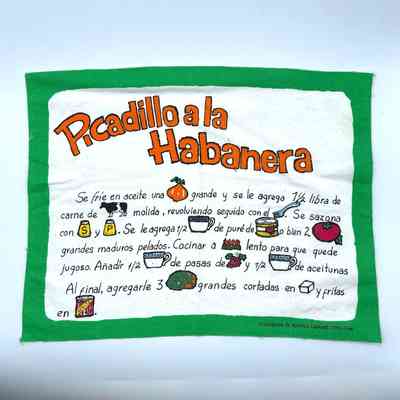
Printed recipe cloth — "Picadillo a la Habanera" (Federación de Mujeres Cubanas)
A rectangular printed cotton kitchen cloth (tea towel / paño) with a green border framing a white field, screen-printed in color with the recipe "Picadillo a la Habanera" set as an illustrated rebus — small pictures stand in for ingredients and utensils (onion, cow for beef, fork, salt/pepper shakers lettered "S" and "P," measuring cups, canned and fresh tomato, stove flame, grapes for raisins, olives, potatoes, oil can, and a cube for "cut in cubes"). Credited at lower right. Edges raw/cut and lightly frayed.
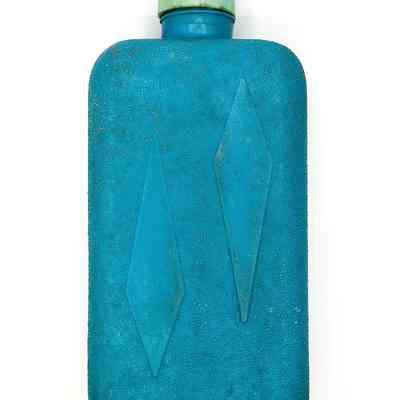
Refrigerator water bottle / flat flask, textured blue with green screw cap
Flat, rectangular bottle with rounded corners and a short off-center neck closed by a faceted (multi-sided) pale-green screw cap. The body is colored turquoise/teal with an overall granular, "sugar"-pebbled surface texture; the front face carries molded low-relief ornament — a tall central elongated diamond/lozenge flanked by two slender diamond forms. The thin, flat profile is characteristic of a bottle made to stand or lie in a refrigerator door. The neck is smoother and glossier than the textured body.
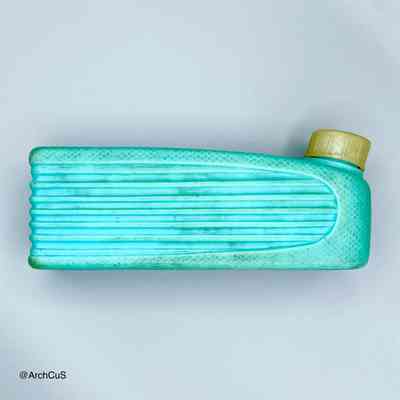
Refrigerator water bottle, teal
A small, flat, wedge-form bottle of molded plastic, roughly rectangular in side profile, taller/thicker at the neck end and tapering slightly toward the opposite (far) end, which terminates in a scalloped, ribbed edge. Each broad face carries a central panel of parallel ribbing enclosed in a rounded-end (stadium/teardrop) frame, surrounded by a finely stippled diamond/cross-hatch texture. A short cylindrical neck set at one upper corner carries a ribbed screw cap (apparently, artisanally made to substitute the original). The body is a pale teal/turquoise. No printed or applied label is present on the surfaces shown. One of three near-identical flasks in the collection differing only in color (teal, orange, pink); cataloged as a separate object.
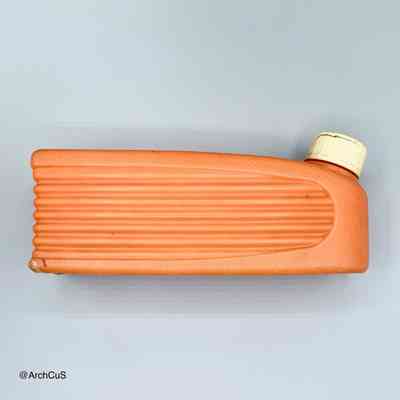
Refrigerator water bottle,, orange
A small, flat, wedge-form bottle of molded plastic, roughly rectangular in side profile, taller/thicker at the neck end and tapering toward the opposite (far) end, which terminates in a scalloped, ribbed edge. Each broad face carries a central panel of parallel ribbing within a rounded-end frame, surrounded by a finely stippled diamond/cross-hatch texture. A short cylindrical neck at one upper corner carries a ribbed screw cap in cream/ivory plastic. The body is an opaque salmon/terracotta-orange. No printed or applied label is present on the surfaces shown. One of three near-identical flasks in the collection differing only in color (teal, orange, pink); cataloged as a separate object.
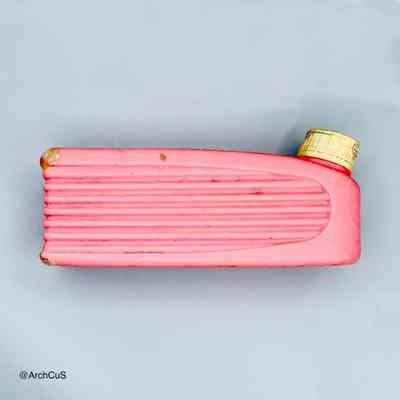
Refrigerator water bottle,, pink
A small, flat, wedge-form bottle of molded plastic, roughly rectangular in side profile, taller/thicker at the neck end and tapering toward the opposite (far) end, which terminates in a scalloped, ribbed edge. Each broad face carries a central panel of parallel ribbing within a rounded-end frame, surrounded by a finely stippled diamond/cross-hatch texture. A short cylindrical neck at one upper corner carries a ribbed screw cap. The body is an opaque rose-pink. No printed or applied label is present on the surfaces shown. One of three near-identical flasks in the collection differing only in color (teal, orange, pink); cataloged as a separate object.
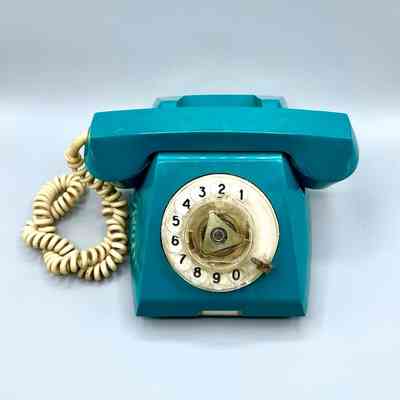
Rotary-dial desk telephone, teal plastic
Wedge-form desktop telephone in teal/turquoise molded plastic, with a cradled handset across the top and a rotary dial set into the sloped front. The dial has a clear plastic finger wheel over a white number ring (1–0) with a metal finger-stop; a small rectangular window sits below the dial. A cream/ivory coiled handset cord is attached. The underside is a dark phenolic baseplate with ventilation slots, four rubber feet, screws, a manufacturer emblem, molded Soviet legends, and a blue ink quality-control stamp.
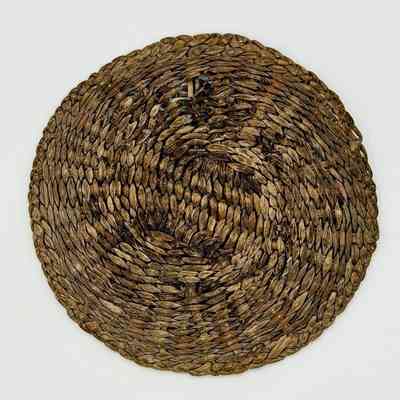
Round coiled plant-fiber coaster
A small circular coaster of coiled and stitched plant fiber (rush/straw-type), worked as a flat spiral from a central coil outward to a braided, lightly scalloped rim. The fiber is now an aged grayish-brown, dry and weathered, with the individual coils and binding stitches clearly visible. Faint specks and traces of color survive on the surface; per donor information, the coaster originally carried painted lines that have now largely faded. No maker's mark, label, or lettering is present. The piece reads as a handmade woven craft.
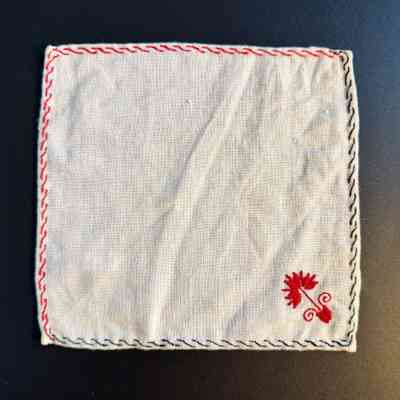
Set of Hand-Embroidered Linen Napkins/Coasters with Floral Motif
Set of eight small square textiles of plain-weave white/cream linen (or linen-cotton), each hand-embroidered in one corner with a small stylized floral sprig and finished on all four sides with a decorative whip-stitched (overcast/twisted) edge. The embroidery and edging alternate between red and black thread across the set — individual pieces combine red and black edging, and the corner motif is worked in red on some pieces and black on others.
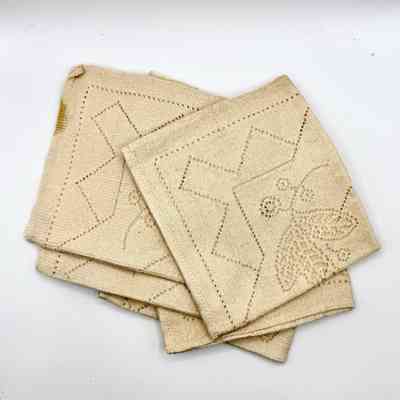
Set of Six Cotton Openwork Napkins
A set of six matching square napkins in ecru, woven as an even, corded weft-rep (ribbed) cotton. Each is decorated with openwork in a drawn-thread/filet manner: dashed openwork lines form a border and concentric diamond/zigzag frames, with a central stylized flower worked as an open filet-style grid. The reverse reads essentially the same as the face, indicating the openwork is structural (woven/machine-worked) rather than surface embroidery. Edges are finished with a narrow folded, stitched hem. The ground is regular and uniform across pieces. Light tan corner staining appears on some pieces. No maker's mark, label, or selvage lettering is visible in the images.
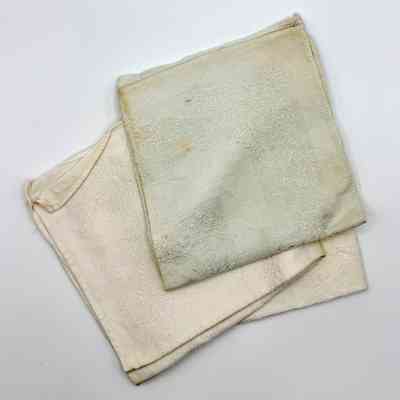
Set of Three Damask Dinner Napkins
Three square dinner napkins woven in a self-patterned (tone-on-tone) damask construction. Two napkins (hereafter A and B) are off-white/ivory; a third (C) is a noticeably cooler silvery blue-gray tone, visible when all three are shown stacked together. All three share the same general woven structure and scale, suggesting they were acquired as a set or similar set. The napkins display an elaborate multi-zone border design: a wide outer band featuring stylized palm-and-floral sprays alternating with scrolling arabesques; a narrower intermediate band of repeating diamond-and-scroll chain; and a plain inner margin. The central field carries a large symmetrical medallion formed by two mirrored C/S-scroll cartouches enclosing a floral or leafy fill. The pattern repeats in the characteristic damask fashion: areas that read as satin-weave highlights on the face reverse to matte on the back.
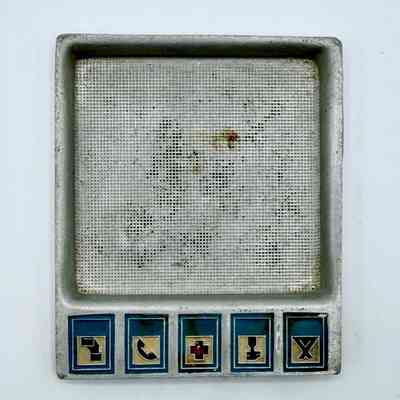
Soviet aluminum desk tray / memo holder with telephone-information pictograms
A small rectangular desk accessory of cast light metal (aluminum or aluminum-type alloy), functioning as a combined memo/note tray. The upper portion is a shallow square well with a finely textured (woven/cross-hatched) base inside a raised rim; below it runs a row of five small square tiles on a blue ground, each bearing a white pictogram: a writing/pointing hand, a telephone handset, a red cross (medical), a stemmed glass or pharmacy-type symbol, and an X/crossed symbol. The reverse has the same textured field and carries an impressed circular maker's mark: a ringed circle enclosing a stylized angular monogram (interlocked "M"/zigzag device) above curved Cyrillic lettering reading "ИОЗОК." The piece shows soiling, spotting, adhesive/residue staining on the lower reverse, a result of having being used as an ashtray.

Soviet wooden figures, Старик со старухой (Old Man and Old Woman)
A pair of lathe-turned and carved wood figures seated on a shared slatted bench, depicting an elderly couple winding red yarn between them. The man (left) is bareheaded with a turned dome of reddish-brown hair, a smiling painted face, a peasant tunic with a small blue collar device, and blue-striped trousers; he holds a skein winder. The woman (right) wears a tall blue headdress painted with orange dots, has rosy cheeks and downcast eyes, and clasps a ball of red yarn against a barrel-form skirt banded in red and brown. A length of red thread links his winder to her yarn ball.
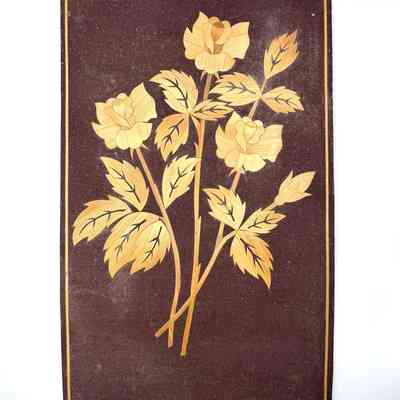
Straw-marquetry wall picture, floral bouquet (roses)
Decorative wall panel worked in straw marquetry (straw inlay/appliqué). On a dark maroon-brown textile-covered board, a vertical bouquet of three open roses with stems and serrated foliage is rendered in pieces of split, flattened, golden-toned straw; the natural sheen and directional grain of the straw create highlight and modeling, and the leaves carry darker incised veining. The composition is framed by a printed gold double-line border. The reverse is a toned paperboard backing bearing a printed paper label, "MADE IN USSR / ART. СГЗ-66 «А»," with remnants of a hanging fitting (fibrous loop and adhesive residue) near the upper center.

Telephone address book ("Libreta Telefónica"), Banco Popular de Ahorro — Sancti Spíritus
Small pocket telephone address book in a textured green imitation-leather (leatherette) cover, gilt-stamped on the front "LIBRETA / TELEFONICA," with a cream paper text block. The inside front opening shows, at left, a violet rubber inkstamp of the Banco Popular de Ahorro (palm-tree-and-"BPA" monogram, lettered "Banco Popular de Ahorro / DIR. PROVINCIAL / SANCTI SPIRITUS") and, at right, a printed owner-identification page headed "PERTENECIENTE A" with ruled fields "NOMBRE:", "DIRECCION:", "TELEFONO:" — all blank. Interior alphabetical address pages not shown.
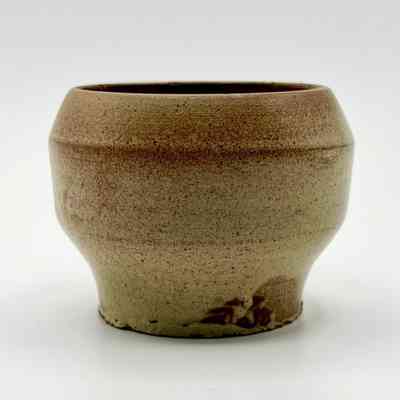
Wheel-thrown stoneware vessel (footed cup/bowl), speckled buff glaze
A small, hand-sized wheel-thrown ceramic vessel with a rounded upper body that draws in to a waisted lower section and flares to a small foot, beneath a plain, slightly irregular rim. The interior is a deep rounded well showing concentric throwing rings and a pooled, glazed surface. The body carries a matte to semi-matte speckled glaze in buff/tan tones with iron-brown speckling and darker blushing, including iron-brown patches toward the foot. The piece reads as handmade studio pottery rather than industrial ware (visible throwing rings, irregular glaze break, hand-finished foot). Function is not determined — consistent with a drinking vessel (tumbler/tea cup), small bowl, or decorative/planting vessel. No maker's mark is visible.