
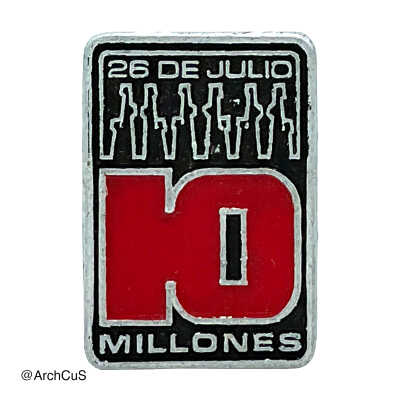
"26 de Julio / 10 Millones" Commemorative Lapel Pin — Zafra de los Diez Millones
Upright rectangular stamped-metal lapel pin with rounded corners and a raised outer border. The design reads top to bottom: the legend 26 DE JULIO across the top; a central band containing a row of six stylized rifle silhouettes, rendered as bare-metal outlines reserved against a black ground; a large red numeral 10 dominating the lower two-thirds; and MILLONES along the bottom. Raised lettering, border, and bottle outlines are bare silver-tone metal; the field is black; the numeral is red.
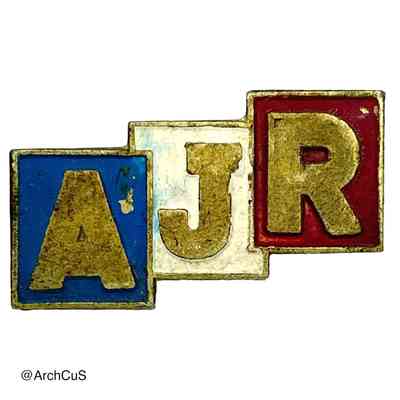
"AJR" Lapel Pin
A small lapel pin formed of three stepped, overlapping square enamel panels, each carrying a single raised gilt capital letter, together reading A J R. The panels asscend left-to-right in the colors of the Cuban national flag: "A" in gilt on blue (lowest, at left), "J" in gilt on white (center), and "R" in gilt on red (highest, at right). Each panel has a thin raised gilt border.
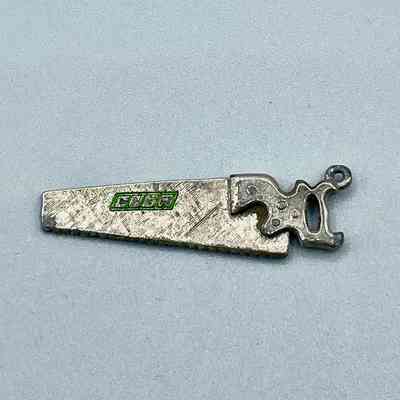
"CUBA" souvenir keychain fob, miniature handsaw
A small cast-metal charm/fob in the shape of a carpenter's handsaw (a panel saw), complete with a toothed blade, a shaped open handle, and imitation handle rivets, with a small suspension loop at the top of the handle for attaching to a key chain (the chain and ring are not present). The blade is stamped/engraved with crosshatch texture and carries the word "CUBA" in raised letters filled with green enamel/paint within a rectangular panel. The metal is a silver-tone alloy, worn and lightly tarnished. It is the pendant portion of a novelty souvenir keychain.
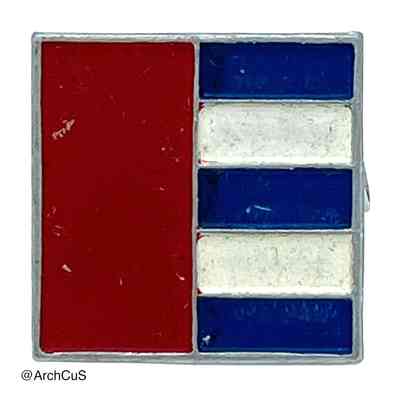
"Cuba Socialista" Enamel Pin — Red Field with Cuban-Flag Stripes
A small square pin in inlaid enamel within a silver-tone metal frame and dividing walls. The left half is a single plain red vertical field; the right half carries five equal horizontal stripes in the order blue, white, blue, white, blue (three blue, two white) — the stripe pattern of the Cuban national flag. There is no star or lettering on the face. The reverse is stamped "HECHO EN CUBA SOCIALISTA" ("Made in Socialist Cuba").
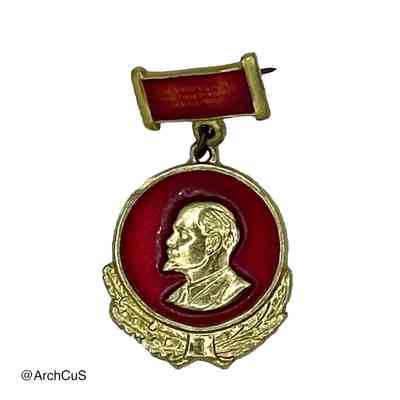
"Winner of Socialist Competition" Badge with Lenin Profile (Победитель социалистического соревнования)
A pin-back suspension badge in two parts. The upper element is a gilt scroll/banner-shaped suspension bar filled with red enamel, carrying gilt lettering now almost entirely rubbed away (for this award type, the banner reads "ПОБЕДИТЕЛЬ СОЦСОРЕВНОВАНИЯ" with a year); a horizontal pin is fitted to the reverse. A loop and ring connect it to the hanging medallion: a circular red-enamel field bearing a gilt high-relief left-facing profile bust of Vladimir Lenin, framed by a gilt wreath of wheat ears (with laurel) gathered at the base.
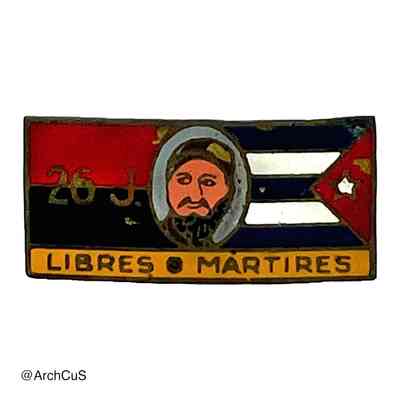
26 of July Movement Enamel Badge — "Libres o Mártires"
A small horizontal rectangular badge in hand-painted enamel (or enamel-like cold paint) over a stamped metal base, with gilt/brass linear detailing dividing the fields. The left field carries the Movimiento 26 de Julio flag — red over black — with "26 J" in gold. At center, an oval medallion bordered in gilt with a white/gray background shows a frontal portrait of Fidel Castro, bearded and wearing an olive field cap. The right field shows the Cuban national flag (blue-and-white stripes, red hoist triangle with white star). Across the bottom runs a yellow banner with dark capitals: "LIBRES O MÁRTIRES" (i.e., "LIBRES O MÁRTIRES").
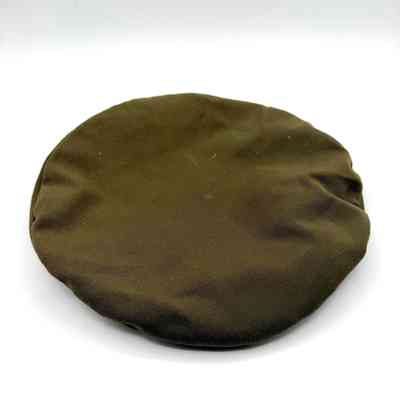
Beret, olive green (boina verde olivo)
Adult's round, flat-crowned beret of olive-green woven cloth. Constructed crown with a separate tan twill lining; headband finished with a dark leather or imitation-leather sweatband; interior woven-cotton adjustment tape/drawstring exits at the rear. No badge, cockade, or unit insignia present or retained.
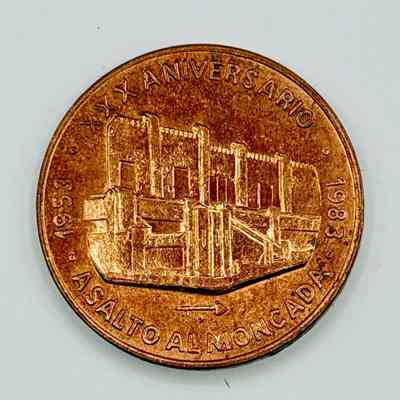
Bronze commemorative medal, 30th anniversary of the Asalto al Moncada (1953–1983) — Moncada Barracks / Granjita Siboney
A circular copper/bronze commemorative medal struck in relief on both faces. The obverse depicts the Moncada Barracks (Cuartel Moncada, Santiago de Cuba) in relief, encircled by "XXX ANIVERSARIO" above and "ASALTO AL MONCADA" below, with the dates "1953" and "1983" flanking and a small arrow device at the bottom. The reverse depicts the Granjita Siboney — the farmhouse staging point — with a royal palm rising beside it and a mountainous background, labeled "GRANJA SIBONEY" below. The medal has toned copper surfaces with brighter relief highlights.
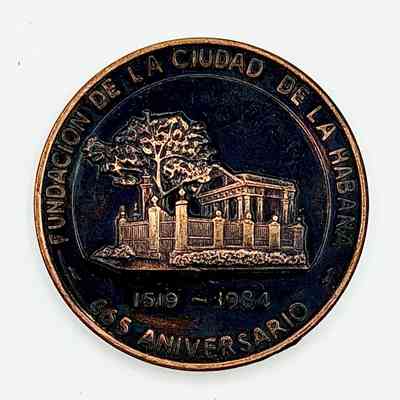
Bronze commemorative medal, 465th anniversary of the founding of Havana (1519–1984) — Museo de la Ciudad / Oficina del Historiador
A circular bronze (or bronzed metal) commemorative medal with a dark patinated field and raised polished relief. The obverse shows El Templete — the neoclassical temple in Havana's Plaza de Armas — with the adjacent ceiba tree, encircled by the legend "FUNDACION DE LA CIUDAD DE LA HABANA" above and "465 ANIVERSARIO" below, with the dates "1519 — 1984" across the lower field. The reverse bears the coat of arms of the City of Havana — three castle-towers (for the Morro, La Punta/La Fuerza fortifications) above a crossed key (the "Key to the New World"), flanked by flags — encircled by "MUSEO DE LA CIUDAD" above and "OFICINA DEL HISTORIADOR" below. Small relief marks/initials appear at the lower obverse edge (engraver/mint marks; not clearly legible). The medal is uniface-relief on both sides with raised rims.
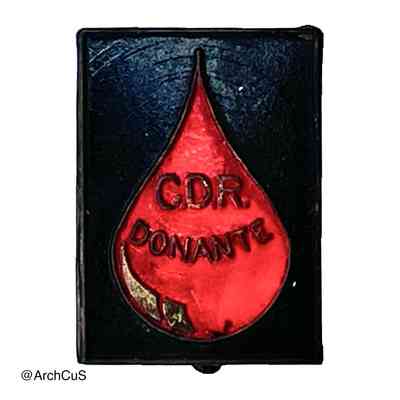
CDR blood‑donor lapel pin ("C.D.R. Donante")
Small rectangular enameled metal lapel pin. Dark blue/black enamel field with a central red‑enamel blood drop in relief, lettered "C.D.R." over "DONANTE." Pin/clasp fastener on the reverse (a fitting is visible at the bottom edge).
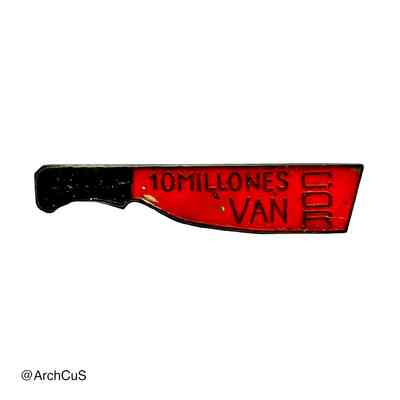
CDR machete lapel pin, "10 Millones Van" (Zafra de los Diez Millones)
Enameled metal lapel pin in the shape of a cane‑cutting machete (mocha). Red‑enamel blade with a black‑enamel handle. The blade is lettered in black: "10 MILLONES VAN," with "CDR" stacked vertically at the heel of the blade; the black handle carries worn lettering (likely "CUBA," illegible). Pin/clasp fastener on the reverse (assumed; reverse not shown).
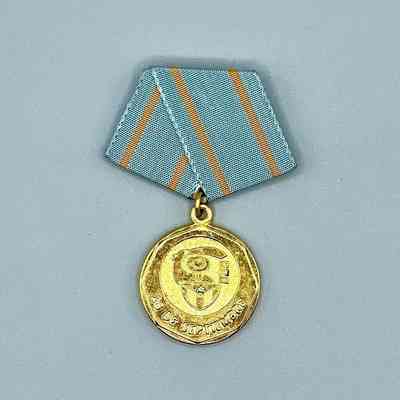
CDR medal "28 de Septiembre" — 30th anniversary of the Comités de Defensa de la Revolución
Cuban suspension medal. A gilt, slightly polygonal (roughly 12-sided) medallion hangs by a ring from a folded trapezoidal ribbon of pale blue with two narrow orange/gold vertical stripes. The medallion's center carries a stylized device combining the numeral "30" (a sweeping curved stroke and an open ring) with vertically stacked letters CDR, above a small heraldic shield charged with a five-pointed star. A raised legend follows the lower rim.
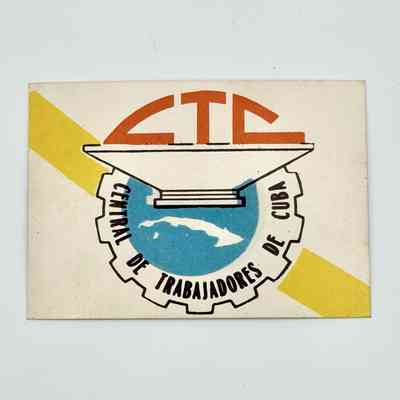
CTC emblem card — Central de Trabajadores de Cuba
A small rectangular printed card bearing the CTC emblem on a white ground: the orange letters "CTC" forming a stylized worker's helmet at the top, over a white anvil, set within a black cogwheel that frames a blue roundel containing the white silhouette of the island of Cuba; the gear is ringed by the legend "CENTRAL DE TRABAJADORES DE CUBA." A yellow diagonal band crosses the field behind the emblem (a printed design element).
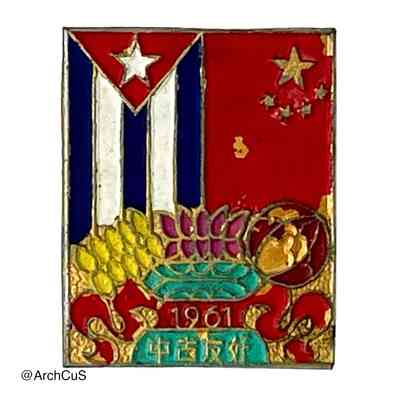
China–Cuba Friendship Badge, 1961 (中古友好)
An upright rectangular enamel-on-gilt-metal badge (cloisonné/champlevé technique). At the upper left is the Cuban national flag (blue-and-white stripes, red hoist triangle with white star); at the upper right, the flag of the People's Republic of China (red field with one large and four small gilt stars). The lower half is filled with a gilt-and-enamel emblem: ears of grain (yellow), a pink/magenta lotus blossom, green foliage, red ribbons, and a central gilt terrestrial globe with a meridian ring (tentative). A red cartouche carries the date "1961," and a green banner beneath bears four gilt Chinese characters, 中古友好 (Zhōng Gǔ Yǒuhǎo, "China–Cuba Friendship").
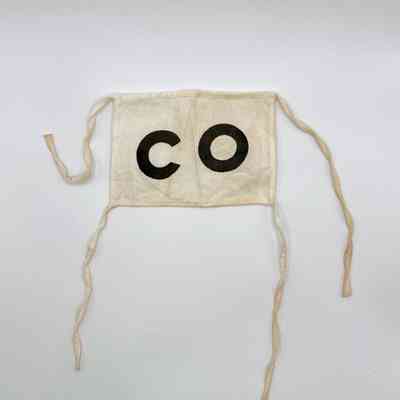
Cloth armband (brassard) lettered "CO" — Comité/Comisión Organizadora
A rectangular off-white cotton/muslin armband, double-layered and edge-stitched, with two large black stenciled/screen-printed letters CO across the front. Long fabric ties extend from all four corners (for binding around the upper arm).
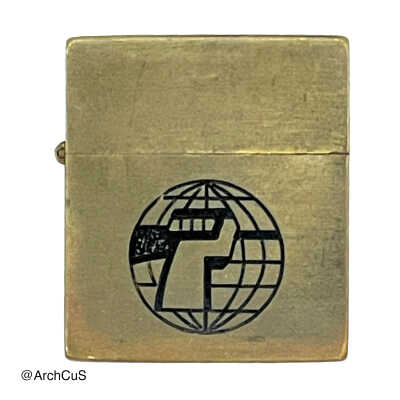
Commemorative Lighter — First Tricontinental Conference (Primera Conferencia de Solidaridad de los Pueblos de África, Asia y América Latina), Havana, 1966
A rectangular brass flip-top petrol lighter (Zippo-style, hinged windscreen lid). One broad face is stamped in black-filled capitals, the text running across both lid and body: on the lid, "PRIMERA / CONFERENCIA"; on the body, "DE SOLIDARIDAD / DE LOS PUEBLOS / DE AFRICA, / ASIA / Y / AMERICA LATINA." The opposite face carries, in black, the Tricontinental/OSPAAAL emblem: a clenched fist and forearm gripping a rifle, superimposed on a wireframe globe of meridians and parallels.
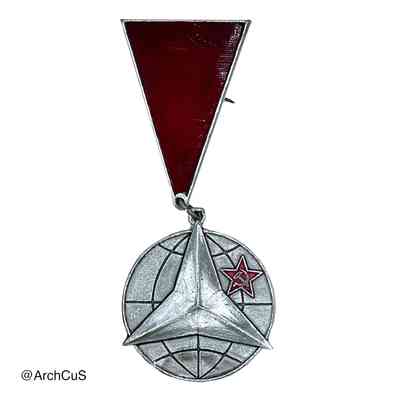
Commemorative Medal "To a Participant of the National-Revolutionary War in Spain 1936–1939" (Soviet Committee of War Veterans) — awarded to Theodore E. Veltfort
Pin-back suspension medal in two joined parts. The upper element is an inverted-triangle (apex-down) suspension filled with glossy red enamel in a plain metal frame, with a reverse brooch pin; a loop and ring link it to the medallion. The circular medallion depicts a wireframe globe (meridians and parallels) in silver-tone metal over which is superimposed, in high relief, the three-pointed/three-rayed star emblem of the International Brigades; at the upper right, a small red enamel five-pointed star bearing a silver hammer and sickle (the Soviet emblem). The obverse carries no legend. The reverse is smooth with a five-line inscription naming the award.
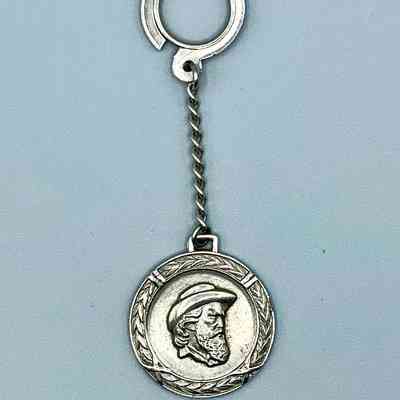
Commemorative key fob with medallion of Camilo Cienfuegos
A metal keychain comprising a flat, openable split-ring at the top, a twisted rope-link chain, and a round silver-tone medallion suspended from a soldered loop. Within a raised laurel-wreath border (broken by two small bars at the sides), the medallion shows the profile bust of Camilo Cienfuegos, facing right, with his characteristic full beard and broad-brimmed hat, its brim turned up at the side.
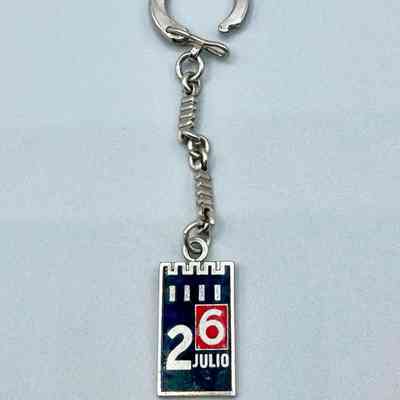
Commemorative keychain, "26 de Julio" (Moncada / 26th of July)
A keychain with a small upright rectangular enameled-metal fob on a fine link chain with a hinged C-shaped snap key ring. The fob has a dark navy enamel ground; the top edge is cut/stylized as the crenellated battlements of a fortress, with four short vertical white marks below the merlons suggesting windows or a wall. The center carries the date "26" — the "2" in white and the "6" reversed out of a red block, the colors of the 26th of July Movement — above "JULIO" ("July") in white. The design reads as a stylized depiction of the Moncada barracks with the revolutionary date. The metal rim is silver-tone; there is light wear to the enamel.
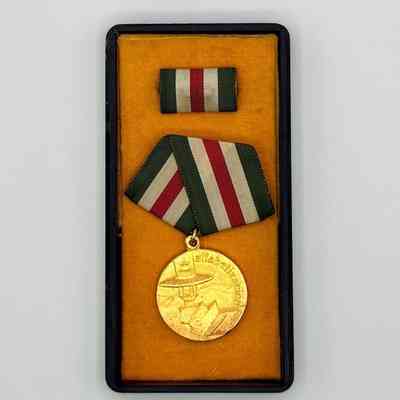
Commemorative medal of the National Literacy Campaign (Alfabetización) — cased set with service ribbon bar
Object Type: State decoration (medal) with suspension ribbon, matching ribbon bar, and presentation case Description: Cased award set comprising (1) a circular gilt medal suspended from a pentagonal Soviet-style ribbon mount on a green/white/red striped ribbon; (2) a matching mounted service ribbon bar; and (3) a hinged presentation case with black exterior and ochre flocked lining. Obverse of the disc bears the relief legend "alfabetización" with a farol (the oil lamp carried by literacy brigadistas), an open primer/book, and a stylized landscape. Reverse bears the Cuban coat of arms flanked by two stars, encircled by "REPÚBLICA DE CUBA" (top) and "CONSEJO DE ESTADO" (bottom). Images 1 and 2 show the obverse and reverse of the same single medal.
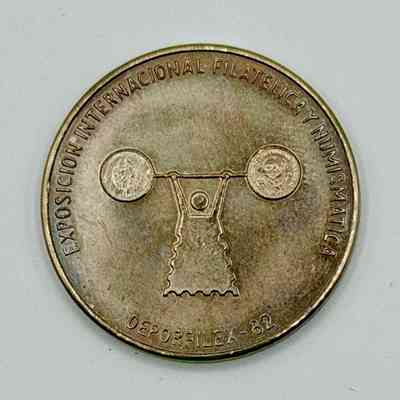
Commemorative medal — DEPORFILEX-82 International Philatelic and Numismatic Exposition
Round metal commemorative medal (table medal / medalla), silvery-gray in tone, struck in relief on both faces with raised rim. One face carries the issuing legend around the upper edge and a stylized figural motif at center: a cartoon-like character with a rounded cap or shell bearing circular bosses, beside a swimming aquatic mammal (flippered, manatee- or seal-like) — apparently an event mascot or emblem. The opposite face shows a weightlifting barbell in which the two end plates are rendered as coins, with a draped/serrated central element below the bar; legends run around the rim and across the lower field. Surfaces show overall toning, scattered contact marks, and minor handling wear; no mount, loop, or suspension is visible.
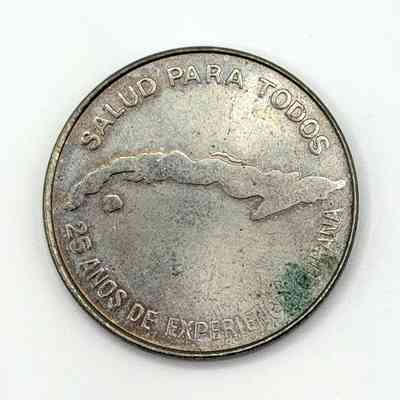
Commemorative medal — International Health Conference, Havana 1983 ("Salud para Todos")
Round silvery-gray metal commemorative medal (table medal), struck in relief on both faces with a raised rim. One face shows a relief map of the island of Cuba across the center field, with a curved legend above and below. The other face shows a World Health Organization–style emblem at center — a single-serpent staff (Rod of Asclepius) superimposed on a gridded globe, flanked by two laurel branches curving up from a crossed base — with curved legends above and below. Surfaces are toned with scattered dark spotting and minor handling marks; no loop or mount.
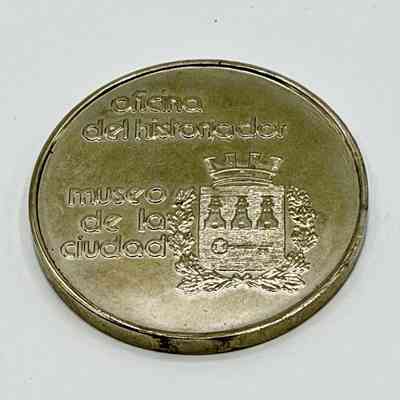
Commemorative medal, "Restauración del Centro Histórico — La Habana 1982" — Oficina del Historiador / Museo de la Ciudad
A circular silver-colored metal commemorative medal, struck in low relief on both faces. One face (obverse) carries the legend "restauración del centro histórico" above and "la habana 1982" below, around a relief plan/map of the historic center of Old Havana — the street grid of the old walled city beside the harbor channel, with a star-fort device at the harbor entrance. The other face (reverse) bears the coat of arms of the City of Havana (three castle-towers beneath a crown, a key in the lower field, flanked by a laurel/oak wreath), with the legends "oficina del historiador" above and "museo de la ciudad" below. Lettering is in modern lowercase. The medal shows light handling wear and toning.
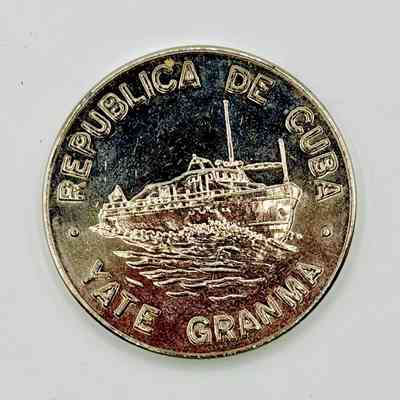
Commemorative medal, "Yate Granma" / anchor — Marina de Guerra Revolucionaria (CPEN/MGR), Cuba
A round silver-colored metal commemorative medal, struck in relief on both faces, with no denomination. The obverse depicts the yacht Granma underway at sea, encircled by "REPUBLICA DE CUBA" (above) and "YATE GRANMA" (below), with small dot ornaments at the sides. The reverse bears a large central anchor, with "CPEN" (above) and "MGR" (below), each flanked by ring/dot ornaments. Size of a large coin/medal; surfaces show toning, tarnish, and handling wear.
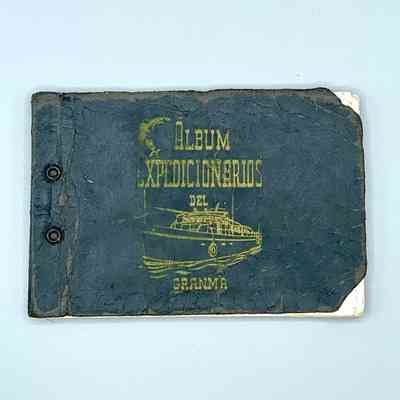
Commemorative photo album, "Álbum Expedicionarios del Granma"
Oblong (landscape) softcover photo album with dark paper-covered wrappers, the front blocked in green/gold: the title "ÁLBUM EXPEDICIONARIOS DEL GRANMA" with a star-and-crescent motif above a line illustration of the yacht Granma. Bound at the left edge with two metal eyelet posts. The interior opens with a title page, "Expedición y Desembarco del 'Granma'," carrying summary data — departure Tuxpan, México, 25 Nov 1956; arrival Playas "Las Coloradas," 2 Dec 1956, Oriente; crew 82 men; boat length 62 ft; crossing 7 days, 8 hours, 23 minutes; "Jefatura y Dirección: Fidel Castro Ruz"; "Prohibida la reproducción." The facing page notes that the album's proceeds would fund a mausoleum (panteón) for the Granma martyrs, beside a circular ink stamp "OPERACIÓN GRANMA / EJECUTIVO / HABANA" with the Cuban arms. The leaves carry black-and-white portrait photographs of the expedition members, opening with the fallen.
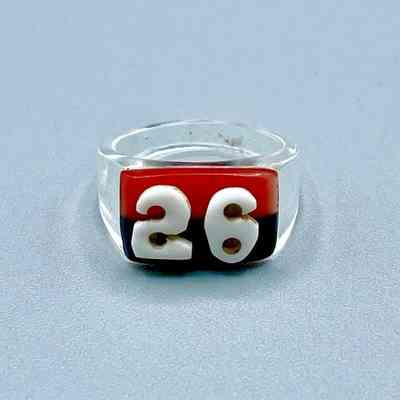
Commemorative resin ring, Movimiento 26 de Julio emblem ("26")
Clear cast-resin ring with a flat, rectangular signet-style face. Inset into the face is the emblem of the 26th of July Movement — a red upper band over a black lower band, with two white numerals "26" set across the color division. The numerals and color blocks are discrete inlaid elements fully encased in transparent resin; their bases are visible protruding on the underside of the face. Plain rounded clear shank. The recesses of the numerals hold brownish grime.
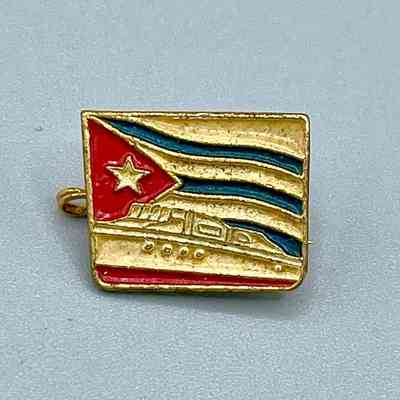
Cuban flag enamel pin commemorating the yacht Granma
Small rectangular gilt-metal brooch-pin enameled with the Cuban national flag shown as if waving — a red triangle at the hoist bearing a white five-pointed star, the flag's blue stripes in blue enamel and the white stripes left as raised gilt, furling across the field. The yacht Granma is struck in relief across the lower portion as a cabin cruiser with a low superstructure and a row of portholes, with a strip of red enamel along the bottom edge. A small wire loop projects at the left edge.
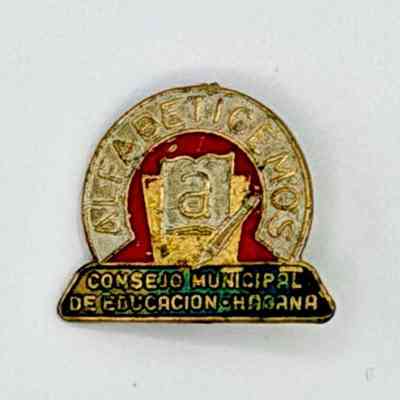
Cuban literacy-campaign enamel pin — "Alfabeticemos," Consejo Municipal de Educación, Habana
Small enameled metal lapel pin, arched/keyhole-shaped. The upper arch bears ALFABETICEMOS in gilt on a white enamel band; within, on a red enamel ground, a stylized open book/notebook marked with a lowercase "a" and a pencil (the campaign emblem). A black enamel banner across the foot reads CONSEJO MUNICIPAL / DE EDUCACIÓN · HABANA in gilt.
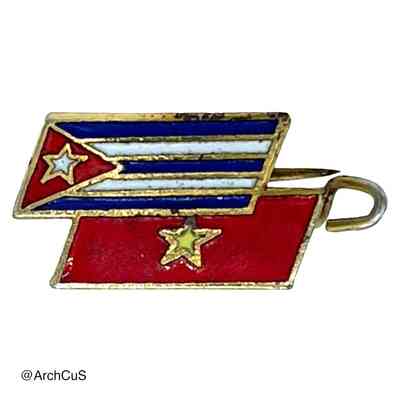
Cuba–Vietnam friendship enamel lapel pin
Small enameled metal stick‑pin showing two overlapping flags. Upper: the flag of Cuba — red hoist triangle with a white five‑pointed star, and three blue / two white horizontal stripes. Lower: a red flag with a single central yellow‑gold five‑pointed star (the flag of Vietnam). Gold‑tone outlines throughout. Needle (stick‑pin) fastener with a wire catch at the right.
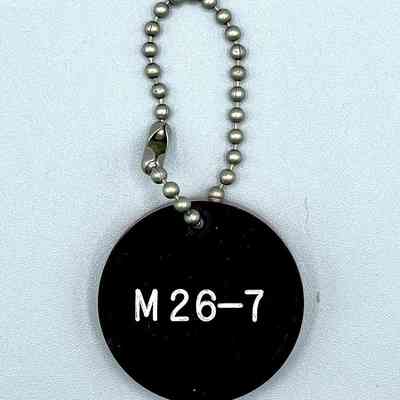
Double-sided "M 26-7" keychain fob (Movimiento 26 de Julio)
Single circular plastic disc fob, pierced near the top and suspended from a short metal ball-chain with coupling. The disc is two-sided — one face black, the other red, the two colors of the 26th of July Movement — with "M 26-7" stamped in white on each face (shown front and back). Lettering are engraved/stamped and white-filled.
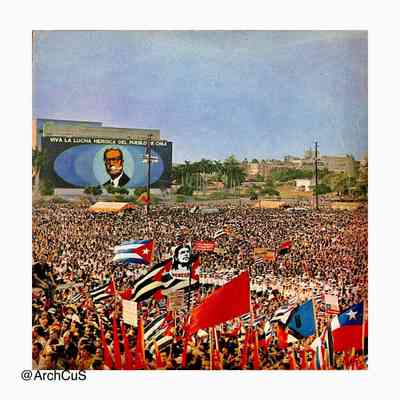
EP jacket (sleeve only) — Canción de los C.D.R. / Marcha del 26 de Julio (Areíto EPA-6432)
A 7-inch EP picture sleeve. Front: a color photograph of a mass rally in a large Havana plaza, with a huge billboard reading "VIVA LA LUCHA HEROICA DEL PUEBLO DE CHILE" above a memorial-style portrait of a bespectacled man; the crowd carries Cuban and Chilean flags, red banners, and a large banner bearing the well-known Guevara ("Venceremos/Vencer") image. Back: dark brown ground with the two-sided track listing, performer and composer credits, the CDR "con la guardia en alto" emblem, the Areíto logo, catalog number, and a design credit.
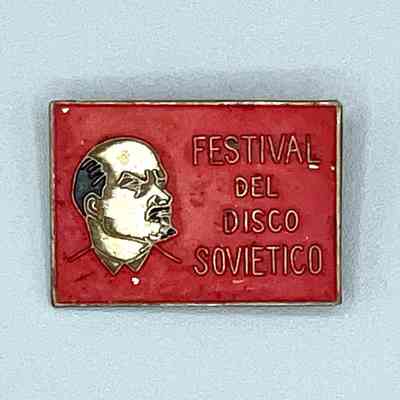
Event badge — "Festival del Disco Soviético"
Rectangular enamel pin on a red ground. At the left, a gilt profile bust of Vladimir Lenin (bald crown, mustache and goatee); at the right, raised gilt lettering in four lines reading "FESTIVAL / DEL / DISCO / SOVIÉTICO." Plain gilt rim.
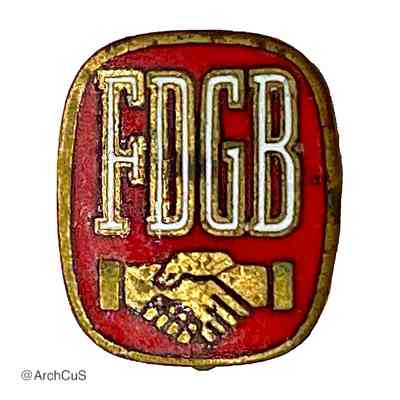
FDGB Membership Pin (Freier Deutscher Gewerkschaftsbund — Free German Trade Union Federation, East Germany)
A small rounded-square (squircle) lapel badge, slightly domed, with a gilt raised border. The field is red enamel. Across the upper two-thirds, "FDGB" appears in tall white block capitals with gilt outlines. Below, two clasped right hands (a handshake) are rendered in gilt relief, the cuffs squared off at left and right.
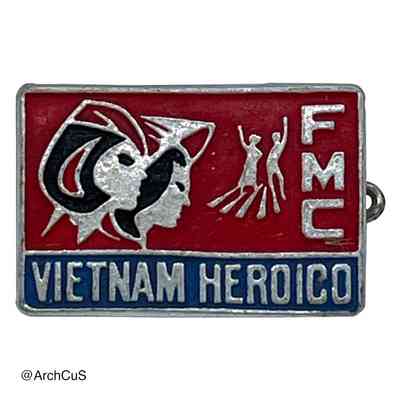
FMC "Vietnam Heroico" Solidarity Pin (Federación de Mujeres Cubanas)
An upright-leaning rectangular enamel pin within a silver-tone frame. The upper two-thirds is a red field; the lower third a blue band lettered "VIETNAM HEROICO" in white capitals. At the upper right, "FMC" is stacked vertically in white. At left are two stylized female heads in profile (white face, dark flowing hair, one with Western features and a beret, the other with Asian features and a Vietnamese hat). To their right, two figures with arms raised in jubilation stands above radiating lines (a burst/celebration motif).
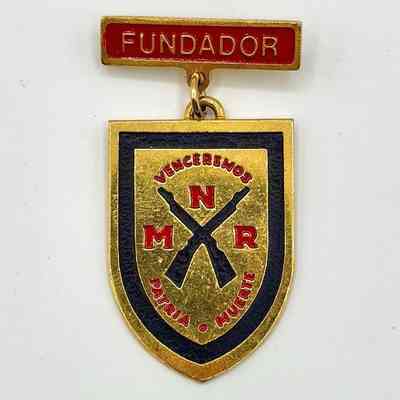
Founding member's badge (Fundador), Milicias Nacionales Revolucionarias (MNR)
Object Type: Pendant badge/medal with brooch suspension bar (membership distinction) Description: Two-part gilt-and-enamel badge. Upper brooch bar with red enamel field and recessed gilt lettering "FUNDADOR," joined by two linked jump rings to a hanging escutcheon (shield) pendant. The pendant carries the MNR emblem on a gilt field within a dark (black/navy) enamel border: crossed rifles at center; "MNR" disposed around them (N above, M left, R right) in red; "VENCEREMOS" arched across the top and "PATRIA O MUERTE" arched across the bottom, both in red, with a small device separating the lower words. Reverse (and fastening pin) not photographed.
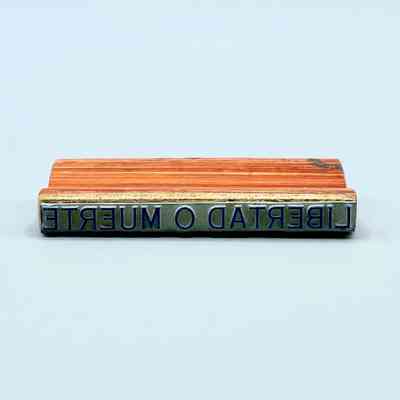
Hand rubber stamp reading "LIBERTAD O MUERTE"
A handheld rubber ink stamp consisting of a shaped wooden handle/block to which a molded rubber printing die is mounted via an intermediate foam/sponge cushion layer. The printing face carries the raised text "LIBERTAD O MUERTE" in capital letters, appearing in mirror-reverse as is normal for a stamp die; blue ink residue on the letters indicates the stamp was used with blue stamp-pad ink. The wooden handle has a reddish/orange varnished finish with a ribbed or grained surface and is rounded along its length for grip. Affixed to the top of the handle is a small red/pink diamond-shaped (lozenge) paper label; the user reports it reads "Hecho en Cuba" ("Made in Cuba"), though the printing is now faint and only partly legible in the image. The stamp shows wear consistent with use, including ink staining of the die and edge wear to the handle finish.
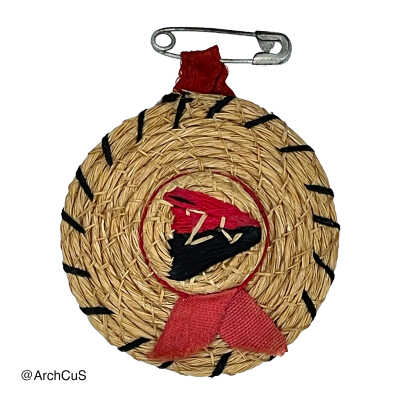
Handmade Straw Brooch — Miniature Campesino Hat with 26 of July Movement Emblem
A handmade brooch in the form of a small round Cuban straw hat. The body is coiled, woven natural palm/straw fiber, whip-stitched with black thread in radiating spokes across the brim. At the center, inside a red-thread ring, is the emblem of the Movimiento 26 de Julio: a diagonally divided field — red above, black below — with the numerals "26" worked over it in white thread. A red woven-fabric ribbon bow is fixed below the emblem, and a red fabric loop at the top carries a metal safety pin that serves as the wearing fastener.
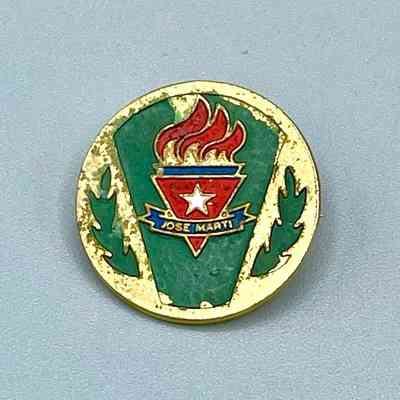
Insignia pin of the Organización de Pioneros José Martí (OPJM)
Small circular gilt-metal badge with colored enamel. The central device is a red flame of several tongues rising above a red triangle that bears a white five-pointed star, crossed at its base by a blue band lettered "JOSE MARTI," the triangle's lower point in blue; this sits on a green ground flanked by gold laurel branches within a plain gilt rim. The reverse is gilt, embossed "HECHO EN CUBA," and fitted with a soldered safety-pin–style brooch clasp.
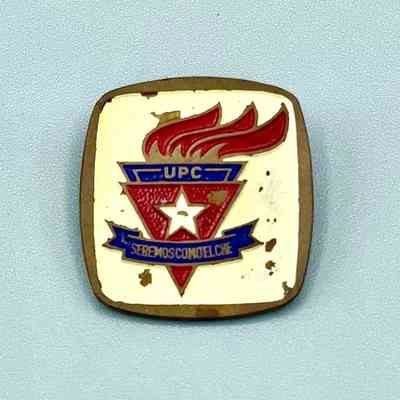
Insignia pin of the Unión de Pioneros de Cuba (UPC), "Seremos como el Che"
Cushion-shaped (rounded-square) gilt-metal brooch-pin with enamel. On a cream/ivory enamel ground, the central emblem shows a red flaming torch above a blue band lettered "UPC," over a red downward-pointing triangle bearing a white five-pointed star, with a blue ribbon banner across the lower field lettered "SEREMOS COMO EL CHE," all within a plain gilt rim. The reverse is plain gilt with a soldered brooch clasp.
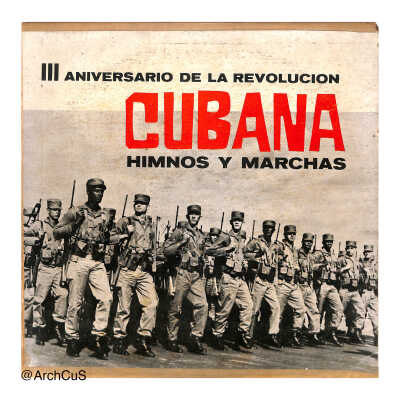
LP record album — III Aniversario de la Revolución Cubana: Himnos y Marchas (Imprenta Nacional de Cuba, INC-1007), jacket and disc
A 12-inch (33⅓ rpm) long-playing vinyl record with its printed paperboard jacket. Front jacket: a black-and-white photograph of uniformed soldiers marching with rifles shouldered, beneath the title set in black and red — "III ANIVERSARIO DE LA REVOLUCION CUBANA" / "HIMNOS Y MARCHAS," with "CUBANA" in large red letters. Back jacket: a black-and-white photograph of a vast crowd filling the Plaza de la Revolución around military vehicles (tanks marked 820, 822, 800, 821); a red title banner; a paragraph of liner text; performer/director credits; the full two-side track listing; and the printer's line. A retail price stamp ("$3.60") and a handwritten/stamped inventory number (appears "374," partly legible) are present. Disc: black vinyl with a patriotic label (blue arc lettering over a red-and-white stylized map of Cuba and musical staff)
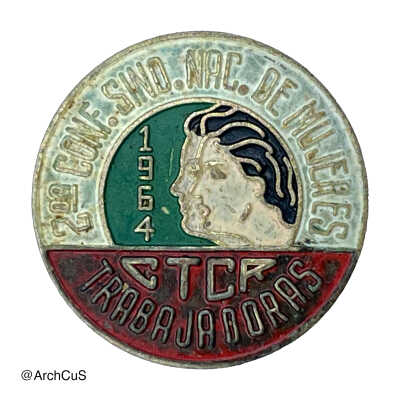
Lapel Pin, "2da Conferencia Sindical Nacional de Mujeres Trabajadoras" (Second National Trade-Union Conference of Working Women)
Enameled metal commemorative lapel pin issued for the Second National Trade-Union Conference of Working Women (2da Conferencia Sindical Nacional de Mujeres Trabajadoras), organized by Cuba's CTC-R labor confederation in 1964. A circular enameled metal pin/badge. Around the upper edge, in raised letters, runs the legend "2da CONF. SIND. NAC. DE MUJERES" (continuing to "TRABAJADORAS" along the lower edge). The center shows two women's heads in left profile, rendered in white/cream with dark hair, set against a green half-field; the year "1964" is stacked vertically in the green field to the left of the face. The lower half of the pin is red, carrying the stylized monogram "CTC R" above the word "TRABAJADORAS." The pin shows considerable age: corrosion spots, enamel loss, oxidation, and surface wear throughout, though all text and the central image remain legible.
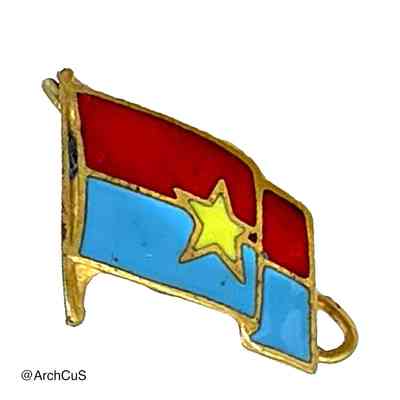
Lapel Pins — Flag of the National Liberation Front of South Vietnam (Viet Cong)
Two small enamel-on-gilt-metal pins cut in the shape of a flag waving from a staff. The staff runs up the left side; the flag flies to the right. The field is horizontally divided: red above, light blue below, with a five-pointed yellow star centered over the division. Gilt cloisonné-style walls outline the staff, the field divisions, and the star. A small gilt loop projects at the lower right.
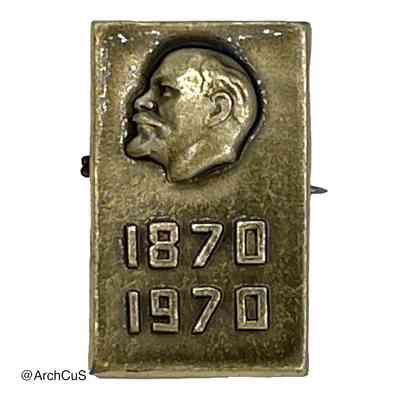
Lenin Centenary Lapel Badge, 1870–1970 (znachok)
An upright rectangular pin-back badge in gilt/golden-tone metal. The upper half carries a relief left-facing profile bust of Vladimir Lenin (bald crown, mustache and short beard) against a finely stippled ground. The lower half bears the relief dates "1870" and "1970" stacked on two lines. There is no other lettering on the face. A horizontal pin/needle fastener is fitted to the reverse.
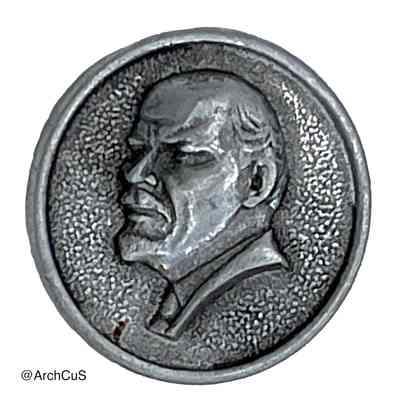
Lenin Profile Lapel Badge (Soviet znachok)
Small circular stamped-metal lapel badge. The obverse bears a high-relief, left-facing profile bust of Vladimir Ilyich Lenin — bald crown, mustache and short pointed beard, rendered to the collar and upper shoulders in a jacket — set against a finely stippled (granular) field and enclosed by a plain raised rim. No text, date, or device appears anywhere on the obverse; the design is portrait-only.
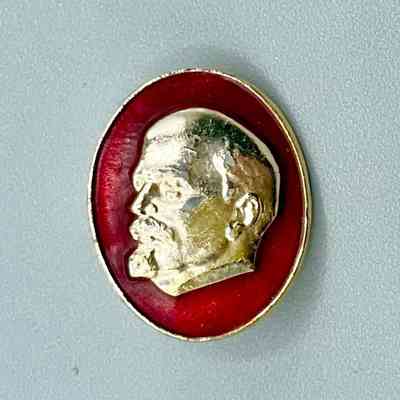
Lenin lapel badge, gold‑marked
Small oval lapel pin. Convex red enamel field carrying a raised left‑facing profile portrait of Vladimir Lenin in a gold‑colored finish; matching rim. Reverse is gold‑colored and textured, with an embossed mark and a small separate hallmark; vertical needle‑and‑clasp pin fastener.
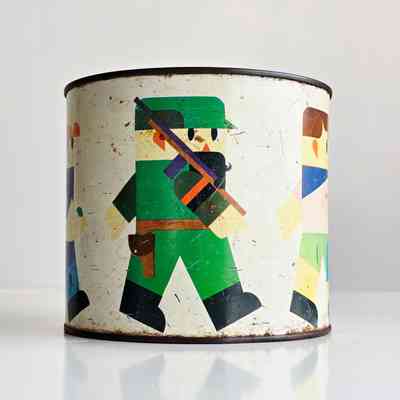
Lithographed Commemorative Tin — "XX Aniversario" (20th Anniversary of the Moncada Assault)
A cylindrical lithographed sheet-metal tin with rolled rims top and bottom. The exterior carries a continuous wraparound frieze of stylized, geometric children cartoon in a flat mid-century graphic style, striding in procession against a cream ground. Among them: one dressed as a soldier with a slung rifle and holstered sidearm; one dressed in blue and green as a militiaman holding a pistol; one with a multicolored beach ball; one dressed like a campesino in a wide yellow/orange straw hat with blue trousers; and one carrying a bag/briefcase printed with the "XX ANIVERSARIO" emblem — two interlocking red X's on a blue ground, "ANIVERSARIO" beneath. Photos courtesy of Estela Estevez and Eira Arrate. Object not in the Cuba Material collection.
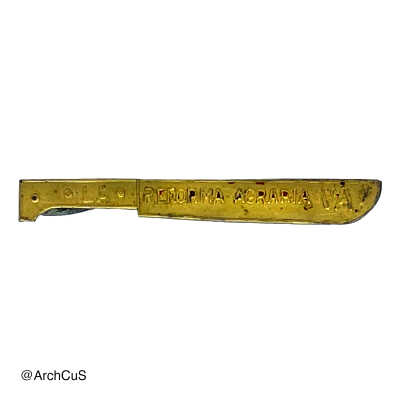
Machete lapel pin, "La Reforma Agraria Va" (Cuban Agrarian Reform)
Small gold‑colored metal lapel pin in the shape of a cane‑cutting machete (mocha). The blade and handle are lettered in relief: "· LA ·" on the handle and "REFORMA AGRARIA VA" along the blade. Pin fastener on the reverse (assumed; reverse not shown).
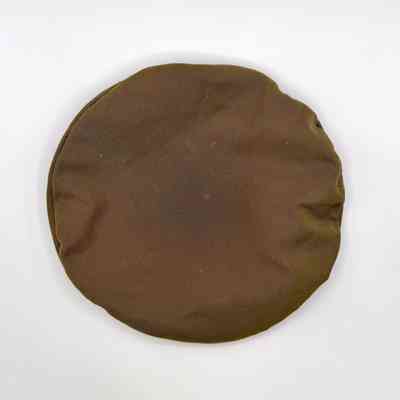
Milicias Nacionales Revolucionarias (MNR) beret with "BON-156 · FUNDADOR" founding-member pin
A khaki/olive-drab wool militia beret with a leather sweatband, tan lining, and side ventilation eyelets, shown interior-up. Affixed to the body is a small domed gilt (brass) pin badge bearing the MNR insignia (central shield) framed by "BON-156" above and "FUNDADOR" below, attached via a pin-back fitting.
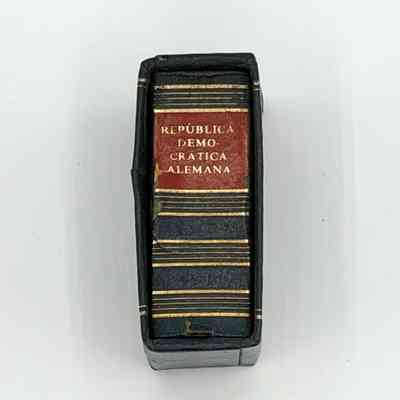
Miniature Book, República Democrática Alemana (German Democratic Republic promotional minibook), with slipcase
Spanish-language GDR promotional miniature book, República Democrática Alemana, in a matching slipcase. Navy leather-grain binding with gilt rules and a red gilt-lettered spine label; navy slipcase with gilt double rules and the gold-tooled GDR state emblem (hammer and compass within a wreath of grain). Illustrated throughout with color photographic plates documenting the GDR. Front leaves carry a handwritten ink dedication; the colophon credits the publisher, designers, and numerous photographers and GDR picture agencies.
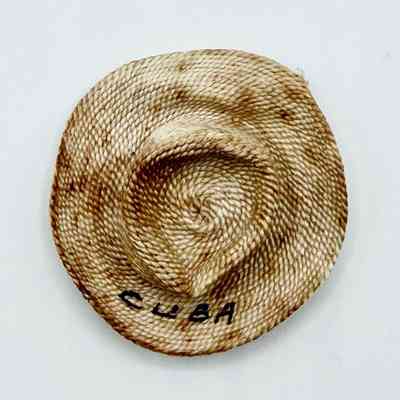
Miniature woven-straw souvenir sombrero brooch, hand-lettered "CUBA"
A small novelty brooch in the form of a miniature wide-brimmed straw hat (sombrero), made of fine plant-fiber/straw cordage coiled and stitched in a spiral from the crown outward to a downturned brim. The crown is raised and rounded; the brim is broad and slightly irregular/wavy. The upper brim is hand-lettered "CUBA" in black ink. The underside carries a metal safety-pin–type brooch fitting fixed across the inside of the crown, with a small folded dark red ribbon/fabric tab retained under the pin. The straw shows natural cream-to-tan tones with darker brown mottling and age spotting. One of a series of three; one of these rests on a spotted (foxed) rectangular card with a cut tab and a slot/pin (shown in one of the images). The piece reads as a handmade revolutionary memento. No maker's mark is present.
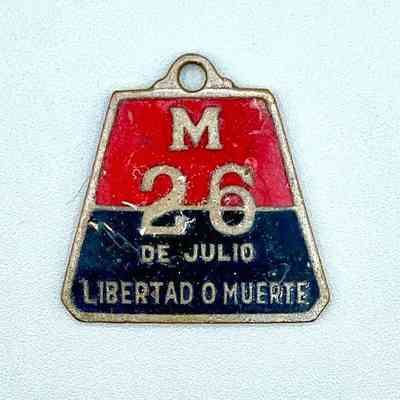
Movimiento 26 de Julio (M-26-7) enamel pendant — "Libertad o Muerte"
A small trapezoidal (bell-shaped) enamel pendant with an integral suspension loop at the top. The field is divided into two horizontal bands — red above, black below — within a gilt frame. Raised gilt lettering reads "M / 26 / DE JULIO" across the division and "LIBERTAD O MUERTE" on the black band.
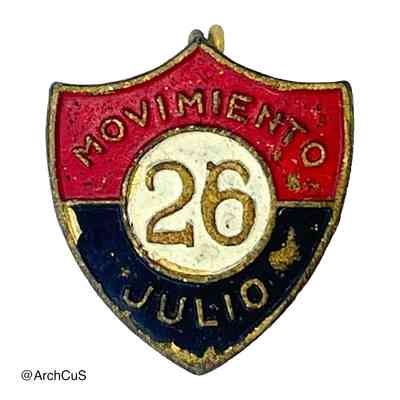
Movimiento 26 de Julio Shield Lapel Pin (M-26-7 insignia)
A small shield-shaped (escutcheon) enamel pin with a gilt rim. The upper field is red enamel lettered "MOVIMIENTO" in gilt across the top; the lower field is black enamel lettered "JULIO" in gilt along the point; at center, a white enamel disc carries a gilt "26."
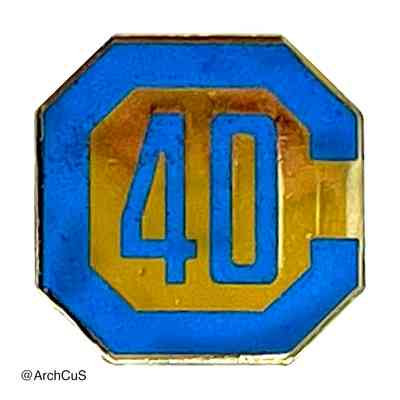
Octagonal "C40" enamel lapel pin
Small octagonal lapel pin with a golden (gold/gilt) finish and blue‑enamel field. Reads "C40" — a large numeral "40" set within a "C"‑shaped device — in gold against the blue. Gold border following the octagon. Pin fastener on the reverse (assumed; reverse not shown).
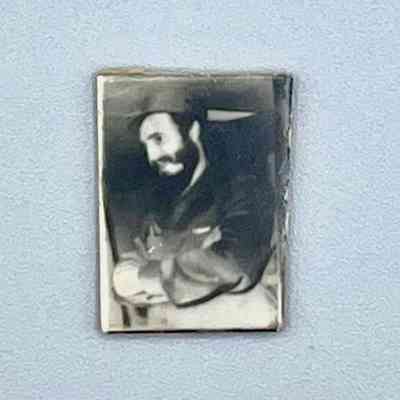
Photographic portrait insert of Fidel Castro
A small black-and-white photographic print, portrait/vertical format, depicting Fidel Castro against a dark indistinct background, in military-style dress. The print is small, with a glossy reflective surface, and shows curling, surface marks, and edge damage at the upper right. Its scale, format, and wear suggest it was originally mounted as the photographic insert of a personal wearable or carried object — such as a locket, pendant, badge, or commemorative token — from which it has become detached; it now survives as a loose component rather than a complete object.
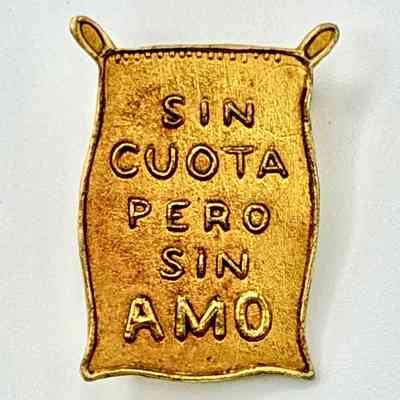
Political-slogan lapel pin — "Sin cuota pero sin amo" (sugar-sack form)
A small gilt metal pin cast in the shape of a burlap sack—the universal symbol of bulk commodity trade—embossed with the phrase: SIN CUOTA PERO SIN AMO. Without quota. But without a master. The slogan refers directly to the US sugar quota, cancelled by the Eisenhower administration in 1960 as economic retaliation against the revolutionary government. Sugar had been the backbone of the Cuban economy for over a century, and the quota guaranteed a preferential market in the United States. Its cancellation was meant to destabilize and starve the revolution into collapse. The pin turns that act of economic aggression into a badge of pride. Cuba lost the quota, and with it, guaranteed income and stability. But the loss is reframed as liberation from dependency, from the asymmetric relationship that had tied the island’s economy to Washington for decades. Sin amo. No master. The sack as form is precise: the very vessel of sugar export becomes the surface for the message.
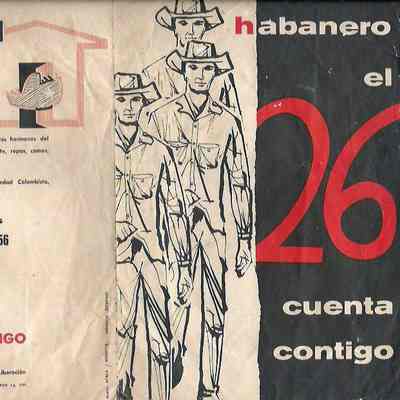
Revolutionary leaflet — "Ábrele tu puerta al campesino / El 26 cuenta contigo" (Concentración Campesina, 26 July 1959)
A folded paper leaflet printed in black and red on cream stock, promoting the 26 July 1959 Concentración Campesina and the Agrarian Reform. Outside: front panel with a bold red "26" on a dark ground, an illustration of campesinos in straw hats, and "habanero / el 26 cuenta contigo." Back panel headed "ÁBRELE TU PUERTA AL CAMPESINO," with a house-and-hat graphic, urging habaneros to host arriving campesinos (lodging, food, transport, clothing, beds) and to offer help at the Sociedad Colombista (Leonor Pérez/Paula 251 esq. Compostela; tels. 5-1952, 5-1956); slogans "la reforma agraria está en camino / CONTAMOS CONTIGO"; dated "Julio 26 de 1959 / Año de la Liberación"; "EDITADO POR LA OPI." Vertical printer's credit at the fold (reads "Gráfica Ayala," tentative). Inside: left panel addressed "HABANERO:", arguing that raising the rural standard of living means more food for the cities and shared economic progress, closing "AFIRMA TU FE EN LA reforma agraria." Right panel headed "contamos contigo…", a series of "PORQUE…" clauses tying the appeal to the first 26 de Julio celebrated in freedom (first Moncada anniversary in liberty), the Agrarian Reform as the Revolution's fundamental law, the peasants' wartime shelter of the rebels, and Havana's record of resistance (referencing the fraudulent 3 November [1958] elections and the January [1959] general strike); closes "CONTAMOS CONTIGO."
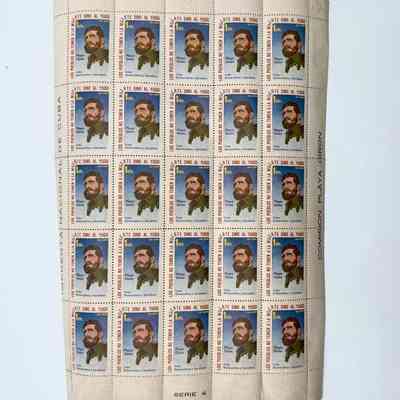
Sheet of "Playa Girón" fundraising stamps (Fidel Castro), Imprenta Nacional de Cuba, Serie 4
A complete printed sheet of 25 identical stamps (5 × 5), perforated and still joined, on paper with selvage (margins) on all sides. Each stamp shows a side profile portrait of Fidel Castro against a blue ground; denomination "1 ctv." at upper right; "Playa Girón" across the center; "Cuba Democrática y Socialista" below; and, along the left edge and top of each design, the slogan "Los pueblos no temen a la muerte sino al yugo," with the name "Fidel Castro" in small type. The sheet selvage is printed vertically at left "IMPRENTA NACIONAL DE CUBA," vertically at right "COMISIÓN PLAYA GIRÓN," and at bottom center "SERIE 4." A handwritten "17" appears in the upper-right margin.
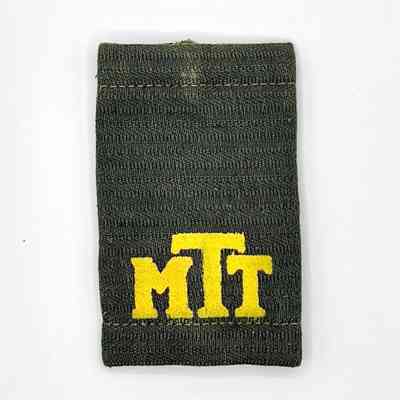
Slip-on shoulder strap (charretera), Milicias de Tropas Territoriales (MTT)
Object Type: Uniform insignia — tubular slip-on epaulette/shoulder board Description: Rectangular olive-green cloth sleeve (open tube) designed to slide over the shoulder loop of a uniform shirt. Two transverse rows of stitching across the face form the tube and a retaining bar. Applied yellow lettering "MTT" on the outer face, the two T's rendered as an overlapping monogram. Loose threads at the upper open end.
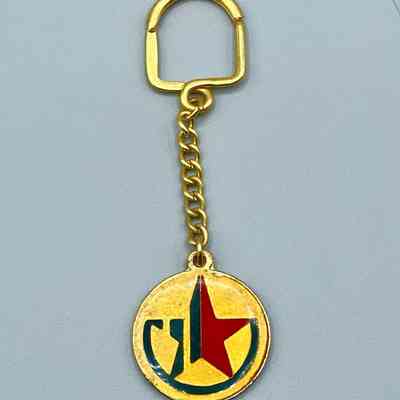
Souvenir keychain (llavero), emblem of the joint Cuban-Soviet space flight (Intercosmos / Soyuz-38)
Gold-tone (gilt base-metal) keychain comprising a sprung key shackle/clasp, a short curb chain, and a circular enameled medallion pendant. The medallion's face carries a champlevé-style enamel emblem: a red five-pointed star set against a gold ground, overlaid/flanked by a green (teal) stylized logogram — a curved hook at lower left, a vertical bar, and a sweeping baseline that together read as a modernist institutional or event monogram (the emblem of the Cuban-Soviet space flight). The reverse is finished with an all-over cross-hatched texture and impressed "HECHO EN CUBA."
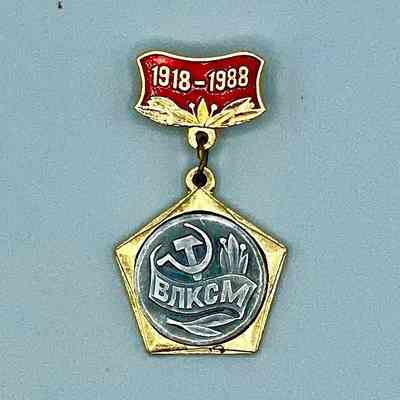
Soviet Komsomol (ВЛКСМ) 70th-anniversary commemorative badge, "1918–1988"
Two-part pendant badge. The upper suspension bar takes the form of a furled red banner lettered "1918–1988" in white, resting on splayed gold-tone wheat ears. A wire loop links it to a hanging pendant: a gold-tone pentagon (point down) framing a circular silver-tone medallion bearing the Komsomol emblem — a hammer-and-sickle above, three stylized flame/ear plumes at right, a furled banner across the center reading ВЛКСМ, and a laurel sprig below.
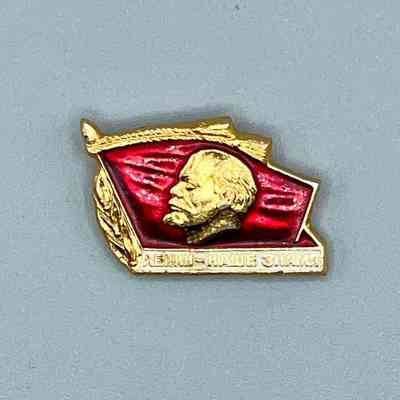
Soviet lapel badge (значок), "Ленин — наше знамя" / Lenin Is Our Banner
Small figural lapel pin in the form of a furled red banner edged at left with gold-tone wheat ears and a flagstaff with finial. A left-facing relief profile of Vladimir Lenin sits in gold-tone over the red field, with incised radiating rays behind. A white band across the lower edge carries a gold Cyrillic slogan.
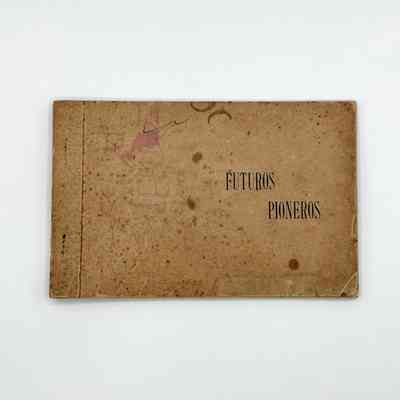
Student's notebook/agenda "Futuros Pioneros," 1970 (Zafra de los Diez Millones)
A small oblong (landscape) saddle-stitched paper booklet with a buff card cover lettered "FUTUROS PIONEROS" in serif capitals, with a faint pink lithographed cartoon child figure (a "future pioneer"). The interior combines a student agenda with revolutionary campaign content: an owner-identification page headed "DATOS PERSONALES" (Nombre / Apellidos / Estudiante de / Dirección / En caso de accidente avisar a — blank); a 1970 calendar headed "1970 DIRECCION DE SUPERACION DE LA MUJER 1970" (twelve months, week beginning Sunday, D-L-M-M-J-V-S); a central "CALENDARIO DE LOS DIEZ MILLONES" box listing target dates for each cumulative million tons of the 1970 harvest (first million 23 December … tenth 15 July); an outline map of Cuba's then-six provinces with sugar-mill counts; a "PRODUCCION EN LA ZAFRA DE 1970" table and "NUESTRO COMPLEJO INDUSTRIAL" list; and a red banner slogan. Several leaves are blank note pages.
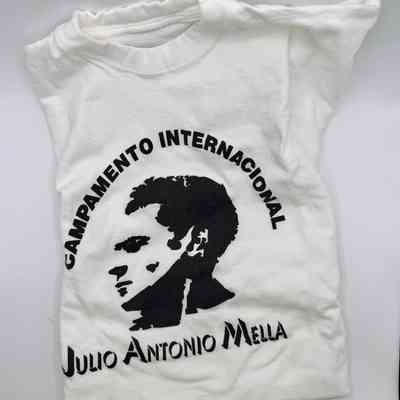
T-shirt, Campamento Internacional "Julio Antonio Mella" (CIJAM)
White short-sleeve knit t-shirt with a black screen-printed front graphic: the stylized portrait of Julio Antonio Mella (the iconic swept-back-hair profile) within a ring reading "CAMPAMENTO INTERNACIONAL" (top arc) and "JULIO ANTONIO MELLA" (bottom).
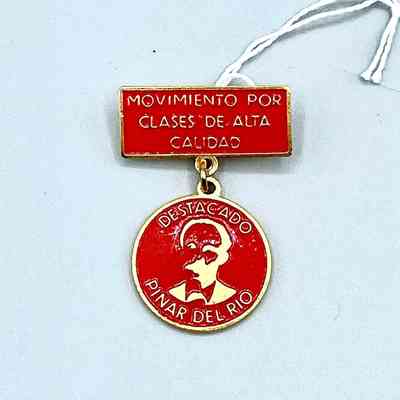
Teaching-emulation badge — "Movimiento por Clases de Alta Calidad," Destacado
A two-part enameled gilt award insignia. A rectangular top bar carries the relief legend "MOVIMIENTO POR CLASES DE ALTA CALIDAD" on a red enamel ground and suspends, via a loop, a circular pendant medal. The pendant has a red enamel ground bearing a left-facing profile portrait of José Martí, encircled by "DESTACADO" (upper arc) and "PINAR DEL RIO" (lower arc) in relief gilt lettering.
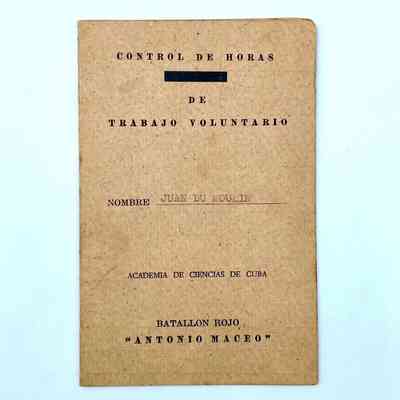
Voluntary-work hours log card — "Control de Horas de Trabajo Voluntario," Academia de Ciencias de Cuba, Batallón Rojo "Antonio Maceo"
A personal log for recording voluntary-labor hours. The printed cover reads, in stacked capitals: "CONTROL DE HORAS / DE / TRABAJO VOLUNTARIO," a "NOMBRE" line bearing the holder's name, "ACADEMIA DE CIENCIAS DE CUBA," and "BATALLON ROJO / 'ANTONIO MACEO'", with a solid black printed bar beneath the title.
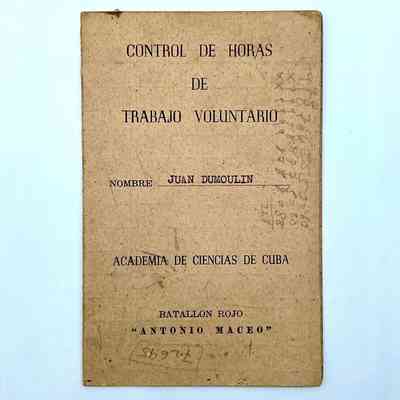
Voluntary-work hours log card — "Control de Horas de Trabajo Voluntario," Academia de Ciencias de Cuba, Batallón Rojo "Antonio Maceo"
A personal log for recording voluntary-labor hours. The printed cover reads, in stacked capitals: "CONTROL DE HORAS / DE / TRABAJO VOLUNTARIO," a "NOMBRE" line bearing the holder's name, "ACADEMIA DE CIENCIAS DE CUBA," and "BATALLON ROJO / 'ANTONIO MACEO'." Handwritten: arithmetic at upper right; a boxed "T-2695" near the foot; scattered marks.
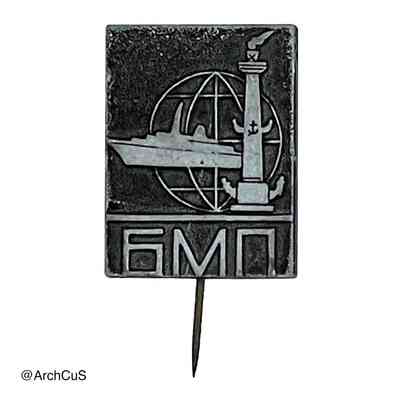
БМП (Baltic Sea Shipping Company) stick‑pin badge
Small rectangular Soviet lapel stick‑pin with an oxidized silver‑gray finish, low‑relief design on a dark ground. Device: a merchant ship crossing a meridian globe, alongside a Rostral Column (Leningrad landmark, with anchor and prow motifs); the Cyrillic abbreviation "БМП" on a banner across the foot. Long needle (stick‑pin) fastener.