
Personal Use
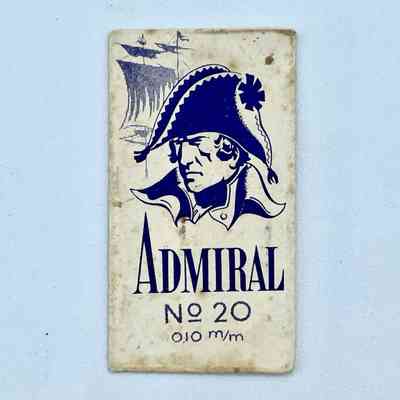
"Admiral" No. 20 double-edge razor blade with wrapper
A double-edge razor blade of the "Admiral" brand, retained in its printed paper wrapper. The wrapper is printed in blue on white paper and marked "MADE IN DENMARK," with a naval officer in a bicorne hat above a sailing ship, the brand name "ADMIRAL," a product designation "Nº 20," and a blade-thickness marking "0,10 m/m." DESCRIPTION: A single double-edge (DE) safety razor blade retained in its individual envelope-style paper wrapper, the wrapper shown front and back. The front carries a blue monochrome illustration of a naval commander shown bust-length, wearing a fore-and-aft bicorne hat with a side cockade or rosette, set against a halftone background of a square-rigged sailing ship. Below the portrait, in tall serif capitals, is the brand name ADMIRAL, beneath it "Nº 20," and beneath that "0,10 m/m" (a blade-thickness specification of 0.10 mm, written with the European decimal comma). The reverse shows the closed envelope-fold of the wrapper with printed use instructions in a script face, a line reading "SYNTHETICAL RUSTPROTECTED," and the country of origin "MADE IN DENMARK." The blade is enclosed within the wrapper; it is not separately pictured in the images.
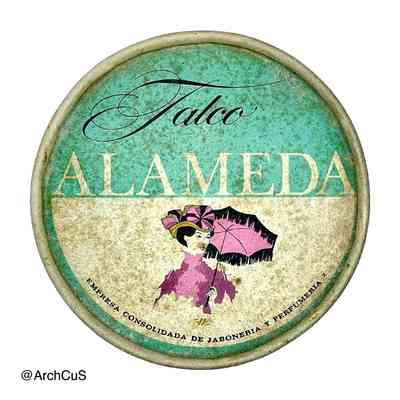
"Alameda" talcum-powder box
A round cardboard talcum-powder box. The lithographed design sets "Talco" in elegant black script over "ALAMEDA" in large pale deco capitals on a turquoise band; below, on a cream ground, is a Belle Époque-style illustration of a lady in a plumed hat holding a fringed pink parasol. Around the lower arc runs the maker's legend "EMPRESA CONSOLIDADA DE JABONERÍA Y PERFUMERÍA," with a small "2" at right and the interlocked state-enterprise monogram centered above the text. The lid is toned, foxed, soiled, and abraded.
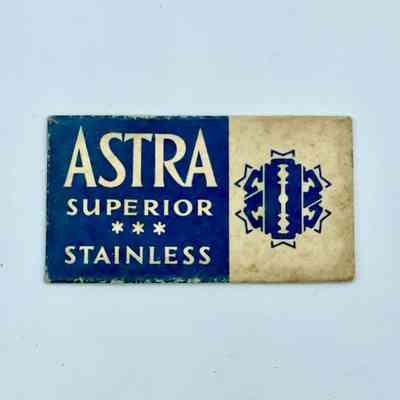
"Astra Superior Stainless" Double-Edge Razor Blade with Individual Wrapper and Outer Box
Four single "Astra Superior Stainless" double-edge safety razor blades preserved in their original printed paper wrapper, together with the cardboard outer box that originally contained five such wrapped blades. Manufactured by the Astra Diu state enterprise in Jevíčko, Moravia, Czechoslovakia. The individual blade wrapper bears the brand name "ASTRA," the "Superior" grade designation, the three-star quality marking, the "STAINLESS" composition marking, and a stylized razor-blade graphic in a sunburst frame. The outer box carries the same brand identity plus the export designations "5 BLADES" and "MADE IN CZECHOSLOVAKIA" in English. DESCRIPTION: OBJECT 1 — INDIVIDUAL BLADE WRAPPER (image 1): A small rectangular paper wrapper (approximately 4 × 2.5 cm estimated), printed in two-color lithography on cream/white paper, folded around a single double-edge razor blade and sealed at the back. The principal face is divided vertically into TWO color zones: - Left half: Deep royal blue ground with "ASTRA" in large cream/yellow block letters at top, "SUPERIOR" in smaller white/cream lettering below, three small cream stars "* * *" in a horizontal row, and "STAINLESS" at the bottom — the Astra wordmark in its full restrained slab-serif house style - Right half: Cream/white ground with a stylized graphic of a double-edge razor blade in dark royal blue. The wrapper itself is well-preserved: the printing is sharp, the colors are saturated, and the edges are clean. Some toning at the corners is visible but no major losses. OBJECT 2 — OUTER BOX (images 2, 3, 4): A small rectangular cardboard slide-box of standard 5-blade DE-razor dimensions. The box originally contained five paper-wrapped blades matching the surviving wrapper described above. FRONT FACE: A larger version of the same design as the individual wrapper — divided vertically into a blue half ("ASTRA / SUPERIOR / *** / STAINLESS") and a cream/white half (the stylized razor-blade graphic with sunburst). The design language is consistent across the wrapper and the outer box. BACK FACE: Mirror of front face with reversed color blocks, so that the brand identity reads correctly whether the box is opened from either side. SHORT SIDE / END PANEL: "MADE IN CZECHOSLOVAKIA" in white/cream lettering on the blue ground. OTHER SHORT SIDE / END PANEL: "5 BLADES" in white/cream lettering on the blue ground, along with a small Astra brand crest / heraldic device. The outer box shows significantly more wear than the surviving individual wrapper: heavy creasing, edge abrasion, surface scuffing, particular wear on the cream/yellow paper-label face which is heavily toned and has some areas of loss. The blue printed face remains more intact. The box has clearly been opened and re-closed many times.
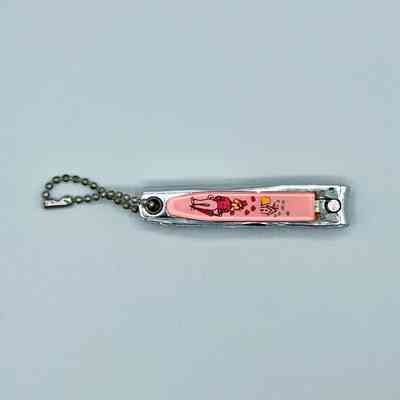
"Bell" Brand Folding Multi-Tool Nail Clipper (Model 709) with Knife Blade and Bottle Opener,
A small chrome-plated folding multi-tool combining a nail clipper, a small knife blade, and a bottle/can opener in a pocket-keychain format. Branded "Bell" with Model 709 (likely the N-709 series of South Korean manufacturer Bell Metal Co.). The clipper face carries a printed decorative pink panel with a small illustrated figure and stylized bell/flower iconography. Origin almost certainly South Korea — making this an unusual object for a Cuban family collection, since South Korea and Cuba had no diplomatic relations until 2024. Indicates a third-country acquisition pathway. DESCRIPTION: The body is bright nickel/chrome-plated steel, with three integrated functions hinged from a central pivot pin: (1) NAIL CLIPPER: When opened, the clipper end functions as a standard lever-arm nail clipper, with the operating arm folding back along the body to provide leverage. The clipper face carries a decorative pink-ground panel with a small printed/stamped illustration. (2) KNIFE BLADE: A short folding knife blade — a small straight-edged blade with pointed tip. (3) BOTTLE/CAN OPENER: A small hooked bottle-opener/can-opener appendagewith the characteristic hooked profile for popping bottle caps or cutting open canned goods. A small ball-link metal keychain (visible in image 1) is attached to one end via a small loop, allowing the tool to be carried on a key ring or chain. The metal end-loop of the keychain is shaped like a small flat tab.
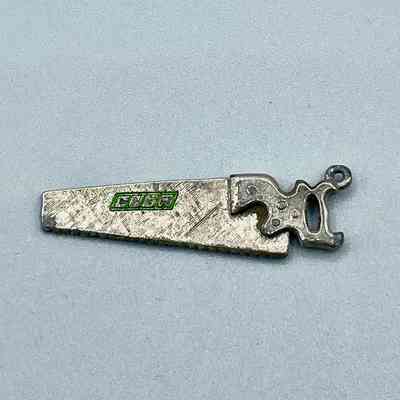
"CUBA" souvenir keychain fob, miniature handsaw
A small cast-metal charm/fob in the shape of a carpenter's handsaw (a panel saw), complete with a toothed blade, a shaped open handle, and imitation handle rivets, with a small suspension loop at the top of the handle for attaching to a key chain (the chain and ring are not present). The blade is stamped/engraved with crosshatch texture and carries the word "CUBA" in raised letters filled with green enamel/paint within a rectangular panel. The metal is a silver-tone alloy, worn and lightly tarnished. It is the pendant portion of a novelty souvenir keychain.
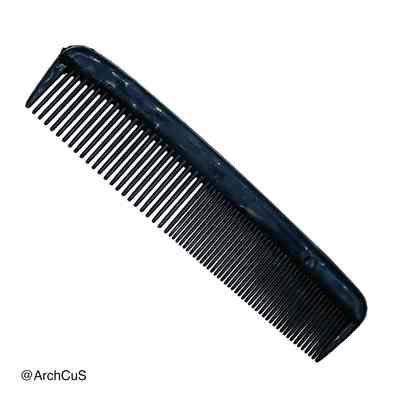
"Cepil" plastic dressing comb, black
A one-piece molded black plastic dressing/combination comb (peine), with a row of coarser, wider-set teeth across roughly half its length and finer, closely set teeth across the other half, and a plain spine. Molded into the spine are "HECHO EN CUBA" (upper edge) and the maker mark "CEPIL" (center); a small circular ejector-pin mark is visible on the spine (a molding artifact). The comb shows surface scuffing, whitish residue/streaking, and general wear.
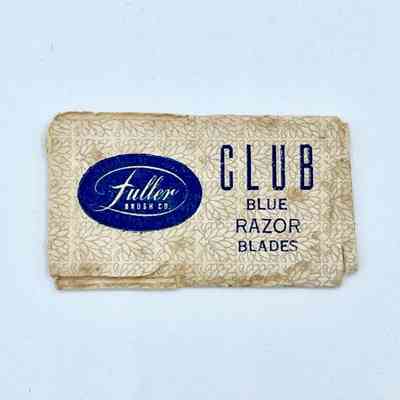
"Club Blue" double-edge razor blade with wrapper (Fuller Brush Company )
A "Club Blue" double-edge safety razor blade in its printed paper wrapper, a private-label product sold under the Fuller Brush Company name. The wrapper is a small rectangular sleeve printed on a cream ground patterned with a fine leaf/damask motif. The front carries the blue oval Fuller Brush Co. logo (the script "Fuller" over "BRUSH CO.") beside the product name set in dark blue block capitals: "CLUB / BLUE / RAZOR / BLADES." The reverse gives the distributor and manufacturer credits and the country of production. The visible element across both images is the folded wrapper; a blade is enclosed but is not separately pictured.
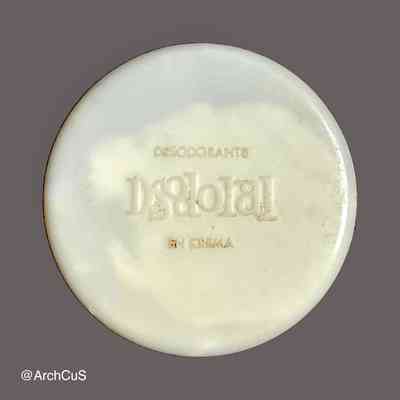
"Desodoral" cream deodorant (Suchel)
Circular molded-plastic case with screw-on lid, containing white cream deodorant. The domed lid top carries embossed lettering; the underside/base carries the maker's mark; the contents are partially used, with the cream surface disturbed and a smear at the inner rim.
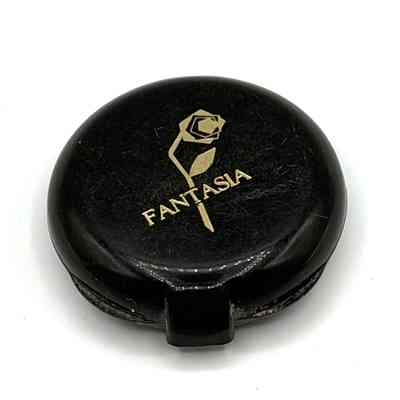
"Fantasía" iridescent blush compact (colorete), shade "Rosa Indio"
Small round compact in black molded plastic with a hinged, snap-closing lid. The lid exterior is printed in gold with a stylized rosebud-and-leaf device above the brand name "FANTASIA." Inside, a circular mirror is set in the lid and a pressed iridescent rouge (blush) cake sits in the base. The underside carries a printed paper label.
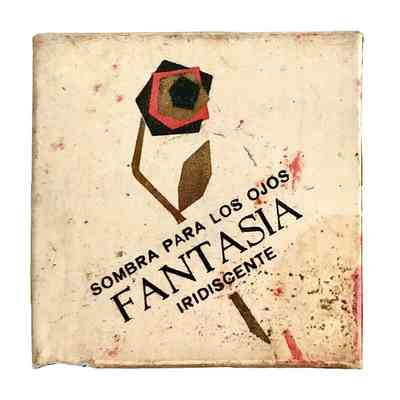
"Fantasía" iridescent eye shadow (sombra en polvo iridiscente), shade "Azul" (blue)
Pressed-powder iridescent blue eye shadow in a small round translucent-blue molded-plastic compact with a hinged, tabbed lid; the lid bears the silver Fantasía rose emblem above "FANTASIA," and the compact base carries a circular paper label. The compact is housed in its original square cardboard box: one side is printed with the geometric Fantasía rose (a stylized rose in black, red, and gold with stem and leaf) and the diagonal legend "SOMBRA PARA LOS OJOS / FANTASIA / IRIDISCENTE"; the reverse carries promotional copy, a die-cut circular window revealing the inside, and "HECHO EN CUBA" beneath the maker's monogram. The box is toned, soiled, and stained with blue and red/pink (product migration; the red is inconsistent with a blue shadow and may derive from a co-stored cosmetic), with bumped edges.
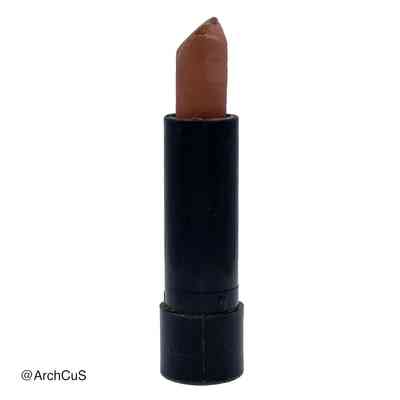
"Fantasía" iridescent lipstick (creyón labial iridiscente Fantasía", shade "Ilusión" (brown)
Swivel-type lipstick with a glossy black molded-plastic barrel and base collar, extended to show a frosted/iridescent nude-to-tan (warm beige-brown) bullet, used and irregularly worn with a fractured facet near the tip. The base collar fitted with a colorless push-on over-cap printed in gilt with an ornamental scheme (paired quatrefoil florets, a central vertical ornament, and beaded border bands). The flat black base carries a circular printed paper label: CREYON LABIAL IRIDISCENTE / FANTASIA / ILUSION / HECHO EN CUBA, above a small printed maker's monogram.
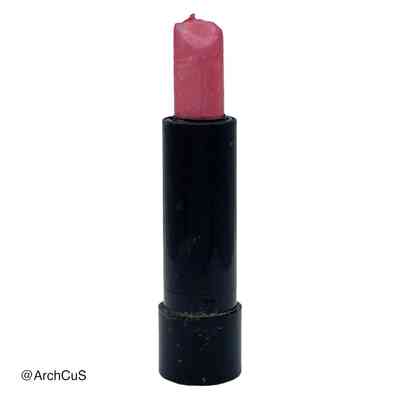
"Fantasía" iridescent lipstick (creyón labial iridiscente Fantasía", shade "Ilusión" (frosted rose-pink)
Swivel-type lipstick comprising a glossy black molded-plastic barrel and base collar fitted with a colorless push-on over-cap printed in gilt with an ornamental scheme (paired quatrefoil florets, a central vertical ornament, and beaded border bands). The flat black base carries a circular printed paper label: CREYON LABIAL IRIDISCENTE / FANTASIA / ILUSION / HECHO EN CUBA, above a small printed maker's monogram.
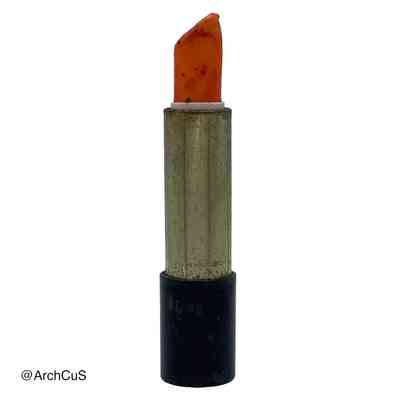
"Fantasía" lipstick (Creyón labial), orange/coral shade
Swivel-type lipstick with a fluted (vertically ribbed) metal barrel sleeve, a black molded-plastic push-on cap, and a black molded-plastic base. Capped, the tube reads as a plain black cylinder with a bright metal seam-band at the cap/base join. Uncapped, the metal barrel — now heavily tarnished/oxidized to a dark greenish-grey over an originally bright gilt or silvered finish — rises from the black base and carries a white inner collar holding an orange-to-coral bullet, used and irregularly worn, with surface mottling/spotting.
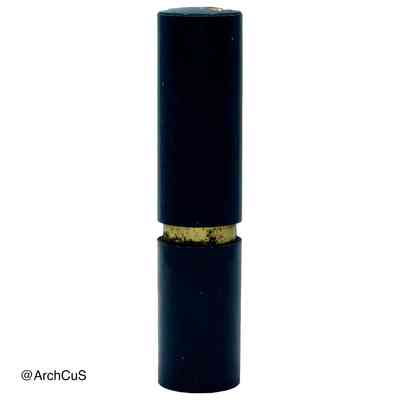
"Fantasía" swivel eyeshadow stick, shade Verde Nilo
Cylindrical swivel‑type cream/wax eyeshadow in a two‑part black molded plastic tube (cap and base) with a gold‑tone metal band at the join. Shown capped and open; the extended product is a pale‑green molded bullet. The inner carrier cup shows soiling and powdery residue.
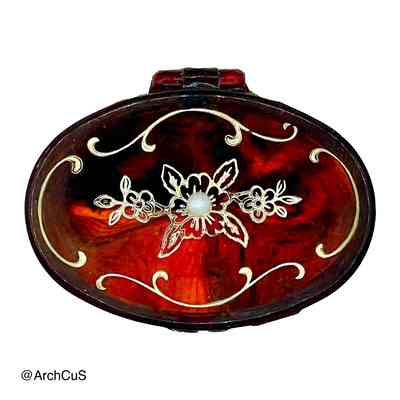
"Henrietta" eye-shadow compact
Oval hinged compact in mottled red-brown ("tortoiseshell"-effect) molded plastic. The lid is decorated with a gold-tone metal appliqué — a floral spray with scrollwork flourishes — centered on a white domed imitation-pearl cabochon; a small thumb-tab clasp projects at the top edge. Opened, the lid holds an oval mirror (heavily desilvered and foxed). The base interior, in the same red-brown plastic, carries a molded plaque lettered "Henrietta" in gold cursive and is fitted with two rectangular powder pans — a green eye shadow (left) and a pale blue/lavender eye shadow (right, with white surface blooming) — above a long narrow empty well (for a missing applicator) and a lower recess.
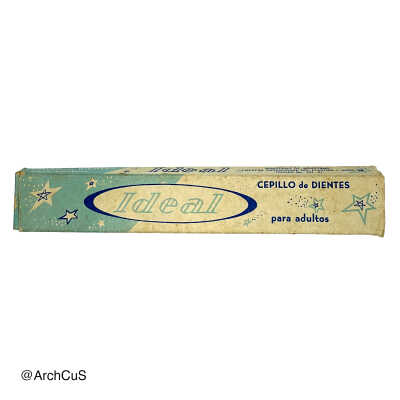
"Ideal" Adult Toothbrush Carton
Long, narrow paperboard toothbrush carton, shown from its principal face and long top edge (closure type not determinable from this single view). The front carries a diagonally split ground of pale teal-green and cream, scattered with five-pointed stars (some filled, some outlined) and small dot clusters. A dark-navy horizontal oval cartouche encloses the brand "Ideal" in outlined script lettering. To the right are the product line "CEPILLO de DIENTES / para adultos" and the maker block "MINISTERIO DE INDUSTRIAS / EMPRESA CONSOLIDADA DEL PLÁSTICO Y GOMA / UNIDAD No. 207-01." The long top edge repeats the brand and product line.
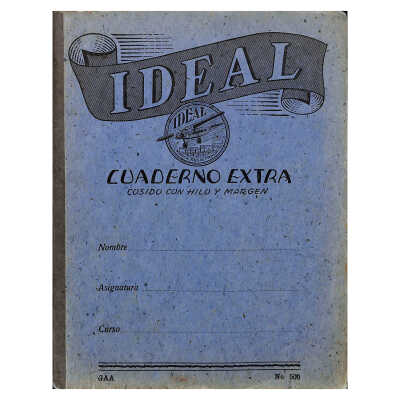
"Ideal" school exercise notebook (Cuaderno Extra No. 500)
Blue speckled‑pulp paper‑covered school exercise notebook (cuaderno), sewn binding with a reinforced spine. Front cover printed in black: a ribbon/banner reading "IDEAL"; a circular trademark with an aircraft over a factory and "IDEAL / MARCA REGISTRADA"; "CUADERNO EXTRA / cosido con hilo y margen"; and blank fill‑in fields "Nombre," "Asignatura," "Curso." Foot of cover: "GAA" (left) and "No. 500" (right).
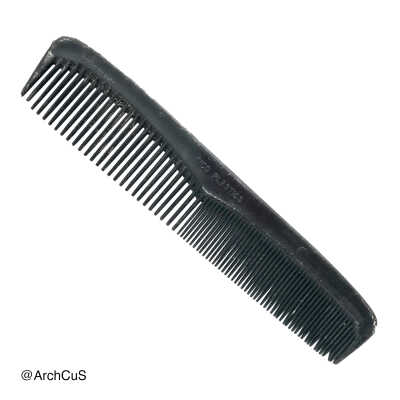
"Kico Plastics" dressing comb (peine), black
A one-piece molded black plastic dressing/combination comb (peine), with a row of coarser, wider-set teeth across roughly half its length and finer, closely set teeth across the other half, and a plain spine. Molded into the spine are the legends "HECHO EN CUBA" and "KICO PLASTICS." A circular ejector-pin mark is visible on the spine (a molding artifact). The comb shows surface scuffing, whitish residue/soiling, and general wear.
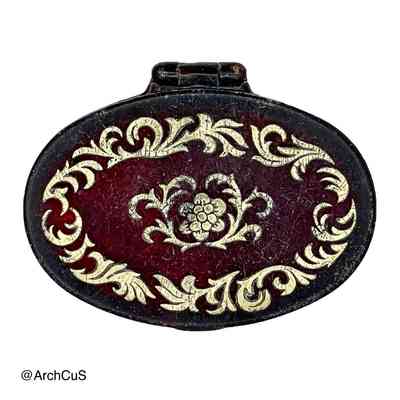
"Mary" eye-shadow compact
Oval hinged compact in mottled dark-red/brown ("tortoiseshell"-effect) molded plastic. The lid bears a gilt-printed rococo scroll-and-floral cartouche centered on a small flower; a thumb-tab projects at the top edge. The base exterior is molded with concentric ribbing around a central roundel reading "Mary / Made in Poland." Opened, the lid holds an oval mirror (heavily desilvered/foxed); the base interior is fitted with shallow wells — an upper rectangular shadow pan (pale/spent), a left pan retaining pale blue shadow, a right empty well, and a long narrow channel (for a missing applicator). Surfaces are worn, soiled, and crazed.
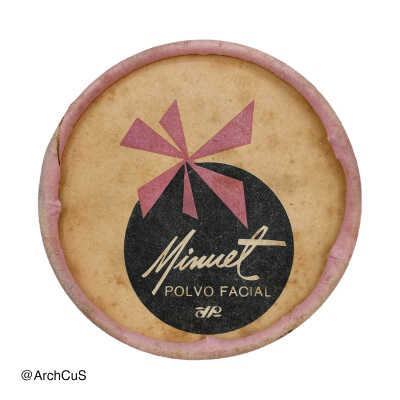
"Minuet" face powder (polvo facial) box
Round cardboard face-powder/concealer (polvo facial) box, shown from the lithographed top. The design centers a rose/pink pinwheel of radiating triangular "blades" rising from a black disc; across the disc, "Minuet" appears in white cursive script above "POLVO FACIAL" in gold/cream, with an interlocked cursive maker's monogram beneath. The box wall and lid rim are rose-pink; the cream ground is toned and browned with age (foxing), with soiling and edge wear to the cardboard.
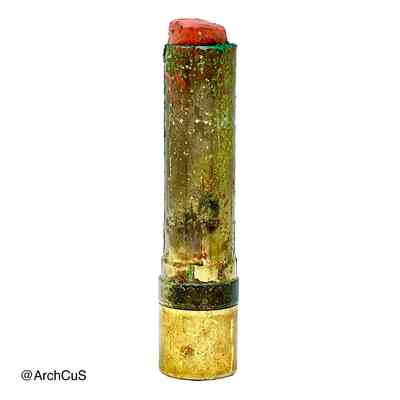
"Minuet" lipstick (creyón labial), labeled shade "Café"
Swivel-type lipstick in a gilt/lacquered metal (brass) tube with a domed push-on cap, the barrel carrying the brand name "Minuet" in flowing engraved/printed cursive, a rectangular swivel slot in its lower third, a black accent band at the barrel/base join, and a gilt-metal base. The base label reads "Minuet / CREYON LABIAL / CAFE," designating a brown/coffee shade. The bullet presently loaded, however, is orange-red/coral — inconsistent with "Café" — and is therefore most likely a later replacement refill rather than the case's original product. Closed, the tube shows heavy tarnish, an irregular white abrasion/loss area on the upper barrel, and soiling; open, the barrel is extensively corroded with green verdigris, the extended bullet worn and contaminated.
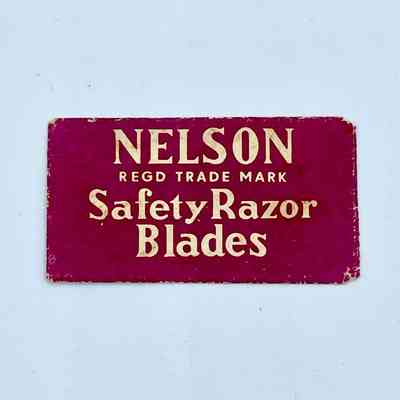
"Nelson" double-edge safety razor blade with wrapper
A double-edge safety razor blade of the "Nelson" brand, recorded with its printed label/wrapper. The element visible in the image is the front label or wrapper face: a deep maroon/magenta rectangle with rounded corners, printed in white/ivory lettering arranged in three registers — "NELSON" in tall serif capitals across the top, "REGD TRADE MARK" in small spaced capitals beneath, and "Safety Razor Blades" in a larger mixed-case display face below, the styling broadly mid-century with Art Deco character. The label edges are frayed and chipped with some corner loss.
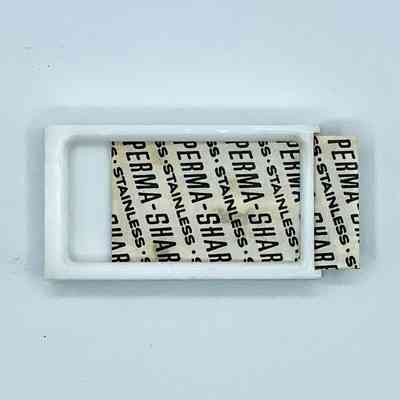
"Perma-Sharp Stainless" Double-Edge Razor Blade in Original Plastic Dispenser
A small white plastic dispenser containing a single wrapped Perma-Sharp Stainless double-edge safety razor blade. The blade remains in its original printed paper wrapper, which carries the distinctive repeating "PERMA-SHARP · STAINLESS ·" perimeter pattern that is the brand's signature visual identity. Most likely manufactured in Turkey, where the Perma-Sharp brand originated under the family-owned Istanbul enterprise Permatik Çelik Sanayi and where the white-plastic-dispenser packaging format was the standard Turkish-market presentation throughout the brand's history. Dating cannot be narrowed beyond the broad Turkish-production window (approximately 1960s through mid-1990s) without additional evidence, as neither the dispenser nor the wrapper carries any printed or embossed text beyond the repeating "PERMA-SHARP · STAINLESS ·" pattern on the wrapper itself. DESCRIPTION: PLASTIC DISPENSER (visible in both images): A small flat rectangular plastic case in plain white plastic, approximately 8 × 4 × 1 cm estimated, with rounded corners and an open-window slot construction at the top through which the wrapper inside is partially visible. The plastic surface is plain, with no printed or embossed text on any visible face — no manufacturer mark, no country of origin marking, no batch code, no copyright date, no Permatik or Gillette branding. The dispenser corresponds to the standard Turkish-market Perma-Sharp packaging format documented in vintage-razor-blade collector sources, distinguished from the cardboard-box-of-5 format used for later Russian-produced Perma-Sharp blades (post-2003 St. Petersburg PPI plant production). INDIVIDUAL WRAPPER (single, visible inside the dispenser and partially extending out of it): A single paper wrapper containing one blade. The wrapper is printed with a repeating "PERMA-SHARP · STAINLESS · PERMA-SHARP · STAINLESS · PERMA-SHARP · STAINLESS ·" pattern in black ink on cream/white paper. The brand name and composition designation form a continuous chain pattern that runs around the entirety of the wrapper, with mid-dot separators between each word. The center of the wrapper appears blank or carries minimal additional information not visible from these angles. The typography is condensed sans-serif uppercase. No other printed text — no manufacturer name, country of origin, batch code, or date marking — is visible on either side of the wrapper. The wrapper appears toned and aged, with some spotting and discoloration consistent with a paper artifact that has been in existence for several decades. This "perimeter brand-name as entire visual identity" design is unusual within the broader international razor-blade-wrapper tradition. Most blade wrappers feature a CENTRAL composition (brand logo, stylized blade graphic, color blocks, decorative elements) with secondary information in the margins. The Perma-Sharp design inverts this convention: the brand name itself becomes the visual frame, with no separate central composition. The visual structure may carry a small trace of the Islamic and Ottoman text-as-frame design tradition characteristic of Turkish graphic-design heritage — a tradition rooted in calligraphic borders, decorative-text framing in manuscript illumination, and the broader Islamic preference for text-as-ornament over figurative composition.
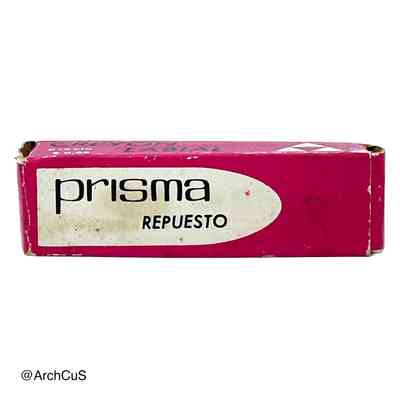
"Prisma" creyón labial (lipstick), shade Romance — refill ("repuesto"), with box
A boxed lipstick refill. The magenta printed-cardboard identifies the product as Prisma "Repuesto" creyón labial, net wt. 4 g, shade "Romance," price $0,65, Suchel, Hecho en Cuba, with the triple-triangle (prism) device. The refill itself is a bare terracotta/brownish-rose bullet (the "Romance" shade), speckled and bloomed with age. As a "repuesto," it is the replacement bullet intended for a reusable lipstick holder.
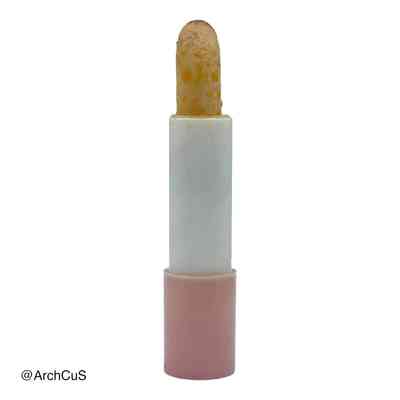
"Realce" (attributed) clear lipstick (creyón labial transparente) — set of two
Two examples of a clear/colorless push-up lipstick in pink-and-white plastic swivel tubes (pink base and cap, white inner barrel; capped form is an all-pink cylinder). The product is a pale, translucent yellowish wax with a domed tip. One unit is heavily used (bullet worn, with surface bloom and yellowing consistent with age/use); the other is unused (fuller, cleaner bullet). Construction and format match the red Realce lipstick catalogued separately.
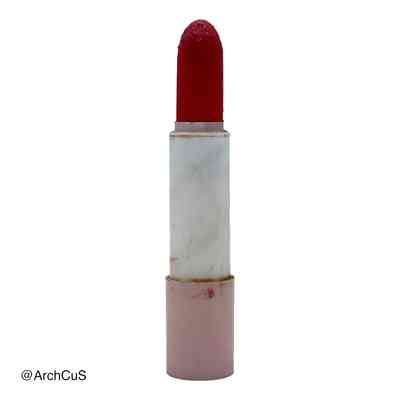
"Realce" creyón labial (lipstick), red shade
Swivel lipstick: white plastic inner barrel rising from a pink plastic base, presenting a red lipstick bullet; pink cap (capped form is an all-pink cylinder). The paper base label reads "Realce" beneath a small crown emblem. White barrel bears transferred red product smudges from use.
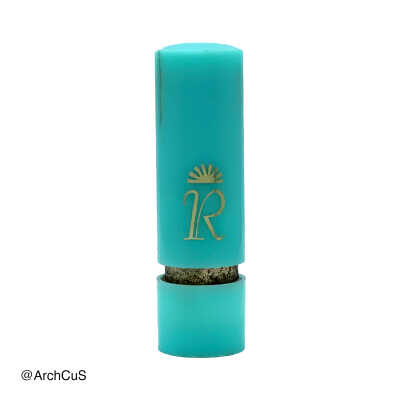
"Realce" eye shadow (sombra para los ojos), shade "Malva" (mauve) – empty
Empty turquoise molded-plastic swivel tube of eye shadow. The upper section (cap) carries the gold Realce emblem — a radiating sunburst above a stylized letter "R"; the lower section is the base, with a metal swivel collar/ferrule exposed between the two. The cap is slightly displaced, revealing the metal collar with granular soiling/residue. The base bears an inscription, transcribed by the holder as "SOMBRA PARA LOS OJOS / Realce / MALVA / HECHO EN CUBA."
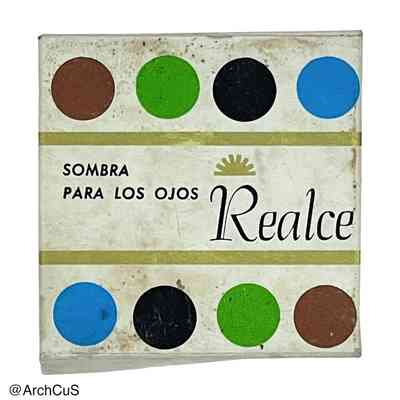
"Realce" eye-shadow box (sombra para los ojos), empty
Empty square cardboard box for Realce pressed-powder eye shadow. The front is printed with two rows of color dots — brown, green, black, blue (and reversed below) — representing the shade range, flanking a central band with olive/gold stripes, "SOMBRA / PARA LOS OJOS," and the Realce wordmark in an elegant script beneath a gold sunburst emblem. The reverse carries application instructions, a die-cut circular window (here empty — no compact/product present), and, at the foot, the interlocked maker's monogram with "HECHO EN CUBA." The board is toned, soiled/foxed, and creased at the corners.
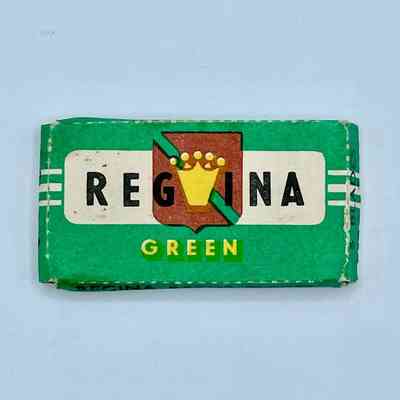
"Regina Green" double-edge razor blades (packet)
A small packet of "Regina" double-edge safety razor blades, the "Green" line, made in Czechoslovakia. The packet is predominantly green. The front carries a central white panel with the brand name "REGINA" in bold black capitals and a heraldic device — a gold crown above a brown shield divided with green — and the line name "GREEN" in yellow on a green ground below. Sets of fine white stripes flank the central panel at each end, and the narrow side is lettered "REGINA BLADES." The reverse is plain green with "REGINA" in cream capitals above "MADE IN CZECHOSLOVAKIA," with the same end striping. The packet is complete and still holding its blades, which are not separately visible.
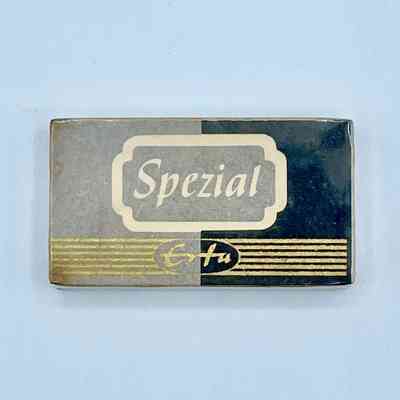
"Spezial" double-edge razor blades, Erfa (packet)
A small cardboard packet of "Spezial" double-edge safety razor blades made under the Erfa label, an East German brand. The box is printed in a two-tone scheme — a gray/silver left half and a black right half — with a white-edged cartouche across the top containing "Spezial" in a cursive script. A band of fine gold pinstripes runs along the lower front, interrupted by an oval bearing the cursive "Erfa" maker's logo straddling the two color fields. One long side is lettered "EXTRA DÜNN" (German for "extra thin," describing the blade gauge). The underside is a gold foil seal carrying the Erfa trademark — a small stylized figure or bust above a plaque reading "ERFA" — together with a triangular stamp enclosing the numeral "1" and a numeric code. The foil seal is intact, so the packet is still full.
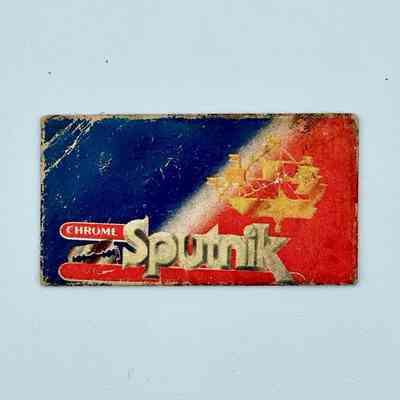
"Sputnik" Chrome Double-Edge Razor Blade Wrapper
An individual paper wrapper for a single "Sputnik" chrome-plated double-edge safety razor blade, manufactured in Leningrad by LMO "Leninets" (Ленинградское машиностроительное объединение "Ленинец"). The blade itself is no longer present; only the printed paper wrapper survives. Sputnik and Neva were SISTER PRODUCTS from the same factory, sharing the historical-Russian-sailing-ship visual motif as part of a unified Leningrad-maritime brand-family heritage. The ship on the Sputnik wrapper is a continuity element with the Neva brand and with the broader Leningrad-maritime visual tradition. The Sputnik name was extended from this maritime tradition (the Russian word "Спутник" meaning "fellow traveler" / "companion" — applicable to ships as well as satellites) onto the 1957 satellite achievement, and the ship-imagery was eventually superseded on later Sputnik packages by Sputnik-satellite imagery. DESCRIPTION: A single small rectangular paper wrapper, printed in multi-color lithography on lightweight paper. The wrapper would have originally been folded around a single double-edge razor blade and sealed at the back; in this object, the wrapper survives intact but the blade itself is no longer present. PRINTED FACE: Multi-color lithograph showing: - Dark navy/cobalt blue ground covering the upper portion - A diagonal red band/sash crossing from upper-left to lower-right of the design - Center: a stylized rendering of a HISTORICAL SAILING SHIP — a three-masted vessel rendered in gold/yellow tones, shown with billowing sails, multiple masts with full rigging, and a dramatic silhouette characteristic of late-medieval / early-modern European sailing vessels. The form is ambiguous between a Russian historical naval vessel of the Petrine era and a generic "Age of Sail" ship; the depiction is romanticized rather than precise — emphasizing the dramatic profile and the suggestion of a "voyage" or "exploration" - Lower-left: a red banner with "CHROME" lettering — indicating the blade coating - Lower-center: "Sputnik" brand name in stylized scripted/decorative lettering, white/cream against the diagonal red band Heavy wear visible across the wrapper face: creasing along the original fold lines, edge abrasion, surface scuffing, color loss especially at the edges, possible discoloration from age and handling.
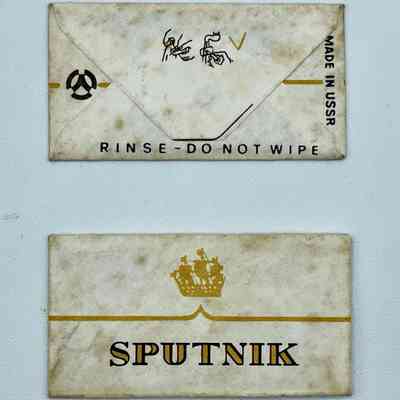
"Sputnik" double-edge safety razor blade with paper wrapper
A Soviet-made stainless-steel double-edge razor blade of the "Sputnik" brand, retained with its printed paper wrapper. DESCRIPTION: A single double-edge (DE) safety razor blade with the standard slotted central cut-out for post-mounting on a three-piece razor. The blade is stainless steel and shows the brand name and country of manufacture stamped into the metal. It is accompanied by its individual paper wrapper (the flat printed sleeve a single blade was folded into). The wrapper carries a gold maritime device — a crown above a three-masted sailing ship — over a gold horizontal rule, with the brand name in serif capitals beneath. A second wrapper face (or the reverse/companion sleeve visible in the record) carries an envelope-style fold graphic, a check mark, a partially visible circular device at the left edge, English-language care text, and the country-of-origin line.
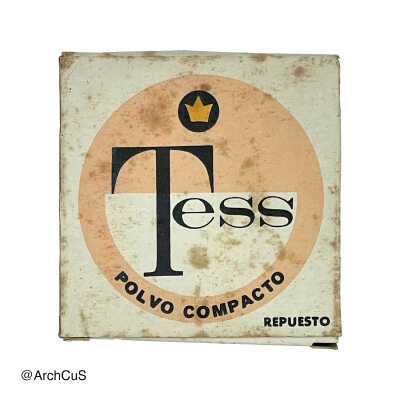
"Tess" compact powder refill (polvo compacto, repuesto), shade "Bronceado"
Square cardboard box for a Tess polvo compacto (pressed face powder/concealer) refill ("repuesto"). The front is printed with the Tess emblem — a stylized serif "T" topped by a small gold crown within a black roundel, the wordmark "Tess" reserved out of a peach disc — over "POLVO COMPACTO," with "REPUESTO" at the lower right; the board is heavily toned, foxed, and stained. The refill itself is a round powder godet topped by a circular blue felt/flocked applicator pad. Per the transcription, the packaging is marked "EMPRESA CONSOLIDADA DE JABONERIA Y PERFUMERIA / HECHO EN CUBA / BRONCEADO."

"Three Beat" Hairbrush
A small handled hairbrush with a one-piece molded blue plastic body — a flat, slightly tapering head running into a straight handle. The head holds a narrow field of bristle tufts in several lengthwise rows; the bristles are ivory colored and stand fairly tall and sparse, with a number splayed or bent and some loose hair caught among them from use. The handle is embossed "three Beat" ("three" in lowercase, "Beat" with a capital B). No size, country, or other text is present. The piece is an everyday mass-produced grooming brush rather than a dressing-table or decorative brush.
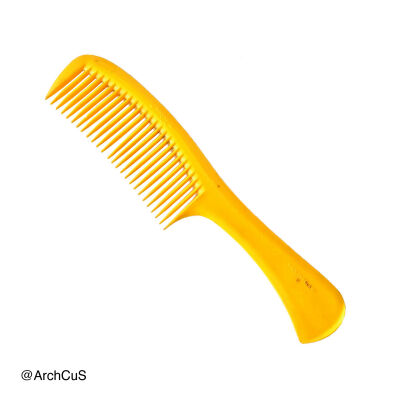
"Tosc" plastic handled comb, yellow
A one-piece molded comb of bright yellow plastic with an integral shaped handle (a rounded, slightly flared grip) and a single row of wide-set, relatively coarse teeth along the head. The handle and spine carry molded lettering: "MADE IN POLAND," with a fainter molded code/number near the spine above the teeth. The comb shows light surface soiling and wear; color strong.
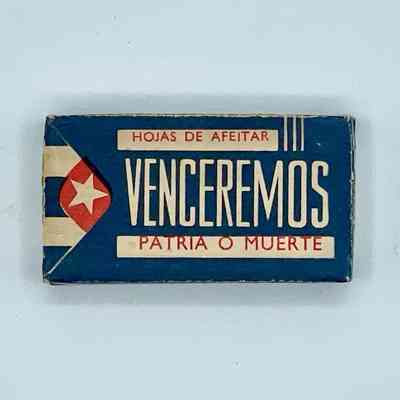
"Venceremos" Double-Edge Razor Blade Box
A small cardboard box for "Venceremos" brand double-edge safety razor blades, manufactured in Czechoslovakia and imported into Cuba by BANCEC (Banco para el Comercio Exterior de Cuba). The box bears the Cuban flag, the revolutionary slogan "PATRIA O MUERTE, VENCEREMOS," the importer designation "IMPORTADAS POR EL BANCEC," and the country-of-origin marking "HECHA EN CHECOSLOVAQUIA." The combination of the BANCEC institutional name and the canonical post-La-Coubre revolutionary slogan dates this object to a remarkably narrow window: between approximately March 1960 and February 1961. DESCRIPTION: A small rectangular cardboard slide-box of standard double-edge razor blade dimensions (approximately 8 × 4 × 1.5 cm estimated), printed in multi-color lithography: FRONT FACE: Dark blue ground. At the left edge, a stylized rendering of the Cuban flag — the red triangle with white five-pointed star on the hoist side, and the alternating blue-and-white horizontal stripes extending to the right. Across the body of the box, on a cream/beige banner: "HOJAS DE AFEITAR" (Razor Blades) in red lettering at the top, "VENCEREMOS" in large dark navy block lettering below it (the brand name), and "PATRIA O MUERTE" (Homeland or Death) in red lettering at the bottom — the two halves of Fidel Castro's canonical revolutionary closing phrase ("¡Patria o Muerte, Venceremos!"). Three vertical stroke marks (||| — likely a stylized typographic element or volume mark) appear above and beside the lettering. BACK FACE: A red-bordered cream/beige label that shows "VENCEREMOS" lettering above a red silhouette of a classic double-edge razor blade — the standard blade-shape with the central slot, lobed mounting cutouts, and two long blade edges. "PATRIA O MUERTE" below. LONG EDGE: Continued navy ground. "IMPORTADAS POR EL BANCEC" (Imported by BANCEC) in cream/light-color lettering on the navy ground — the importer designation. On the long edge: "HECHA EN CHECOSLOVAQUIA" (Made in Czechoslovakia) in cream/light-color lettering — the country-of-origin marking. SIDE EDGE: "10 HOJAS" (10 blades) — the quantity. The box is unopened. It contains all its blades.
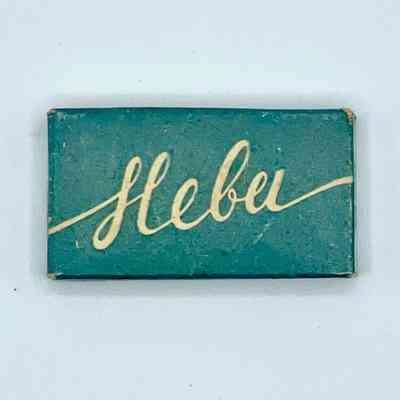
"Нева" (Neva) Soviet Double-Edge Razor Blade Box
A small cardboard slide-box for "Нева" (Neva) brand double-edge safety razor blades, manufactured at the Завод металлоизделий (Metalware Factory) on Vasilievsky Island, Leningrad, USSR. Bears the brand name in flowing white cursive on a dark teal/blue ground (the river-Neva calligraphic logo); the ministerial designation "Мин·Маш·Лег·Пищ·Пром·" (Ministry of Machine-Building for Light and Food Industry); the manufacturer's address ("Leningrad V.O. 16th Line, House No. 5-7"); the blade specification (0.1 mm); and the Soviet technical-standard number (РТУ РСФСР 533-58, indicating the standard was adopted in 1958). DESCRIPTION: FRONT FACE / TOP (image 1): A dark teal-blue or petrol-blue painted/printed ground. Across the center, the brand name "Нева" (Neva) is rendered in a flowing white/cream cursive hand-drawn script — the letters connected in a single sweeping stroke ending in a horizontal flourish. The script style is restrained and elegant, characteristic of mid-twentieth-century Soviet calligraphic logo design. There is no other text on this primary face — the brand name alone fills the visual field. BACK FACE / OTHER MAJOR FACE: A cream/white rectangular label set against the dark teal/blue ground, with multiple lines of Russian Cyrillic text and a small central emblem: - Top line: "Мин·Маш·Лег·Пищ·Пром·" (with dot separators between syllables) — the abbreviated form of "Министерство машиностроения для легкой и пищевой промышленности" (Ministry of Machine-Building for Light and Food Industry), one of the Soviet industrial ministries - Middle line: "ЗАВОД МЕТАЛЛОИЗДЕЛИЙ" (Factory of Metal Goods / Metalware Factory) in larger bold lettering - Central emblem: A small circular mark - Bottom line: "Ленинград В.О. 16 линия д. № 5-7" (Leningrad, V.O., 16th Line, House No. 5-7) — the specific factory address. "В.О." abbreviates "Васильевский Остров" (Vasilievsky Island), the historic Leningrad district that uses the unique "линия" (line) numbered-street system instead of conventional street names. EDGE / BOTTOM PANEL (image 3): On the long edges of the box, additional technical-regulatory markings: - "0,1 мм" (0.1 mm) — the blade thickness, in Russian Cyrillic - "РТУ РСФСР 533-58" — the Soviet technical standard designation: "РТУ" = "Республиканские Технические Условия" (Republican Technical Conditions, the RSFSR-level standards designation, below the all-Union ГОСТ standard), "РСФСР" = Российская Советская Федеративная Социалистическая Республика (Russian Soviet Federative Socialist Republic — the largest Soviet republic), "533-58" = standard number 533, adopted in year '58 (1958). The box, unopened, contains the blades.
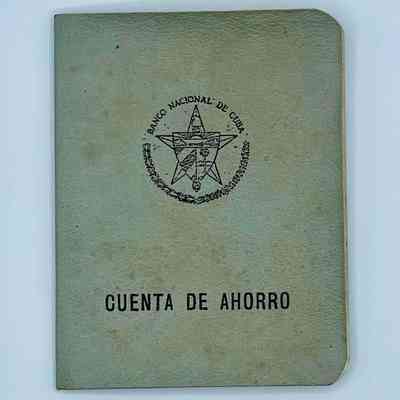
Banco Nacional de Cuba Savings Passbook (Libreta de Cuenta de Ahorro)
A printed paper savings passbook (libreta de cuenta de ahorro / cuenta de ahorro) issued by the Banco Nacional de Cuba in 1968 in the name of MARIA ANTONIA ARUS CARABALLO. Issued by the BNC's Vedado branch (Agencia 4-10-18, Calle 23 No. 1054, e/ 6 y 8, Vedado, Havana). A direct material trace of the Cuban revolutionary state's centralized banking system, which after the 1960 bank nationalizations consolidated all banking activity in Cuba into the single state bank. The cover is a grey colored cardstock with textured surface, debossed/printed with central decoration showing the Banco Nacional de Cuba emblem — a five-pointed star (the Cuban national symbol) within a circular wreath border. Around the star, in circular arrangement: "BANCO NACIONAL DE CUBA". Below the seal, printed in black: "CUENTA DE AHORRO" (Savings Account) Inside front cover (brown/kraft endpaper): A purple/violet ink stamp applied vertically, reading "MARIA ANTONIA ARUS CARABALLO" (the account holder's name in capital letters) with a manuscript signature flourish above. Below the name, a second stamp in the same purple ink: "BANCO NACIONAL DE CUBA / AGENCIA 4-10-18 / CALLE 23 NO. 1054, e/ 6 Y 8 VEDADO" (the issuing branch identification). First page (mint green watermarked security paper): - Top left: printed form/stock number "114-624" - Center: the BNC seal printed in black - Below: "BANCO NACIONAL DE CUBA" (printed) - Branch stamp in black ink (slightly skewed): "BANCO NACIONAL DE CUBA / AGENCIA 4-10-18 / AGENCIA / CALLE 23 No. 1054, e/ 6 Y 8 VEDADO" - "DEPARTAMENTO DE AHORRO" (printed) - "Cuenta No. 26 265" (account number, in larger handwriting or stamping) - "Libreta No. 134698" (passbook number) The first page is printed on watermarked security paper.
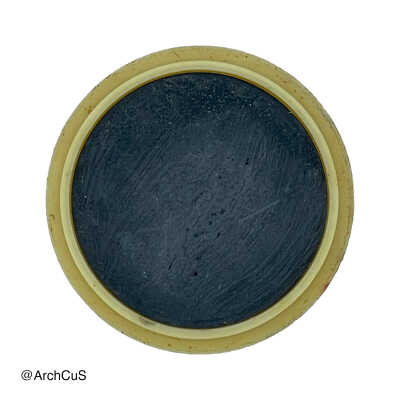
Cake mascara (máscara para pestañas, en pastilla), black
Round black cake ("block") mascara in a small two-part molded-plastic pot of yellow/amber-cream plastic. The lid (Image 1) is a shallow translucent disc, interior cloudy/frosted and empty. The base (Image 2) holds a black pressed mascara cake set within the translucent rim; the cake surface shows brush striations and wear from use. No applicator brush is present. No brand, label, shade, or country marking is visible on either component.
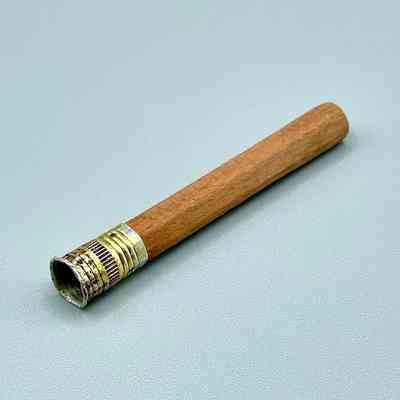
Cigarette holder (boquilla) made from a pencil
Short cigarette holder improvised from a wooden pencil. Natural varnished‑wood hexagonal/round barrel with the painted ferrule (metal band, with banded gold and dark printing) retained at the mouth end; the eraser and its core have been removed and the barrel hollowed through to form a tube. The opposite end tapers slightly. The ferrule end is worn and partly crushed/splayed from use.
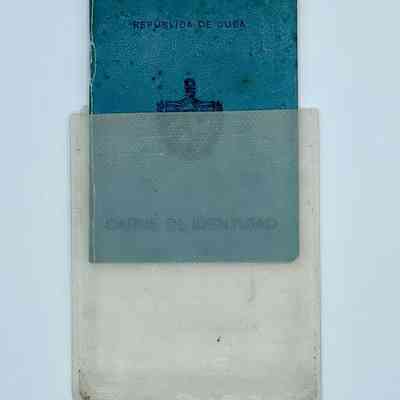
Clear Plastic Protective Sleeve for Cuban Carné de Identidad
A clear/translucent plastic protective sleeve used to house a Cuban carné de identidad (national identity booklet) for everyday carrying. An aftermarket household accessory rather than a state-issued item. Shown with a carné de identidad inserted in it. A material trace of the everyday practical care that Cuban citizens took to protect their compulsory state identification document. DESCRIPTION: A small rectangular pouch or sleeve of clear/translucent thin plastic, open at one short edge and sealed on the other three edges, sized to hold a Cuban carné de identidad booklet snugly. The plastic shows a slightly textured surface — possibly a woven-pattern PVC or a frosted/condensation-mottled polyethylene — visible as a faint grid or weave texture across the plane of the sleeve. The material has yellowed and accumulated dirt along the edges and corners (especially the closed seams), consistent with years of daily handling, friction in pockets/purses, and exposure to atmospheric humidity.
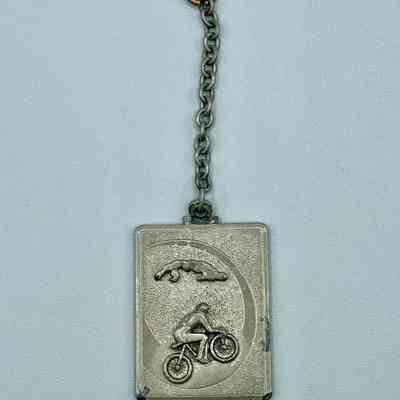
Commemorative Keychain, Cuban Delegation to the XXI Olympiad, Montreal 1976
A small rectangular pendant in silver-toned cast metal, attached by a soldered loop to a fine cable-link chain. The front face carries a low-relief design: a cyclist crouched over the handlebars of a racing bicycle, set within a partial circular or arcing frame, with a small bird in flight (with outstretched wings, suggestive of a dove) above the rider. The reverse face carries a deeply embossed text inscription in blocky sans-serif capitals (transcribed below). The piece has the soft, slightly granular surface texture typical of cast (rather than die-struck) commemorative tokens, and a uniform dark grey-silver patina from age and handling.
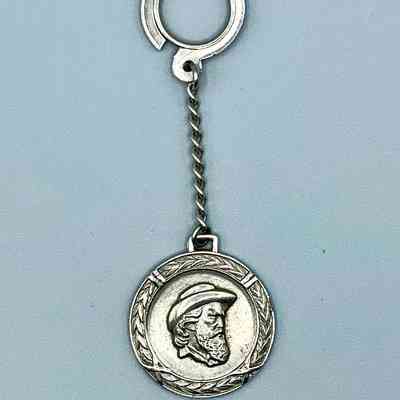
Commemorative key fob with medallion of Camilo Cienfuegos
A metal keychain comprising a flat, openable split-ring at the top, a twisted rope-link chain, and a round silver-tone medallion suspended from a soldered loop. Within a raised laurel-wreath border (broken by two small bars at the sides), the medallion shows the profile bust of Camilo Cienfuegos, facing right, with his characteristic full beard and broad-brimmed hat, its brim turned up at the side.
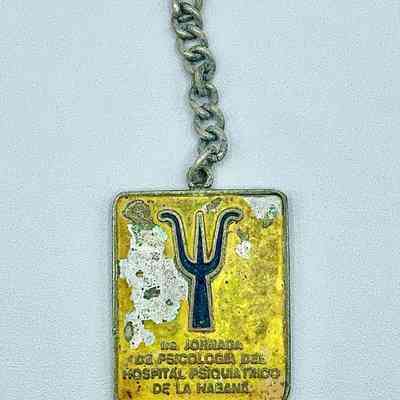
Commemorative keychain fob, 1st Psychology Conference of the Havana Psychiatric Hospital
A small rectangular metal keychain pendant on a short curb-link chain. The face is enameled yellow with a central dark-blue Greek letter psi (Ψ), the conventional symbol of psychology, rendered as a stylized trident-like form. Below the symbol, raised lettering reads "1ra. JORNADA DE PSICOLOGÍA DEL HOSPITAL PSIQUIÁTRICO DE LA HABANA" ("1st Psychology Conference of the Havana Psychiatric Hospital"). The plaque is set in a metal frame with an integral loop at the top connecting to the chain. The enamel/paint is extensively chipped and worn, exposing the metal beneath.
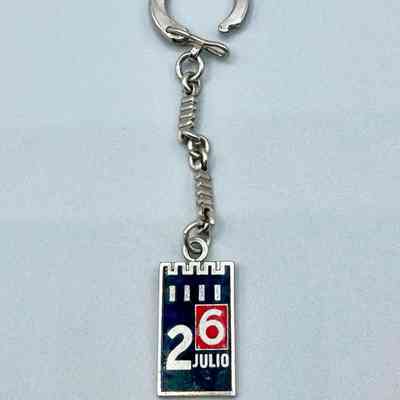
Commemorative keychain, "26 de Julio" (Moncada / 26th of July)
A keychain with a small upright rectangular enameled-metal fob on a fine link chain with a hinged C-shaped snap key ring. The fob has a dark navy enamel ground; the top edge is cut/stylized as the crenellated battlements of a fortress, with four short vertical white marks below the merlons suggesting windows or a wall. The center carries the date "26" — the "2" in white and the "6" reversed out of a red block, the colors of the 26th of July Movement — above "JULIO" ("July") in white. The design reads as a stylized depiction of the Moncada barracks with the revolutionary date. The metal rim is silver-tone; there is light wear to the enamel.
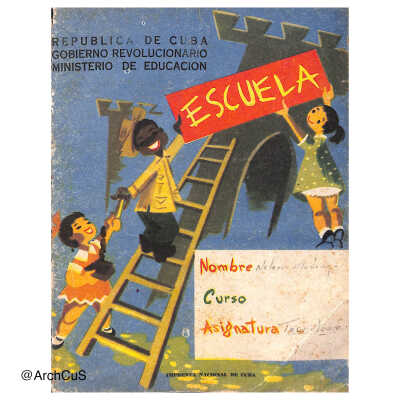
Cuban School Notebook
SUMMARY: Cover of a used Cuban primary-school exercise notebook issued by the Revolutionary Government's Ministry of Education and printed by the Imprenta Nacional de Cuba during the "Año de la Planificación" (1962). The illustrated cover celebrates the post-literacy-campaign expansion of schooling; the inside covers carry measurement-conversion and arithmetic tables. The notebook is inscribed with a pupil's name (Nelson Madruga). DESCRIPTION: A soft-cover school exercise notebook (cuaderno escolar). The front and back covers show a color illustration in a mid-century children's-book style: smiling children in a green-and-blue landscape carry placards reading "ESCUELA" (School) and climb ladders toward castle-like structures labeled "CUARTEL" (Barracks); a large yellow placard quotes José Martí, "SER CULTO ES EL ÚNICO MODO DE SER LIBRE" (To be educated is the only way to be free). Across the top, in the fornt: "AÑO DE LA PLANIFICACIÓN" and "REPÚBLICA DE CUBA / GOBIERNO REVOLUCIONARIO / MINISTERIO DE EDUCACIÓN." A printed fill-in box on the cover provides lines for "Nombre," "Curso," and "Asignatura," completed in handwriting (Nombre: Nelson Madruga; Asignatura: Tecnología). The publisher imprint reads "IMPRENTA NACIONAL DE CUBA." The inside front cover prints a table of measurement conversions ("Algunas medidas y sus equivalencias," including traditional Cuban units — varas, cordeles, caballerías, botellas, garrafones — and Anglo-to-metric conversions); the inside back cover prints arithmetic tables (addition, subtraction, multiplication, division). The notebook shows heavy use and age: worn, chipped, and darkened cover edges, a split spine, and toning of the paper.
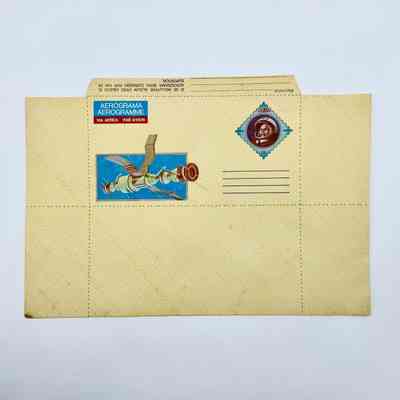
Cuban airmail aerogram (aerograma), space theme, 15 c, 1986 — unused
A single sheet of lightweight postal stationery designed to fold into its own envelope (aerogram/aerogramme), shown unfolded and flat. The paper has an allover pale geometric security tint. The main address panel carries, at upper left, a blue-and-red label reading "AEROGRAMA / AEROGRAMME / VIA AEREA · PAR AVION"; a color illustration of a Soviet-type orbital spacecraft/station (solar panels, docking module) against a blue starfield; five ruled address lines at center; and, at upper right, an imprinted (printed-on) diamond-shaped stamp showing a cosmonaut in a space helmet lettered in Cyrillic, inscribed "CUBA / aéreo / 1986 / 15." The gummed closure flap (printed upside-down relative to the panel) carries a "Remite" (sender) line and a notice about enclosures. Dotted lines mark the folds/cuts. The piece is blank/unused — no address, message, postmark, or cancellation.
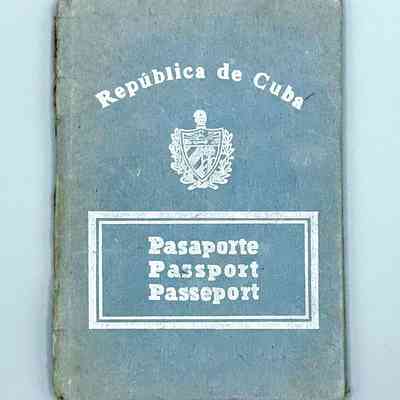
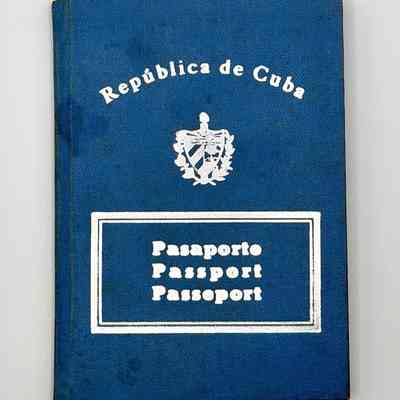
Cuban passport (Pasaporte, República de Cuba)
A Republic-of-Cuba passport booklet with gray-blue card covers, issued by the Ministerio de Relaciones Exteriores. Cover: "República de Cuba" arched over the national coat of arms, "Pasaporte / Passport / Passeport" in a box; silver-white on gray card. Endpapers/title page: guilloche security underprint repeating "República de Cuba / Ministerio de Relaciones Exteriores"; coat of arms and trilingual "Pasaporte/Passport/Passeport." Page 2: "FOTOGRAFÍAS" with an affixed black-and-white photograph of the bearer (a young woman, attached with a metal grommet); note that the passport is valid five years from issue. Page 3: "FILIACIÓN" — parents' names, birthplace, date of birth, civil status, profession, height, complexion, eye and hair color, and bearer's signature. (Personal data redacted.) Pages 4–5: record/receipt numbers; "Observaciones"; the citizenship certification, "Dado en la Habana, a 13 de Sept/61," signed by the Jefe del Departamento de Ciudadanía y Pasaportes.
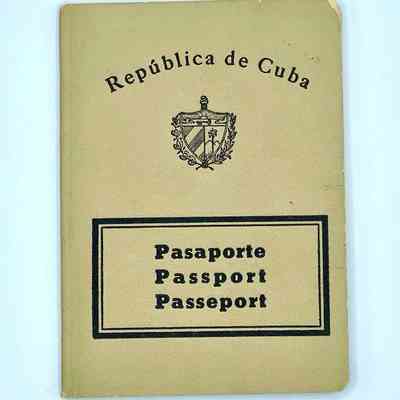
Cuban passport (República de Cuba — Pasaporte / Passport / Passeport), hard-cover booklet
Buff, pebble-grained hard-cover passport booklet for the Republic of Cuba. Front cover printed in dark ink with, from top: the arched legend "República de Cuba," the Cuban national coat of arms (shield bearing the royal palm, the key over the gulf and the rising sun, flanked by oak and laurel and topped by a Phrygian-cap crest), and a ruled rectangular panel enclosing the trilingual title in Spanish, English, and French. Interior leaves and the personal data page are not imaged.
Cuban passport of Natalia "Naty" Revuelta Clews — Pasaporte Nº 7314
Republic of Cuba passport booklet issued by the Ministerio de Estado, completed in manuscript for bearer Natalia Elena Revuelta y Clews. Blue silver-stamped cover with the national coat of arms and trilingual title; 32 interior leaves of teal guilloché security paper repeating "República de Cuba / Ministerio de Estado." Page 2 bears an affixed studio portrait of an elegant woman with styled hair and drop earrings; the filiación page records birth on 7 December 1925 in La Habana, status casada, and green eyes. Issued in Havana on 7 March 1958 and later revalidated.
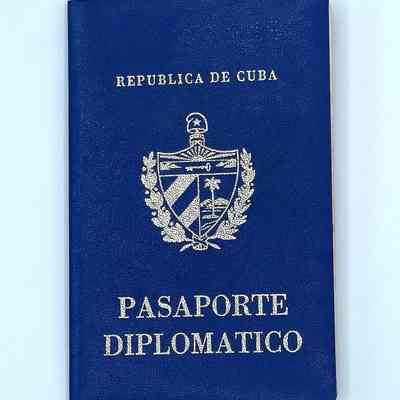
Diplomatic passport, República de Cuba
A Cuban diplomatic passport booklet. Royal-blue cover stock (textured leatherette/coated board) foil-blocked in metallic gold/silver: the upper legend "REPÚBLICA DE CUBA"; the centered national coat of arms of Cuba (shield bearing the royal palm, the key between two headlands beneath a rising sun, the Phrygian-capped staff/star above, flanked by an oak branch and a laurel wreath); and, in larger capitals below, "PASAPORTE DIPLOMÁTICO." Interior pages (bio-data, photograph, visas) are not imaged and not recorded.
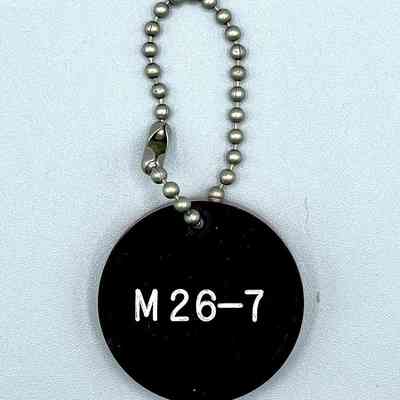
Double-sided "M 26-7" keychain fob (Movimiento 26 de Julio)
Single circular plastic disc fob, pierced near the top and suspended from a short metal ball-chain with coupling. The disc is two-sided — one face black, the other red, the two colors of the 26th of July Movement — with "M 26-7" stamped in white on each face (shown front and back). Lettering are engraved/stamped and white-filled.
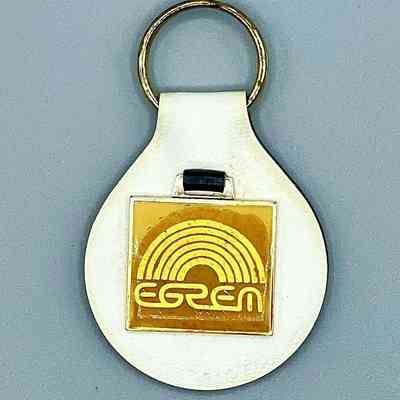
EGREM promotional leather key fob
Teardrop/spade-shaped white leather key fob with a brass split-ring at the top. A square gold-tone metal plaque is fixed to the leather by a small metal loop with a black spacer. The plaque carries EGREM's logo — a gold rainbow/arch of nested concentric arcs above the segmented wordmark "EGREM." The reverse is plain, unmarked white leather.
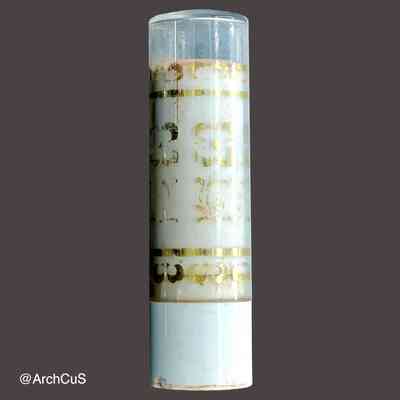
Empty "Fantasía" iridescent lipstick (Creyón labial iridiscente Fantasía) container
Cylindrical swivel-type lipstick in a colorless molded-plastic case with a fitted clear push-on cap and a white inner sleeve/mechanism. The barrel is decorated with three horizontal gilt bands framing two registers of gilt lettering; the printing is heavily abraded and now largely illegible. The flat base carries a circular printed paper label reading CREYON LABIAL IRIDISCENTE / FANTASIA / ROJO CLARO / HECHO EN CUBA, above a small printed monogram/device. The lipstick bullet is empty. Soiling and reddish residue are present around the lower barrel and base rim.
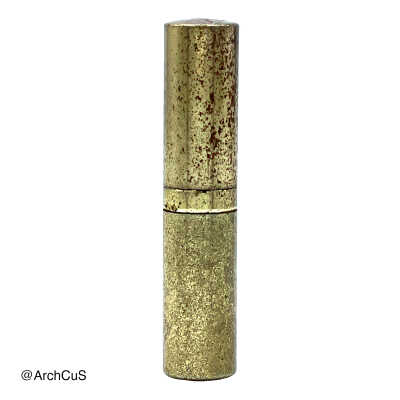
Fantasía eye-shadow case (empty), shade "Azul La Habana" (Havana Blue) — gilt-metal casing
Empty gilt-metal cylindrical eye-shadow case (sombra para los ojos) of two-part swivel construction — push-on cap over a barrel/base — now heavily tarnished. The cap shows dense reddish-brown corrosion spotting over worn gilding; the base is a matte, abraded gold with a brighter collar at the cap/base join. The cap top bears an engraved Fantasía rose emblem. The base is labeled "AZUL LA HABANA". No product remains; the case is empty.
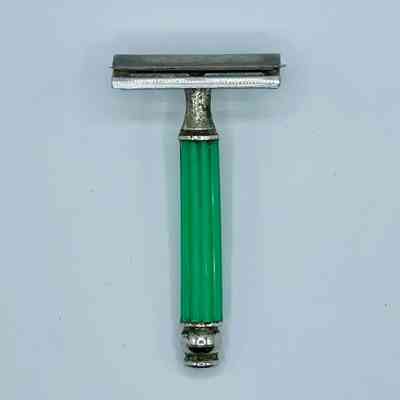
Flying Eagle Double-Edge Safety Razor
Mid-20th-century Chinese double-edge safety razor made by Kwang Yung Safety Razor Set Factory, Shanghai, with a ribbed green plastic handle. A three-piece double-edge (DE) safety razor of standard "T" form. The head is a closed-comb top cap and baseplate in chromed or nickel-plated metal, threaded onto a slender ribbed handle of green plastic. A short metal collar joins the handle to the head, and the handle terminates in a decorative knurled metal end cap with a small ball finial. The overall silhouette is closely modeled on mid-20th-century Western three-piece safety razors of the Gillette "Tech" lineage. Surface wear and minor tarnish are visible on the metal parts; the green handle remains bright.
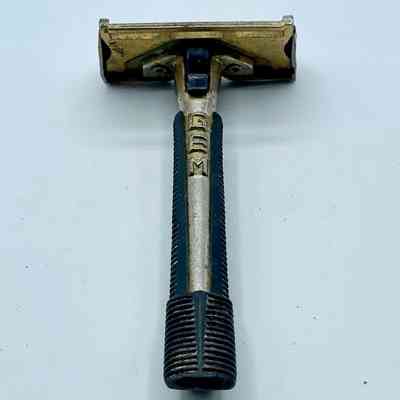
GEM Single-Edge Safety Razor
American GEM-brand single-edge (SE) safety razor with a bar-type head and a two-tone (chrome and black) knurled handle marked "GEM," manufactured by the American Safety Razor Company. A T-shaped single-edge safety razor. The head is a bar-type single-edge design; the baseplate shows a warm brass color where the original plating has worn through, and a darker top cap/clamping bar holds the single-edge blade. The handle is distinctly two-tone: an upper section in silver finish carrying the vertically-embossed maker's mark "GEM," transitioning to a lower section in black plastic with fine vertical knurling for grip, and terminating in a black threaded/knurled end. The razor shows substantial honest wear: plating loss on the head (brass showing through), darkening and patina on the blued sections, and general handling wear consistent with long use.
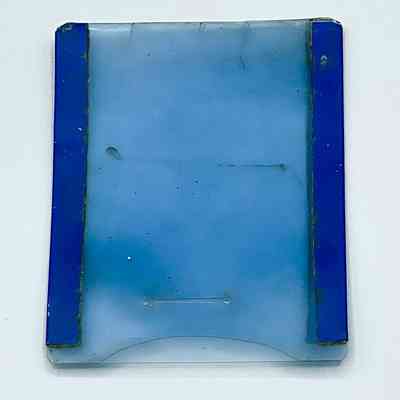
Hand-made ID card holder (sleeve) made from X-ray film and tape
A hand-made flat sleeve or pocket for holding an identity card, rectangular in form, constructed from repurposed radiographic (X-ray) film bound with adhesive tape. The film provides the translucent, milky blue-white body of the sleeve — its cloudy, speckled, faintly mottled appearance is characteristic of processed and cleared X-ray sheet film. Two opaque blue strips of tape run down the left and right edges, forming the bound side seams that join two layers of film into an open-topped pocket; the tape edges carry a fine metallic-looking line and now show tarnish-like discoloration, corrosion, and flaking with age. The lower edge is open to receive a card; a short recessed slot appears to ease insertion and removal of the card. The object shows age-related wear — surface spotting, clouding, adhesive degradation along the taped seams — and is empty (no card present).
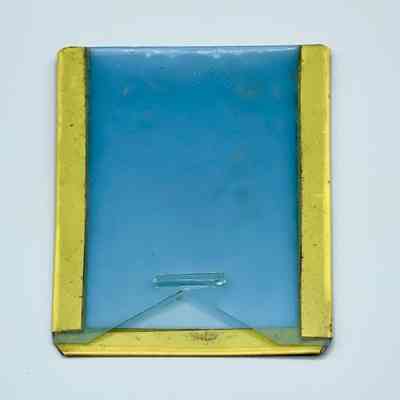
Hand-made ID card holder (sleeve) made from X-ray film and tape
A hand-made flat sleeve or pocket for holding an identity card, rectangular in form, constructed from repurposed radiographic (X-ray) film bound with adhesive tape — closely comparable to the preceding holder in the collection. The film forms the translucent, milky blue-white body, its cloudy and faintly mottled surface characteristic of processed and cleared X-ray sheet film. Yellow adhesive tape binds the two vertical side edges and the bottom edge, joining two layers of film into a pocket that is open along the top to receive a card. A short recessed slot is visible toward the lower center, with fine diagonal score or fold lines running down to the lower corners, and the taped lower edge shows a slight central dip. The tape is discolored, soiled, and degrading with age, with staining along the seams. The holder is empty (no card present).
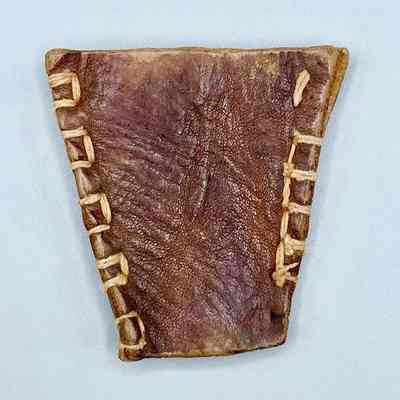
Handmade leather sleeve for a spoon (prisoner's improvised utensil holder)
A small handmade case or sleeve of leather, roughly trapezoidal, wider at the top and tapering toward the base, made to hold a spoon. It is constructed from leather pieces laced together along both side edges with pale cord/string passed through punched holes in a whip-stitch or overcast manner. The front (first image) shows the grained, mottled outer surface. The reverse (second image) carries a narrow vertical leather loop or strap, stitched down at top and bottom, that holds the spoon's handle against the body of the sleeve; the surrounding surface is inscribed in ink (now faded blue-green and brown) with several lines of handwritten text, including place names and a personal name and number. The object is worn, soiled, stiffened, and stained throughout, consistent with hard daily use and long age.
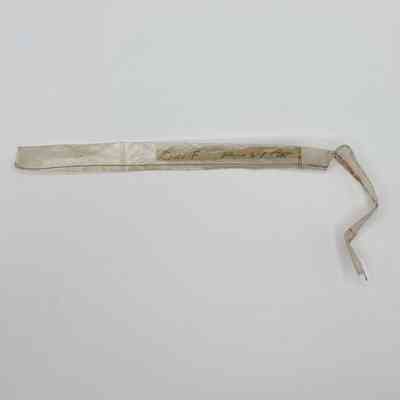
Hospital birth-identification bracelet, 1973
A newborn's hospital identification band — a long, narrow translucent strip of repurposed nylon, now creased and limp, made to be wrapped around an infant and tied. The nylon was reused from another purpose, and traces of its earlier life remain visible as red printed lettering and a red line running along the band, alongside the birth record. A small paper insert held within the band carries the handwritten pencil inscription with the birth details. The piece is a single intact length with the data slip retained inside.
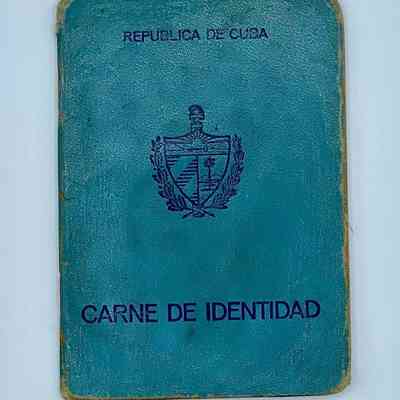
Identity Booklet (Carné de Identidad)
First-generation Cuban national ID booklet issued in Havana in 1975 to María A. Arús Caraballo — from the inaugural year of Cuba's national identity card system. A small, soft-covered booklet with a blue/teal paper or paper-over-card cover. The front cover is embossed in dark-blue ink with "REPÚBLICA DE CUBA" across the top, the Cuban national coat of arms (shield with royal palm, key, rising sun, and supporting branches, surmounted by a Phrygian liberty cap) at center, and "CARNE DE IDENTIDAD" along the lower portion. The cover shows handling wear, especially at the corners and along the spine edge.
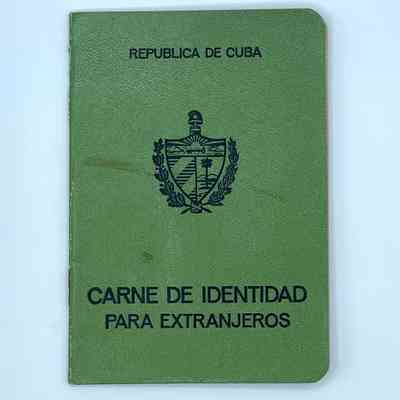
Identity card for foreigners ("Carné de Identidad para Extranjeros"), Republic of Cuba
A small stapled identity booklet, printed in black: "REPÚBLICA DE CUBA" across the top, the Cuban national coat of arms (shield with key, rising sun, and royal palm, flanked by oak and laurel branches beneath a Phrygian cap on a fasces) at center, and "CARNE DE IDENTIDAD / PARA EXTRANJEROS" below. Only the front cover is shown.
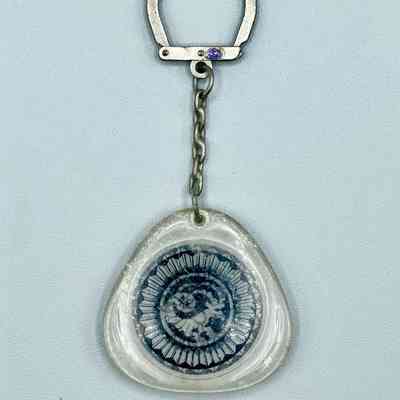
Keychain with clear plastic fob enclosing a goat emblem
A keychain consisting of a rounded, roughly triangular clear cast-plastic (Lucite/acrylic-type) fob on a short metal link chain with a D-shaped split key ring at the top. Embedded inside the transparent fob is a printed disc showing a central figure of a goat (a standing or rearing goat with a beard and horns) within concentric ring borders, ringed by a radiating sunburst/fan pattern, printed in black on a pale ground. The plastic is clouded, partly obscuring the image; the metal ring and chain are tarnished. It is a souvenir/novelty keychain.
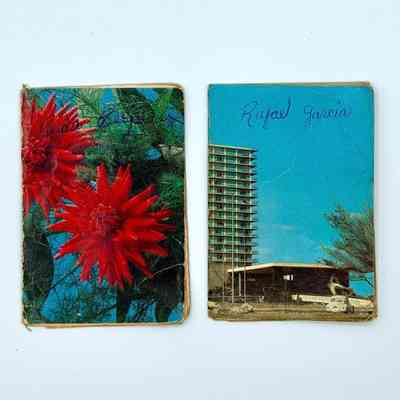
Libreta de Productos Industriales (Cuban industrial-goods / clothing ration book), 1989 — two examples with repurposed postcard covers
Small stapled booklet issued by MINCIN for the rationed purchase of industrial products (clothing, footwear, a few appliances, and once-yearly children's toys). Interior pages carry perforated tear-off coupons coded H-11 through H-24 (and a numbered control grid), each marked "SERIE 1989," with a green sun emblem; printed consumer instructions ("AL CONSUMIDOR" / "ADVERTENCIA") and the issuing-ministry address appear on an inside page. Each of the two booklets is sheathed in a protective cover hand-cut from a Cuban tourist postcard, with the holder's name inked on the front. Multiples — two booklets: 1- Rafael García; cover Hotel Habana Riviera card (trilingual; "Cuba alegre como su sol" series); handwritten poem/dedication to "Madre" inside 2- Neida Céspedes; cover red-flowers (cactus-dahlia) card
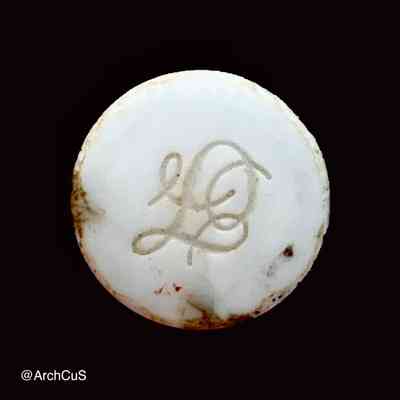
Lipstick cap
Small white cylindrical cap, the detached closure of a lipstick. Flat circular top, straight sides, open underside (not imaged). The top face carries an incised cursive monogram — looping, intertwined script, possibly initials or a maker's logo — not legibly resolved. The body is plain. A short reddish streak on one side and small flecks elsewhere appear to be transferred product residue.
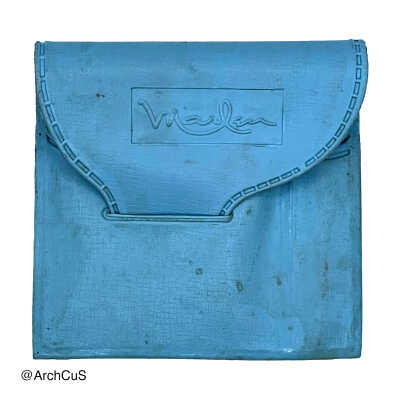
Marlen cosmetics pouch (soft envelope-flap case)
Flat square soft cosmetics pouch in light-blue vinyl with an allover fine woven-texture emboss. A rounded envelope flap closes over the front and tucks into a horizontal slot; the flap and tuck-slot are bordered by an embossed faux-stitch/dashed line, and the flap centers an embossed rectangular cartouche with the cursive brand "Marlen." A slot/pocket beneath the flap edge could have held a slim compact and/or a pencil or brush. The pouch is empty; surface soiled, stained, and creased with wear. No contents, maker mark, or country marking are present.
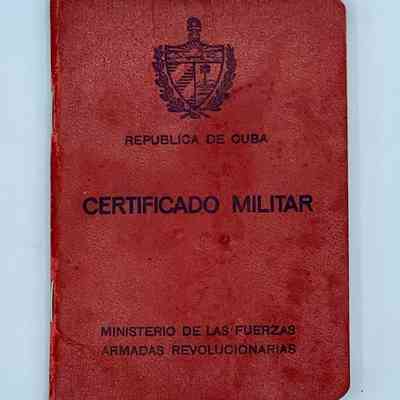
Military Service Identification booklet
Cuban military service booklet issued by the Ministerio de las Fuerzas Armadas Revolucionarias in Havana on August 31, 1977. A small, soft-covered booklet with a deep red cover, sized for a pocket or wallet. The front cover carries text and imagery in a centered, hierarchical layout. From top to bottom: "REPÚBLICA DE CUBA" in small capitals; the Cuban national coat of arms (shield with royal palm, key, rising sun, and flanking branches, surmounted by the Phrygian liberty cap); the principal title "CERTIFICADO MILITAR" in large letter-spaced capitals; and at the bottom, in two centered lines, "MINISTERIO DE LAS FUERZAS / ARMADAS REVOLUCIONARIAS".
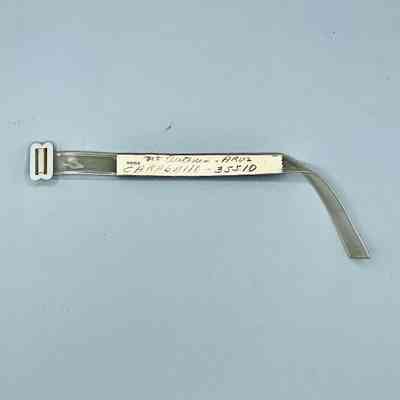
Newborn Identification Bracelet (Manilla de Identificación de Recién Nacido)
Manufactured plastic-and-paper hospital newborn ID bracelet issued in a Havana maternity hospital on September 1, 1974, bearing the mother's name and clinical history number in handwritten ink under a clear cover, with original plastic buckle closure. The form is what María A. Cabrera Arús describes in her Cuba Material blog as a "manilla original," manufactured specifically for the purpose, distinguishing it from the improvised, nylon-strip bracelets she documents from the preceding year. The inscription identifies the mother of the newborn (standard Cuban maternity-hospital practice of the period), not the infant directly.
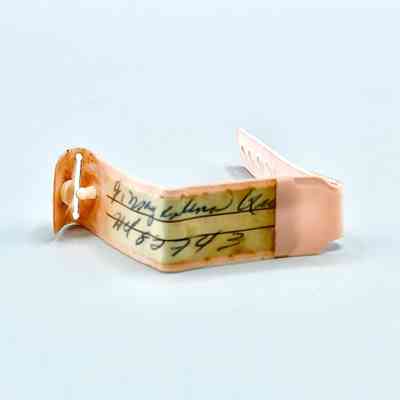
Newborn infant ID bracelet
Small hospital newborn identification bracelet in pale pink plastic. A narrow flexible plastic band sized for an infant's wrist or ankle, closing with a snap fastener (stud visible) and a punched row of adjustment holes/slot at one end, tapering to a thin tab at the other. A handwritten paper identification slip is held beneath a clear plastic window in the band — ruled paper with cursive ink recording identifying details.
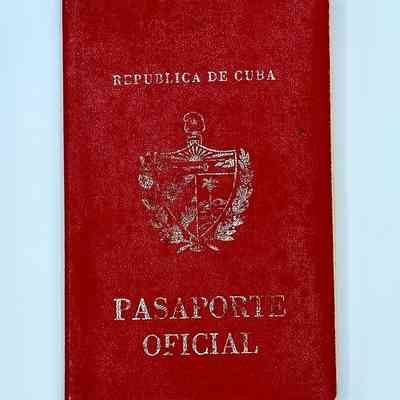
Official passport, República de Cuba — "Pasaporte Oficial"
Front cover of a Cuban official passport booklet. Red cover stock (textured leatherette/coated board), foil-blocked in gold: the upper legend "REPÚBLICA DE CUBA"; the centered national coat of arms of Cuba (palm-bearing shield, key between headlands beneath a rising sun, Phrygian-capped staff above, oak branch and laurel wreath); and below, in capitals, "PASAPORTE OFICIAL." Interior pages (bio-data, photograph, validity, visas) not imaged; interior bearer data recorded internally only and redacted from this record.
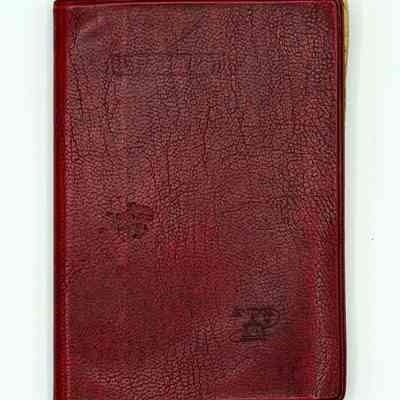
Personal Pocket Address & Telephone Agenda of Armando Lucas Correa (Havana)
Small red leather-grain personal directory/agenda, filled in by hand in blue ballpoint. The printed "DATOS PERSONALES" page identifies the owner as Armando Correa, address Calle 30 #3508 e/ 35 y 37, Playa (Havana), telephone 223796, carnet de identidad 591018... The alphabetical tabbed address section contains handwritten personal and institutional contacts with Havana telephone numbers. Printed reference matter (Spanish provincial and European dialing prefixes) indicates the blank agenda was manufactured in Spain and imported/used in Cuba. A front endpaper bears the handwritten date "1986."
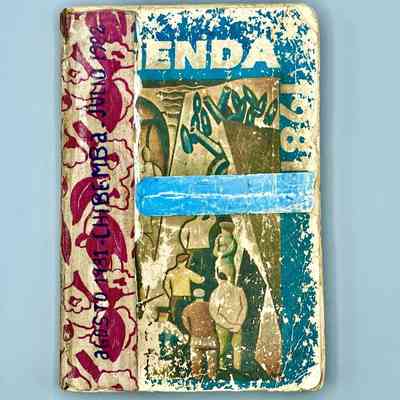
Personal diary of a Cuban soldier in Angola, Chibemba (repurposed 1981 agenda), August 1981 – July 1982
A handmade field diary built from a repurposed commercial datebook. The printed front cover reads "[AG]ENDA 1981" in white on blue, over a reproduced illustration of standing figures with a banner. The volume has been rebound/reinforced along the spine with red-and-cream floral-patterned cloth or paper, hand-lettered in dark ink: "AGOSTO 1981 – CHIBEMBA – JULIO 1982." A strip of blue adhesive tape crosses the front cover (later repair or label). The interior holds the diarist's manuscript entries (not shown; not examined here).

Plastic dressing comb, black
A one-piece molded comb of black plastic in the combination form: a row of coarser, wider-set teeth across roughly half its length and finer, closely set teeth across the other half, with a plain spine. The plastic is notably thin/flimsy and lighter-gauge than the other Cuban combs in the collection. Molded into the spine are "HECHO EN CUBA" and, near one end, the number "10"; a small circular ejector-pin mark is visible on the spine (a molding artifact). No maker name or brand is present. The comb shows surface scuffing and wear.
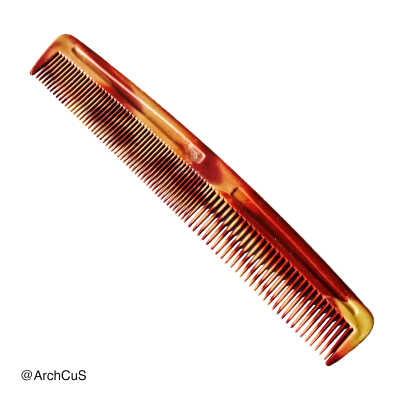
Plastic dressing comb, tortoiseshell-effect
A one-piece molded dressing/combination comb in mottled, translucent red-amber-and-cream plastic imitating tortoiseshell, with a swirled/marbled pattern. It has a row of coarser, wider-set teeth across roughly half its length and finer, closely set teeth across the other half, with a plain spine and slightly upswept ends. No maker's mark, brand, lettering, or country of origin is present. The comb shows surface scuffing, dulling, and wear.
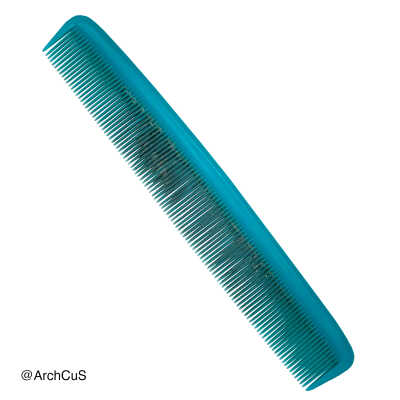
Plastic dressing comb, turquoise
A one-piece molded dressing/combination comb in turquoise plastic, with a row of coarser, wider-set teeth across roughly half its length and finer, closely set teeth across the other half, and a plain spine with slightly upswept ends. Molded into the spine is "MADE IN [illegible] … 577"; the country name is not legible, and "577" is most plausibly a mold/model number. The comb shows surface scuffing, dulling, and some whitish residue/soiling.
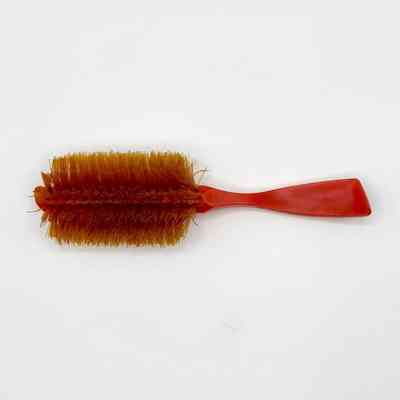
Plastic hairbrush with synthetic bristles, red
Hand-held grooming/styling hairbrush. Molded opaque red-orange plastic handle, flat and waisted, flaring to a paddle-shaped end. Double-sided rectangular head with two opposed rows of bristles separated by a central molded spine (visible in the back view). Bristles are translucent amber/honey-colored synthetic filament, set in tufts. No grip texture or thumb rest beyond the molded contour.
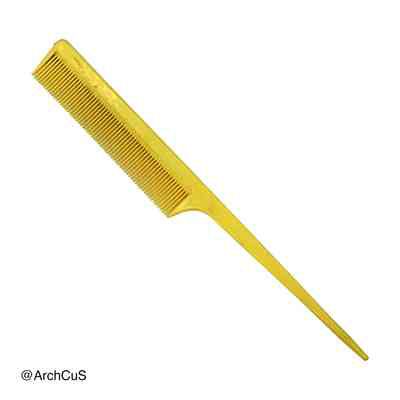
Plastic rat-tail comb, yellow
A one-piece molded comb of bright yellow plastic in the "rat-tail" (tail comb) form: a head with a single row of fine, closely set teeth, and a long, slender, tapering pointed tail/handle used for parting, sectioning, and teasing hair. A small faint molded mark (logo and/or code) appears near the base of the tail where it meets the toothed head; it is not legible in the image. The comb shows light surface soiling/streaking and wear; color strong.
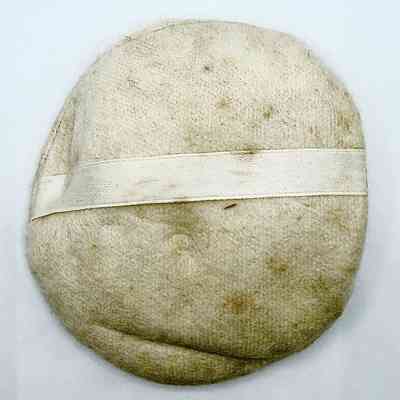
Powder puff, velour/plush with ribbon hand-strap
A round cosmetic powder puff, of the type used to apply face or body powder. It is made of a soft, dense pile fabric (velour, plush, or swansdown-type material) in a cream/off-white color, slightly domed and padded. Across the back runs a flat woven ribbon band, stitched at each side, forming a strap under which the fingers slip to hold and apply the puff. The puff is soiled, discolored, and matted with use — toned to a grayish-tan in places, with darker staining and compression of the pile — consistent with extended use absorbing cosmetic powder and handling. No maker's mark or label is visible.
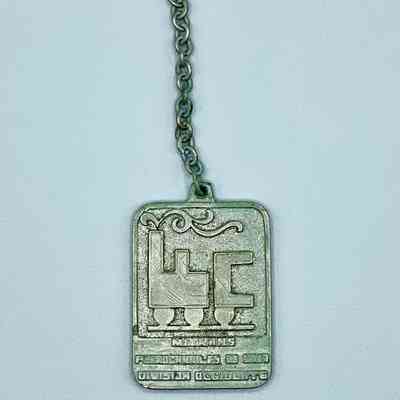
Promotional keychain, Ferrocarriles de Cuba — División Occidente
A rectangular cast-metal keychain fob with rounded corners on a link chain (the split ring is now missing, leaving the chain's end loop open). The front is die-cast in low relief: a stylized monogram of interlocked letters reading "FC" (for Ferrocarriles) formed as two facing locomotive/rolling-stock shapes on wheels, with a small decorative scroll above, over the lettering "MÁQUINAS / FERROCARRILES DE CUBA / DIVISIÓN OCCIDENTE" ("Locomotives / Railways of Cuba / Western Division"). The reverse is plain but for raised lettering: "VIAJE MÁS CONFORTABLE POR FERROCARRIL" ("Travel more comfortably by rail"). The metal is worn with greenish surface corrosion.
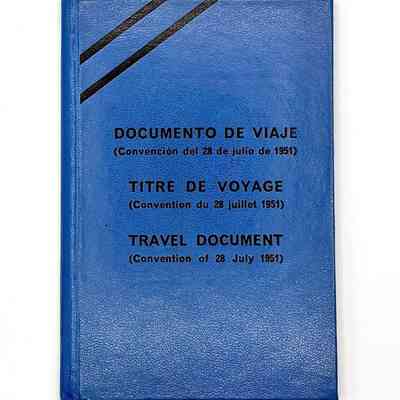
Refugee travel document (1951 Convention "Geneva passport"), issued by Spain to Francisco de Jesús Rivera Figueras (Paquito D'Rivera)
Hardbound, passport-style booklet with a blue textured cover bearing, in black, the trilingual title "Documento de Viaje / Titre de Voyage / Travel Document," each with the parenthetical reference to the Convention of 28 July 1951, and two black diagonal stripes across the upper-left corner — the conventional marking of a 1951 Refugee Convention travel document. Interior leaves carry a green security underprint repeating "Convención del veintiocho de julio de 1951," the trilingual issuing text, and ruled manuscript fields completed in ink. The booklet states it contains 36 pages exclusive of the cover and appears complete.
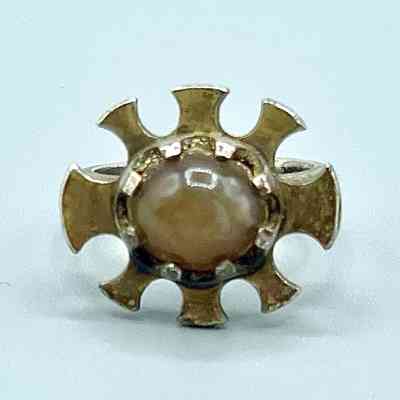
Ring with radiating sunburst setting and honey-colored cabochon
An artisan/costume ring whose face is a flat openwork radiating form of roughly eight tapering arms, each flaring and notched at the tip (a sunburst or cog-like motif), centered on a domed translucent honey/amber cabochon held in a beaded (granulated) bezel collar. Plain rounded shank. The front face reads warm golden; the shank and setting back are white metal showing wear and tarnish. The bezel is open-backed, exposing the underside of the stone.
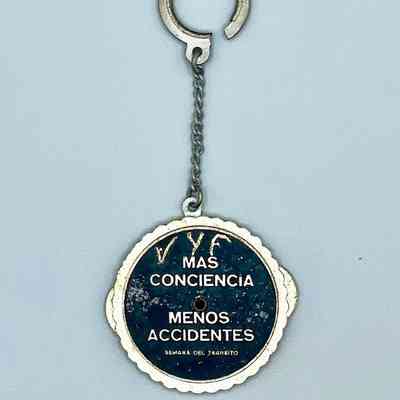
Road-safety perpetual-calendar keychain, "Más conciencia, menos accidentes" (Semana del Tránsito)
A round metal keychain fob on a fine link chain with a C-shaped split key ring. The fob has a scalloped white-metal rim around a black painted face. The front carries a road-safety slogan in white capitals — "MÁS CONCIENCIA MENOS ACCIDENTES" ("More awareness, fewer accidents") — with "V Y F" (initials) above and "SEMANA DEL TRÁNSITO" ("Traffic/Road Safety Week") in small letters below; a small central rivet is the pivot for the reverse mechanism. The reverse is a perpetual-calendar dial: a printed grid of weekdays (DOM LUN MAR MIÉ JUE VIE SÁB) and dates 1–31, flanked by the years "1968" and "1980," with rotating month and year rings (months ENE–DIC and year digits …69 70 71 72…) read against arrows — i.e., a wheel calendar good for the years 1968 through 1980.
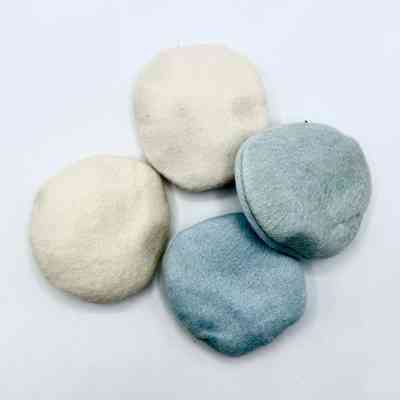
Set of four unused cosmetic powder puffs (off white and pale blue)
Four small round cosmetic powder puffs of soft, dense pile fabric (plush/velour or wool-type), each a slightly domed circular pad. Two are cream/off-white and two are pale blue/gray. All four are clean and appear unused or barely used — the pile is full, soft, and largely unsoiled, in contrast to the two heavily used puffs elsewhere in the collection. No hand-straps are visible. No maker's marks or labels are visible.
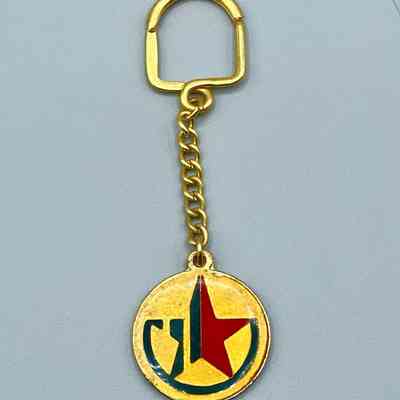
Souvenir keychain (llavero), emblem of the joint Cuban-Soviet space flight (Intercosmos / Soyuz-38)
Gold-tone (gilt base-metal) keychain comprising a sprung key shackle/clasp, a short curb chain, and a circular enameled medallion pendant. The medallion's face carries a champlevé-style enamel emblem: a red five-pointed star set against a gold ground, overlaid/flanked by a green (teal) stylized logogram — a curved hook at lower left, a vertical bar, and a sweeping baseline that together read as a modernist institutional or event monogram (the emblem of the Cuban-Soviet space flight). The reverse is finished with an all-over cross-hatched texture and impressed "HECHO EN CUBA."
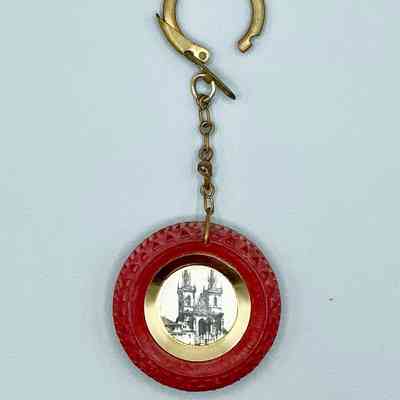
Souvenir keychain, Prague
A souvenir keychain whose fob is a small molded red plastic tire (a detailed miniature with tread and sidewall patterning) framing a central two-sided photographic medallion behind a gold-tone metal bezel. One face shows a black-and-white view of a twin-spired Gothic church (the Church of Our Lady before Týn, on Prague's Old Town Square); the reverse shows a castle-and-river view (Prague Castle/Hradčany above the Vltava) captioned "PRAHA" (Prague). The fob hangs from a brass-tone link chain with a hinged C-shaped snap key ring. Both images are the same object (the two faces of the medallion).
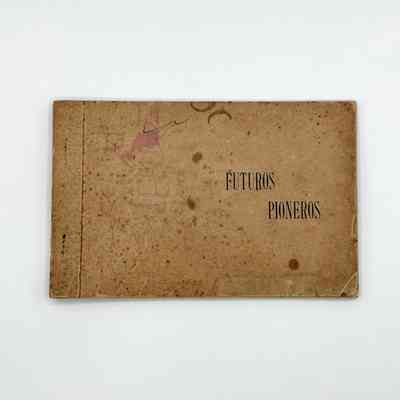
Student's notebook/agenda "Futuros Pioneros," 1970 (Zafra de los Diez Millones)
A small oblong (landscape) saddle-stitched paper booklet with a buff card cover lettered "FUTUROS PIONEROS" in serif capitals, with a faint pink lithographed cartoon child figure (a "future pioneer"). The interior combines a student agenda with revolutionary campaign content: an owner-identification page headed "DATOS PERSONALES" (Nombre / Apellidos / Estudiante de / Dirección / En caso de accidente avisar a — blank); a 1970 calendar headed "1970 DIRECCION DE SUPERACION DE LA MUJER 1970" (twelve months, week beginning Sunday, D-L-M-M-J-V-S); a central "CALENDARIO DE LOS DIEZ MILLONES" box listing target dates for each cumulative million tons of the 1970 harvest (first million 23 December … tenth 15 July); an outline map of Cuba's then-six provinces with sugar-mill counts; a "PRODUCCION EN LA ZAFRA DE 1970" table and "NUESTRO COMPLEJO INDUSTRIAL" list; and a red banner slogan. Several leaves are blank note pages.
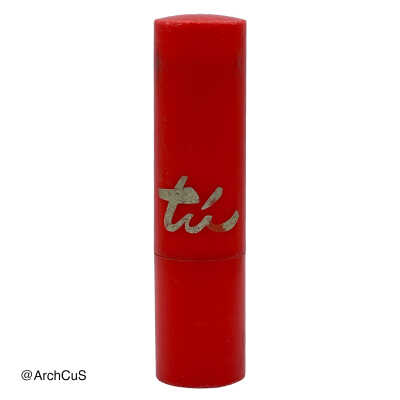
Suchel "tú" lipstick (creyón labial), shade Naranja
Swivel lipstick in a red plastic case. The cap is printed with a golden script "tú" logo. Opened, a gold-tone (brass) metal inner barrel rises from the red plastic base and presents an orange lipstick bullet. The paper base label reads "CREYON LABIAL / tú / NARANJA" with the cursive Suchel signature and flower device. The bullet color matches the "Naranja" (orange) shade name.
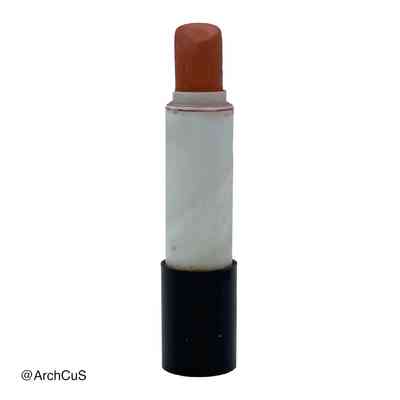
Suchel lipstick (creyón labial), shade "Chantelle" no. 205
Swivel-type lipstick with a black molded-plastic push-on cap and base and a white molded-plastic barrel. Closed, the tube reads as a plain glossy black cylinder. Open, the white barrel rises from the black base, holding a nude tan-brown bullet (used, rounded, with minor surface pitting/spotting) seated in a white collar; light rust-colored speckling and a small pink residue mark are present on the upper white barrel. The base bears a printed label, transcribed as "CHANTELLE 205 / Suchel."
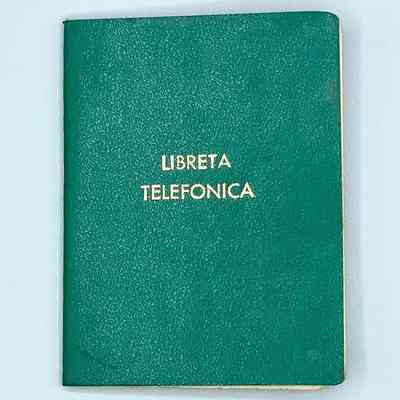
Telephone address book ("Libreta Telefónica"), Banco Popular de Ahorro — Sancti Spíritus
Small pocket telephone address book in a textured green imitation-leather (leatherette) cover, gilt-stamped on the front "LIBRETA / TELEFONICA," with a cream paper text block. The inside front opening shows, at left, a violet rubber inkstamp of the Banco Popular de Ahorro (palm-tree-and-"BPA" monogram, lettered "Banco Popular de Ahorro / DIR. PROVINCIAL / SANCTI SPIRITUS") and, at right, a printed owner-identification page headed "PERTENECIENTE A" with ruled fields "NOMBRE:", "DIRECCION:", "TELEFONO:" — all blank. Interior alphabetical address pages not shown.
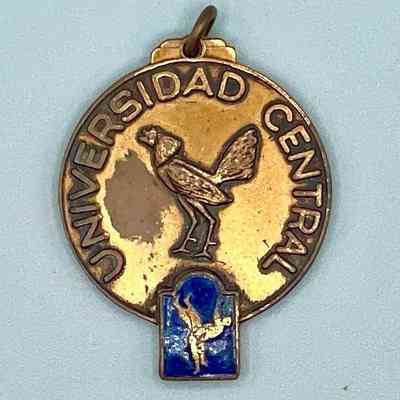
University sports medal — Universidad Central de Las Villas, IV Juegos (1964)
Round gilt-metal medal with an integral suspension loop and jump ring at the top, surmounting a small arch-topped blue-enamel tab at the bottom. The obverse bears the arched legend "UNIVERSIDAD CENTRAL" around the upper rim, a rooster/gamecock (the "Gallo Criollo") struck in relief at center, and the appended blue-enamel tab carrying a gilt figure of an athlete in a dynamic pose. The reverse is a plain field embossed "IV JUEGOS 1964."
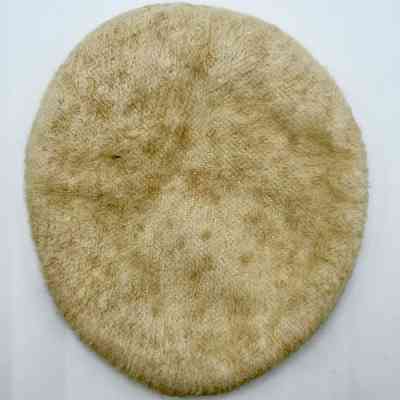
powder puffs
A round cosmetic powder puff for applying face or body powder, of soft dense pile — a plush, fleecy or wool/mohair-type material — in a cream/off-white color. It is a flattened oval-round pad with a fluffy, slightly curly nap. Unlike the companion puff in the collection, it has no ribbon hand-strap: it is a simple pile pad, held directly in the hand or fingers. The puff is soiled and discolored from use, toned to grayish-tan with darker staining and matting/compression of the pile in places, consistent with extended use absorbing cosmetic powder. No maker's mark or label is visible.
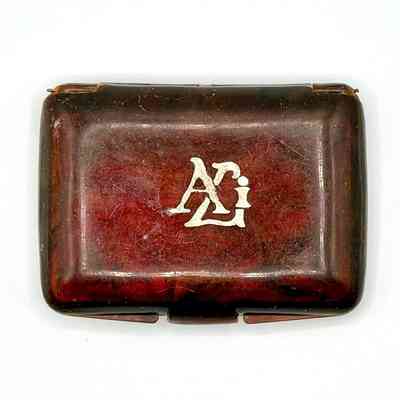
“Ali” powder compact
A small rectangular compact with rounded corners, in dark reddish-brown high-polished plastic (with a leather-like appearance). The hinged lid is inset with an applied gold-colored interlaced "ALi" device; the front edge has a twin-tab clasp. The surface shows fine scratching, wear, and a rich patina.